
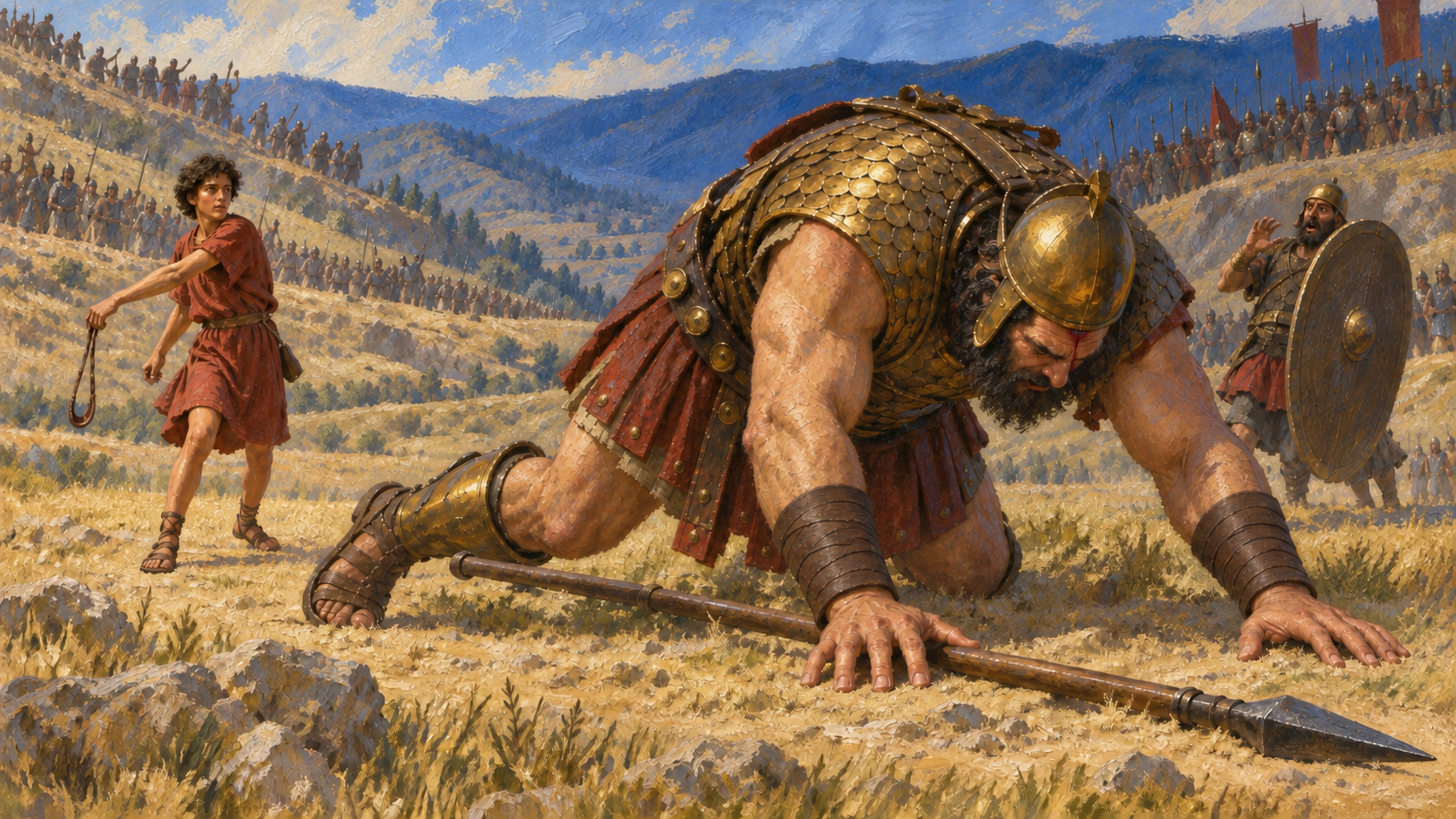
Goliath is one of the best-known people in the Bible, but I think we miss 1 Samuel 17 if we turn it into a lesson about believing in ourselves. His size and weapons were real, and Israel had good human reasons to fear him. The detail I keep coming back to is that David saw the living God as more decisive than the giant standing in the valley.
Goliath’s Challenge Made Israel’s Fear Visible
Israel and the Philistines faced each other from opposite mountains, with the Valley of Elah between them. Before a full battle began, the Philistines sent out Goliath as their champion. He challenged Israel to send one man to represent its army in a fight against him.
The challenge threatened Israel with humiliation. If it accepted and lost, the nation would be subjected to its enemy. If no one answered, its silence would bring shame. Goliath was using that military and psychological pressure to frighten them, but he was also mocking their confidence in the LORD. His challenge reached into their faith as well as their courage in battle.
“And he stood and cried out to the armies of Israel, and said to them, ‘Why have you come out to line up for battle? Am I not a Philistine, and you the servants of Saul? Choose a man for yourselves, and let him come down to me.'”
I notice that Goliath used the phrase “servants of Saul” for the Israelites. He defined them by the visible king who stood trembling with them. David, however, would call them the armies of the living God. That difference helps me understand the whole chapter: David saw their relationship with God where Goliath pointed only to Saul.
Goliath looked capable of backing up every threat. The NKJV gives his height as six cubits and a span. Using the common estimate of about eighteen inches for a cubit and nine inches for a span, he would have stood near nine feet nine inches tall. I do not think we need to settle the exact modern conversion to see the inspired author’s point: he was extraordinarily large and terrifying.
“And a champion went out from the camp of the Philistines, named Goliath, from Gath, whose height was six cubits and a span.”
The description continues with a bronze helmet and coat of mail. Bronze armor covered his legs, and he carried a javelin and a massive spear. His coat weighed five thousand shekels of bronze, while the iron spearhead weighed six hundred shekels. Older estimates often put those weights around 125 pounds and 15 pounds. We do not need perfect modern conversions to understand why Israel trembled.
From a human point of view, Goliath’s weapons seemed to decide the outcome before the fight began. His armor promised protection, and his spear showed the strength a challenger would have to face. No one in Saul’s army was willing to fight him. I don’t read these details as descriptions included merely to satisfy our curiosity. They explain why Israel’s fear seemed reasonable and make God’s deliverance unmistakable. We need to understand how formidable Goliath was before seeing that his armor could not put him beyond God’s reach.
Faith did not require anyone to pretend Goliath was harmless. He controlled the field because no Israelite believed he could survive fighting him. The Spirit recorded that visible strength so we would understand how unequal the contest appeared, yet even this dangerous man remained under the living God’s authority.
Goliath repeated his challenge every morning and evening for forty days. That gives me a sense of how firmly fear had taken hold of Israel. They kept hearing the same voice and remained unable to answer it. With each passing day, Goliath repeated his proud defiance and Israel continued in fear.
“And the Philistine said, ‘I defy the armies of Israel this day; give me a man, that we may fight together.'”
Gath Connects Goliath to the Giant Clans
Goliath came from the Philistine city of Gath. I want to pay attention to that location because Joshua 11 says some Anakim remained in Gaza, Gath, and Ashdod after Joshua cut them off from Israel’s hill country. Numbers 13 connects the sons of Anak with giants, and Deuteronomy 2 places the Anakim within the broader Rephaim context. Together, those passages give us a setting for considering Goliath’s ancestry.
“None of the Anakim were left in the land of the children of Israel; they remained only in Gaza, in Gath, and in Ashdod.”
This evidence supports a connection between Goliath and the giant clans, but it does not tell us everything about his ancestry. Scripture never directly says, “Goliath was a Nephilim.” His city and extraordinary size fit the giant-clan setting, and later passages mention more giants from Gath. A likely connection is still not the same as an explicit statement, so I would not go beyond the text.
The studies on the Nephilim and giants in the Bible and giants in the Bible trace that wider material. Here, the necessary conclusion is narrower: Goliath belonged to Gath’s giant setting, yet the Bible does not give permission to invent a complete genealogy for him.
Goliath was not the only giant warrior associated with Gath. In the accounts of later battles, 2 Samuel 21 and 1 Chronicles 20 name men such as Saph and Lahmi. Chronicles explicitly identifies Lahmi as Goliath’s brother. Another warrior had six fingers on each hand and six toes on each foot. Scripture says these four were born to the giant in Gath.
“These four were born to the giant in Gath, and fell by the hand of David and by the hand of his servants.”
Some of the other warriors may have been Goliath’s close kin, but Scripture does not identify every relationship. I would describe them as related warriors from the same giant line or house in Gath without trying to fill in the missing family details. Their defeats also show that Goliath’s fall was no isolated trick. God continued to give David and his servants victory over these intimidating enemies.
Saul Saw the Giant, but David Remembered the LORD
Saul stood head and shoulders above the people, so if appearance decided the battle, Israel’s visible king would have been the obvious man to answer Goliath. Yet he was afraid along with the rest of the army. I see a painful contrast there: he looked the part of a king but did not show the courage that came from trusting Israel’s covenant God.
The LORD had rejected Saul as king because of his disobedience, while David had already been anointed in private. Chapter 17 brings that contrast into public view and helps us follow the larger movement of 1 Samuel. Saul offered armor and measured the battle through equipment and appearance. David remembered how the LORD had delivered him before and trusted in His name. The related study on King Saul develops that contrast across Saul’s life.
When David heard Goliath, he asked who this uncircumcised Philistine was that he should defy the armies of the living God. “Uncircumcised” identified Goliath as outside Israel’s covenant, rather than serving as a casual insult. That helps me understand what troubled David about the challenge. Goliath was insulting soldiers who belonged to the living God, and his defiance reached God Himself.
“For who is this uncircumcised Philistine, that he should defy the armies of the living God?”
David’s courage was not a claim that the giant was small. He simply refused to treat Goliath’s visible strength as the final measure of the battle. Psalm 20:7 says some trust in chariots and some in horses, but God’s people remember the name of the LORD. 1 Samuel 17 shows that truth in action.
David cared about more than his own glory. The LORD’s name had been reproached, and Israel had forgotten to whom its army belonged. David did not bring a new source of power into the valley. He reminded the army of what it had neglected: they belonged to the living God.
David Fought Because the Battle Belonged to the LORD
David refused Saul’s armor because he had not tested it, then took his own staff and sling and chose five smooth stones. That doesn’t look to me like contempt for tools or a refusal to prepare. He used what God had trained him to use instead of equipment that did not fit that experience. Nor would he borrow Saul’s confidence in outward appearance.
I would be careful about assigning hidden meanings to those five stones. Scripture later mentions other giants from Gath, but 1 Samuel 17 never says David chose one stone for Goliath and four for his relatives. We can understand his preparation without adding that explanation. He prepared responsibly with the weapon he knew how to use, but the number of stones was not the source of his confidence.
David’s words to Goliath explain why he could enter the battle with that confidence. The giant came with weapons everyone could see, while David came in the name of the LORD of hosts. This was the God of Israel’s armies whom Goliath had defied.
“Then David said to the Philistine, ‘You come to me with a sword, with a spear, and with a javelin. But I come to you in the name of the LORD of hosts, the God of the armies of Israel, whom you have defied.'”
David said the victory would make God known to all the earth and teach the gathered assembly that the LORD does not save with sword and spear. I want to keep that purpose in view as we read what happened next. God’s name would be honored through the victory, rather than David becoming a hero of self-confidence.
“Then all this assembly shall know that the LORD does not save with sword and spear; for the battle is the LORD’s, and He will give you into our hands.”
I notice that David expected two audiences to learn from the victory. The surrounding nations needed to know that the God of Israel was real, while Israel needed to learn again how He saves. One defeat would answer pagan defiance and correct the fear of God’s covenant people. Neither Goliath’s weapons nor David’s skill deserved the final credit.
David ran toward the Philistine army and slung a stone. It struck Goliath in the forehead, and the champion fell on his face. David then used Goliath’s own sword to cut off his head. When the Philistines saw that their champion was dead, they fled. The sight that had held Israel in fear was now lying on the ground, and everyone could see who truly ruled the battle.
Goliath’s death brought judgment on a blaspheming enemy and deliverance to God’s people in a real war within Israel’s old-covenant history. We should read it in that setting instead of treating it as violence to admire for its own sake. What happened publicly confirmed what David had publicly confessed: the battle belonged to the LORD.
This is why the study on Jehovah-Nissi, the LORD our banner, fits naturally with David’s words. The banner over Israel’s victory was not David’s skill or Israel’s strength. It was the name of the LORD.
What This Story Teaches—and What It Does Not
Goliath was a real Philistine champion who defied the covenant people of the living God. Remembering that keeps me from reducing him to a motivational label for whatever obstacle I face. David’s victory does strengthen believers who are afraid, but it was historical deliverance. It does not give us a formula in which enough confidence defeats every difficult circumstance.
David knew how to use a sling, and Scripture gives us no reason to dismiss that ability. But his own speech makes clear where the credit belongs. The LORD saved Israel through David’s practiced skill, so we should value the skill without treating it as the whole explanation for the victory.
The same care is needed when we discuss the giant clans. Scripture connects Goliath with Gath and connects that city with those clans, but it does not give us his complete ancestry. I can teach the connection confidently while still stopping where the Bible stops.
David carried stones and a sling, so his refusal of Saul’s armor cannot mean that using equipment is faithless. He refused armor he had not tested and the confidence Saul placed in outward appearance. We need to distinguish depending on God from refusing the means He allows us to use. The related study on the armor of God helps distinguish spiritual dependence from confidence in visible equipment.
When I consider Israel’s fear, I can see how measuring only by sight distorted their judgment. They saw Goliath’s height and armor and heard his reputation reinforced with every challenge. David faced those same facts while remembering the living God. That helps me understand how faith faces danger. We do not have to pretend it is small, but we must not treat it as greater than God.
Goliath acted as though his strength gave him the right to speak against God, while Israel treated its visible weakness as an excuse for unbelief. David avoided both responses by trusting the LORD’s character and covenant name. He could face what he saw without surrendering to fear or boasting in himself. That challenges pride as well as unbelief.
David’s concern for the LORD’s honor should also affect us, though we need to recognize our different calling. Christians are not ancient Israel’s army and have not been commanded to take up David’s sling. We are called to honor Christ and trust God’s Word. When visible power demands our fear, we do not have to assume that whoever looks strongest will have the final word.
Goliath kept speaking through those forty days because judgment did not fall at once. His conduct shows how pride can mistake delay for permission. Israel treated that same delay as proof that fear should rule. Then the LORD answered through His chosen servant. I should not read God’s patience as approval when Goliath’s defiance remained dangerous all along.
The account also points beyond David to the greater Son of David. David’s victory delivered Israel from a terrifying enemy, but Jesus Christ delivers sinners from sin and death. He did so through His own body and blood. Jesus was mocked, tortured, and crucified. He shed His blood, died, and rose bodily from the dead. The true and final victory belongs to Him.
I want to make that connection without forcing a one-for-one allegory. David is not Jesus in every detail, and Goliath is not every inconvenience in a believer’s life. Yet David’s victory belongs within the biblical pattern of God saving through the deliverer He chooses, often in a way that puts visible strength to shame. Christ looked weak in crucifixion, but He triumphed through His death and resurrection.
Ephesians 6:10 tells believers to be strong in the Lord and in the power of His might. I think 1 Samuel 17 teaches us to approach danger with that same confidence. Our strength belongs in the Lord, not in intimidation or human boasting.
My Final Thoughts
After reading the whole account, I do not believe Goliath’s fall is meant to leave us impressed mainly with David’s bravery. The chapter shows the living God answering a proud enemy who believed size and weapons gave him the right to defy God’s name. David prepared and used the skill he had, but his confidence rested in the LORD of hosts rather than in himself. We should face real danger honestly while refusing to let visible power define what God can do. The battle belonged to the LORD then, and every final victory over sin and death belongs to Jesus Christ now.