
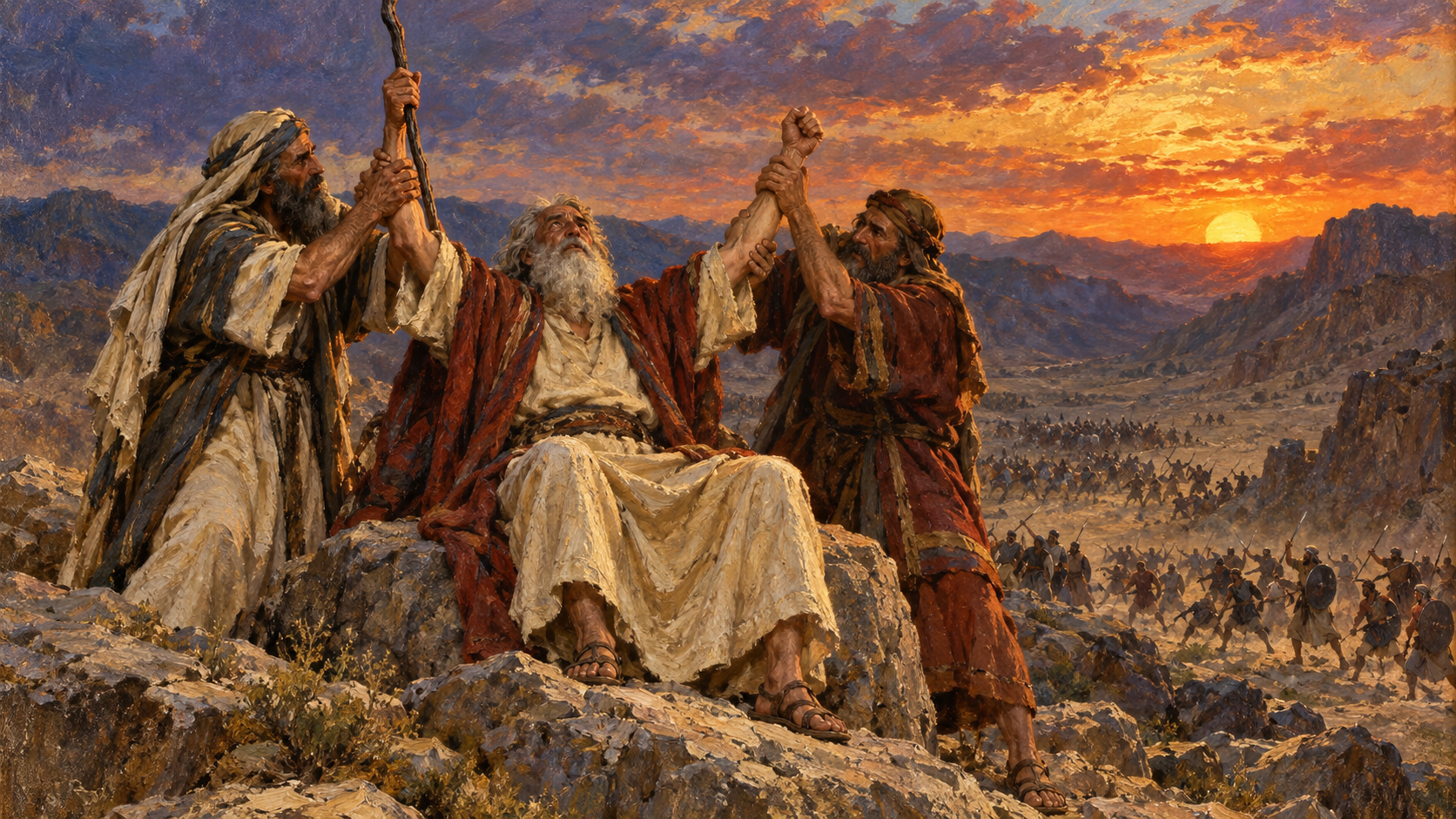
When Moses named an altar Jehovah-Nissi, “The LORD Is My Banner,” he was responding to a battle Israel had just survived. Joshua had fought in the valley while Moses stood on a hill with the rod of God. Aaron and Hur had helped when Moses could no longer keep his hands raised. I need to read those events together to understand why Moses credited the victory to the LORD and what his confession asks of us.
Rephidim, the Rock, and Amalek’s Attack
Israel had reached Rephidim at the LORD’s command, but there was no water. Their need was real. Yet Exodus 17 says the people responded by contending with Moses and questioning whether the LORD was among them. He had delivered them from Egypt, brought them through the sea, and provided manna. Now they treated the lack of water as a reason to doubt the God who had already sustained them.
The LORD told Moses to take the rod that had struck the Nile and go with Israel’s elders to the rock at Horeb. God would stand before him there, and Moses was to strike the rock. Water came out for the people to drink. Paul later identifies the spiritual Rock as Christ, directing us beyond Moses to the Lord who gives life. God had provided for people who were accusing Him rather than trusting Him.
Moses called the place Massah and Meribah, names associated with testing and contention. Those names preserved the warning as well as the memory of the water. The people’s question, “Is the LORD among us or not?” was followed by another danger: Amalek came to fight them. God’s presence had not kept an enemy from attacking, but neither had the attack placed Israel beyond His care.
Deuteronomy explains what the Amalekites did. They struck the rear of a traveling people, targeting the exhausted stragglers:
“Remember what Amalek did to you on the way as you were coming out of Egypt, how he met you on the way and attacked your rear ranks, all the stragglers at your rear, when you were tired and weary; and he did not fear God. Therefore it shall be, when the LORD your God has given you rest from your enemies all around, in the land which the LORD your God is giving you to possess as an inheritance, that you will blot out the remembrance of Amalek from under heaven. You shall not forget.
Moses identifies both their predatory conduct and their lack of fear of God. They attacked vulnerable people whom the LORD had redeemed, and God later commanded judgment against them. This was more than a border disagreement between two settled nations. Amalek had set itself against God’s work by preying on those least able to defend themselves.
We should keep those actual people and actions in view. Some teachers make Amalek a permanent code for the flesh or demonic powers. Others use the name for unbelievers, political opponents, or anyone who resists a ministry’s plans. Scripture gives us no such equation. An illustration of opposition may be useful, but it cannot replace the meaning of the recorded attack.
God’s judicial commands concerning Amalek belonged to His covenant dealings with Israel. The church has no authority to assign that identity to a modern group and take up Israel’s sword. Neither does a modern nation or political party. Our commission is to carry the gospel to every nation and make disciples, while loving our enemies. We can learn to depend on God here without turning the passage into permission for religious hatred.
At Rephidim, Israel’s responsibility was to fight the attackers under the LORD’s direction. He had already redeemed these people and was teaching them to live under His care and authority. The wider study on The Exodus follows the Passover, deliverance from Egypt, crossing of the sea, and provision that brought them to this point.
The Valley, the Hill, and Heavy Hands
Moses gave Joshua the responsibility to choose men and fight Amalek. Moses himself would go to the hill with the rod of God, accompanied by Aaron and Hur:
Now Amalek came and fought with Israel in Rephidim. And Moses said to Joshua, “Choose us some men and go out, fight with Amalek. Tomorrow I will stand on the top of the hill with the rod of God in my hand.” So Joshua did as Moses said to him, and fought with Amalek. And Moses, Aaron, and Hur went up to the top of the hill. And so it was, when Moses held up his hand, that Israel prevailed; and when he let down his hand, Amalek prevailed.
Joshua obeyed and entered the danger with the men he had chosen. They had to fight, and their responsibility was not canceled by their need for God. At the same time, God made the course of the battle correspond to Moses’ raised hand. When it was up, Israel prevailed; when it came down, Amalek prevailed. The outcome could not be credited to Joshua’s tactics or the soldiers’ strength alone.
The rod had already been associated with God’s commands and His public acts in Egypt, at the sea, and at the rock. Its wood possessed no power of its own. Holding the rod before Israel directed attention to the authority under which Moses served and the God on whom they depended.
Exodus first speaks of Moses’ hand and then of his hands becoming heavy. It does not describe every movement or explicitly call his posture prayer. Some understand him to have been interceding; others emphasize the raised rod as a visible standard. Both readings recognize dependence on God, but the passage does not settle every physical detail. We should not turn a possible explanation into something Moses is expressly said to have done.
Other passages commend raised hands in prayer and worship, but this battle does not establish a technique for controlling results. Moses had not discovered that anyone could secure victory by holding his arms at a particular angle. The changing course of the battle exposed Israel’s dependence on the LORD, and Moses’ exhaustion soon exposed his own need for help.
But Moses’ hands became heavy; so they took a stone and put it under him, and he sat on it. And Aaron and Hur supported his hands, one on one side, and the other on the other side; and his hands were steady until the going down of the sun. So Joshua defeated Amalek and his people with the edge of the sword.
Scripture does not rebuke Moses for being tired. Aaron and Hur gave him a stone to sit on and supported his hands, one on either side, until sunset. Their practical help enabled him to continue while Joshua and the soldiers remained in the battle. Moses was prominent, but he could not carry out his part alone.
I do not want to overlook Aaron and Hur because Joshua and Moses are more familiar names. The men holding up weary hands were serving in the same work as the men facing Amalek. Their help did not need to attract attention to be necessary. The LORD gave the victory through people who had different assignments and genuine limitations.
Afterward, God told Moses to write a memorial and recount it in Joshua’s hearing. This is the first passage in Exodus that shows Joshua commanding men in battle. He had seen the fighting from the valley, where his decisions and the soldiers’ effort were part of a dangerous day. As God prepared him for later leadership, He required that Joshua hear His declaration about the conflict and Amalek’s eventual judgment.
The record would also teach those who had not been there. They needed to remember the attack, the fighting, Moses’ weakness, and the help he received, rather than retell the victory as an achievement of unusually capable leaders. Moses built an altar that identified the One to whom they owed their deliverance.
The LORD Is My Banner
Then the LORD said to Moses, “Write this for a memorial in the book and recount it in the hearing of Joshua, that I will utterly blot out the remembrance of Amalek from under heaven.” And Moses built an altar and called its name, The-LORD-Is-My-Banner; for he said, “Because the LORD has sworn: the LORD will have war with Amalek from generation to generation.”
The familiar name Jehovah-Nissi expresses the confession the NKJV gives as The-LORD-Is-My-Banner. The Hebrew nissi means “my banner,” from nes, a banner, standard, or raised signal. A standard provided a visible gathering point and identified the people assembled under it. By naming the altar this way, Moses declared that his confidence and allegiance belonged to the LORD.
The personal word my did not make the victory Moses’ private possession. He was confessing dependence before the people whose deliverance he had just witnessed. He named the altar for the LORD, rather than Joshua, the soldiers, his own endurance, or the rod. Israel’s confidence was to rest in God Himself, not in the sign through which He had made His authority visible.
Verse 16 contains a difficult Hebrew expression involving a hand, the unusual form kes, and Yah, a shortened form of the LORD’s name. Translations variously connect the hand with God’s throne, an oath, or the banner. The banner reading involves a proposed change from kes to nes; it is not simply another meaning of the same word. The NKJV renders the clause, “Because the LORD has sworn.” The NET Bible’s translation note explains the difficulty.
Those alternatives leave the opening image uncertain, but the declaration that follows is clear: the LORD would have war with Amalek from generation to generation. The altar commemorated a victory within His continuing judgment against a people who had attacked the weak and resisted His redemptive work. Saul would later be judged for disobeying the command God gave him concerning Amalek.
This name therefore carries a call to allegiance as well as comfort. God was not offering Israel a symbol they could use while ignoring His commands. He protected His people and required them to live under His authority. The study on The Names of Jehovah considers other names through which the LORD reveals His character and covenant faithfulness.
We make the same mistake if we treat Jehovah-Nissi as a charm. Speaking the name cannot force God to support a plan we have never submitted to His Word. A building, a method, a leader, a song, or the memory of a revival can also become an object of misplaced trust. I need to ask whether those things are helping me obey God or have become what I depend on instead of Him.
The Banner of Truth and the Root of Jesse
Later passages use banner language when God’s people gather in hope of His salvation. In Psalm 20, they pray for their king in trouble and confess where their confidence lies:
We will rejoice in your salvation, And in the name of our God we will set up our banners! May the LORD fulfill all your petitions. Now I know that the LORD saves His anointed; He will answer him from His holy heaven With the saving strength of His right hand. Some trust in chariots, and some in horses; But we will remember the name of the LORD our God.
The psalm does not pretend chariots and horses are useless. It refuses to treat military strength as the source of lasting security. Technology, money, expertise, influence, and organization can likewise serve legitimate purposes. They become idols when we place in them the trust we owe to God and begin to excuse disobedience in order to keep them.
Psalm 60 speaks of a banner during national distress and defeat. The people ask God to restore them, and the banner belongs with their reverence for Him and the truth:
You have given a banner to those who fear You, That it may be displayed because of the truth. Selah
Christian language cannot put a ministry under God’s banner if its leaders distort Scripture, trade on fear, or conceal sin to protect a reputation. Better publicity will not repair that conduct. Those responsible need to repent and return to the written Word. Allegiance to the LORD includes receiving what He says when it corrects us.
Isaiah then uses the image for the promised King from Jesse’s line. The One who judges righteously and establishes peace will Himself stand as a banner for the peoples:
“And in that day there shall be a Root of Jesse, Who shall stand as a banner to the people; For the Gentiles shall seek Him, And His resting place shall be glorious.”
Jesus Christ is the promised Son of David and the eternal source of David’s line. He is fully God and fully human, completely sinless, and the rightful King. Isaiah’s promise includes the nations seeking Him, and Paul quotes it when calling Jewish and Gentile believers to receive one another and glorify God together:
And again, Isaiah says: “There shall be a root of Jesse; And He who shall rise to reign over the Gentiles, In Him the Gentiles shall hope.” Now may the God of hope fill you with all joy and peace in believing, that you may abound in hope by the power of the Holy Spirit.
People once outside Israel’s covenant privileges now share hope in Christ. They do not become His people because a human empire forces them. The gospel announces the crucified and risen Lord, and the Holy Spirit uses that truth to convict. God’s offer is genuine, and people can resist it. Those who believe gather around the same Savior despite their different backgrounds. Ethnic pride, party loyalty, and personal branding cannot supply that unity.
Paul’s application does not cancel God’s promises to national Israel. Isaiah 11 also looks ahead to the literal kingdom in which the Messiah rules righteously and gathers Israel. Gentile believers already share hope in Christ, while Israel’s promised future remains. The church receives mercy without taking Israel’s identity.
Living under the LORD’s Banner
Jewish and Gentile believers who share that hope are called to stand against evil together. Paul tells the church how to fight, directing us to the LORD’s strength while identifying an enemy beyond the people we can see:
Finally, my brethren, be strong in the Lord and in the power of His might. Put on the whole armor of God, that you may be able to stand against the wiles of the devil. For we do not wrestle against flesh and blood, but against principalities, against powers, against the rulers of the darkness of this age, against spiritual hosts of wickedness in the heavenly places.
People are not our ultimate enemy. We still expose false teaching, confront sin, protect those at risk, and recognize civil authority’s responsibility to punish crime. Yet deception and temptation extend beyond the person we can see. Paul calls us to stand against spiritual wickedness through the strength God supplies.
His armor includes truth, righteousness, readiness through the gospel, faith, salvation, and the Word of God as the Spirit’s sword. Persevering prayer accompanies it all. Manipulation, rage, and public spectacle cannot replace those provisions. We cannot resist the devil’s lies by adopting his dishonesty, or claim to serve Christ while using His name to make our anger sound holy.
Dependence also leaves us with work to do. Joshua chose men and fought; Moses went to the hill; Aaron and Hur met the practical need in front of them. A family facing debt can pray while preparing an honest budget. A church confronting false doctrine should pray with Scripture open. Someone resisting temptation can ask God for strength while removing access to what feeds the sin. Serving suffering people requires prayer along with dependable, accountable ways of delivering help.
If I ignore prayer and Scripture because I trust my competence, I am refusing to acknowledge my need for God. If I speak about dependence while avoiding a clear duty, I am making an excuse that sounds religious. We should learn the skills our responsibilities require, plan carefully, and seek wise counsel while trusting the LORD to accomplish what our effort cannot.
We must also distinguish His promises from the results we would prefer. Faithful believers have endured prison, rejection, poverty, and death while obeying Christ. An illness, lawsuit, election, or ministry plan may not turn out as we ask. Exodus 17 does not promise otherwise. We can seek deliverance and use lawful means without treating earthly success as the test of whether God has remained faithful.
Our decisions still have consequences, just as Joshua’s choices and the soldiers’ effort involved real danger. We need to tell the truth, protect vulnerable people, and give ordinary duties proper care. But even sound judgment cannot foresee every consequence or control another person’s response. I need to work faithfully without demanding control over everything before I will trust God.
Moses’ fatigue should also correct how we respond to weary believers. A pastor can love his congregation and need rest. A parent can trust God and still need help, and grief can make ordinary tasks difficult for someone who knows sound doctrine. Aaron and Hur changed Moses’ circumstances so he could continue; they did not reprimand him for reaching the limits of his strength.
We can offer that sort of help through meals, transportation, childcare, financial assistance, or sharing work for a season. Rest, appropriate medical care, or counseling may also be needed. A specific offer is often more useful than telling someone to let us know if they need anything. Exhaustion is not admirable in itself, and refusing all help can conceal pride rather than demonstrate faith.
The person helping needs humility too. Aaron and Hur supported Moses without taking over his calling. We should not use another believer’s need to gain control or make our own personality indispensable. Human helpers have limitations and cannot become saviors. Faithful support meets real needs while encouraging wise action, Scripture, and prayer.
The support Moses received belonged in the memorial God commanded him to preserve. We should show the same honesty when we teach the next generation. Families and churches should recount His provision, correction, protection, and sustaining care truthfully. Israel’s record included unbelief at Rephidim as well as water and victory. Omitting the failures and weakness would make God’s mercy sound like an achievement of impressive servants. Those who follow us need to hear what He did for people who needed both help and correction.
Above all, the banner language in Isaiah directs us to Jesus Christ. Wicked men tortured and crucified Him, and He willingly bore that real punishment for our sins in His innocent body. He shed His blood and died, completing His saving work before His bodily resurrection. The Father did not punish or curse His beloved Son. He did not abandon, strike, or bruise Jesus, and He did not pour wrath upon Him.
Christ died for the whole world, and everyone who repents and believes receives forgiveness and eternal life. People can resist His grace and reject Him, but the offer is sincere. Neither religious heritage, ritual, personal courage, nor human effort can reconcile us to God. We must trust His Son. Everyone genuinely born again becomes a new creation, indwelt by the Holy Spirit and sealed for eternal redemption. That security gives us reason to repent, obey, and endure. Obedience is evidence of new life, not the price we pay to keep ourselves saved.
The study on The Bronze Serpent examines another raised sign in Israel’s history and Jesus’ explanation in John 3 of His own lifting up for sinners. Like the rod at Rephidim, the sign directed attention to God’s saving work and was never meant to become the object of trust.
Christ’s bodily resurrection also tells us why victory cannot be measured by earthly comfort or survival. Paul writes:
The sting of death is sin, and the strength of sin is the law. But thanks be to God, who gives us the victory through our Lord Jesus Christ.
Paul’s argument in 1 Corinthians 15 concerns bodily resurrection. Sin brings death, but Christ rose bodily. Paul calls Him the firstfruits because His resurrection assures us that those who belong to Him will also be raised. His death accomplished redemption, and His resurrection declared the victory that death cannot undo. Because He will raise us, present work in the Lord is not empty even when its results are small or its cost is severe.
A faithful witness may lose influence and still belong to Christ. A believer may die knowing the risen Lord will raise his body. A ministry does not have to become large for its labor to be accepted by God. I need that promised future before me when I am tempted to judge God’s faithfulness by what I can see now.
My Final Thoughts
Jehovah-Nissi directs my confidence to the LORD who deserves my allegiance. I cannot use His name to guarantee success for a cause of my own choosing, but I can obey His Word, depend on His help, and receive support when I become weary. Moses’ altar remembered a victory God had given to people who could not secure it alone. In Christ, we have hope that reaches beyond death, and good reason to keep serving even when the outcome before us is difficult.