
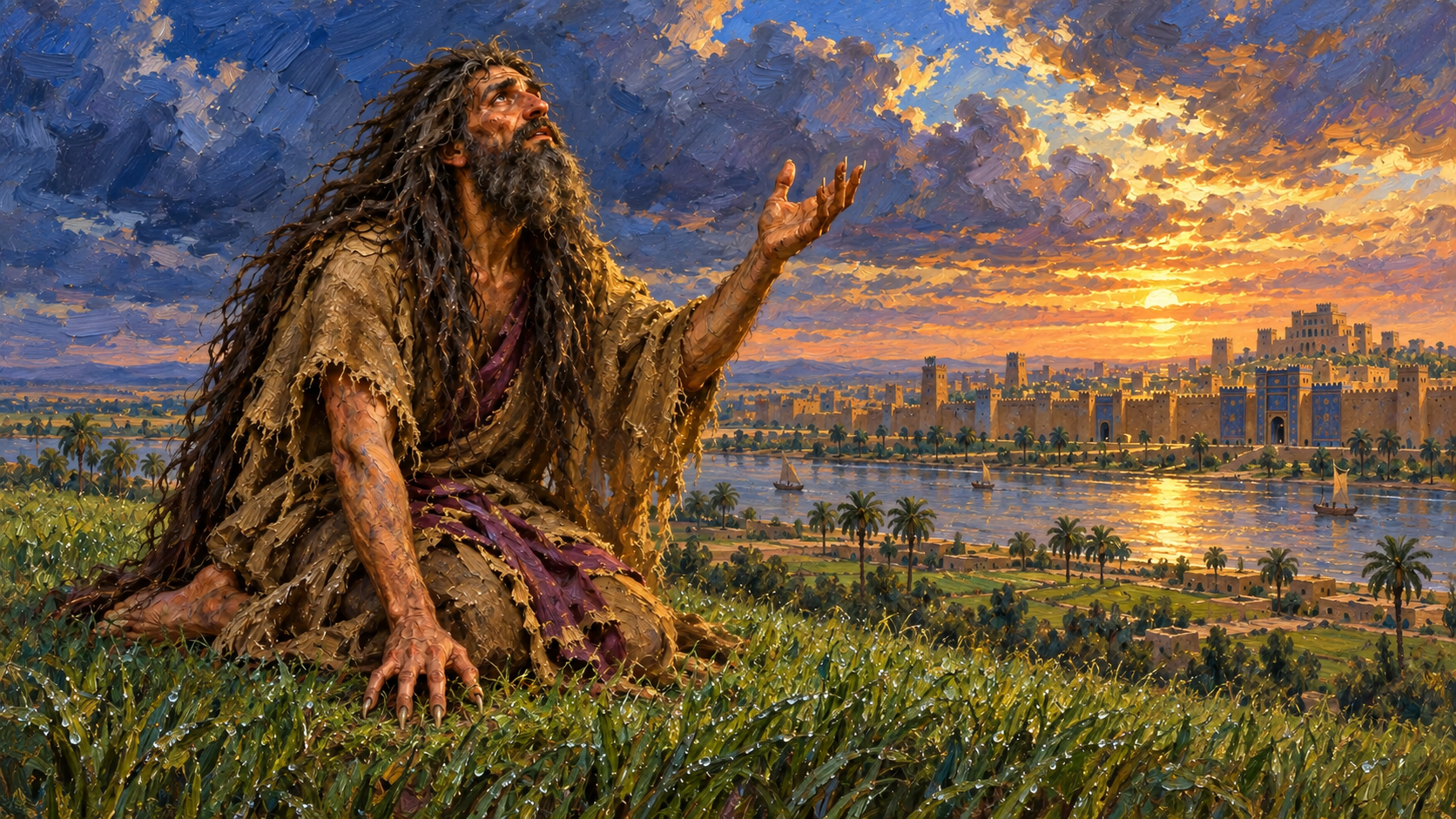
Nebuchadnezzar could conquer Jerusalem and carry away treasures from the temple, but he could not make himself independent of the God he refused to honor. As I follow him through Daniel 1–4, I see a man who repeatedly encountered the truth about God without wanting to surrender his pride. His dreams reveal what would happen to great kingdoms, including his own, while his humiliation shows how personally he needed to hear the message.
Judah Falls, but God Still Rules
When Nebuchadnezzar came against Jerusalem during Jehoiakim’s reign, he took selected Judeans into exile and carried temple articles to the treasury of his god. That could look like proof that Babylon’s god had defeated the God of Israel, but Daniel explains the conquest differently.
And the Lord gave Jehoiakim king of Judah into his hand, with some of the articles of the house of God, which he carried into the land of Shinar to the house of his god; and he brought the articles into the treasure house of his god.
Daniel 1:2, NKJV
The Lord gave Judah’s king into Nebuchadnezzar’s hand. Judah’s defeat fulfilled the warnings God had given His people; it didn’t mean He had become powerless against Babylon. I need to keep that explanation together with the fact that Nebuchadnezzar was responsible for the suffering his army inflicted. God’s use of Babylon to discipline Judah did not make its violence or idolatry righteous. Habakkuk also wrestled with how God could use the Chaldeans while holding them accountable for their wickedness.
The Hebrew title Adonai, used here for Lord, means Lord or Master. Nebuchadnezzar appeared to be in command, yet Daniel begins by telling us that the Lord permitted his victory. Even the reference to Shinar, where the temple articles were taken, recalls Babel in Genesis 11 and its people’s ambition to make a name for themselves. Babylon’s rulers could boast about their greatness, but their military success could not establish that their gods were real or their beliefs true.
The exile unfolded in stages, which helps explain why Daniel was already serving in Babylon before Jerusalem and the temple were finally destroyed. He and his friends entered a court that controlled their education and replaced their Hebrew names with names associated with Babylon’s gods. They could learn the language and perform their work faithfully without adopting that religion, but the king’s provisions also required discernment. Daniel’s refusal to defile himself with the royal food shows that service to Babylon did not give the king the right to decide his obedience to God.
God gave all four young men knowledge and skill, with Daniel also receiving understanding in visions and dreams. They would use those abilities in the king’s service, but Babylon’s gods had not supplied them. That becomes particularly clear when the king’s own religious advisers cannot explain his dream.
The Dream and the Kingdoms to Come
Nebuchadnezzar was troubled by a dream and summoned his wise men. Some readers think he had forgotten the dream, while others think he was withholding it to test his advisers. Daniel doesn’t tell us which was the case, but either way, the king demanded that they tell him both the dream and its meaning. They could not discover what he had seen, as their answer makes clear.
The Chaldeans answered the king, and said, “There is not a man on earth who can tell the king’s matter; therefore no king, lord, or ruler has ever asked such things of any magician, astrologer, or Chaldean. It is a difficult thing that the king requests, and there is no other who can tell it to the king except the gods, whose dwelling is not with flesh.”
Daniel 2:10-11, NKJV
Nebuchadnezzar responded by ordering the wise men killed, placing Daniel and his friends under a death sentence for a failure that wasn’t theirs. Daniel asked for time and brought the danger to his companions so they could seek God’s mercy together. Their faithfulness had not protected them from a ruler’s cruelty, and Daniel did not pretend he could produce the answer through his own ingenuity.
Then Daniel went to his house, and made the decision known to Hananiah, Mishael, and Azariah, his companions, that they might seek mercies from the God of heaven concerning this secret, so that Daniel and his companions might not perish with the rest of the wise men of Babylon. Then the secret was revealed to Daniel in a night vision. So Daniel blessed the God of heaven.
Daniel 2:17-19, NKJV
Before Daniel spoke to the king, he thanked God for revealing the secret. The Aramaic word raz, meaning secret or mystery, is used repeatedly in this chapter; the Aramaic portion of Daniel begins at 2:4. This was knowledge God disclosed, not a technique Daniel had mastered. When he later received a promotion, he also asked for positions for the companions who had prayed with him. I appreciate that he remembered them rather than treating God’s answer as an opportunity for his own advancement alone.
In the dream, Nebuchadnezzar saw an imposing image made of different materials. A stone cut without hands struck its feet and crushed the whole structure, then became a mountain filling the earth.
“You, O king, were watching; and behold, a great image! This great image, whose splendor was excellent, stood before you; and its form was awesome. This image’s head was of fine gold, its chest and arms of silver, its belly and thighs of bronze, its legs of iron, its feet partly of iron and partly of clay.”
Daniel 2:31-33, NKJV
The image’s materials range from the precious gold of its head to the divided mixture of iron and clay at its feet. Daniel described the kingdom following Babylon as inferior, but that need not mean it would have less territory or a weaker military in every respect. The materials portray differing qualities of rule, with the feet showing the instability of its final form. All that intimidating splendor would eventually be destroyed by something no human kingdom had produced.
Nebuchadnezzar was the head of gold, but Daniel made clear that he had received his greatness. The king would later boast about what he had built; first he had to hear who had given him the authority to build it.
You, O king, are a king of kings. For the God of heaven has given you a kingdom, power, strength, and glory.
Daniel 2:37, NKJV
Receiving that authority did not excuse the way he used it. Nebuchadnezzar was accountable to God for threatening his wise men and demanding idolatry, even though God could overrule those decisions and carry out His purposes. I don’t think we should make him a puppet with no responsibility, or imagine that his rebellion could force God to abandon His plan.
Daniel 2 describes the kingdoms after Babylon without naming all of them, so I look to the rest of the book for their identification. Daniel 5 records Babylon’s fall to the Medes and Persians, and Daniel 8 identifies Media and Persia through the ram and Greece through the goat. I understand the fourth kingdom, with its iron-like crushing strength, as Rome, extending prophetically into the divided final stage represented by the feet. Interpreters dispute that final form, but the references to Media, Persia, and Greece give us firmer grounds than speculation about current political alliances.
The changes of empire also show that God was carrying out purposes the rulers did not understand. Isaiah named Cyrus long before that king permitted the Jewish exiles to return and rebuild. Greek conquests spread a language later used widely in proclaiming the gospel, while Rome provided the political setting for Christ’s first coming and crucifixion.
The iron and clay retained some strength without forming a durable union. Daniel explains that the parts would mingle but would not hold together.
As you saw iron mixed with ceramic clay, they will mingle with the seed of men; but they will not adhere to one another, just as iron does not mix with clay.
Daniel 2:43, NKJV
I don’t think “the seed of men” requires an exotic theory to make sense of the passage. Conquest and alliances can bring people together without resolving their divisions, and economic dependence doesn’t necessarily produce agreement. A system may look formidable while remaining fractured. In Daniel’s account, however, the final answer to that weakness is not another human effort to repair the image.
The stone strikes the feet and destroys the metals together before becoming a mountain that fills the earth. Its being cut without hands points to God’s action, and the sequence doesn’t describe gradual human progress transforming the empires into His kingdom.
And in the days of these kings the God of heaven will set up a kingdom which shall never be destroyed; and the kingdom shall not be left to other people; it shall break in pieces and consume all these kingdoms, and it shall stand forever.
Daniel 2:44, NKJV
I understand this everlasting kingdom to be centered in the Messiah. Jesus applied the rejected stone of Psalm 118 to Himself and spoke of a stone crushing the one on whom it falls. We should read each passage in context rather than assume Daniel 2 alone explains every stone reference, but these passages direct our attention to God’s appointed King. Jesus Christ will bring rebellious dominion to an end.
Christ first came in humility, taking true humanity without ceasing to be God. He lived without sin and willingly suffered in His body for our sins. He shed His blood and died, then rose bodily from the dead. He is exalted now, and Daniel’s vision points beyond our present spiritual experience to His public reign. We receive the King through repentance and faith, but His future fulfillment of this promise includes returning bodily and ruling openly on earth.
I cannot turn that promise into an assignment for the church to seize an empire and establish His kingdom through political control. Neither can I reduce it to an inward experience with no future earthly fulfillment. Our present allegiance to Christ and His coming reign belong together, and neither makes a successful human government the fulfillment of Daniel’s vision.
The Furnace and the Demand for Worship
Nebuchadnezzar had been told that his kingdom would end, yet in Daniel 3 he erected an enormous gold image and commanded the gathered peoples to worship it. The image might have represented him or expressed a rejection of his dream, but Scripture doesn’t give us that identification or motive. What it does show is that hearing the truth had not prevented him from using his authority to demand something God had forbidden.
Shadrach, Meshach, and Abed-Nego refused, even when the king threatened to throw them into the furnace. They believed God could deliver them, but their answer did not make obedience conditional on being spared.
If that is the case, our God whom we serve is able to deliver us from the burning fiery furnace, and He will deliver us from your hand, O king. But if not, let it be known to you, O king, that we do not serve your gods, nor will we worship the gold image which you have set up.
Daniel 3:17-18, NKJV
I don’t understand their answer as fatalism, as though an inevitable outcome made obedience pointless. They chose to obey God while trusting His ability to rescue them and acknowledging that He could choose otherwise. They addressed Nebuchadnezzar respectfully as king, but his power to threaten their bodies did not entitle him to their worship. A firm refusal to sin did not require contempt for his office or a disregard for their own lives.
When the king saw a fourth figure with the men in the fire, he described the sight in the language of a pagan ruler. He later acknowledged that God had sent His Angel. I believe this was likely Christ appearing before He took on human flesh, an appearance known as a Christophany. The account gives fewer identifying details than some appearances of the Angel of the LORD in Genesis and Exodus, so I would not claim the same certainty here or base the identification solely on Nebuchadnezzar’s words.
God preserved the men so completely that the fire did not harm them, overturning the result Nebuchadnezzar intended. I am grateful for their rescue, but I should not promise myself that every refusal to sin will end that way. God is worthy of obedience when He delivers His servants and when they must endure suffering.
The King Is Humbled
In Daniel 4, Nebuchadnezzar recounts another dream, this time about a flourishing tree that provided food and shelter until heaven ordered it cut down. Daniel was distressed when he understood that the tree represented the king. Nebuchadnezzar’s greatness would be taken from him until he learned who had authority over his kingdom.
They shall drive you from men, your dwelling shall be with the beasts of the field, and they shall make you eat grass like oxen. They shall wet you with the dew of heaven, and seven times shall pass over you, till you know that the Most High rules in the kingdom of men, and gives it to whomever He chooses.
Daniel 4:25, NKJV
Daniel urged him to turn from his sins by doing right and showing mercy to the poor. I find Daniel’s concern remarkable when I remember what Babylon had done to his own people. He wished the dream concerned the king’s enemies rather than Nebuchadnezzar, yet he still explained the judgment honestly. He could warn a man who had caused enormous suffering without taking pleasure in his humiliation.
The king had twelve months to respond, but he was still boasting about his own power and majesty when judgment fell. Before he had finished speaking, a voice from heaven announced that his kingdom had departed from him. He was driven from human society and lived like an animal until the appointed time passed. The man who claimed credit for Babylon’s grandeur could not preserve his own reason.
When Nebuchadnezzar lifted his eyes to heaven and his understanding returned, he blessed the Most High and acknowledged His everlasting rule. His reason, honor, and kingdom were restored, and he publicly described what God had done to him.
Now I, Nebuchadnezzar, praise and extol and honor the King of heaven, all of whose works are truth, and His ways justice. And those who walk in pride He is able to put down.
Daniel 4:37, NKJV
Was he genuinely saved? His confession is far more than casual politeness, but Daniel doesn’t expressly tell us he was born again. I wouldn’t dismiss the change in his words because of his earlier arrogance, or claim a complete account of his spiritual condition because the chapter ends encouragingly. We are told that God humbled him and restored his understanding, and that his public praise replaced the boasting for which he had been judged.
The twelve-month delay also keeps me from treating God’s patience as permission to carry on in sin. Nebuchadnezzar had been warned clearly, and the passage connects the judgment to the pride he continued to express. God had given him time to respond, but that did not make the warning empty.
I don’t have to rule an empire to recognize the same temptation in myself. I can begin treating an ability or an opportunity as proof that I made myself successful, forgetting how much I have received. Daniel’s advice about mercy to the poor also stops me from reducing repentance to saying modest things about myself. The king was called to turn from his wrongdoing in how he treated others.
From Babylon to Christ’s Kingdom
Revelation develops the same pattern of human power demanding worship, persecuting God’s people, and finally coming under judgment. Daniel gives an outline of Gentile kingdoms; Revelation brings the final rebellion under the beast and its defeat by Christ into view. I want those connections to shape my hope without forcing every headline into a symbol or assigning names Scripture has not supplied.
Then the seventh angel sounded: And there were loud voices in heaven, saying, “The kingdoms of this world have become the kingdoms of our Lord and of His Christ, and He shall reign forever and ever!”
Revelation 11:15, NKJV
I understand these prophecies from a futurist and premillennial perspective: Christ will return before establishing His literal thousand-year reign. The church will be gathered to Him before the coming worldwide Tribulation, after which He will return publicly and defeat the rebellious powers. Daniel’s image doesn’t supply every detail of that sequence, so we need the wider prophetic passages. The studies on the end-times timeline and Matthew 24–25 examine those connections more fully.
Revelation 13 describes the beast drawing the world into worship, and Revelation 19 describes Christ returning to defeat the beast and the kings gathered against Him. The thousand-year reign follows in Revelation 20. These passages give our hope a future fulfillment beyond the survival of any present government. The study on the Kingdom of Heaven and the Kingdom of God also considers the kingdom’s present and future aspects.
Some readers treat Daniel’s prophecies as history written after the events because they assume genuine prediction cannot happen. I don’t accept that starting assumption. The God who revealed a dream no human adviser could discover could also reveal the kingdoms that would follow Babylon. I receive Daniel as inspired prophecy, and its accuracy gives me reason to trust God’s knowledge rather than suppose a later author presented past events as predictions. We can study that prophecy carefully without pretending to know dates or modern identifications God has not given us.
Daniel and his friends lived under rulers who did not share their faith, yet they performed public duties without surrendering their worship. Their example helps me avoid both naive confidence in government and the idea that faithfulness requires withdrawing from every responsibility within it. Rulers can maintain order and benefit people, but they can also inflict terrible harm, and their authority is never final.
That also puts a limit on my political ambitions. Caring about public righteousness and defending truth are Christian responsibilities, but politics cannot save us. Nor can I earn God’s favor by making myself seem humble enough. I need the salvation He provides through Jesus Christ.
The eternal Son became fully man without ceasing to be fully God and obeyed the Father without sin. He willingly gave Himself to be slain as the perfect sacrifice for our sins. Wicked men tortured and crucified Him, but the Father did not punish or abandon Him. Father and Son remained united in this saving work. Christ accomplished our redemption through His shed blood and death before His burial and bodily resurrection. He died for the whole world, and God’s offer of salvation is genuine for every person, though it can be resisted and rejected. We cannot earn or keep salvation through religious effort or personal improvement; we receive His mercy when we turn to the crucified and risen Lord in repentance and faith.
My Final Thoughts
Nebuchadnezzar had to learn that his kingdom and even his ability to think were gifts he could not preserve by boasting about them. I want to recognize my dependence on God before pride makes me disregard what He has said. The king’s dreams also give me reason to trust Christ when earthly power looks permanent, because the kingdom God establishes will outlast every ruler who opposes Him.