
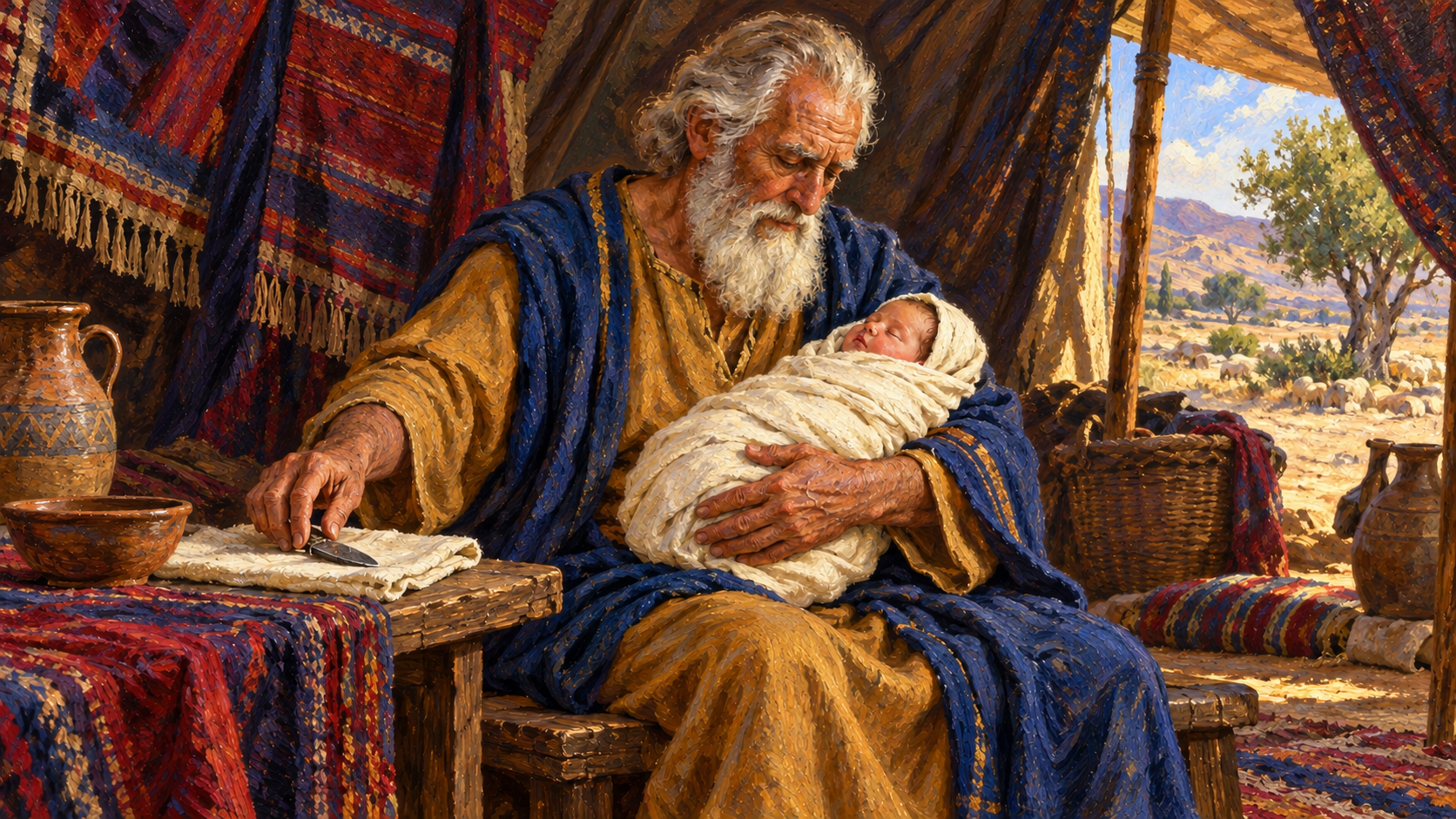
Why did God command circumcision and later warn Gentiles not to receive it as a condition of salvation? I want to understand that difference without treating the sign as meaningless or evil. God gave it a place in His covenant with Abraham and Israel. When the apostles explain righteousness and Christian liberty, they help us see what the sign could never accomplish and what Christ does through the circumcision made without hands.
Abraham Was Righteous Before Receiving the Sign
After these things the word of the LORD came to Abram in a vision, saying, "Do not be afraid, Abram. I am your shield, your exceedingly great reward." But Abram said, "Lord GOD, what will You give me, seeing I go childless, and the heir of my house is Eliezer of Damascus?" Then Abram said, "Look, You have given me no offspring; indeed one born in my house is my heir!" And behold, the word of the LORD came to him, saying, "This one shall not be your heir, but one who will come from your own body shall be your heir." Then He brought him outside and said, "Look now toward heaven, and count the stars if you are able to number them." And He said to him, "So shall your descendants be." And he believed in the LORD, and He accounted it to him for righteousness.
Genesis 15 records that Abram believed the LORD and was counted righteous, years before the command in Genesis 17. He had not been circumcised, and the promised son had not yet been born. God did not wait for Abram to possess the land or complete a ritual before declaring him righteous.
Paul draws attention to that order in Romans. If Abraham was counted righteous while he was still uncircumcised, how could justification belong only to circumcised people? Abraham’s own life answers the question. I need to keep that sequence in view when considering what the sign meant.
Does this blessedness then come upon the circumcised only, or upon the uncircumcised also? For we say that faith was accounted to Abraham for righteousness. How then was it accounted? While he was circumcised, or uncircumcised? Not while circumcised, but while uncircumcised. And he received the sign of circumcision, a seal of the righteousness of the faith which he had while still uncircumcised, that he might be the father of all those who believe, though they are uncircumcised, that righteousness might be imputed to them also, and the father of circumcision to those who not only are of the circumcision, but who also walk in the steps of the faith which our father Abraham had while still uncircumcised.
Paul calls circumcision a sign and a seal of the righteousness Abraham already had through faith. It pointed to a covenant reality and confirmed it, rather than creating something Abraham had lacked. God’s earlier declaration of righteousness did not need to be rewritten when Abraham received the sign.
That is how Abraham can be the father of believing Gentiles who remain uncircumcised, as well as circumcised people who follow the faith he had before receiving the sign. Physical descent and circumcision still have historical significance. Neither changes the fact that saving righteousness comes through faith.
We cannot conclude that circumcision saved every male in Abraham’s line. Scripture describes circumcised Israelites who remained in unbelief and came under judgment. Receiving a covenant privilege made them responsible before God; it did not remove their need to trust Him.
The Covenant Sign in Abraham’s Household and Israel
When Abram was ninety-nine years old, the LORD appeared to Abram and said to him, "I am Almighty God; walk before Me and be blameless. And I will make My covenant between Me and you, and will multiply you exceedingly." Then Abram fell on his face, and God talked with him, saying: "As for Me, behold, My covenant is with you, and you shall be a father of many nations. No longer shall your name be called Abram, but your name shall be Abraham; for I have made you a father of many nations. I will make you exceedingly fruitful; and I will make nations of you, and kings shall come from you. And I will establish My covenant between Me and you and your descendants after you in their generations, for an everlasting covenant, to be God to you and your descendants after you. Also I give to you and your descendants after you the land in which you are a stranger, all the land of Canaan, as an everlasting possession; and I will be their God." And God said to Abraham: "As for you, you shall keep My covenant, you and your descendants after you throughout their generations. This is My covenant which you shall keep, between Me and you and your descendants after you: Every male child among you shall be circumcised; and you shall be circumcised in the flesh of your foreskins, and it shall be a sign of the covenant between Me and you. He who is eight days old among you shall be circumcised, every male child in your generations, he who is born in your house or bought with money from any foreigner who is not your descendant. He who is born in your house and he who is bought with your money must be circumcised, and My covenant shall be in your flesh for an everlasting covenant. And the uncircumcised male child, who is not circumcised in the flesh of his foreskin, that person shall be cut off from his people; he has broken My covenant."
When Abram was ninety-nine, God identified Himself as Almighty God and called him to walk blamelessly before Him. He changed Abram’s name to Abraham and reaffirmed what He had promised for his future. Nations and kings would come from him, and Canaan would belong to his descendants. We need to hear the command about circumcision within that larger promise.
God called the physical mark “a sign of the covenant.” His command included every male in Abraham’s household, whether born there or purchased from a foreigner. I notice that ancestry alone does not explain who received it. The sign applied throughout the household, although God would establish the covenant line through Isaac.
An uncircumcised male was to be cut off from his people because he had broken the covenant. That consequence tells us how seriously God regarded His command, however unfamiliar the subject may feel to us. We should neither soften the penalty nor detach it from that covenant community and impose it on the church.
Calling the covenant “everlasting” leaves no room to dismiss it as a temporary mistake. God’s promises to Abraham and his descendants remain real. Yet the way a covenant is administered need not remain unchanged in every respect, and Gentile Christians are not commanded to receive the physical sign. Later revelation shows how they share in Abraham’s blessing through faith in Christ without becoming Israel.
The Hebrew verb mul and Greek noun peritome refer to circumcision. Scripture uses these words for the physical act and also uses that act as an image of inward moral and spiritual realities, so understanding the original words also means attending to their context. We cannot choose between a physical and inward meaning from the word alone; the surrounding passage tells us how it is being used.
The act was neither evil nor able to save. Its meaning came from the covenant God attached to it, so I would not dismiss it as an empty custom Abraham invented. But I also cannot give the physical mark the place Scripture gives to faith. Abraham was already counted righteous when God commanded him to receive this serious covenant sign.
And the LORD visited Sarah as He had said, and the LORD did for Sarah as He had spoken. For Sarah conceived and bore Abraham a son in his old age, at the set time of which God had spoken to him. And Abraham called the name of his son who was born to him–whom Sarah bore to him–Isaac. Then Abraham circumcised his son Isaac when he was eight days old, as God had commanded him.
Abraham circumcised Isaac on the eighth day, obeying God’s command after the son was born at the appointed time. Isaac could not yet understand or profess the covenant. He received the national and household sign God had given to Abraham’s male descendants.
I do not believe Isaac’s reception of that sign as an infant establishes infant baptism. The New Testament neither calls water baptism the new infant circumcision nor commands us to baptize babies on the basis of Genesis 17. Instead, Christian baptism follows hearing and responding to the gospel in repentance, faith, and confession. It publicly identifies the believer with Christ.
Servants in the household received the sign too. Circumcision placed a male within the visible covenant order without erasing his ancestry or guaranteeing that he had a regenerated heart. Ishmael also received circumcision and a real blessing from God, yet God said He would establish the covenant line through Isaac.
Isaac’s circumcision marked the covenant order God had established before the child could understand it. We should not confuse that household sign with a personal profession of saving faith. Later, when God called Moses, circumcision remained a serious obligation within his household as well.
And it came to pass on the way, at the encampment, that the LORD met him and sought to kill him. Then Zipporah took a sharp stone and cut off the foreskin of her son and cast it at Moses' feet, and said, "Surely you are a husband of blood to me!" So He let him go. Then she said, "You are a husband of blood!"–because of the circumcision.
On the journey to Egypt, the LORD met “him” and sought to kill him. The account gives us little preparation for that danger. Zipporah circumcised her son and touched the foreskin to the feet, speaking of a husband of blood. Then the danger ended.
The passage leaves questions unanswered. The pronoun does not explicitly identify whether Moses or the son was threatened, and the son is not named. Scripture never tells us who delayed the command or why. We also are not told whether “feet” is literal or euphemistic, and I would be careful not to invent the full emotional meaning of Zipporah’s words.
The unanswered details should not obscure what the passage does tell us: circumcision resolved the covenant crisis. Moses had been called to lead Abraham’s descendants out of bondage, yet that public responsibility did not allow him to neglect God’s command in his own household. I cannot read his calling as an exemption from private obedience.
God was enforcing a covenant command in the setting where He had given it. The episode does not teach that surgery saves a person or that human blood appeases divine wrath. We can recognize the seriousness of what happened without inventing answers to the questions Scripture leaves open.
And the LORD said to Moses and Aaron, "This is the ordinance of the Passover: No foreigner shall eat it. But every man's servant who is bought for money, when you have circumcised him, then he may eat it. A sojourner and a hired servant shall not eat it. In one house it shall be eaten; you shall not carry any of the flesh outside the house, nor shall you break one of its bones. All the congregation of Israel shall keep it. And when a stranger dwells with you and wants to keep the Passover to the LORD, let all his males be circumcised, and then let him come near and keep it; and he shall be as a native of the land. For no uncircumcised person shall eat it. One law shall be for the native-born and for the stranger who dwells among you."
The Passover law barred uncircumcised males from eating the meal. A foreigner who wished to keep Passover to the LORD could circumcise the males of his household and come near, after which he was treated as a native of the land for that observance.
Circumcision was therefore tied to Israel’s remembrance of redemption from Egypt. The requirement for Passover shows that the sign had a public covenant meaning, beyond a person’s medical circumstances.
So it was, when all the kings of the Amorites who were on the west side of the Jordan, and all the kings of the Canaanites who were by the sea, heard that the LORD had dried up the waters of the Jordan from before the children of Israel until we had crossed over, that their heart melted; and there was no spirit in them any longer because of the children of Israel. At that time the LORD said to Joshua, "Make flint knives for yourself, and circumcise the sons of Israel again the second time." So Joshua made flint knives for himself, and circumcised the sons of Israel at the hill of the foreskins. And this is the reason why Joshua circumcised them: All the people who came out of Egypt who were males, all the men of war, had died in the wilderness on the way, after they had come out of Egypt. For all the people who came out had been circumcised, but all the people born in the wilderness, on the way as they came out of Egypt, had not been circumcised. For the children of Israel walked forty years in the wilderness, till all the people who were men of war, who came out of Egypt, were consumed, because they did not obey the voice of the LORD–to whom the LORD swore that He would not show them the land which the LORD had sworn to their fathers that He would give us, "a land flowing with milk and honey." Then Joshua circumcised their sons whom He raised up in their place; for they were uncircumcised, because they had not been circumcised on the way. So it was, when they had finished circumcising all the people, that they stayed in their places in the camp till they were healed. Then the LORD said to Joshua, "This day I have rolled away the reproach of Egypt from you." Therefore the name of the place is called Gilgal to this day. Now the children of Israel camped in Gilgal, and kept the Passover on the fourteenth day of the month at twilight on the plains of Jericho. And they ate of the produce of the land on the day after the Passover, unleavened bread and parched grain, on the very same day. Then the manna ceased on the day after they had eaten the produce of the land; and the children of Israel no longer had manna, but they ate the food of the land of Canaan that year.
The males born during Israel’s wilderness years had not been circumcised. Before they observed Passover in the land and began the conquest, Joshua circumcised them at Gilgal. They stayed in camp until they had healed and then kept the feast.
The LORD said He had rolled away the reproach of Egypt, which explains the name Gilgal. But the account does not make circumcision a weapon that won Jericho. Israel submitted to God’s covenant order before following His separate command about the city.
Under the law, males continued to be circumcised on the eighth day. Jesus later pointed out that this could be done on the Sabbath so that Moses’ law would not be broken. That allowance exposed the inconsistency of people who were angry with Him for making an entire man well on the Sabbath.
The Heart Must Also Be Circumcised
By the time Israel entered the land, circumcision was part of their Passover observance and life under the law, but their history already showed that the physical sign could exist alongside unbelief. Many circumcised men of the wilderness generation died in rebellion. Moses addressed the inward response they needed, because a mark on the body had not removed their resistance to God.
"And now, Israel, what does the LORD your God require of you, but to fear the LORD your God, to walk in all His ways and to love Him, to serve the LORD your God with all your heart and with all your soul, and to keep the commandments of the LORD and His statutes which I command you today for your good? Indeed heaven and the highest heavens belong to the LORD your God, also the earth with all that is in it. The LORD delighted only in your fathers, to love them; and He chose their descendants after them, you above all peoples, as it is this day. Therefore circumcise the foreskin of your heart, and be stiff-necked no longer. For the LORD your God is God of gods and Lord of lords, the great God, mighty and awesome, who shows no partiality nor takes a bribe. He administers justice for the fatherless and the widow, and loves the stranger, giving him food and clothing. Therefore love the stranger, for you were strangers in the land of Egypt. You shall fear the LORD your God; you shall serve Him, and to Him you shall hold fast, and take oaths in His name. He is your praise, and He is your God, who has done for you these great and awesome things which your eyes have seen. Your fathers went down to Egypt with seventy persons, and now the LORD your God has made you as the stars of heaven in multitude.
Moses called Israel to respond to God’s greatness and covenant love with their whole heart. They were to fear and love the LORD, serving Him as they walked in His ways. Circumcising the foreskin of the heart meant giving up their stubborn resistance and obeying His commands.
Heart circumcision uses a familiar covenant act to describe inward separation from rebellion. The image does not make the body evil. It calls for the removal of stubborn resistance so that a person responds to God in love and obedience.
The surrounding commands help me see what that inward response looks like. God is impartial and gives justice to the fatherless and widow. He loves the stranger, and His people are to reflect that care. A circumcised heart therefore shows itself in worship and obedience, including justice and love toward others. Moses is not describing a private mystical experience with no effect on how someone lives.
Moses spoke to a circumcised nation and still called for changed hearts. That alone shows why the physical mark was insufficient. Outward religious identity could not take the place of living faithfully before God.
"Now it shall come to pass, when all these things come upon you, the blessing and the curse which I have set before you, and you call them to mind among all the nations where the LORD your God drives you, and you return to the LORD your God and obey His voice, according to all that I command you today, you and your children, with all your heart and with all your soul, that the LORD your God will bring you back from captivity, and have compassion on you, and gather you again from all the nations where the LORD your God has scattered you. If any of you are driven out to the farthest parts under heaven, from there the LORD your God will gather you, and from there He will bring you. Then the LORD your God will bring you to the land which your fathers possessed, and you shall possess it. He will prosper you and multiply you more than your fathers. And the LORD your God will circumcise your heart and the heart of your descendants, to love the LORD your God with all your heart and with all your soul, that you may live. "Also the LORD your God will put all these curses on your enemies and on those who hate you, who persecuted you. And you will again obey the voice of the LORD and do all His commandments which I command you today. The LORD your God will make you abound in all the work of your hand, in the fruit of your body, in the increase of your livestock, and in the produce of your land for good. For the LORD will again rejoice over you for good as He rejoiced over your fathers, if you obey the voice of the LORD your God, to keep His commandments and His statutes which are written in this Book of the Law, and if you turn to the LORD your God with all your heart and with all your soul.
Deuteronomy 30 looks ahead to Israel’s return after being scattered among the nations. The people will remember the covenant words and return to the LORD, and He will gather them to the land. He also promises to circumcise their hearts so they will love Him and live.
In Deuteronomy, I want to keep the command in chapter 10 together with the promise in chapter 30. Israel is responsible to turn to God, and God must do the work that brings lasting inward renewal. His grace makes restored obedience possible without making the people’s response imaginary.
The prophecy still names Israel and its descendants, speaking of the nations and the land to which Israel will return. I cannot make those words mean that the church has replaced Israel. Believers experience inward renewal through the Spirit now, while God retains His future purposes for the nation He named.
Jeremiah likewise called Judah to repent, warning people who were circumcised in body but uncircumcised in heart. Having the sign never gave them an excuse for idolatry or injustice. The prophets called them to faith instead of allowing the mark to conceal their unbelief.
Indeed you are called a Jew, and rest on the law, and make your boast in God, and know His will, and approve the things that are excellent, being instructed out of the law, and are confident that you yourself are a guide to the blind, a light to those who are in darkness, an instructor of the foolish, a teacher of babes, having the form of knowledge and truth in the law. You, therefore, who teach another, do you not teach yourself? You who preach that a man should not steal, do you steal? You who say, "Do not commit adultery," do you commit adultery? You who abhor idols, do you rob temples? You who make your boast in the law, do you dishonor God through breaking the law? For "the name of God is blasphemed among the Gentiles because of you," as it is written. For circumcision is indeed profitable if you keep the law; but if you are a breaker of the law, your circumcision has become uncircumcision. Therefore, if an uncircumcised man keeps the righteous requirements of the law, will not his uncircumcision be counted as circumcision? And will not the physically uncircumcised, if he fulfills the law, judge you who, even with your written code and circumcision, are a transgressor of the law? For he is not a Jew who is one outwardly, nor is circumcision that which is outward in the flesh; but he is a Jew who is one inwardly; and circumcision is that of the heart, in the Spirit, not in the letter; whose praise is not from men but from God.
Paul addresses someone who bears the name Jew and rests in the law, boasting in God and teaching others. That person possesses circumcision as well. But does he obey the commands he teaches? His own transgression brings God’s name into disrepute among the Gentiles, despite the religious standing in which he takes pride.
Circumcision is profitable if a person keeps the law, but it cannot protect a lawbreaker from judgment. Paul is confronting the belief that possessing the covenant makes inward obedience unnecessary.
Paul describes the Jew who is one inwardly and whose heart is circumcised by the Spirit. That is the inward reality God praises. It does not erase ethnic distinctions or turn every Gentile Christian into an ethnic Jew. Romans 9-11 continues to identify Israel as a nation, describing its partial blindness and faithful remnant while also speaking of its future.
People may praise outward religious standing, but God praises truth in the inward person. That is the contrast Paul is making. Ancestry and covenant history remain facts; neither can make a sinner righteous apart from faith.
Gentiles Are Saved by Grace Without Circumcision
And certain men came down from Judea and taught the brethren, "Unless you are circumcised according to the custom of Moses, you cannot be saved." Therefore, when Paul and Barnabas had no small dissension and dispute with them, they determined that Paul and Barnabas and certain others of them should go up to Jerusalem, to the apostles and elders, about this question. So, being sent on their way by the church, they passed through Phoenicia and Samaria, describing the conversion of the Gentiles; and they caused great joy to all the brethren. And when they had come to Jerusalem, they were received by the church and the apostles and the elders; and they reported all things that God had done with them. But some of the sect of the Pharisees who believed rose up, saying, "It is necessary to circumcise them, and to command them to keep the law of Moses." Now the apostles and elders came together to consider this matter. And when there had been much dispute, Peter rose up and said to them: "Men and brethren, you know that a good while ago God chose among us, that by my mouth the Gentiles should hear the word of the gospel and believe. So God, who knows the heart, acknowledged them by giving them the Holy Spirit, just as He did to us, and made no distinction between us and them, purifying their hearts by faith. Now therefore, why do you test God by putting a yoke on the neck of the disciples which neither our fathers nor we were able to bear? But we believe that through the grace of the Lord Jesus Christ we shall be saved in the same manner as they."
The men from Judea said, “Unless you are circumcised according to the custom of Moses, you cannot be saved.” They were making circumcision a requirement for salvation, not offering it as an optional cultural practice. Others insisted that Gentiles must also keep the law of Moses. I can see why this became such a serious dispute: the message of salvation itself was being changed.
Peter pointed to Gentiles who had already heard and believed the gospel. God had acknowledged them by giving them the Holy Spirit and purifying their hearts by faith. He had done this without requiring circumcision or making them Israelites first.
To place the Mosaic yoke on those believers would be to test God. Peter made their common ground clear: Jews are saved through the grace of the Lord Jesus Christ in the same way as Gentiles. Jewish ancestry did not provide a different way to be saved.
Then it pleased the apostles and elders, with the whole church, to send chosen men of their own company to Antioch with Paul and Barnabas, namely, Judas who was also named Barsabas, and Silas, leading men among the brethren. They wrote this letter by them: The apostles, the elders, and the brethren, To the brethren who are of the Gentiles in Antioch, Syria, and Cilicia: Greetings. Since we have heard that some who went out from us have troubled you with words, unsettling your souls, saying, "You must be circumcised and keep the law"–to whom we gave no such commandment– it seemed good to us, being assembled with one accord, to send chosen men to you with our beloved Barnabas and Paul, men who have risked their lives for the name of our Lord Jesus Christ. We have therefore sent Judas and Silas, who will also report the same things by word of mouth. For it seemed good to the Holy Spirit, and to us, to lay upon you no greater burden than these necessary things: that you abstain from things offered to idols, from blood, from things strangled, and from sexual immorality. If you keep yourselves from these, you will do well. Farewell.
The council sent a letter denying authorization to the men who troubled Gentile believers with circumcision and law-keeping demands. The apostles did not burden them with that yoke.
The letter still required them to abstain from things offered to idols, as well as blood and things strangled. It also forbade sexual immorality. Those instructions protected holiness and fellowship at the table. Grace did not make obedience disposable, but obedience was not made the basis on which God declared them righteous.
That decision helps us understand why Paul could refuse circumcision in one case and accept it in another. He would not allow it to become a requirement for salvation. Where no claim to justification was involved, however, he could consider whether the practice would remove a barrier to ministry. We see the difference in Titus and Timothy.
Then after fourteen years I went up again to Jerusalem with Barnabas, and also took Titus with me. And I went up by revelation, and communicated to them that gospel which I preach among the Gentiles, but privately to those who were of reputation, lest by any means I might run, or had run, in vain. Yet not even Titus who was with me, being a Greek, was compelled to be circumcised. And this occurred because of false brethren secretly brought in (who came in by stealth to spy out our liberty which we have in Christ Jesus, that they might bring us into bondage), to whom we did not yield submission even for an hour, that the truth of the gospel might continue with you.
Titus was an uncircumcised Greek. False brothers had come in secretly to spy on Christian liberty and bring believers into bondage. Giving in to them would have told the church that faith in Christ was insufficient for full acceptance with God.
Paul refused to yield even for an hour because he wanted the truth of the gospel to continue with the churches. His refusal did not express contempt for Abraham or Moses, or for Jewish people. He was defending salvation by grace and the Gentile believers whom God had already received.
I need to ask what an accommodation would communicate, not just whether it would please someone. Love can make room for a preference, but the same action can surrender truth when it carries a false message. In Titus’s case, the demand made circumcision necessary for salvation, so Paul had to refuse.
Then he came to Derbe and Lystra. And behold, a certain disciple was there, named Timothy, the son of a certain Jewish woman who believed, but his father was Greek. He was well spoken of by the brethren who were at Lystra and Iconium. Paul wanted to have him go on with him. And he took him and circumcised him because of the Jews who were in that region, for they all knew that his father was Greek. And as they went through the cities, they delivered to them the decrees to keep, which were determined by the apostles and elders at Jerusalem. So the churches were strengthened in the faith, and increased in number daily.
Acts records Timothy’s circumcision immediately after the Jerusalem decision, then tells us that Paul and Timothy delivered that decision to the churches. I don’t see how we can read this as Paul secretly reversing what he was publicly teaching. The circumstances of Timothy’s ministry explain his action.
Timothy’s mother was a Jewish believer, while his father was Greek, and the local Jews knew that background. Since Paul regularly began his preaching in synagogues, an objection to Timothy’s background could keep people from listening to him. Circumcision removed that avoidable barrier to ministry among Jewish hearers.
The church had already denied that circumcision was necessary for salvation. Timothy received it as a voluntary and costly accommodation for ministry. It could not make him righteous before God, complete his salvation, or give him the Holy Spirit.
Titus and Timothy help me understand how liberty serves the gospel. We must refuse a practice when false teachers make it necessary for acceptance with God. Yet we may choose that same lawful practice out of love when it helps others hear and does not compromise the message.
Confidence Belongs in Christ, Not the Flesh
Stand fast therefore in the liberty by which Christ has made us free, and do not be entangled again with a yoke of bondage. Indeed I, Paul, say to you that if you become circumcised, Christ will profit you nothing. And I testify again to every man who becomes circumcised that he is a debtor to keep the whole law. You have become estranged from Christ, you who attempt to be justified by law; you have fallen from grace. For we through the Spirit eagerly wait for the hope of righteousness by faith. For in Christ Jesus neither circumcision nor uncircumcision avails anything, but faith working through love. You ran well. Who hindered you from obeying the truth? This persuasion does not come from Him who calls you. A little leaven leavens the whole lump. I have confidence in you, in the Lord, that you will have no other mind; but he who troubles you shall bear his judgment, whoever he is. And I, brethren, if I still preach circumcision, why do I still suffer persecution? Then the offense of the cross has ceased. I could wish that those who trouble you would even cut themselves off! For you, brethren, have been called to liberty; only do not use liberty as an opportunity for the flesh, but through love serve one another. For all the law is fulfilled in one word, even in this: "You shall love your neighbor as yourself." But if you bite and devour one another, beware lest you be consumed by one another!
Paul tells believers to stand in the freedom Christ gave them and not return to bondage. Here he is warning someone who receives circumcision as a requirement for justification. That person cannot choose one part of the law as a means of becoming righteous and disregard the rest. He becomes responsible to keep the whole law.
Paul’s warning “Christ will profit you nothing” confronts two incompatible grounds of confidence. I cannot seek to be justified by keeping the law and at the same time claim to rely entirely on Christ. The physical procedure does not have some power of its own that makes Jesus unwilling to save.
The words “You have fallen from grace” describe turning from grace as the basis of justification to seek righteousness through the law. They do not mean a truly born-again believer becomes unborn. Paul is warning against false teaching and misplaced reliance, not describing a failure of the Spirit’s seal.
In Christ, neither circumcision nor uncircumcision can justify us. Faith works through love, so Christian freedom does not become permission to indulge the flesh. It leads believers to serve one another as they obey the command to love their neighbor.
Paul’s severe wish concerning the agitators reflect the danger of teachers drawing churches away from gospel truth. His target was that corrupt teaching. We should not turn his warning into contempt for Jews or circumcised bodies, or hostility toward Jewish believers.
See with what large letters I have written to you with my own hand! As many as desire to make a good showing in the flesh, these would compel you to be circumcised, only that they may not suffer persecution for the cross of Christ. For not even those who are circumcised keep the law, but they desire to have you circumcised that they may boast in your flesh. But God forbid that I should boast except in the cross of our Lord Jesus Christ, by whom the world has been crucified to me, and I to the world. For in Christ Jesus neither circumcision nor uncircumcision avails anything, but a new creation. And as many as walk according to this rule, peace and mercy be upon them, and upon the Israel of God.
Some teachers wanted to display their converts’ circumcision as evidence of their own success. They could boast in those bodies and avoid persecution for the cross of Christ. Their pressure on Gentiles served that desire for a good outward showing.
Paul would boast only in the cross of the Lord Jesus Christ, through whom the world had been crucified to him and he to the world. A bodily mark could not give him standing before God, nor could its absence. What counted was being made a new creation.
That new creation gives believers an identity and life in Christ that no bodily credential can produce. It does not erase the difference between male and female bodies, remove ethnic history, or cancel God’s national promises to Israel.
Finally, my brethren, rejoice in the Lord. For me to write the same things to you is not tedious, but for you it is safe. Beware of dogs, beware of evil workers, beware of the mutilation! For we are the circumcision, who worship God in the Spirit, rejoice in Christ Jesus, and have no confidence in the flesh, though I also might have confidence in the flesh. If anyone else thinks he may have confidence in the flesh, I more so: circumcised the eighth day, of the stock of Israel, of the tribe of Benjamin, a Hebrew of the Hebrews; concerning the law, a Pharisee; concerning zeal, persecuting the church; concerning the righteousness which is in the law, blameless. But what things were gain to me, these I have counted loss for Christ. Yet indeed I also count all things loss for the excellence of the knowledge of Christ Jesus my Lord, for whom I have suffered the loss of all things, and count them as rubbish, that I may gain Christ and be found in Him, not having my own righteousness, which is from the law, but that which is through faith in Christ, the righteousness which is from God by faith; that I may know Him and the power of His resurrection, and the fellowship of His sufferings, being conformed to His death, if, by any means, I may attain to the resurrection from the dead.
Paul was not criticizing qualifications he lacked. Circumcised on the eighth day, he belonged to Israel and the tribe of Benjamin. He was a Hebrew of Hebrews who had lived as a Pharisee. His zeal had even led him to persecute the church, and his outward record under the law appeared blameless.
Yet he counted those gains as loss compared with Christ. He wanted the righteousness received through faith in Christ, rather than his own righteousness from keeping the law. Paul was contrasting confidence in the flesh with receiving Christ. He was not arguing that Jews were inferior to Gentiles.
Paul describes believers as the circumcision who worship God in the Spirit and rejoice in Christ Jesus, placing no confidence in the flesh. I understand him to be identifying the inward people God recognizes. That description neither cancels Israel nor transfers every ethnic promise to the church.
His warning about dogs and mutilation confronts teachers who corrupt the gospel by imposing a bodily requirement. It is not a judgment against Jewish people or permission to demean anyone’s body. Nor does it condemn an ordinary medical decision.
Complete in Christ Through the Circumcision Made Without Hands
Beware lest anyone cheat you through philosophy and empty deceit, according to the tradition of men, according to the basic principles of the world, and not according to Christ. For in Him dwells all the fullness of the Godhead bodily; and you are complete in Him, who is the head of all principality and power. In Him you were also circumcised with the circumcision made without hands, by putting off the body of the sins of the flesh, by the circumcision of Christ, buried with Him in baptism, in which you also were raised with Him through faith in the working of God, who raised Him from the dead. And you, being dead in your trespasses and the uncircumcision of your flesh, He has made alive together with Him, having forgiven you all trespasses, having wiped out the handwriting of requirements that was against us, which was contrary to us. And He has taken it out of the way, having nailed it to the cross. Having disarmed principalities and powers, He made a public spectacle of them, triumphing over them in it.
Colossians turns believers away from human tradition and the world’s basic principles to Christ. All the fullness of the Godhead dwells bodily in Him, and believers are complete in Him. That is where Paul begins his explanation of the circumcision made without hands.
He is describing something God does, rather than a human operation. This circumcision belongs to the believer’s union with Christ in His death and resurrection. Through faith in God’s working, the person is made alive with Christ and forgiven every trespass. God also triumphs over the hostile powers.
Union with Christ changes who we belong to and how we live. The passage does not teach hatred of the body or promise that believers instantly become sinless. Because God has given them a new life under His ownership, they are to keep putting sin to death in their daily conduct.
“The circumcision of Christ” should not be reduced to the rite Jesus received on His eighth day, as though His infant circumcision were mechanically passed on to Christians. Paul speaks here of Christ’s death and burial, followed by resurrection. Forgiveness and triumph belong to that saving work, and the passage describes the believer’s participation in it.
Colossians brings circumcision together with burial and resurrection in baptism, but does not make the two identical. The spiritual circumcision is “without hands.” Water baptism, by contrast, is something people administer with their hands. Paul places the saving power in God’s work and explicitly mentions faith.
In the New Testament, people hear and believe the gospel before receiving baptism. Baptism pictures their identification with Christ in His death, burial, and resurrection. It does not regenerate an infant or pass a parent’s faith to a child. Nor does it replace the eighth-day sign or make anyone righteous.
The accounts of household baptisms do not say that unconscious babies were baptized apart from faith. We cannot import Abraham’s household command into the church while setting aside the different pattern the apostles give us.
A believer should be baptized in obedience to Christ, but that obedience follows salvation. No ceremony or minister’s hand can accomplish the circumcision made without hands. Neither the amount of water nor a child’s age supplies that saving power.
If believers are complete in Christ, their bodily condition cannot give them a higher or lower spiritual standing. Some are circumcised and others are not, and conversion does not require them to alter their bodies in either direction. Paul addresses this directly when he explains how each person should walk after being called.
But as God has distributed to each one, as the Lord has called each one, so let him walk. And so I ordain in all the churches. Was anyone called while circumcised? Let him not become uncircumcised. Was anyone called while uncircumcised? Let him not be circumcised. Circumcision is nothing and uncircumcision is nothing, but keeping the commandments of God is what matters. Let each one remain in the same calling in which he was called.
Paul tells those who are circumcised not to seek reversal, and those who are uncircumcised not to receive the sign as a spiritual improvement. Each believer can obey God faithfully in the place where He called that person.
A Christian may choose or decline ordinary male circumcision with qualified medical information and a clear conscience. Family and cultural circumstances may affect that private decision too. Scripture does not allow us to make it a test of salvation or spiritual maturity. It cannot establish masculinity, Jewish identity, or covenant rank.
I am not offering clinical advice here. Parents or adults weighing a procedure should obtain qualified medical information appropriate to the individual rather than treating a theological article as a substitute for a clinician.
The biblical command concerned males. Cutting the genitals of girls or women is not the Abrahamic rite and cannot be defended from Genesis 17. No church or family may extend God’s words beyond the people and act He specified.
The public covenant meaning of circumcision does not remove an individual’s bodily dignity. In the church, we should respect the privacy of the decision just discussed, rather than making anatomy a measure of faithfulness.
Abraham’s experience gives us a direct answer to the claim that circumcision saves. God counted him righteous by faith before he received it, and Romans calls the mark a sign and seal of that earlier righteousness. We cannot substitute baptism as an infant version of the rite. The apostles did not transfer Genesis 17’s household command to Christian baptism, which follows faith in the New Testament.
Inward circumcision also leaves Israel’s identity intact. Romans 9-11 distinguishes Gentiles from the Jewish remnant and speaks of national blindness and future restoration. Context is equally necessary when we compare Titus and Timothy. Paul refused circumcision as a requirement for acceptance with God, but accepted it as a voluntary accommodation for ministry when the gospel was not compromised.
After considering what these practices can and cannot do, I come back to the righteousness found in Jesus Himself. A covenant sign can testify to God’s promise, and Christian liberty can protect the truth of the gospel. Baptism can publicly identify a believer with Christ. But none of these supplies the sinless life or saving work that sinners need.
For to this you were called, because Christ also suffered for us, leaving us an example, that you should follow His steps: "Who committed no sin, Nor was deceit found in His mouth"; who, when He was reviled, did not revile in return; when He suffered, He did not threaten, but committed Himself to Him who judges righteously; who Himself bore our sins in His own body on the tree, that we, having died to sins, might live for righteousness–by whose stripes you were healed.
Jesus is the eternal Son, fully God and fully man, virgin-born and completely sinless. He fulfilled righteousness no outward credential could produce and bore our sins in His own body on the tree.
Wicked men physically tortured and punished Jesus, putting Him to death. He willingly bore that real punishment for our sins in His innocent body. He shed His blood and died, was buried, and rose bodily. The Father did not punish or curse Jesus, nor did He abandon Him. He did not strike or bruise Him or pour wrath on Him.
Christ died for the whole world, and God genuinely offers salvation to every person. People can resist or reject Him, but everyone who repents and believes is forgiven and justified. That person is born again as a new creation, indwelt and sealed by the Holy Spirit. The life received in Christ is eternally secure.
Eternal security does not permit lawlessness, any more than a religious profession proves that someone has been born again. Faith receives Christ, and the Spirit produces a changed life. Neither circumcision nor its absence can add anything to His blood or bodily resurrection. The righteousness God gives us in Him needs no improvement from either.
For related studies, see The Promise to Abraham, Legalism, and Baptism in the Bible.
My Final Thoughts
I want to give circumcision the place God gave it without making it a requirement for the church or asking it to accomplish what only Christ can do. God commanded the sign for Abraham’s household and made it part of Israel’s covenant life, yet He had already counted Abraham righteous by faith. He continued to call His people to a changed heart. The apostles defended salvation by faith when they refused to require Gentile believers to become Jewish in order to be saved. In Christ, God accomplishes the circumcision made without hands, which we receive through faith. No operation or ancestry can produce it, and neither can baptism or religious effort. Our confidence belongs in Jesus, who shed His blood and died for the whole world, was buried, and rose bodily. We are free to obey God and serve others in love because our righteousness rests in Him.