
Jesus commanded water baptism, but Christians do not all agree about what happens when a person is baptized. Does the water save us, or does baptism express a faith we already have? I want to understand who should be baptized and why Scripture connects it with Christ’s death and resurrection. We need to take His command seriously without giving the water the saving place that belongs to Him.
Salvation Comes Before Baptism
Water baptism publicly identifies a believer as someone who belongs to Jesus Christ. Going into the water pictures His death and burial, while rising from it pictures resurrection life. I want us to appreciate what that confession means without confusing the outward act with the spiritual life it displays.
Some treat baptism as little more than a family milestone. Others say water washes away sin or completes salvation. Some understand it as the cause of the new birth. Neither view gives baptism its proper place. We obey because the risen Lord commanded it, but we place our hope in Him rather than in the water through which we confess our faith.
Jesus physically bore the punishment for our sins in His innocent body. He shed His blood and died, then rose bodily from the grave. The Father and Son remained united in that work. The Father did not punish or curse Jesus, and He never abandoned Him. Nor did the Father strike or bruise the Son or pour wrath on Him. A sinner is justified, declared righteous before God, by grace through faith in Christ. Water cannot provide that standing, and neither can church membership or personal reform. Baptism follows salvation as the believer’s first public confession of belonging to Him.
God does not begin saving us through Christ and then leave a ceremony to finish the work. He saves according to His mercy when a sinner believes in Jesus. The obedience that follows grows out of the new life He has already given. It does not make faith sufficient or complete His grace.
For by grace you have been saved through faith, and that not of yourselves; it is the gift of God, not of works, lest anyone should boast.
Ephesians 2:8-9, NKJV
If baptism completed our justification, we would have to add a work to Paul’s explanation of salvation by grace. Faith would become one part of a ritual process rather than the means of receiving God’s gift. Romans 4 makes the distinction clear: God declares righteous the ungodly person who believes in Him, not the person who earns that standing through work.
But to him who does not work but believes on Him who justifies the ungodly, his faith is accounted for righteousness.
Romans 4:5, NKJV
Titus also places salvation in God’s mercy rather than in righteous works we perform. The expression “washing of regeneration” describes the Holy Spirit renewing a person inwardly. It does not make an outward ceremony with water the cause of that new birth.
not by works of righteousness which we have done, but according to His mercy He saved us, through the washing of regeneration and renewing of the Holy Spirit,
Titus 3:5, NKJV
Baptism follows salvation because it is our response to what Christ has done. That doesn’t make it unimportant. Christ Himself is the door to salvation, and when a believer is baptized, he openly obeys the Lord and confesses before the church and the world that he belongs to Jesus.
I don’t want to protect grace by treating Christ’s command as optional, or defend obedience by making water necessary for justification. Scripture gives both their place. The sinner receives the gospel by faith, and the believer is then called to confess that faith in baptism.
Romans 6 and the Meaning of Baptism
To understand Romans 6, we need to begin with the question Paul is answering. If salvation is entirely by grace, should believers keep sinning so that grace can abound? Paul isn’t explaining how to conduct a baptism service here. He is confronting that misuse of grace, and in doing so gives us the clearest explanation of what baptism means.
What shall we say then? Shall we continue in sin that grace may abound? Certainly not! How shall we who died to sin live any longer in it?
Romans 6:1-2, NKJV
Paul reminds believers that they have died to sin. He isn’t threatening a genuinely saved person with the loss of salvation, nor is he saying that believers can no longer sin. Later in the same chapter, he tells them not to let sin rule their mortal bodies. They now belong to Christ, so sin has no rightful claim to be their master.
Or do you not know that as many of us as were baptized into Christ Jesus were baptized into His death? Therefore we were buried with Him through baptism into death, that just as Christ was raised from the dead by the glory of the Father, even so we also should walk in newness of life.
Romans 6:3-4, NKJV
In the New Testament, baptism normally followed faith without a long delay. Paul can therefore speak of the person’s conversion through the sign that accompanied it. I understand his baptism language here as describing our union and identification with Christ. The Holy Spirit joins us to Him, and water baptism makes that inward reality visible.
Going down into the water pictures burial, and coming up pictures resurrection life. The believer is publicly declaring that sin’s former rule has been broken and life under the risen Lord has begun. That helps me understand why Paul connects baptism with his answer to continuing in sin in Romans 6. What we confess in baptism concerns how we now live, so neither the confession nor the sin can be treated lightly.
The Greek verb behind baptize is commonly associated with dipping or immersing. That meaning agrees with the picture in Romans 6, where going into the water and rising from it portrays burial and resurrection. A few drops of water do not express that picture as clearly. The wording and the passage’s imagery together lead me to believer baptism by immersion.
The Pattern in Acts
In Acts, people heard the gospel and received it by faith before they were baptized. We do not see a ceremony performed in the hope that faith will come later. Baptism gave public expression to their faith through the sign Jesus had commanded.
Then those who gladly received his word were baptized; and that day about three thousand souls were added to them.
Acts 2:41, NKJV
At Pentecost, Peter told the Jewish crowd that the Jesus they had crucified was risen and was both Lord and Christ. His hearers were cut to the heart. Those who gladly received the message responded in repentance and faith, then were baptized. Receiving the message meant welcoming God’s testimony about His Son, not merely listening to a sermon.
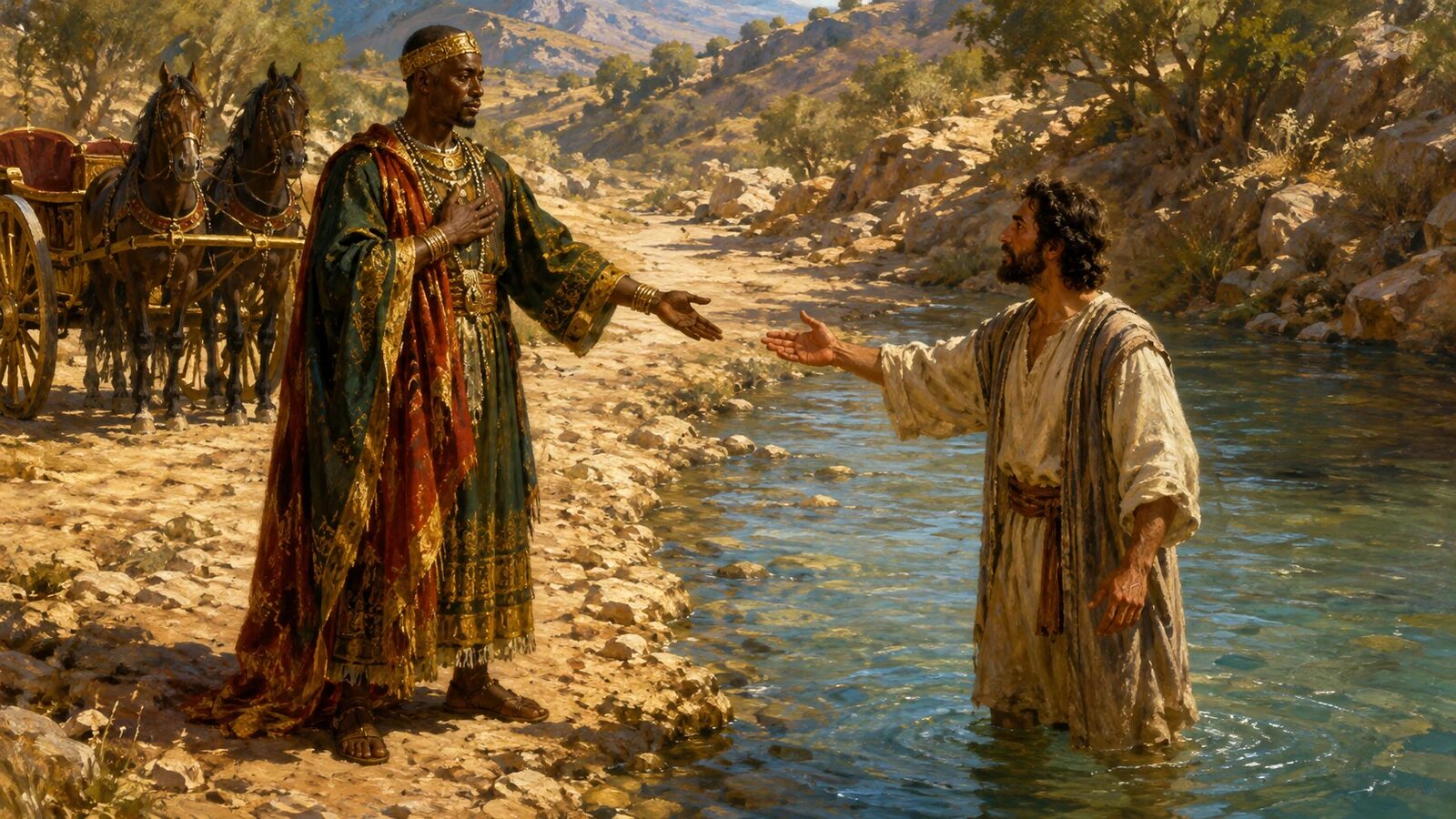
We see the same order when Philip met the Ethiopian official. On his journey home, the man was reading Isaiah 53 but could not understand whom the prophet meant. The Holy Spirit sent Philip, who began with that passage and preached Jesus to him. When they came to water, Philip directed him to faith in Christ rather than suggesting that the water could produce belief.
Now as they went down the road, they came to some water. And the eunuch said, “See, here is water. What hinders me from being baptized?” Then Philip said, “If you believe with all your heart, you may.” And he answered and said, “I believe that Jesus Christ is the Son of God.”
Acts 8:36-37, NKJV
The events in Cornelius’s household make the order especially clear. God brought this Gentile centurion together with Peter, who spoke to the household about Jesus’ ministry and death and testified to His bodily resurrection. As Peter explained forgiveness through faith in Christ’s name, the Holy Spirit came upon the hearers. They received the Spirit before Peter commanded them to be baptized in water.
“Can anyone forbid water, that these should not be baptized who have received the Holy Spirit just as we have?” And he commanded them to be baptized in the name of the Lord. Then they asked him to stay a few days.
Acts 10:47-48, NKJV
I notice that Peter appeals to what God had already done. These Gentiles had received the Holy Spirit, so there was no reason to withhold baptism from them. They did not need water to persuade God to accept them. Baptism was their public response to His saving work.
Water Baptism, Spirit Baptism, and Who Should Be Baptized
Water baptism and Spirit baptism are related, but Scripture distinguishes them. John baptized in water while directing people to the One who would baptize with the Holy Spirit. Jesus repeated that distinction before Pentecost.
for John truly baptized with water, but you shall be baptized with the Holy Spirit not many days from now.
Acts 1:5, NKJV
Water baptism is performed by people and touches the body. Spirit baptism is the work of God, joining a believer to Christ and placing him in Christ’s body. In 1 Corinthians 12:13, Paul says that all believers were baptized by one Spirit into one body. God does this when a person believes, independently of a pastor’s hands or where and how much water is used.
That distinction helps us understand expressions such as “baptized into Christ” without making physical water the cause of spiritual life. Baptism closely accompanied conversion in apostolic practice, but Acts 10 still places the reception of the Spirit before the water. In 1 Corinthians 1:17, Paul likewise distinguishes preaching the gospel from performing baptisms.
Colossians 2 describes a circumcision “made without hands,” which directs our attention to an inward work only God can perform. The passage connects baptism with burial and resurrection, but the power belongs to God and is received through faith. We should not confuse that work with an outward act performed by people.
In Him you were also circumcised with the circumcision made without hands, by putting off the body of the sins of the flesh, by the circumcision of Christ, buried with Him in baptism, in which you also were raised with Him through faith in the working of God, who raised Him from the dead.
Colossians 2:11-12, NKJV
Paul says “through faith in the working of God” because our trust is in the One who raises the dead. I am not being asked to place my faith in water. Baptism can express something powerful because it points to what God has done, but the sign itself does not supply that power.
This is why I understand the New Testament pattern as believer baptism. People hear the gospel and respond personally in repentance and faith, then confess Christ through baptism. Infant baptism does not follow that order. We should love and pray for infants while parents teach them Scripture and raise them under the Lord’s instruction. Baptism, however, is connected with the person’s own faith and discipleship.
The household baptisms in Acts do not give us a different order. Acts 16 describes the jailer and his household hearing the Word of the Lord, followed by his belief, baptism, and rejoicing with the household. The passage describes a household brought under the preaching of the Word. It never says that unconscious infants were baptized apart from faith, so I would not use the household to replace a personal response to Christ with a ceremony.
Christ can save someone who was sprinkled as a baby or has not had an opportunity to understand baptism correctly. Salvation depends on Him, not on the amount of water. Once we understand the New Testament pattern, though, we should follow it. Being saved by grace gives us confidence to obey rather than a reason to disregard His command.
Public Confession and the Beginning of Discipleship
Baptism brings a personal confession into public view. The believer acknowledges Jesus as Lord and identifies with Him instead of the life he has left behind. God calls His people into fellowship with one another, not into a hidden faith that leaves them attached to their former life.
Jesus Himself was baptized even though He had no sin to confess and needed no cleansing. John knew that Jesus was greater and initially resisted. Yet the Lord submitted to the Father’s appointed path as He publicly entered the work set before Him.
But Jesus answered and said to him, “Permit it to be so now, for thus it is fitting for us to fulfill all righteousness.” Then he allowed Him.
Matthew 3:15, NKJV
Jesus needed neither repentance nor cleansing, so His baptism was not identical to ours. Still, I notice His willingness to submit to the path the Father appointed. Baptism was not beneath the dignity of the sinless Son of God. As people He has redeemed, we should be willing to obey His command as well.
In the Great Commission, Jesus placed baptism near the beginning of discipleship. He told the church to make disciples, not simply count decisions. They were to be baptized and then taught to observe everything He commanded. The water does not save them, but it publicly marks the beginning of a life under His authority.
Go therefore and make disciples of all the nations, baptizing them in the name of the Father and of the Son and of the Holy Spirit, teaching them to observe all things that I have commanded you.
Matthew 28:19-20, NKJV
Baptism belongs in the life of the church, where the believer confesses Christ and the church recognizes that profession of faith. It should mean more than a family tradition or an occasion for a photograph. A pastor should take time to learn whether the person trusts Jesus and understands that He died for sins and rose bodily. The person should also understand that salvation comes by grace, not through the ceremony. Asking those questions cares for the believer and helps everyone understand what the baptism is confessing.
We should welcome sincere faith in a child while being patient about baptism. Pressuring a child into the water cannot provide assurance of salvation. There needs to be a credible profession of faith first, just as there does with an adult. The ceremony expresses conversion; it cannot bring conversion about.
In Galatians, Paul first says that we are sons of God through faith in Christ Jesus. He then describes those baptized into Christ as having put on Christ. I don’t want to reverse that order. Faith brings us into sonship, and baptism openly identifies us with the Savior to whom we belong.
For you are all sons of God through faith in Christ Jesus. For as many of you as were baptized into Christ have put on Christ.
Galatians 3:26-27, NKJV
We might compare baptism to a uniform that identifies whom a person represents. Wearing it cannot make someone a son, just as water cannot give inward life. The joy of baptism comes from belonging to Christ. The believer is confessing dependence on the crucified and risen Savior rather than celebrating personal greatness.
Difficult Texts and the Believer’s Response
I want to examine the verses used to argue that baptism saves. We need to read each one in context while allowing the Bible’s clear teaching about grace and faith to govern the conclusion.
Acts 2:38 says, “Repent, and let every one of you be baptized in the name of Jesus Christ for the remission of sins.” I take that command seriously, but I also need to read it alongside the chapter’s statement that those who received the Word were baptized. Repentance and faith receive the gospel, and baptism is the commanded public response. The word for does not by itself make water the cause of forgiveness. Someone wanted “for robbery” is not wanted so that he can commit a robbery. The surrounding context tells us how the action and its reason relate.
In 1 Peter 3:21, Peter says that baptism now saves us, but he immediately explains what he does and does not mean.
There is also an antitype which now saves us–baptism (not the removal of the filth of the flesh, but the answer of a good conscience toward God), through the resurrection of Jesus Christ,
1 Peter 3:21, NKJV
Peter explicitly excludes the physical washing of dirt from the body as the source of salvation. He directs us instead to a good conscience toward God through Jesus Christ’s resurrection. Baptism is the antitype, the appointed sign connected with faith’s appeal and the risen Lord. I understand the saving power to belong to Jesus, whom the sign confesses, rather than to the water.
Mark 16:16 says, “He who believes and is baptized will be saved; but he who does not believe will be condemned.” Notice what Jesus identifies as the reason for condemnation in the second half. It is unbelief, not the absence of water. Faith and baptism normally belong close together in Christian obedience, but a person remains condemned because he does not believe.
If you have not trusted Jesus Christ, you need Him before you need baptism. He died for the whole world, and His offer of salvation is genuinely extended to you even though it can be resisted. Come to Him in repentance and faith, believing that He shed His blood and died for your sins, was buried, and rose bodily. Neither attending church nor belonging to a Christian family can give you the new life you need. You must be born again.
If you have trusted Christ but have not been baptized as a believer, speak with your church leaders about taking that step. Ask the questions you need to ask and make a definite plan, rather than leaving obedience for some unknown future date. Baptism is your confession that you belong to Jesus, not a performance for the people watching.
If your baptism took place before you understood the gospel or while you were an infant, consider whether you have ever been baptized as a believer in conscious obedience to Christ. You don’t need to hide from that question or be overwhelmed by shame about the past. If you have not taken that step of obedience, you can follow Him in it now.
Our public obedience continues after baptism. Romans 6 points beyond the water to a whole life under Christ. Everyone truly born again is indwelt and sealed by the Holy Spirit and is eternally secure. That assurance should help us walk in the newness of life Christ gave us, never provide an excuse to become comfortable with sin again.
For related studies, see A Complete Bible Study on Being Born Again, A Complete Bible Study on Soteriology, and A Complete Bible Study on Communion.
My Final Thoughts
I believe water baptism is the public confession Christ commands of someone already saved through faith in Him. It does not cause the new birth, but that does not make it optional or empty. We openly identify with His death, burial, and resurrection as we begin a life of visible discipleship. If you belong to Christ and have not been baptized as a believer, you can obey without placing your trust in the water or being afraid of it. Your confidence belongs in the Savior who gave you life, and baptism is a way of responding to Him in faith.