
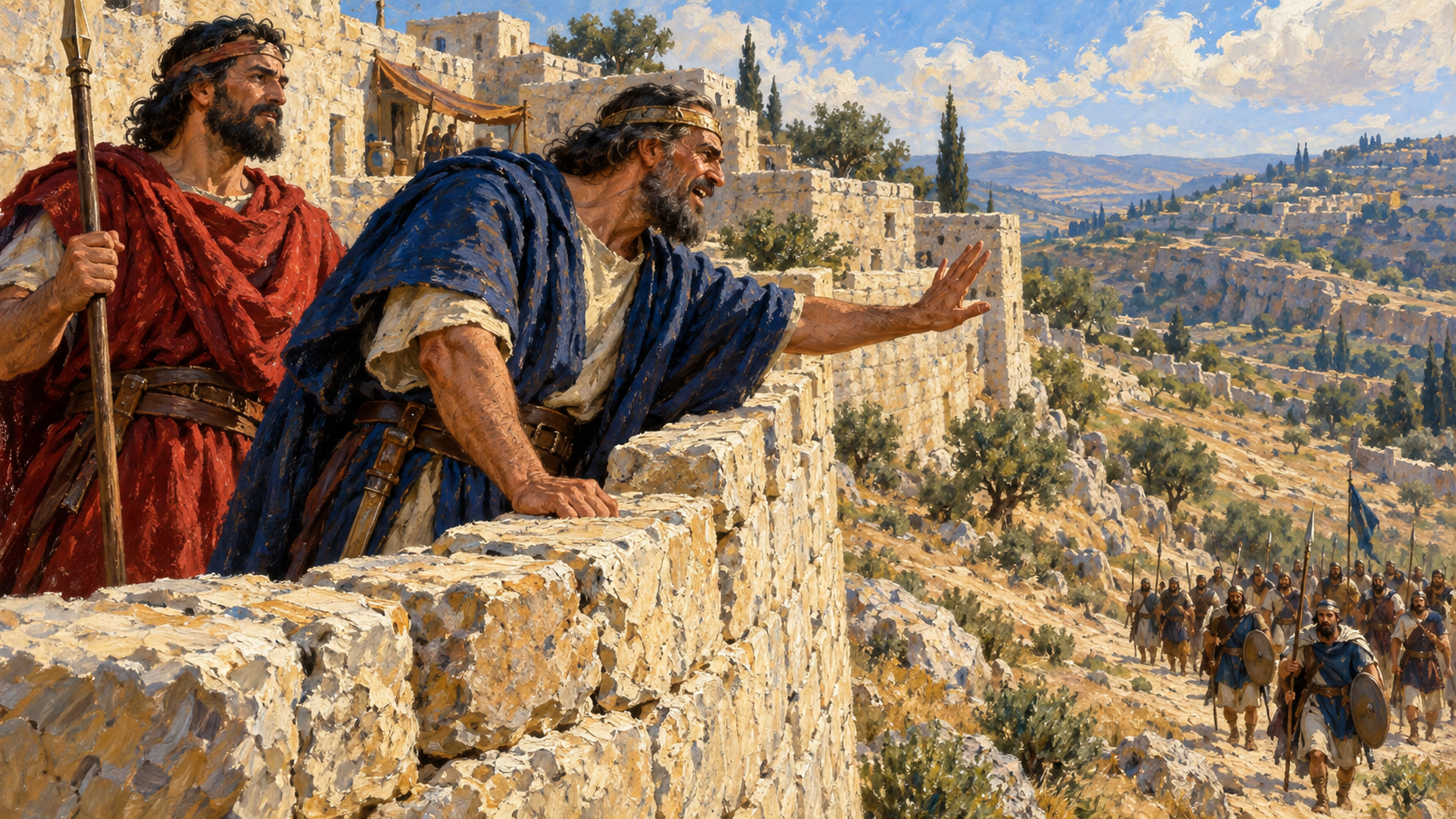
The Jebusites held Jerusalem’s stronghold long after Israel entered Canaan. David eventually captured it, and land owned by an individual Jebusite later became the temple site. I want to follow those events in their setting, because they bring together Israel’s unfinished obedience, God’s covenant promise, and mercy shown where we might have expected only continued hostility.
The Jebusites in Canaan and the Promised Land
Genesis places the Jebusites among the peoples descended from Canaan, the son of Ham. They belonged to the Canaanite world Israel encountered in the land, alongside the Amorites, Girgashites, Hivites, and other peoples:
Canaan begot Sidon his firstborn, and Heth; the Jebusite, the Amorite, and the Girgashite;
Noah’s curse in Genesis 9 was pronounced on Canaan. It does not establish a racial doctrine or give anyone permission to be cruel. Nor does it place every descendant of Canaan beyond God’s mercy. Rahab of Jericho received mercy through faith. A family record tells us a people’s ancestry; it does not establish the moral condition of every person born among them.
The Canaanite nations were judged for wickedness, including deeply rooted idolatry and corruption. Israel was not naturally superior to them. Deuteronomy 9 specifically warns the people against claiming that God gave them the land because they were righteous. He was judging wicked nations and keeping the promise He had made to their fathers.
That promise preceded Israel’s entrance into the land by generations. When God made His covenant with Abram, He named both the land and its inhabitants:
On the same day the LORD made a covenant with Abram, saying: “To your descendants I have given this land, from the river of Egypt to the great river, the River Euphrates–the Kenites, the Kenezzites, the Kadmonites, the Hittites, the Perizzites, the Rephaim, the Amorites, the Canaanites, the Girgashites, and the Jebusites.”
The Jebusites therefore belonged within the particular land promised to Abram’s descendants. Genesis 15 also says that the iniquity of the Amorites was not yet complete, explaining why possession would be delayed. God’s judgment was neither an impulsive reaction nor an ordinary tribal struggle for prestige. He had been patient with the people of the land before Israel’s conquest under Joshua.
Israel received its conquest commands within a theocratic covenant, a national arrangement in which God directly governed His people through His revealed law. The command concerning these cities was severe:
But of the cities of these peoples which the LORD your God gives you as an inheritance, you shall let nothing that breathes remain alive, but you shall utterly destroy them: the Hittite and the Amorite and the Canaanite and the Perizzite and the Hivite and the Jebusite, just as the LORD your God has commanded you, lest they teach you to do according to all their abominations which they have done for their gods, and you sin against the LORD your God.
God gave the reason: the nations would teach Israel to practice the abominations they committed in worship of their gods. Israel had no independent authority to decide who deserved conquest or to make its own pride righteous. These were commands to a particular nation, concerning a particular inheritance, under God’s judgment. The study on the land of Canaan considers that setting more fully.
Jebus Remained an Unresolved Stronghold
The Jebusites are particularly associated with Jerusalem, also called Jebus in Judges 19:10–11. The city stood in the hill country near the boundary between Judah and Benjamin. Joshua 15:8 describes Judah’s border passing along its southern side, while Joshua 18:28 lists Jerusalem in Benjamin’s inheritance.
Jerusalem’s king joined the coalition against Gibeon in Joshua 10 after Gibeon made peace with Israel. Joshua defeated that coalition, but defeating its kings did not give Israel permanent control of every city they had ruled. The tribal accounts still describe Jebusites living in Jerusalem:
As for the Jebusites, the inhabitants of Jerusalem, the children of Judah could not drive them out; but the Jebusites dwell with the children of Judah at Jerusalem to this day.
But the children of Benjamin did not drive out the Jebusites who inhabited Jerusalem; so the Jebusites dwell with the children of Benjamin in Jerusalem to this day.
Judges 1:8 also records that Judah attacked Jerusalem, captured it, struck it with the sword, and burned it. I understand that victory as a successful assault that did not produce lasting possession of the whole Jebusite position. Judah may have taken and burned the city without permanently removing the fortified stronghold or establishing control throughout it. The text records the victory and the continuing Jebusite presence without describing every stage between them.
We should therefore distinguish a battle won from an inheritance fully occupied. Joshua’s campaigns broke the power of many kings, but the tribes still had a responsibility to take possession of the land God had given them. Judah’s attack on Jerusalem did not remove Benjamin’s responsibility to drive out its Jebusite inhabitants.
The military difficulties were real. Fortified positions on difficult ground could be hard to take, and elsewhere Judges describes iron chariots among the obstacles Israel faced. Yet the book also shows tribes accepting arrangements with remaining Canaanite peoples instead of completing their task. Their religious influence continued, and Israel fell repeatedly into idolatry, oppression, and cries for deliverance. God raised deliverers, but the nation’s incomplete obedience kept bringing trouble upon it.
I cannot explain the unresolved Jebusite stronghold solely by its defenses. Israel had an unfulfilled covenant responsibility there, and its failure was not proof that God had broken His promise. Jerusalem remained under Jebusite control until the reign of David.
David Took Zion and Made It His City
After David became king over all Israel, he and his men went against Jerusalem. The Jebusites trusted their defenses enough to taunt him that even the blind and lame would repel him. Their confidence did not prevent his victory:
Nevertheless David took the stronghold of Zion (that is, the City of David).
The NKJV mentions a water shaft in David’s command in 2 Samuel 5:8, but Samuel does not describe the entire route or each stage of the assault. What follows is clear: David settled in the stronghold, called it the City of David, and built around it. The Jebusites no longer held the position from which they had mocked him.
Jerusalem’s location near Judah and Benjamin suited its use as the capital of a united kingdom. It had not developed as an established center belonging to either the northern or southern tribal leadership. As David’s royal city, it could serve Israel as a whole. Samuel also says that the LORD God of hosts was with David as he grew great. His courage and strategy had their place, but the passage gives God the credit for the strength of his rule. The study on the life of King David follows that reign.
The city’s importance extended beyond government. David later brought the ark there, and Solomon built the temple. The prophets would speak of Zion in connection with the Lord’s reign and future hope. None of this made David sinless or guaranteed Jerusalem’s obedience. He later sinned grievously, and the city eventually came under judgment, even though its capture was a real advance in God’s covenant purpose.
Araunah’s Threshing Floor Became the Temple Site
Before Solomon’s reign, Araunah, also called Ornan, owned the land that became the temple site. After David’s sinful census brought a plague upon Israel, Gad instructed David to build an altar on Araunah’s threshing floor. Araunah offered the property and oxen freely, but David insisted on paying rather than offering the Lord something that cost him nothing.
God restrained judgment, commanded the altar, and received David’s worship. Araunah did not save Israel, and the land possessed no power of its own. Yet this man recognized the king and generously offered what he had. His conduct prevents me from treating every Jebusite as though his ancestry were all we needed to know about him. The study on the threshing floor of Araunah examines the command, purchase, and sacrifice.
Chronicles then identifies the same place as the location of Solomon’s temple:
Now Solomon began to build the house of the LORD at Jerusalem on Mount Moriah, where the LORD had appeared to his father David, at the place that David had prepared on the threshing floor of Ornan the Jebusite.
A Jebusite man’s property became a place where God received sacrifice, and then the site of the temple itself. Araunah’s generosity belonged to that history of mercy, even though his people had long resisted Israel.
By Solomon’s reign, the remaining Jebusites no longer ruled Jerusalem as an independent power. Kings describes their changed position among the surviving Canaanite peoples:
All the people who were left of the Amorites, Hittites, Perizzites, Hivites, and Jebusites, who were not of the children of Israel–that is, their descendants who were left in the land after them, whom the children of Israel had not been able to destroy completely–from these Solomon raised forced labor, as it is to this day.
Their loss of political control should not be confused with the disappearance of every later reference to them. Ezra 9:1 names the Jebusites again in a warning about the surrounding peoples and their abominations. Ezra and Nehemiah do not describe them as a nation still ruling Jerusalem. Their name remained in Israel’s memory and warnings, while the city they had once defended had become David’s capital and the place of the temple.
How Christians Should Read the Jebusite Account
Israel’s conquest must be read within the covenant in which God commanded it. Christians have received no command to repeat the conquest of Canaan, and the church’s mission is to proclaim Christ to all nations. We have no authority to despise an ethnicity, identify a modern people as the Jebusites, or turn the gospel into a military campaign for territory.
We can learn from entrenched resistance without making the Jebusites into a code for our opponents. In 2 Corinthians 10:3–5, Paul uses the language of pulling down strongholds while explaining the overthrow of arguments and proud claims against the knowledge of God. He calls for thoughts to be brought into obedience to Christ. He is not directing Christians to attack a city or a group of people.
If false teaching has shaped my thinking, I need to answer it with Scripture and turn from it. If I have become comfortable with a sin, I need to confess and forsake it instead of making excuses for keeping it. Prayer and dependence on God belong with that obedience. Dramatic claims or religious theatrics cannot substitute for receiving His truth and doing what He says.
The long persistence of the Jebusites also warns me against treating delay as proof that God has failed. His promise did not become false because Israel stopped short in obedience. Waiting should not make us cynical or give us an excuse to accommodate what God has told us to reject. His faithfulness gives us reason to continue obeying patiently.
Araunah’s part in the temple site brings mercy into this history without denying judgment. God directed David to worship where He had restrained destruction. I want to read the conquest with humility before His holiness and with gratitude that mercy is not limited by a person’s ancestry.
Our own sin can be forgiven only through Jesus Christ, the eternal Son, fully God and fully man, virgin-born and completely sinless. On the cross He physically bore the punishment for our sins in His innocent body. Wicked men inflicted the real torture and crucifixion He willingly endured. He shed His blood and completed His saving work through His death, was buried, and rose bodily from the dead.
The Father did not punish, curse, abandon, strike, bruise, or pour wrath on Jesus. Christ died for the sins of the whole world, and God’s offer of salvation is genuine for every person, though people may resist His grace and reject Him. Everyone who repents and believes is forgiven and born again, indwelt and sealed by the Holy Spirit, and eternally secure. The study on the gospel explains that saving work more fully.
No one earns salvation by conquering territory, overcoming a personal stronghold, or making a costly gift. Obedience follows mercy received through faith; it does not purchase that mercy. Nor does assurance give us permission to carry on in lawlessness. The grace of Christ gives His people reason to turn from sin and follow Him.
My Final Thoughts
The Jebusites held Jerusalem until David took Zion, but their place in the biblical account includes more than a defeated stronghold. Araunah’s land became a place of mercy and worship, then the temple site. I want Israel’s unfinished obedience to warn me against tolerating my own sin, while God’s faithfulness keeps me from despairing over delay. We can read these events honestly and humbly, looking to the mercy found fully in Jesus Christ, the only Savior.