
What exactly makes a rule legalistic? The answer cannot be simply that the rule is strict, because Jesus really does command His people to obey Him. To sort this out, I want to ask whether God actually commanded the rule and whether anyone is using it to earn or protect a standing only Christ can give.
What Legalism Is—and Is Not
Although legalism does not appear in the NKJV, Scripture repeatedly confronts the errors Christians describe with that word. Someone may rely on law-keeping or religious performance to be made righteous before God. A teacher may add a ritual to the gospel, or a church may give its own customs the authority of God’s Word. Even a believer’s private conviction can become a measure of everyone else’s holiness when Scripture never made it universal.
In each case, human action is given merit or authority God never gave it. I distinguish four forms because they help us identify the problem instead of accusing everyone who takes holiness seriously. Salvation legalism makes performance part of the price of being declared righteous before God, which is justification. When continued salvation is made to depend on keeping a human or Mosaic rule, that is Security legalism. The problem with Authority legalism is that a custom is taught as though God commanded it. Superiority legalism uses a chosen discipline to rank believers. These forms can overlap, but each helps us see what is being claimed for the rule.
Obeying God’s actual commands is not legalism. Jesus is Lord, and He commands people to repent and believe. Following Him means learning to love others and speak truthfully. His authority also reaches our sexual conduct and calls us to forgive, pray, and give generously. He commands care for vulnerable people and gives instructions for church discipline. Under His authority, the apostles also gave binding teaching to churches. I cannot dismiss a command as legalistic simply because obeying it costs me something or I would rather avoid it.
Christian liberty frees believers from condemnation and dependence on human merit. It also releases them from the Mosaic covenant that governed Israel, with its priesthood and sacrifices, national penalties, food distinctions, and calendar. But freedom from that covenant does not release us from Christ’s authority. In 1 Corinthians 9, Paul says he is not under the Law in that covenant sense while also saying he is under law toward Christ. I need to keep that distinction clear. We are comparing Sinai’s covenant administration with the risen Lord’s authority under the new covenant, rather than choosing between having rules and having none. Grace gives us a secure place as God’s children and empowers us to obey through the Spirit.
People outside the church can try to justify themselves in similar ways, even without using the word legalism. A religious system may promise acceptance through ceremonies or penance, making dietary rules or sacred journeys a way to earn standing. Loyalty to an institution can become another measure of worth. A secular person may make a comparable defense by appealing to respectability, activism, or family reputation. Someone else may offer productivity as proof of being acceptable. Those are not identical to every theological use of legalism, but the defense is familiar: I have done enough, or I compare well enough with someone else, to declare myself acceptable.
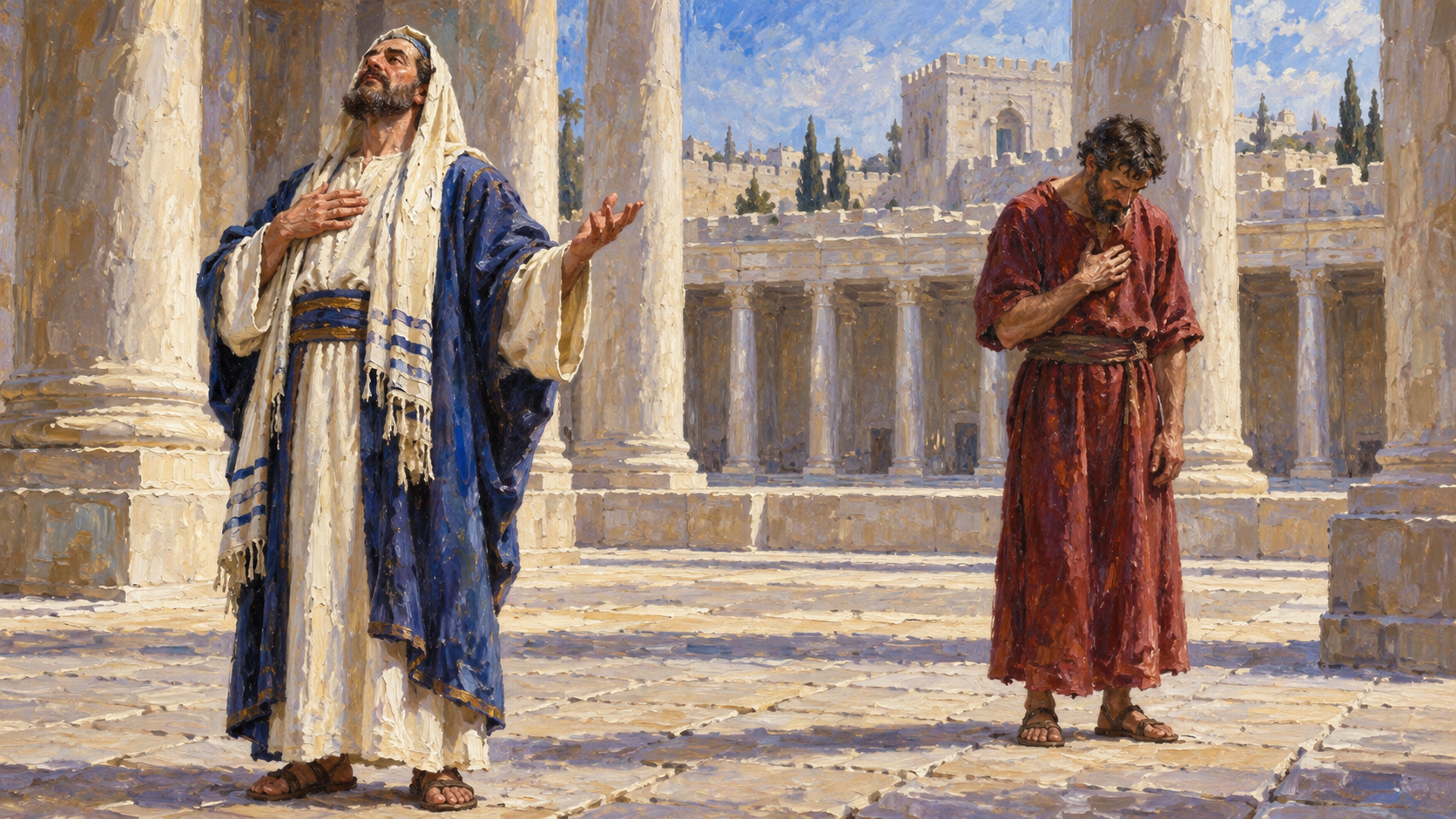
Jesus addressed that posture in the parable of the Pharisee and the tax collector. The Pharisee used prayer to recite his moral record and distance himself from other sinners. The tax collector would not lift his eyes and pleaded for mercy.
Also He spoke this parable to some who trusted in themselves that they were righteous, and despised others: “Two men went up to the temple to pray, one a Pharisee and the other a tax collector. The Pharisee stood and prayed thus with himself, ‘God, I thank You that I am not like other men–extortioners, unjust, adulterers, or even as this tax collector. I fast twice a week; I give tithes of all that I possess.’ And the tax collector, standing afar off, would not so much as raise his eyes to heaven, but beat his breast, saying, ‘God, be merciful to me a sinner!’ I tell you, this man went down to his house justified rather than the other; for everyone who exalts himself will be humbled, and he who humbles himself will be exalted.”
Fasting and giving were not the problem in themselves. The Pharisee trusted his own righteousness and used those acts to defend it, comparing himself with another man’s visible sin to support his pride. I notice that Jesus identified the humbled tax collector as the one who went home justified. The man pleading for mercy received what the other man’s religious record could not establish.
The same shift away from confidence in Christ can happen inside a church while using Christian words. Baptism or denominational membership may start serving as proof of salvation. People can use a Bible translation preference or a chosen abstinence in the same way. A group may make its dress code the test, or point to tithing and homeschooling as evidence of superior standing. Political loyalty and favored ministry methods can become false measures too. Some of those questions involve real biblical principles, but none of them can take the place of the crucified and risen Savior.
Human effort cannot justify a sinner, whether the defense sounds religious or secular. The Law truthfully reveals God’s holiness and our sin. By identifying our guilt, it stops our excuses; it also warns of judgment and teaches righteousness. But the Law cannot turn a guilty past into innocence or give spiritual life to a dead sinner.
Now we know that whatever the law says, it says to those who are under the law, that every mouth may be stopped, and all the world may become guilty before God. Therefore by the deeds of the law no flesh will be justified in His sight, for by the law is the knowledge of sin. But now the righteousness of God apart from the law is revealed, being witnessed by the Law and the Prophets, even the righteousness of God, through faith in Jesus Christ, to all and on all who believe. For there is no difference; for all have sinned and fall short of the glory of God, being justified freely by His grace through the redemption that is in Christ Jesus, whom God set forth as a propitiation by His blood, through faith, to demonstrate His righteousness, because in His forbearance God had passed over the sins that were previously committed, to demonstrate at the present time His righteousness, that He might be just and the justifier of the one who has faith in Jesus. Where is boasting then? It is excluded. By what law? Of works? No, but by the law of faith. Therefore we conclude that a man is justified by faith apart from the deeds of the law.
By this point in Romans 1-3, Paul has brought both Gentile rebellion and Jewish possession of the Law under judgment. He does not blame a defective Law or leave either group any grounds for boasting. All have sinned, so every mouth is stopped. When God justifies a believer, He declares that person righteous in Christ and gives that standing freely by grace. I receive it by faith because my works cannot earn it.
Ephesians makes the same order plain: salvation is God’s gift, not a product we can claim as our achievement. The next verse then places good works in their proper position as the fruit God prepared for His people.
For by grace you have been saved through faith, and that not of yourselves; it is the gift of God, not of works, lest anyone should boast. For we are His workmanship, created in Christ Jesus for good works, which God prepared beforehand that we should walk in them.
God saves people by grace and creates them in Christ to live differently. Good works grow from that salvation; they do not produce it. That is how I understand Paul and James together. James rejects a claim of faith that never gives living evidence, while Paul rejects works as the price or ground of justification. They are addressing different errors, so I do not have to set one against the other.
Repentance does not pay God for forgiveness. Together, repentance and faith describe a sinner turning from rebellion and trusting Jesus Christ without earning any merit. We come empty-handed, stop defending our sin, and receive the only Savior.
When Human Requirements Are Added to the Gospel
The early church confronted this problem when certain men told Gentile believers they could not be saved without circumcision according to the custom of Moses. Circumcision had been a real command and a sign of the Abrahamic covenant. That detail helps me see the error precisely: these men were taking an actual covenant requirement and making it necessary for Gentile salvation after Christ had come. They were not simply inventing a meaningless ritual.
And certain men came down from Judea and taught the brethren, “Unless you are circumcised according to the custom of Moses, you cannot be saved.” Therefore, when Paul and Barnabas had no small dissension and dispute with them, they determined that Paul and Barnabas and certain others of them should go up to Jerusalem, to the apostles and elders, about this question. So, being sent on their way by the church, they passed through Phoenicia and Samaria, describing the conversion of the Gentiles; and they caused great joy to all the brethren. And when they had come to Jerusalem, they were received by the church and the apostles and the elders; and they reported all things that God had done with them. But some of the sect of the Pharisees who believed rose up, saying, “It is necessary to circumcise them, and to command them to keep the law of Moses.” Now the apostles and elders came together to consider this matter. And when there had been much dispute, Peter rose up and said to them: “Men and brethren, you know that a good while ago God chose among us, that by my mouth the Gentiles should hear the word of the gospel and believe. So God, who knows the heart, acknowledged them by giving them the Holy Spirit, just as He did to us, and made no distinction between us and them, purifying their hearts by faith. Now therefore, why do you test God by putting a yoke on the neck of the disciples which neither our fathers nor we were able to bear? But we believe that through the grace of the Lord Jesus Christ we shall be saved in the same manner as they.”
Peter pointed to what God had already done among the Gentiles. He had given them the Holy Spirit through faith and purified their hearts by faith. Requiring them to take on the Mosaic yoke would test God and obscure the fact that Jews and Gentiles are saved in the same way, through the grace of the Lord Jesus.
The council still required Gentile believers to abstain from four things: things polluted by idols, sexual immorality, things strangled, and blood. The command about blood goes back beyond Sinai to Genesis 9. I cannot dismiss it as temporary social advice when its basis reaches that far back. These instructions protected holiness and the God-given meaning of blood, as well as fellowship between Jewish and Gentile believers. Rejecting circumcision as a condition of salvation did not make every behavior permissible. Grace settled how they were accepted, while the Lord still required holy fellowship.
Paul later refused to have Titus circumcised because false brothers wanted to make it a gospel requirement. He allowed Timothy to be circumcised for mission among Jews, however, because Timothy had a Jewish mother and the act was not being used to justify him. The same outward action can have different doctrinal meanings. I can voluntarily adapt for love without allowing that choice to become a condition of salvation. Liberty cannot surrender the truth of the gospel.
In Galatians 2, that truth also governed whom believers ate with. Peter had shared meals with Gentile believers, but fear of the circumcision party made him withdraw when men associated with James arrived. His separation pressured other Jews, including Barnabas, to follow his hypocrisy. Paul confronted him publicly because his conduct was not straightforward about the gospel. Justification by faith cannot remain only something I affirm in a discussion. It also forbids me from treating a justified Gentile brother as spiritually second-class.
1 John says that believers love God because He first loved them. Jesus says, “If you love Me, keep My commandments.” This order protects both grace and obedience. Christians do not obey to make a reluctant Savior begin loving them. They obey the Lord who already loved and saved them and gave them life.
Being loved and saved does not make obedience effortless or automatic. Believers must still confront the flesh and renew their minds. As we learn endurance, we need to confess sin and receive correction. Gratitude becomes concrete when I forgive someone and speak truthfully. It also calls me to reject lust and serve a difficult person, even when nobody is watching.
A legalistic system often focuses on things the group can inspect while overlooking inward faithfulness. Someone may wear the approved clothing, use the expected vocabulary, and attend every required gathering. He can follow all the customs while nurturing pride or cruelty, with greed and secret lust still hidden. He may even despise other people. Jesus’ teaching does not reduce holiness to appearances; God’s moral demand reaches the heart.
I do not believe we have to choose between anxious rule-keeping and careless self-expression. I believe the gospel produces obedience grounded in our secure place as God’s children. We neither purchase that place through obedience nor use it as permission to rebel.
In Mark 7, the Pharisees and scribes criticized Jesus’ disciples for eating without the traditional handwashing ceremony. They were concerned with a ritual connected to ceremonial purity, not ordinary hygiene. Jesus quoted Isaiah in reply and showed how their tradition had displaced God’s command.
He answered and said to them, “Well did Isaiah prophesy of you hypocrites, as it is written: ‘This people honors Me with their lips, But their heart is far from Me. And in vain they worship Me, Teaching as doctrines the commandments of men.’ For laying aside the commandment of God, you hold the tradition of men–the washing of pitchers and cups, and many other such things you do.” He said to them, “All too well you reject the commandment of God, that you may keep your tradition. For Moses said, ‘Honor your father and your mother’; and, ‘He who curses father or mother, let him be put to death.’ But you say, ‘If a man says to his father or mother, “Whatever profit you might have received from me is Corban”–‘ (that is, a gift to God), then you no longer let him do anything for his father or his mother, making the word of God of no effect through your tradition which you have handed down. And many such things you do.”
Corban designated a gift devoted to God. The leaders allowed people to use that designation to withhold resources a person should have used to honor and support his parents. I find the result sobering: a rule that appeared especially devout gave people a way to disobey God. Jesus exposed more than excessive strictness around a command. Their system let them evade the command itself while claiming unusual devotion.
That does not make every tradition sinful. Families and churches need ordinary patterns, and Paul commends apostolic tradition given with divine authority. I need to ask where a practice comes from and what authority is being claimed for it. Scripture may command it, or it may be a wise local policy. Some practices may simply be cultural customs or personal preferences. Trouble begins when a human practice is presented as God’s universal law.
Healthy leaders can explain the difference: “Scripture requires modesty” is a divine standard. “For this ministry assignment, we have chosen this dress policy” is a human application within a limited stewardship. The second may be wise, but it should not be preached as though a verse supplied its exact measurements.
Conscience, Liberty, and Stumbling
Jewish and Gentile believers came together in Rome’s congregations with different histories, so their consciences did not immediately agree. They differed over food and the esteem of days. Some ate broadly, while another ate vegetables, possibly to avoid meat whose source was unknown. One esteemed a particular day and another every day alike. Paul did not resolve those differences by requiring everyone to adopt the same private practice.
Receive one who is weak in the faith, but not to disputes over doubtful things. For one believes he may eat all things, but he who is weak eats only vegetables. Let not him who eats despise him who does not eat, and let not him who does not eat judge him who eats; for God has received him. Who are you to judge another’s servant? To his own master he stands or falls. Indeed, he will be made to stand, for God is able to make him stand. One person esteems one day above another; another esteems every day alike. Let each be fully convinced in his own mind. He who observes the day, observes it to the Lord; and he who does not observe the day, to the Lord he does not observe it. He who eats, eats to the Lord, for he gives God thanks; and he who does not eat, to the Lord he does not eat, and gives God thanks. For none of us lives to himself, and no one dies to himself. For if we live, we live to the Lord; and if we die, we die to the Lord. Therefore, whether we live or die, we are the Lord’s. For to this end Christ died and rose and lived again, that He might be Lord of both the dead and the living. But why do you judge your brother? Or why do you show contempt for your brother? For we shall all stand before the judgment seat of Christ. For it is written: “As I live, says the LORD, Every knee shall bow to Me, And every tongue shall confess to God.” So then each of us shall give account of himself to God. Therefore let us not judge one another anymore, but rather resolve this, not to put a stumbling block or a cause to fall in our brother’s way.
Paul calls the hesitant believer weak in faith, yet he neither mocks nor excludes him. The person who eats must not despise the one who abstains, and the person who abstains must not condemn the one who eats. Both belong to the Lord and thank Him. Both will answer before His judgment seat.
Romans 14 concerns practices through which believers on different sides can genuinely honor the Lord. It cannot turn explicit sin into a neutral matter of conviction. Adultery and idolatry cannot be placed in that category, nor can dishonesty, abuse, or false doctrine. We need to establish that a practice is permitted before treating it as a matter of liberty.
If I believe an act would disobey God, I should not train myself to ignore that warning, because acting without faith is sin. But my conscience is not infallible. It can be weak or defiled. Bad teaching can misinform it, and persistent sin may sear it, so Scripture must train it. Maturity means taking conscience seriously without making my present understanding a permanent law for everyone else.
for the kingdom of God is not eating and drinking, but righteousness and peace and joy in the Holy Spirit. For he who serves Christ in these things is acceptable to God and approved by men. Therefore let us pursue the things which make for peace and the things by which one may edify another. Do not destroy the work of God for the sake of food. All things indeed are pure, but it is evil for the man who eats with offense. It is good neither to eat meat nor drink wine nor do anything by which your brother stumbles or is offended or is made weak. Do you have faith? Have it to yourself before God. Happy is he who does not condemn himself in what he approves. But he who doubts is condemned if he eats, because he does not eat from faith; for whatever is not from faith is sin.
1 Corinthians 8 addresses food associated with idols. Knowledgeable believers understood that an idol is nothing and that food does not commend anyone to God. Some believers, however, still carried a conscience shaped by former idol worship.
However, there is not in everyone that knowledge; for some, with consciousness of the idol, until now eat it as a thing offered to an idol; and their conscience, being weak, is defiled. But food does not commend us to God; for neither if we eat are we the better, nor if we do not eat are we the worse. But beware lest somehow this liberty of yours become a stumbling block to those who are weak. For if anyone sees you who have knowledge eating in an idol’s temple, will not the conscience of him who is weak be emboldened to eat those things offered to idols? And because of your knowledge shall the weak brother perish, for whom Christ died? But when you thus sin against the brethren, and wound their weak conscience, you sin against Christ. Therefore, if food makes my brother stumble, I will never again eat meat, lest I make my brother stumble.
The stumbling Paul describes is more than annoyance. A weak believer sees someone with knowledge eating in an idol’s temple and feels encouraged to join in, even though he still connects that act with worshiping the idol. He violates his conscience and sins. That is the spiritual harm the knowledgeable believer’s use of liberty has helped bring about.
In chapter 10 of the same letter, Paul distinguishes sharing an idol’s table from buying meat at the market. Christians cannot participate at both the Lord’s table and the table of demons, so the idol’s table is forbidden. Market meat, however, can be eaten without investigating its history. If someone identifies it as offered to an idol, love may lead a believer to abstain for that person’s conscience.
Love does not give the most demanding person permanent control of a church, and maturity does not flaunt liberty to prove independence. Before acting, I should consider whether I will glorify God and build others up. Could the choice entangle someone in idolatry or pressure a weak believer to sin? I also need to consider what it communicates through the church’s gospel witness.
Applying Scripture Without Inventing Law
Clothing gives us a practical example of the difference between God’s command and our application. Some churches require every woman to wear a dress or skirt and treat pants as evidence of rebellion. Scripture does require modesty and propriety, along with self-control and conduct fitting godliness. We must also preserve the distinction God gave between male and female. Those standards are binding, even as we consider how to apply them.
The Bible does not prescribe one modern garment pattern for every woman in every culture and occupation. In biblical times both men and women wore forms of tunics and outer garments, with distinctions in their dress. Importing a recent Western wardrobe into Scripture and declaring it the universal test of holiness goes beyond the text.
Freedom does not excuse deliberately sexual display or gender confusion, nor does it justify vanity or contempt for appropriate settings. Our clothing should be modest and recognizably fitting our sex, while suiting the task and showing consideration for others. Parents and ministry leaders may set policies suited to a person’s age or ministry role. They should explain those policies honestly as applications, rather than claim God wrote a verse He never gave.
A woman may choose dresses out of personal conviction or practical need, or because of beauty and custom. She should be free to do so without being mocked for her restraint. She should also refrain from condemning a modest sister whose faithful application is different.
Psalm 96 genuinely invites fresh praise when it calls for a new song. But I would not use that phrase to settle every question about musical style or whether a performance serves congregational worship. A new song can be corrupt, and an old one can be repeated without life. Age alone does not answer the question.
I would begin with what a song actually says. Are its lyrics true and clear, and do they show reverence toward the God Scripture reveals? The music should serve those words rather than work against them. In gathered worship, the song should help the church teach and admonish one another and be suitable for congregational singing. Its presentation should draw attention toward God rather than sensuality or celebrity performance. Some music may fit private enjoyment better, while other songs may be unwise in either setting.
No biblical verse declares a particular beat or instrument inherently holy or sinful. Scripture does not sanctify a musical century or condemn a non-biblical genre by name. We should still consider associations and conscience, because a former setting may make a particular sound unwise for one believer. A church may choose a narrower musical policy to maintain coherent worship. That choice should be defended as pastoral judgment unless Scripture truly makes the rule universal.
Legalism can stop at asking whether a song belongs to the approved camp. Discernment requires more: we consider the words and how the music serves them, then weigh the song’s setting and effect. Its associations and fruit remain subject to Scripture’s authority.
Colossians addresses the same issue beyond clothing and music. Believers are not to be judged over food or drink, or over festivals, new moons, and Sabbaths. Those things were shadows; Christ is the substance. Paul also rejects regulations such as “do not touch” and “do not taste.” His warning includes “do not handle” when those rules function as human commands and self-imposed religion.
So let no one judge you in food or in drink, or regarding a festival or a new moon or sabbaths, which are a shadow of things to come, but the substance is of Christ. Let no one cheat you of your reward, taking delight in false humility and worship of angels, intruding into those things which he has not seen, vainly puffed up by his fleshly mind, and not holding fast to the Head, from whom all the body, nourished and knit together by joints and ligaments, grows with the increase that is from God. Therefore, if you died with Christ from the basic principles of the world, why, as though living in the world, do you subject yourselves to regulations– “Do not touch, do not taste, do not handle,” which all concern things which perish with the using–according to the commandments and doctrines of men? These things indeed have an appearance of wisdom in self-imposed religion, false humility, and neglect of the body, but are of no value against the indulgence of the flesh.
Harsh self-denial can look wise because its severity seems so serious. Yet Paul says those rules have no value against indulging the flesh. I can boast about what I avoid while envy or lust still rules my heart. Deprivation may even feed pride, leaving self-exaltation hidden beneath an outwardly disciplined life.
Paul’s warning does not condemn fasting or a disciplined schedule. He practiced self-control himself, and voluntary abstinence can be wise. A believer may avoid alcohol because of personal weakness or past history, or because wisdom and love lead to that choice. The error is treating a chosen discipline as meritorious or necessary for everyone’s holiness. No discipline can take the place of the Spirit’s transforming work.
1 Timothy 4 warns about teachers who forbid marriage and require abstinence from foods God created to be received with thanksgiving. God’s gifts must be governed by His Word, but they must not be called unclean merely because renunciation appears more spiritual.
Legalism can flourish under abusive leadership, but the answer is not leaderless Christianity. Christ gives qualified men responsibility to teach and shepherd local churches. They must guard sound doctrine and maintain biblical order. Believers are called to receive faithful leadership.
That authority is given for service under Christ, not for absolute control. A pastor does not own consciences. He must teach what Scripture says and explain where pastoral judgment begins. He also remains accountable to the qualifications and discipline of God’s Word. “Obey me because I am the pastor” cannot transform a preference into revelation.
Church policies can serve necessary responsibilities without becoming eternal law. Membership and children’s work need order, financial practices need clarity, and safety deserves serious attention. A congregation must also decide how to use its facilities and who may teach or represent it publicly. Leaders should explain why each policy exists and apply it without favoritism. Appropriate questions should be welcome, and a policy should be revised when wisdom or changing circumstances require it.
I should not call every inconvenient church decision legalism. Order requires boundaries. I need to ask whether a policy contradicts Scripture, claims authority God never gave it, or has become a test of salvation or superior holiness. A policy must never protect wrongdoing or be enforced through manipulation and fear.
Grace That Saves and Trains
Some people react to legalism by distrusting every call to holiness, but I find no support for that reaction in Paul. The same grace that brings salvation also trains believers to deny ungodliness and live for God.
For the grace of God that brings salvation has appeared to all men, teaching us that, denying ungodliness and worldly lusts, we should live soberly, righteously, and godly in the present age, looking for the blessed hope and glorious appearing of our great God and Savior Jesus Christ, who gave Himself for us, that He might redeem us from every lawless deed and purify for Himself His own special people, zealous for good works.
Jesus gave Himself to redeem people from lawless deeds and purify them to be zealous for good works. That is why grace cannot mean divine indifference to how we live. Works do not keep a born-again believer saved, but salvation changes our allegiance. It reshapes what we desire and gives our lives a new direction.
A truly born-again believer is a new creation, indwelt and sealed by the Holy Spirit and eternally secure. That does not make lawlessness permissible or prove every superficial profession genuine. As God’s secure child, I can receive the Father’s discipline and confess sin without trying to buy a place in His family. If I have caused harm, I can repair it and continue to grow.
Jesus Christ is the eternal Son, fully God and fully man. Born of a virgin, He remained sinless. Wicked men physically tortured and punished Him until they killed Him, and He willingly bore that real punishment for our sins in His innocent body. He shed His blood before dying and then rose bodily. The Father did not punish or curse Him, abandon His Son, or pour wrath upon Him.
Christ died for the whole world and genuinely offers salvation, even though people may resist and reject Him. Everyone who repents and believes is forgiven, justified, and born again. The Holy Spirit seals that believer, and Christ keeps him eternally secure. I cannot improve His saving work by adding a human rule, any more than I can remove His lordship by claiming liberty.
Someone coming out of a legalistic system may understand those truths before feeling free in conscience. Decisions about clothing or food may still trigger fear, as may a holiday, a song, or even a visit to another church. I would not answer that fear by demanding a quick demonstration of liberty. Romans 14 teaches that acting against conscience is sin, so freedom cannot be taught by pressuring someone to violate it.
I would begin by separating what Scripture commands and forbids from what wisdom recommends. Writing those distinctions down can help. Then identify which requirements your church has set for a limited purpose and which practices you have personally chosen. A mature teacher can help you examine the context of passages that were used to control you.
We also need to confess the sins legalism can conceal. Pride often grows alongside contempt for people who does not follow the group’s rules. Watching everyone else may encourage gossip, while fear of people can become stronger than the desire to please God. False accusations and trust in personal performance need to be brought into the light too. Yet we should reject guilt for acts God never condemned. Some people need to forgive leaders while continuing to tell the truth and keep necessary boundaries. Forgiveness does not prevent reporting abuse or leaving a church that refuses correction.
Use liberty gradually and for good, without feeling you must do everything Scripture permits. You can abstain without boasting or participate without fear where God gives freedom. The aim is a conscience increasingly governed by His Word and a heart at rest in Christ, so that love can shape how you act.
My Final Thoughts
I cannot define legalism as serious obedience when Scripture calls us to obey Christ. The problem begins when we trust human effort for a standing only He can give, or grant a human rule authority God never gave it. Grace removes our grounds for boasting without leaving us lawless. We rest securely in Christ and learn to obey Him through the Spirit. Where Scripture gives liberty, I want God’s Word to keep training my conscience so I use that freedom to seek another believer’s genuine good.