
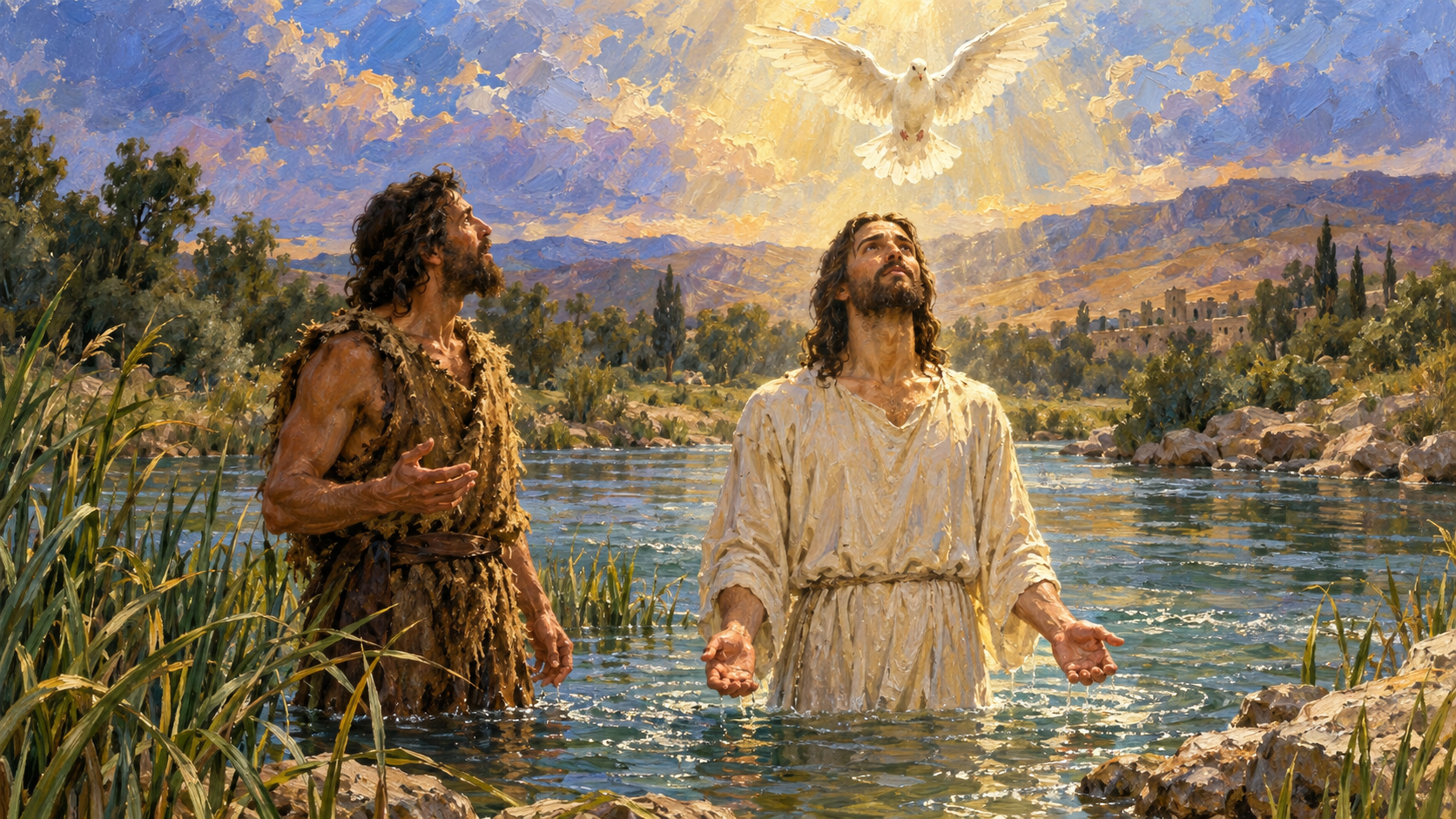
What did John actually see when the Holy Spirit descended like a dove at Jesus’ baptism? The Gospels describe a visible descent, and John explains the sign God had told him to expect. I want to follow that testimony carefully, because the purpose of the event concerns much more than the appearance of the dove. It identifies Jesus and reveals the Father, Son, and Holy Spirit acting together as His public ministry begins.
Jesus Comes to the Jordan
John the Baptist had been calling Israel to repent and baptizing those who responded. He also directed people beyond himself to Someone mightier, who would baptize with the Holy Spirit. Then Jesus came from Galilee to the Jordan to be baptized by John.
Then Jesus came from Galilee to John at the Jordan to be baptized by him.
And John tried to prevent Him, saying, “I need to be baptized by You, and are You coming to me?”
But Jesus answered and said to him, “Permit it to be so now, for thus it is fitting for us to fulfill all righteousness.” Then he allowed Him.
John’s objection shows that he recognized the difference between himself and the Man standing before him. He needed what Jesus could give, yet Jesus was asking to receive baptism from him. The people responding to John’s preaching had sins to confess. Jesus, the sinless Son of God, had none.
Jesus answered that this was fitting to fulfill all righteousness, and John accepted His instruction. I understand His baptism as obedience to the Father’s appointed work and identification with the people in Israel responding faithfully to John’s message. He was not confessing wrongdoing or undergoing a change from sinful to righteous. He entered the water as the obedient Son whose mission would eventually take Him to the cross.
As Jesus came up from the water, the heavens opened, the Spirit descended upon Him, and the Father spoke. The accounts describe something seen and heard at a particular time in His earthly ministry. John’s later testimony gives us an eyewitness explanation of what he saw. The study on John the Baptist examines the wider work of the man God appointed to prepare the way.
What All Four Gospels Say
Each Gospel records the Spirit’s descent, while drawing attention to particular details. Matthew describes the Spirit of God coming upon Jesus:
When He had been baptized, Jesus came up immediately from the water; and behold, the heavens were opened to Him, and He saw the Spirit of God descending like a dove and alighting upon Him.
Mark places the descent immediately after Jesus came up from the water:
And immediately, coming up from the water, He saw the heavens parting and the Spirit descending upon Him like a dove.
Luke adds that Jesus was praying, describes the Spirit’s bodily form, and records the Father’s declaration:
When all the people were baptized, it came to pass that Jesus also was baptized; and while He prayed, the heaven was opened.
And the Holy Spirit descended in bodily form like a dove upon Him, and a voice came from heaven which said, “You are My beloved Son; in You I am well pleased.”
John’s Gospel gives the Baptist’s testimony that the Spirit remained upon Jesus:
And John bore witness, saying, “I saw the Spirit descending from heaven like a dove, and He remained upon Him.”
Reading these accounts together, I cannot reduce the event to a feeling John had about Jesus. He says that he saw the Spirit descend and remain. Luke’s description includes bodily form and a voice from heaven. We are not given a list of everyone who perceived those things. John does tell us what he saw, and God had sent him to bear witness to Jesus.
The Sign Given to John
We do not need to guess why God gave this sign, because John tells us. The One who sent him to baptize with water had also told him how to recognize the One who baptizes with the Holy Spirit:
I did not know Him, but He who sent me to baptize with water said to me, “Upon whom you see the Spirit descending, and remaining on Him, this is He who baptizes with the Holy Spirit.”
And I have seen and testified that this is the Son of God.
John’s certainty rested on what God had said and what he then witnessed. The Spirit descended upon Jesus and remained, just as he had been told. John did not choose a striking image and assign a meaning to it afterward. God supplied both the sign and its explanation, so John could testify, “This is the Son of God.” In John 1:31, he also explains that his water baptism served to reveal Jesus to Israel.
The emphasis on the Spirit remaining is part of that identification. Jesus was not a temporary prophet whose commission would end when a passing empowerment left Him. In some Old Testament instances, the Spirit came upon someone for a particular task or office, and such empowerment could be withdrawn. John describes the Spirit remaining upon the Messiah. I understand this as the abiding anointing for the mission the Father had given His Son.
That mission had already been described in prophecy. Isaiah did not mention a dove-like appearance, but he did say that the Spirit would rest upon the promised ruler from Jesse’s line and that the Lord delighted in His chosen Servant:
The Spirit of the LORD shall rest upon Him, The Spirit of wisdom and understanding, The Spirit of counsel and might, The Spirit of knowledge and of the fear of the LORD.
Behold! My Servant whom I uphold, My Elect One in whom My soul delights! I have put My Spirit upon Him; He will bring forth justice to the Gentiles.
Isaiah 11 looks ahead to the Messiah’s righteous rule. Isaiah 42 describes the Servant who brings justice to the Gentiles, with God’s Spirit upon Him. At the Jordan, the Spirit descended upon Jesus and the Father declared His pleasure in Him. I understand the baptism as a public commissioning that identifies Him with the work these promises describe.
John’s testimony also points beyond the beginning of Jesus’ ministry. The Man upon whom the Spirit remained would Himself baptize with the Holy Spirit. John could baptize people in water, but he could not give them God’s Spirit. Jesus would later promise the Spirit to His disciples. The sign identified the Son who reveals the Father and gives the Spirit to those who belong to Him.
Like a Dove, Not a Dove
In Matthew 3:16, the word translated “like” is ὡσεί (hosei), meaning “as,” “like,” or “as it were.” It introduces a comparison. The Spirit descended like a dove; Matthew does not identify the Spirit as a bird. We should retain the comparison without changing the identity of the One descending.
Luke’s phrase “in bodily form” also needs its full weight. He describes a visible manifestation, not merely a poetic way of saying that Jesus felt peaceful. The wording gives us reason to speak of a real, dove-like appearance. It does not give us a complete description of its dimensions, movement, or every detail an artist might want to paint. I can accept what Luke records without pretending to supply the missing particulars.
The Holy Spirit is a divine Person. He speaks and teaches, guides God’s people, and convicts the world. He lives in believers, seals them as God’s own, and distributes gifts according to His will. A visible manifestation at the Jordan did not make Him an animal or change Him into a created being. The study on the Person of the Holy Spirit considers His identity and work more fully.
The Bible’s other references to doves cannot decide the purpose of this appearance for us. Noah sent a bird from the ark to learn about the receding waters. The Law permitted birds as offerings, and Song of Solomon uses doves in love poetry. Those passages deserve attention in their own settings. The study on doves in the Bible follows those uses without treating them as a code for the Spirit’s descent.
Father, Son, and Spirit in the Work of Redemption
The Father’s words deserve as much attention as the visible descent. Matthew records His declaration:
And suddenly a voice came from heaven, saying, “This is My beloved Son, in whom I am well pleased.”
The Son stood in the water, the Spirit descended upon Him, and the Father spoke from heaven. Scripture teaches one God, while showing these Persons acting in relationship with one another. By the Trinity, I mean the one God who eternally exists as Father, Son, and Holy Spirit. The three Persons are distinct without being three separate gods.
This is why I reject modalism, the view that Father, Son, and Spirit are manifestations or roles of a single divine Person. My objection concerns more than the locations described at the Jordan. The Father really loves and sends the Son, the Son really obeys the Father, and the Spirit really comes upon the Son. Those relationships cannot be reduced to one Person appearing under different names. The study on the Trinity examines the wider biblical teaching.
The Father’s voice declared Jesus to be the Son He already was. John 1:1 identifies the eternal Word as God, and John 1:14 tells us that the Word became flesh. The claim that a merely human Jesus was adopted as God’s Son at His baptism is a form of adoptionism, but it does not fit that testimony. The Father did not confer deity upon an ordinary man at the Jordan. The eternal Son had taken true humanity, and He was holy from conception.
The Spirit’s descent was an anointing for ministry, not the repair of a moral deficiency in Jesus. Nor does it mean that He had lived without the Spirit until that moment. He came to the Jordan as the holy Son, and His baptism marked the beginning of His public work with the Father’s testimony and the Spirit’s anointing.
Peter later described that work when he spoke in the household of Cornelius:
That word you know, which was proclaimed throughout all Judea, and began from Galilee after the baptism which John preached:
how God anointed Jesus of Nazareth with the Holy Spirit and with power, who went about doing good and healing all who were oppressed by the devil, for God was with Him.
Jesus went about doing good, healing people oppressed by the devil. His teaching, healing, and deliverance were the work of the Spirit-anointed Messiah Peter proclaimed. The Father had sent Him, and the Spirit rested upon and empowered Him. The Son, fully God and truly man, carried out the mission in obedience to the Father.
These distinct actions belong to one united work of redemption. The Father’s delight in the Son did not disappear when Jesus’ obedience brought Him to the cross. Wicked people inflicted the physical suffering He willingly endured, and He bore the punishment for our sins in His innocent body. He shed His blood and died, completing His saving work before He rose bodily from the grave. His bodily resurrection vindicated Him as Lord and Christ.
John had identified Jesus as the Lamb of God who takes away the sin of the world. The sign at the baptism directs us to that Savior, not merely to an interesting appearance in the sky. The One John recognized would give Himself for sinners and give the Holy Spirit to believers. I want to receive John’s witness by trusting the Son to whom he pointed, rather than admiring the image while overlooking the salvation Jesus provides.
We should also honor the Spirit as He is revealed. Calling Him a mood in a meeting or treating Him as an impersonal influence does not account for His will, His teaching, or His indwelling presence. He chose to make His descent visible at the Jordan, but He cannot be confined to the appearance through which John saw Him. I need the whole testimony of Scripture to govern how I speak about Him.
My Final Thoughts
John saw the Holy Spirit descend like a dove and remain upon Jesus, in fulfillment of the sign God had given him. The Father declared Jesus to be His beloved Son, and the Gospels identify the Spirit’s descent as a real, visible event. We can affirm those details without claiming to know everything a witness might have seen.
I want to follow the purpose God gave the sign: to recognize His Son and receive the testimony about Him. At the Jordan, the Father, Son, and Spirit act distinctly and together as Jesus begins the ministry that will lead to His saving death and bodily resurrection. The sign gives us reason to trust Christ and worship the one true God, without turning the Spirit into a bird or the baptism into the beginning of Jesus’ Sonship.