
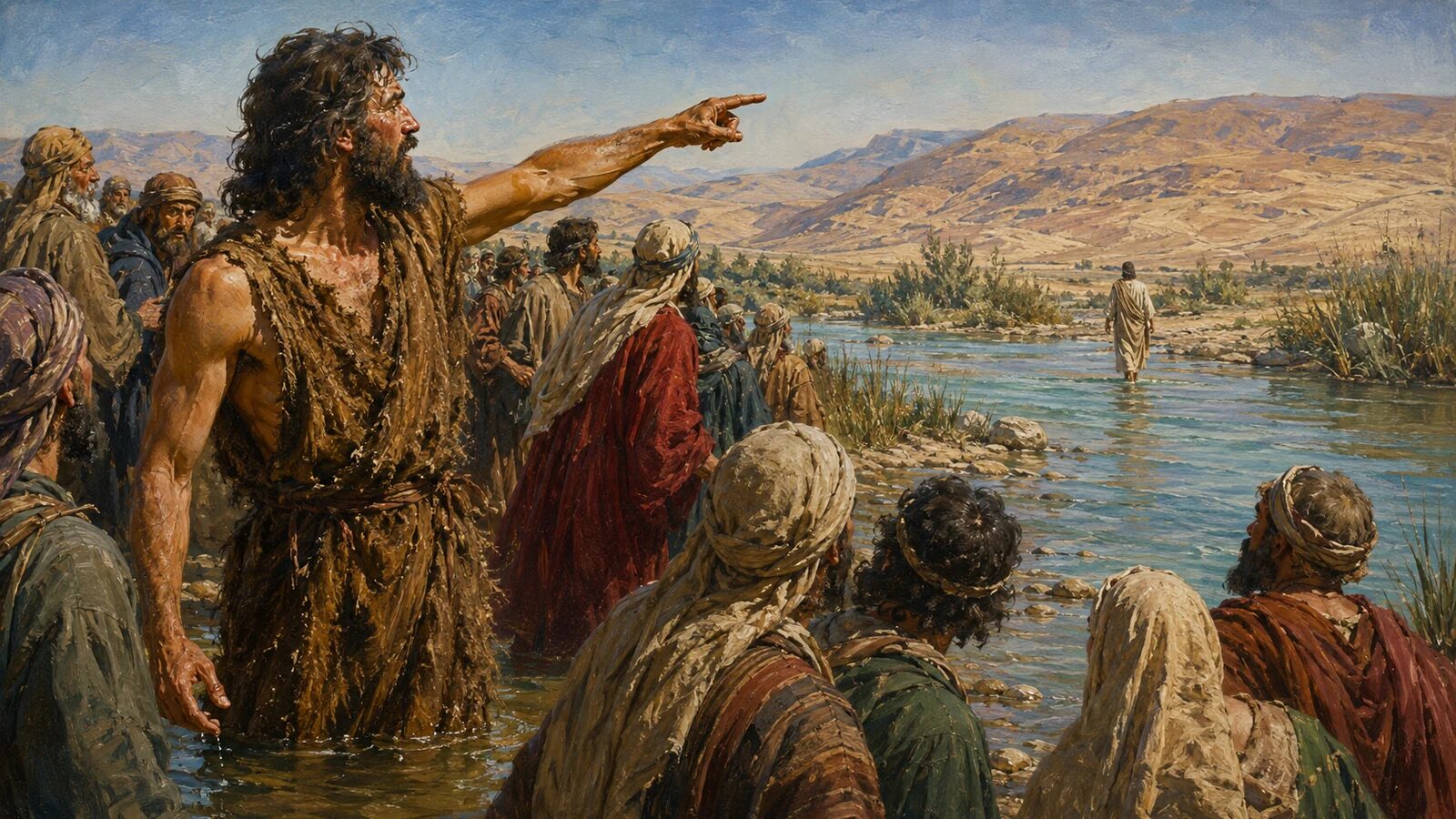
John the Baptist knew that God had sent him to prepare people for the Lord and point them to Jesus. What I want to understand is how he stayed true to that calling without building a movement around himself. We can follow that purpose from the promises made before his birth all the way through his imprisonment and death.
The Promised Forerunner
John’s unusual clothes and rugged way of life can easily draw our attention, but the Gospels explain his ministry through promises God made in Isaiah and Malachi. He called people to repent and confronted sin wherever he found it because he was preparing them for Jesus Christ. His own limits were clear: he could baptize people in water, but he could not give them the Holy Spirit or take away their sin. He was preparing the way for the King who alone could save those who believed.
The Gospel writers keep taking us back to those promises because John didn’t appear without warning. God had been preparing His people for the Messiah long before John began preaching. Isaiah spoke of a voice that would announce the Lord’s coming.
The voice of one crying in the wilderness: “Prepare the way of the LORD; Make straight in the desert A highway for our God.”
Isaiah 40:3, NKJV
Isaiah 40 begins with comfort after discipline. God promised to rescue and shepherd His people, giving them a reason for comfort that went beyond a change in how they felt. In the ancient world, workers might clear and straighten a road before a king arrived. Isaiah used that picture for the coming of the LORD: the way needed to be made ready and set in order. John called people to prepare for the Lord by facing the condition of their hearts. They could not hide behind their heritage or assume that social standing and a religious appearance made them ready. His work served the Lord’s arrival rather than drawing attention to himself.
I notice that Isaiah draws our attention to the voice while saying almost nothing about the man speaking. That fits John’s willingness to be known for the message he carried. With the King coming, he had no need to make himself the center of attention.
Malachi makes the promise even more direct by naming whom the messenger would go before. He would prepare people for the Lord Himself, not simply for a spiritual experience.
“Behold, I send My messenger, And he will prepare the way before Me. And the Lord, whom you seek, Will suddenly come to His temple, Even the Messenger of the covenant, In whom you delight. Behold, He is coming,” Says the LORD of hosts.
Malachi 3:1, NKJV
Malachi says the messenger would prepare the way before the Lord, and the Gospels apply that promise to John preparing people for Jesus. That connection helps me understand who Jesus is: He is the Lord whose coming Malachi announced. The Gospels fulfill the prophecy without weakening its claim.
Malachi also promises Elijah before the great and dreadful Day of the LORD. Luke explains that John came “in the spirit and power of Elijah.” He was an Elijah-like prophet, not Elijah reincarnated in another body. Like Elijah, John lived apart from the comforts of respectable religion and courageously confronted sin. He called people back to God ahead of the coming judgment.
Luke takes us back to the time before John was born. His father, Zechariah, was a priest, and his mother, Elizabeth, was also descended from Aaron. They had grown old without a child, yet Luke describes them as righteous before God. I wouldn’t want us to read their sorrow as evidence that God had rejected them when Luke has been so clear about their standing before Him. While Zechariah served in the temple and the people prayed outside, Gabriel announced that Elizabeth would bear a son. The son promised to this grieving couple would prepare people for the Messiah.
He will also go before Him in the spirit and power of Elijah, “to turn the hearts of the fathers to the children,” and the disobedient to the wisdom of the just, to make ready a people prepared for the Lord.
Luke 1:17, NKJV
God gave John his mission before he was born: he would turn hearts toward the Lord and call the disobedient to the wisdom they needed. That purpose helps me understand the choices he made later. He did not choose rough clothing to create an image, and the wilderness was more than an unusual location for his preaching. His baptism served the same calling as his rebukes of sin and warnings of judgment. He was preparing people to meet the Lord as God had told him to do.
Luke also says John would be filled with the Holy Spirit even from his mother’s womb, marking him out for his unique calling as the promised forerunner. After his birth, Zechariah said that his son would be called the prophet of the Highest and would go before the Lord’s face to prepare His ways. Even in these announcements of John’s greatness, we can see that his purpose was to direct people to Someone greater than himself.
The Wilderness Voice and the Call to Repent
Matthew places John in the wilderness of Judea, just as Isaiah said. In Israel’s history, the wilderness had been a place of testing and dependence on God, exposing what people might hide elsewhere. There, away from the usual centers of power and religion, John called Israel to face God honestly.
In those days John the Baptist came preaching in the wilderness of Judea, and saying, “Repent, for the kingdom of heaven is at hand!”
Matthew 3:1-2, NKJV
John’s call to repent asked people to change their minds about sin and turn in a new direction. Feeling sorry was not enough, and adding a religious mood to their lives would leave the same problem untouched. He wasn’t telling them to punish themselves until God accepted them, either. He was calling them to agree with God’s verdict and confess the sin they had been defending. If I am preparing to meet the King, I need to face what He says about my heart instead of managing how I appear to others.
John’s clothing and simple food recalled the rough way of life that set Elijah apart as a prophet. He wasn’t trying to impress Herod’s court or earn a place among the religious leaders. By living outside those comfortable settings and speaking the truth, he challenged a religion more concerned with protecting itself than obeying God.
When the Pharisees and Sadducees came to his baptism, John refused to accept a shallow show of repentance. He warned them against relying on their descent from Abraham, because even that respected family line could not take the place of a changed heart.
Therefore bear fruits worthy of repentance, and do not think to say to yourselves, “We have Abraham as our father.” For I say to you that God is able to raise up children to Abraham from these stones.
Matthew 3:8-9, NKJV
We need to understand why John looked for fruit. He wasn’t asking people to buy forgiveness through their behavior, but to show that their repentance was genuine. They could not claim to be ready for the Lord while clinging to pride and the sins they had cherished in defiance of God. Relying on ancestry would not help them, any more than spiritual laziness or self-righteousness could prepare their hearts for the King.
John’s baptism gave repentant people a public way to acknowledge that God’s verdict about their sin was right. The water itself neither removed sin nor created new life. It belonged to John’s work of preparing Israel to receive the Messiah who was about to appear.
So John was asking for more than better behavior or another ceremony added to an unchanged life. He called people to stop using religion to hide from God and to receive the Lord he was sent to reveal. His preaching was preparing the way for the Lord Himself.
Behold the Lamb of God
Acknowledging sin still leaves us with a need we cannot meet ourselves. I can admit that I have sinned without having any atonement for that sin, so John’s ministry could not stop at making people feel convicted. He exposed their sin to direct them to the One who could take it away.
The next day John saw Jesus coming toward him, and said, “Behold! The Lamb of God who takes away the sin of the world!”
John 1:29, NKJV
By calling Jesus the Lamb of God, John drew together the Bible’s teaching about sacrifice and substitution. His words also point us to Passover and the need for shed blood. Jesus came to deal with our sin before God, which is far more than a teacher helping us improve our behavior.
John says Jesus takes away the sin of the world. I can recognize the full reach of those words without concluding that everyone is automatically saved, because Scripture still calls each person to repent and believe. Christ’s blood is sufficient for all, and God’s offer of salvation genuinely extends to the world. Jesus is not a private Savior for one narrow group. People may resist His offer, but everyone who receives Him by faith will be saved.
The Lamb dealt with our sin through a physical sacrifice. Wicked men tortured and punished Jesus, then killed Him, while He willingly bore that punishment for our sins in His innocent body and shed His blood. His death was real, and He rose bodily after His burial. The Father did not punish or curse His Son. Neither did He abandon Him or turn against Him. Scripture does not say the Father struck or bruised Jesus, and He did not pour wrath on Him. The Father and Son remained united in the work of redemption. When I consider what Christ did to save us, I can see why John kept directing people to Him. John could announce salvation, but he could never take the place of the Lamb who alone could save them.
And I have seen and testified that this is the Son of God.
John 1:34, NKJV
John identified Jesus as the Son of God and said he was not worthy even to loosen His sandal. Although John appeared first in public ministry, Jesus had always outranked him. His explanation that Jesus “was before me” is especially revealing because John was born first. I cannot understand that as a comparison of their ages. John was pointing to Christ’s eternal existence and superior identity, far beyond that of another prophet.
Jesus at the Jordan
If John’s baptism was a call to repentance, why did Jesus come to be baptized? He was sinless, with no guilt to confess or uncleanness for the water to wash away. John recognized that difficulty and tried to prevent Him.
Then Jesus came from Galilee to John at the Jordan to be baptized by him. And John tried to prevent Him, saying, “I need to be baptized by You, and are You coming to me?” But Jesus answered and said to him, “Permit it to be so now, for thus it is fitting for us to fulfill all righteousness.” Then he allowed Him.
Matthew 3:13-15, NKJV
Jesus entered the water beside the people He came to save without confessing any sin of His own. He was fulfilling righteousness and identifying Himself with sinners while remaining the sinless One who would stand in their place. From the beginning of His public ministry, He willingly accepted the mission that would lead Him to the cross.
His baptism also revealed His identity publicly. As the Son came up from the water, the Holy Spirit descended like a dove and the Father’s voice spoke from heaven.
When He had been baptized, Jesus came up immediately from the water; and behold, the heavens were opened to Him, and He saw the Spirit of God descending like a dove and alighting upon Him. And suddenly a voice came from heaven, saying, “This is My beloved Son, in whom I am well pleased.”
Matthew 3:16-17, NKJV
We can see the Father, Son, and Holy Spirit acting distinctly here. This cannot be explained as one Person changing from one role to another, because the Son was coming up from the water while the Spirit descended and the Father spoke. They are distinct Persons who are the one God, and the account at the Jordan gives us one of Scripture’s clearest revelations of the Trinity.
John distinguished his baptism in water unto repentance from Jesus’ baptism with the Holy Spirit. He also warned of baptism with fire, and I understand that warning by looking at the surrounding passage. In Matthew 3, wheat is gathered into the barn while chaff burns with unquenchable fire. That picture describes the coming King’s work of separating people and judging them. I understand the fire here as a warning of judgment, not an expression of spiritual excitement.
John’s baptism prepared Israel to receive the Messiah, while Christian baptism follows Jesus’ death and resurrection. Acts 19 helps us see why they are not identical. When Paul met disciples at Ephesus who knew only John’s baptism, he explained that John had called people to believe in the One coming after him, Christ Jesus. Christian water baptism follows salvation and publicly identifies the believer with Christ in His death, burial, and resurrection. It pictures that union without causing forgiveness or the new birth.
He Must Increase
John knew who Jesus was and understood the work God had given him, so he had no need to compete with Him. When his disciples noticed people going to Jesus, John did not respond with jealousy. His humility came from recognizing that his assignment had come from heaven. He was refusing to claim a place God had never given him, which takes conviction rather than weakness.
He must increase, but I must decrease.
John 3:30, NKJV
John compared himself to the friend of a bridegroom who rejoiced when the bridegroom arrived. That helps me hear the joy in his willingness to decrease. He wasn’t expressing hatred of himself or treating his ministry as a failure because people left him to follow Jesus. Their response fulfilled the purpose for which God had sent him, and he could gladly step back knowing he was not the Christ.
John 1 says John the Baptist was sent to bear witness to the Light without being the Light himself. I need to remember that distinction in my own service to Christ, because none of us produces the light we proclaim. If I begin needing the attention that belongs to the Lord, my service has taken a dangerous direction.
John’s words reach beyond preachers to anyone serving in Christ’s name. Those who teach or lead need this humility, as do those whose service involves writing or singing. It belongs in a parent’s care for the home just as much as in a pastor’s care for a church. I want the help I give people to make Jesus clearer to them, even if that means they come to depend less on me. A faithful servant should never make himself the person others finally rest their trust in.
The repentance John preached also challenges any comfort we find in religious appearances. Descent from Abraham could not protect his hearers from God’s verdict, and Christian language cannot protect us from it now. We can spend years around Bible teaching and still refuse the repentance and faith God commands. Instead of polishing our image, we need to agree with God about our sin and believe in the Lamb who died for the whole world.
Everyone who receives the risen Christ is forgiven and declared righteous before God. Christ gives that person new birth, and the Holy Spirit comes to dwell within the believer and seal him. A genuinely born-again believer is eternally secure, but that security gives no permission for lawlessness. Nor does a shallow profession prove that someone possesses new life. The fruit of real repentance follows because Christ has saved the person and begun changing him. It never earns that salvation.
John in Prison and a Faithful Death
John’s faithfulness eventually led to imprisonment. Herod Antipas ruled Galilee under Roman authority and had taken Herodias, who had been his half-brother’s wife. The repeated names in Herod’s family can be confusing, but the moral issue is clear: a ruler had used his position to enter a forbidden marriage and wanted the prophet silenced. John gave him the same call to repentance he gave everyone else. The danger of speaking to a ruler did not change God’s standard.
From prison, John sent disciples to ask Jesus, “Are You the Coming One, or do we look for another?” I don’t know that we can settle exactly what was in John’s heart when he asked. He may have been bringing an honest struggle to Jesus in his suffering, or he may have wanted his disciples to hear the Lord’s answer for themselves. We do know how Jesus responded: He directed John to evidence that fulfilled Scripture instead of crushing him for asking.
Jesus answered and said to them, “Go and tell John the things which you hear and see: The blind see and the lame walk; the lepers are cleansed and the deaf hear; the dead are raised up and the poor have the gospel preached to them.”
Matthew 11:4-5, NKJV
Jesus’ answer echoed Isaiah’s promises of Messianic restoration and directed John’s disciples to works that fulfilled those Scriptures. People who had been blind could see, and those unable to walk were walking. Others were cleansed from the disease that had separated them. Along with healing the deaf and raising the dead, Jesus brought good news to the poor. John had announced both salvation and judgment, yet he was still in prison under a corrupt ruler. Jesus pointed him to the works of mercy already taking place and assured him that the kingdom was arriving in God’s order, even though final judgment had not yet fallen.
Jesus then honored John before the crowd, saying that among those born of women there had not risen anyone greater than John the Baptist. I notice that He said this after answering John’s question. The question had not erased John’s years of faithfulness or canceled his prophetic calling. Jesus strengthened His suffering servant without treating his pain as something easy to bear.
John eventually died because he would not call sin acceptable. Herodias hated him, while Herod feared him and sometimes listened to him without repenting. At a birthday feast, Herod’s pride and lust left him open to manipulation. After making a foolish oath, he ordered John beheaded in prison.
John’s death was brutal, but Scripture does not present him as a defeated servant. He died before the cross and the empty tomb, and he never saw Pentecost or the gospel spread to the nations. Yet he had seen the Lamb and directed people to Him. I need to remember that before measuring faithful service by how long it lasts or how comfortable it is. The success others can see does not tell us whether a servant has obeyed God.
John was willing to confront sin even in a ruler’s house, and his death shows what telling the truth can cost. His example challenges a preacher who speaks only against sins that are safe to condemn. It doesn’t excuse harsh or reckless speech, or give us a reason to feel important. We need the courage to tell the truth without trading it away for our own protection.
Matthew 11:13 says that all the prophets and the Law prophesied until John. As the last great prophet before the Messiah’s public ministry, he stood at the edge of an era. The promised voice in the wilderness was also the bridegroom’s friend, glad to step aside when Christ came forward. In each role, he directed people to the Lord he had come to announce.
For related studies, see A Complete Bible Study on Baptism in the Bible, A Bible Study on The Messiah in the Bible, and A Complete Bible Study on The Deity of Jesus.
My Final Thoughts
John’s greatness is clearest to me in how he helped people recognize Jesus. He called people to repent because the King was near, then directed them to the Lamb and gladly stepped aside when Jesus appeared. Prison and death could not undo that witness, because protecting his own place or comfort had never been his task. His message still calls us to stop defending our sin and trust the risen Christ whose blood alone can take it away. Our service should help people see Jesus more clearly instead of continually drawing their attention back to ourselves.