
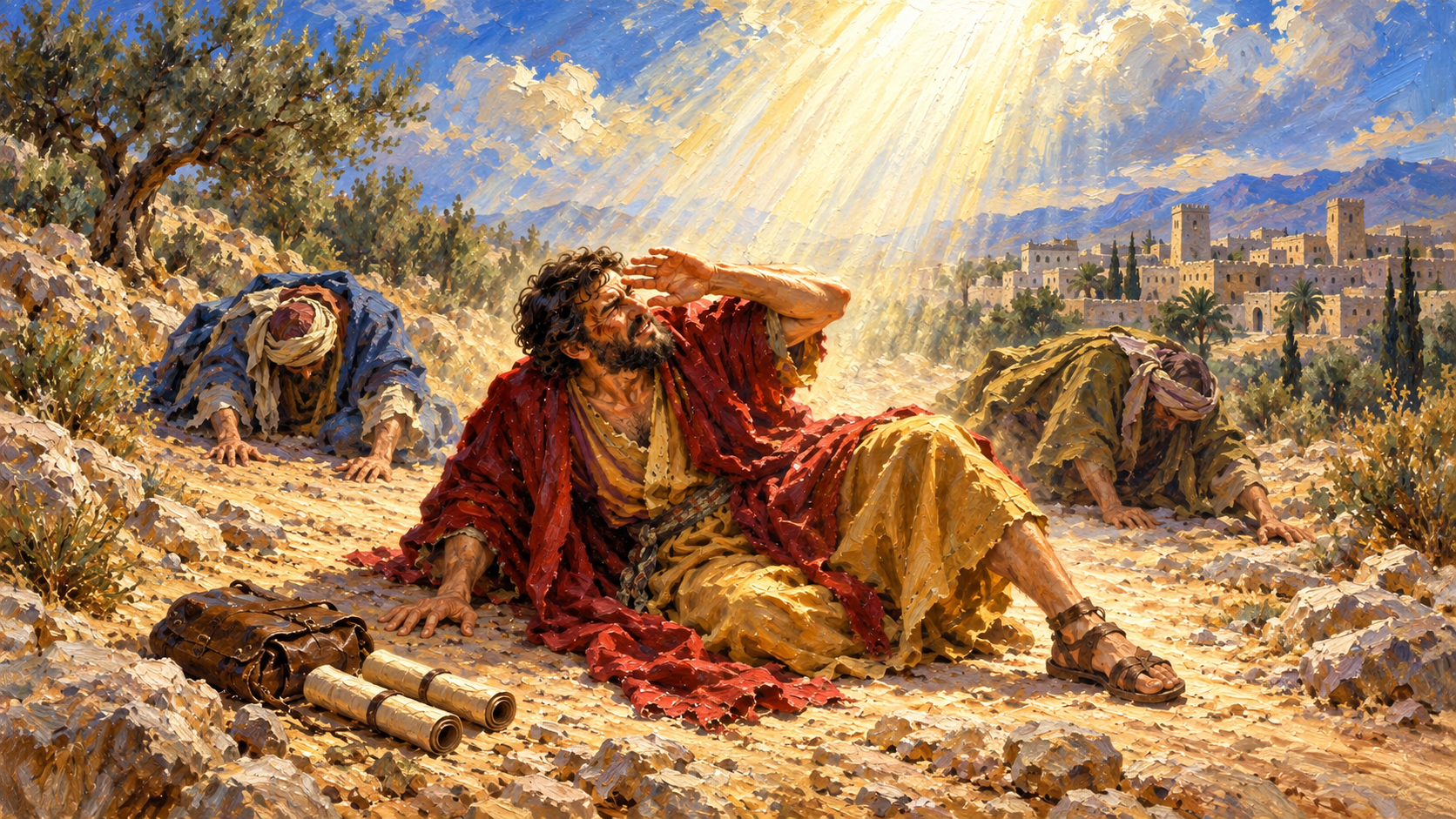
When we first meet Saul in Acts, he is helping persecute Christians and then hunting them from house to house. How did that man become the apostle whose letters teach so much of the New Testament? As I follow him through Acts and his own writings, I keep finding that the risen Jesus is central. He saved an enemy and taught him to serve faithfully through suffering.
Acts 7-9 gives us Saul’s persecution and conversion. Acts 13-20 then follows his missionary work and care for new churches. From Acts 20 through the end of the book, we see his arrest and trials, the shipwreck on the way to Rome, and his witness after he arrives there. Paul’s letters let us hear the doctrine and pastoral concern behind that history. Romans 3-5 and Galatians 1-2 are especially important for understanding the gospel he preached. Ephesians 1-2 and 1 Corinthians 15 add further clarity, while his final words in 2 Timothy 4 show us how he faced the end of his course.
Saul Before Damascus
Paul was a Jew from Tarsus in Cilicia, thoroughly trained under Gamaliel and also a Roman citizen. That background enabled him to move through different cultural and legal settings. Christ claimed the whole man, bringing that history under His authority rather than erasing it when He saved him.
But Paul said, “I am a Jew from Tarsus, in Cilicia, a citizen of no mean city; and I implore you, permit me to speak to the people.”
Acts 21:39, NKJV
Paul made this calm, lawful appeal while a Roman commander was trying to control an angry crowd, and it gained him a hearing. I see the same care in how he addressed other people. He reasoned from Scripture in synagogues and began with what Greeks could understand in public settings, without surrendering the gospel. He carried that same message before governors and kings, using his Roman citizenship properly when unlawful treatment threatened the mission.
His background did not make him an apostle, but I can see God’s providence in preparing a man with deep Jewish roots who understood the Greek-speaking world. His knowledge of Scripture helped him reason, and his legal standing sometimes gave him a protected way to testify. Christ gave him the ministry and the courage to speak when it became dangerous. Grace brought his whole past under Christ’s lordship for His service.
Acts does not say that Jesus changed Saul’s name to Paul at his conversion. He is still called Saul after the Damascus road, and Acts 13:9 introduces him as “Saul, who also is called Paul” as the account turns more directly toward his work among Gentiles. Saul was his Hebrew name; Paul was the Roman name suited to the wider world in which he traveled. Luke’s wording marks a new stage in his ministry, not another conversion or a command from Jesus to adopt a new name.
Saul makes me think carefully about the difference between zeal and truth. A disciplined person can speak reverently about God while opposing His Son, and neither moral seriousness nor loyalty to inherited tradition resolves that rejection. Paul understood the angry crowd he later addressed because he had once shared their zeal toward God.
“I am indeed a Jew, born in Tarsus of Cilicia, but brought up in this city at the feet of Gamaliel, taught according to the strictness of our fathers’ law, and was zealous toward God as you all are today.”
Acts 22:3, NKJV
Paul was explaining the error he had lived in, not praising his former devotion. He had believed that persecuting Christians was faithfulness and could quote Scripture while missing the One it pointed to. That should make me cautious about trusting sincerity or a respected heritage to put me right with God. Religious training can strengthen a conviction without making it true. If I refuse Christ, zeal can give energy to rebellion even while I call it obedience.
Saul was present when Stephen died, with the witnesses laying their clothes at his feet. When persecution broke out, he became one of its chief instruments. Luke describes his sin plainly:
As for Saul, he made havoc of the church, entering every house, and dragging off men and women, committing them to prison.
Acts 8:3, NKJV
Luke’s Greek verb for “made havoc” is lumainomai, which can mean to ravage, damage, or ruin. The actions he describes show why that word fits. Saul entered homes and dragged believers to prison, harming women as well as men. He was not simply debating in a classroom or pursuing a few public leaders. Ordinary households suffered under his campaign, and the grace seen in his later ministry must be understood alongside that real, public, grievous sin.
Knowing what Saul had done helps me understand why believers did not immediately trust him after his conversion. God’s forgiveness is full when a sinner believes, but trust between people often needs time and visible fruit. The church could rightly love him and still remember the wounds he had caused. Grace brings the past under Christ’s blood and teaches the forgiven person to walk truthfully; it does not pretend his actions were harmless.
Saul was on his way to Damascus with authority to arrest believers when the risen Jesus stopped him. He had not grown tired of strict religion or decided to reinvent his life. Jesus revealed Himself and changed Saul’s direction, rather than Saul reasoning his way into a new outlook.
Then he fell to the ground, and heard a voice saying to him, “Saul, Saul, why are you persecuting Me?” And he said, “Who are You, Lord?” Then the Lord said, “I am Jesus, whom you are persecuting. It is hard for you to kick against the goads.”
Acts 9:4-5, NKJV
Jesus asked, “Why are you persecuting Me?” He spoke of the persecution of His followers as something done to Himself. That helps me understand the teaching Paul later gave about the church as Christ’s body in 1 Corinthians 12. The Head takes personally what happens to the body.
By calling him “Saul, Saul,” Jesus addressed a particular man, not a faceless enemy. The repeated name made the confrontation personal and solemn, holding Saul accountable while extending mercy. Saul fell and answered, discovering that the Jesus he opposed was alive.
Blind and led by the hand into Damascus, Saul had to depend on others for every step. He had dragged people from their homes; now he could not make his own way. That physical blindness reflected the spiritual blindness he had lived in. For three days he could not see and did not eat, praying as he waited for the Lord’s direction. God used his helplessness to humble him in mercy.
When God sent Ananias to Saul, Ananias feared the man whose persecution he knew about. I can understand that concern, and the Lord did not dismiss it as irrational. He answered by explaining what He intended to do through Saul.
But the Lord said to him, “Go, for he is a chosen vessel of Mine to bear My name before Gentiles, kings, and the children of Israel. For I will show him how many things he must suffer for My name’s sake.”
Acts 9:15-16, NKJV
That calling promised wide opportunities to bear Christ’s name, together with suffering. Paul would preach to Gentiles and testify before kings while continuing to speak to Israel. The Lord was not offering him a comfortable religious career. Useful service and suffering would often come together.
Ananias obeyed and entered the house, calling Saul “brother” as he laid hands on him. Saul received his sight, was baptized as a new believer, and soon began preaching Christ. Later in Jerusalem, the disciples were afraid because they did not believe he had truly become a disciple. Barnabas brought him to the apostles and explained his encounter with the Lord and his bold preaching in Damascus. He helped them receive a changed man through credible testimony, without asking them to ignore the danger. God had forgiven Saul when he believed, but those he had threatened needed truthful evidence before they could trust him.
The Apostle and the Gospel of Grace
The risen Christ appointed Paul as an apostle; Paul did not pursue the position out of ambition. An apostle is someone sent as a commissioned representative, and Scripture can use the term broadly for a messenger given a mission. Paul’s authority was more specific because Christ called him directly. He saw the risen Lord and received the gospel through Christ’s revelation. The other apostles recognized that ministry, and the churches saw its fruit.
But I make known to you, brethren, that the gospel which was preached by me is not according to man. For I neither received it from man, nor was I taught it, but it came through the revelation of Jesus Christ.
Galatians 1:11-12, NKJV
Receiving his authority from Christ did not keep Paul apart from the church. He joined other believers and was commended by churches for missionary work. Coworkers traveled with him, others gave practical help, and he returned from a journey to report what God had done. Yet no human committee had supplied his gospel. Christ made him its servant, so his letters carry apostolic authority rather than merely a gifted man’s opinions.
Paul did not preach moral repair as the doorway to God. He proclaimed Jesus Christ, the eternal Son who became fully man without ceasing to be God. Jesus lived completely without sin. Wicked men inflicted real physical suffering upon His innocent body, and He willingly shed His blood for our salvation. He died for our sins, was buried, and rose bodily from the grave. The gospel announces what God accomplished through Christ. It is not advice about how sinners can make themselves acceptable.
The Father did not turn against His Son or pour wrath on Him. He did not punish Jesus, nor did He curse or abandon Him. The Father was not the one who struck and bruised Him. Wicked human beings physically tortured and killed the innocent Son of God, while Jesus willingly bore the punishment for our sins in His own body. That suffering was real. His blood was truly shed, and He died. He gave Himself for the sins of the whole world, so the offer of salvation is genuine for every person. God does not force anyone to receive that offer. A sinner may resist His grace and reject Christ, but everyone who repents and believes in the Lord Jesus is forgiven and born again.
For I delivered to you first of all that which I also received: that Christ died for our sins according to the Scriptures, and that He was buried, and that He rose again the third day according to the Scriptures.
1 Corinthians 15:3-4, NKJV
Whether Paul reasoned with philosophers or answered legalists, he kept returning to the same gospel. It also shaped his comfort for suffering believers and his instructions to pastors, including his correction of disorder in churches. The cross does not represent vague kindness: Jesus bore our punishment in His innocent body and shed His blood. Nor was His resurrection an image of optimism. The empty tomb was God’s bodily vindication of His Son, giving believers a sure foundation for hope.
Paul could not make up for persecuting the church by becoming impressive afterward. He needed Christ’s grace as every sinner does. Yet his past did not make him permanently unusable either. Its painful consequences remained serious, while Christ’s forgiveness gave his life a new direction.
Paul’s teaching on justification by faith explains how a sinner can stand righteous before God. The Greek dikaioō means to justify or declare righteous, using courtroom language. God declares the believer righteous because Christ has truly dealt with sin through His blood and death, not because sin is unimportant. His bodily resurrection confirms that His saving work is sufficient.
Therefore, having been justified by faith, we have peace with God through our Lord Jesus Christ.
Romans 5:1, NKJV
How could someone who ravaged the church have peace with God? Paul’s missionary work could never outweigh his violence, any more than becoming a better Pharisee could erase his guilt. Nor could his suffering pay the debt. He needed Christ’s saving work, received by faith, just as we do. God counts the believer righteous through the Lord Jesus.
Paul preached that same truth publicly. In Antioch of Pisidia, he announced forgiveness of sins through Christ and justification from what the law of Moses could not justify.
Therefore let it be known to you, brethren, that through this Man is preached to you the forgiveness of sins; and by Him everyone who believes is justified from all things from which you could not be justified by the law of Moses.
Acts 13:38-39, NKJV
Faith means relying on Christ instead of personal achievement. It does not earn salvation, and repentance does not purchase it either. They belong together because the gospel calls sinners to turn from rebellion and entrust themselves to Jesus. God gives salvation by grace, and we receive His gift by faith. Good works follow as the fruit of new life. Neither law-keeping nor religious ritual can justify us, and family heritage gives us no claim to acceptance. Later service and personal merit cannot earn it either. Our peace rests on Christ’s finished work, not our changing record of performance.
Paul followed the New Testament pattern of believing before being baptized. Baptism publicly identifies the believer with Christ’s death and burial and confesses hope in His resurrection. Because Christ commands it, that act of obedience must be taken seriously. But the water neither causes the new birth nor completes justification, and it does not seal salvation. Christ saves us; baptism publicly declares that we belong to the crucified and risen Lord.
In 1 Corinthians, Paul distinguishes his commission to preach the gospel from the act of baptizing. He is not dismissing baptism. He is keeping it distinct from the message that saves.
For Christ did not send me to baptize, but to preach the gospel, not with wisdom of words, lest the cross of Christ should be made of no effect.
1 Corinthians 1:17, NKJV
I cannot reconcile Paul’s words with the idea that baptism itself causes salvation. But I also cannot use grace to excuse neglecting a command of Christ. Paul taught baptism as a picture of union with Christ and a new walk, so obedience has its proper place in the life of someone who now belongs to the Lord.
The Holy Spirit indwells and seals every true believer, as Paul’s letters explain. He is a divine Person, not an impersonal force, and He applies Christ’s work and gives new life. His work produces spiritual fruit and makes obedience possible. Saul’s change was far more than adopting a different religious opinion: through the Spirit, he became a new creation in Christ.
In Him you also trusted, after you heard the word of truth, the gospel of your salvation; in whom also, having believed, you were sealed with the Holy Spirit of promise.
Ephesians 1:13, NKJV
The Spirit’s abiding seal gives me assurance without making sin safe. Paul warns God’s children not to grieve Him, but the Spirit does not abandon a true believer. Our security rests on Christ’s finished work and the Spirit who remains with us. Belonging to God calls us to worship Him and continue in holiness.
Eternal security does not permit lawlessness. The Spirit gives the new creation a changed direction, even when growth is uneven and struggles with sin continue. A shallow profession without evidence of new life cannot establish that someone was born again. Paul points believers to Christ and His seal for assurance while calling professing Christians to examine whether they walk in the faith they claim. Grace excludes law-keeping as the basis of justification, but obedience still belongs in Christian life. Love should shape our conduct, church discipline still has its place, and Christ’s command to be baptized still stands. The Spirit leads us to live as people who belong to God.
Mission, Churches, and Hard Roads
Acts does not move directly from Saul’s conversion to a solitary worldwide ministry. Barnabas later brings Saul from Tarsus to Antioch, where they teach the church together for a year. Antioch was a congregation in Syria where Jewish and Gentile believers worshiped Christ together. It became the church that sent Barnabas and Saul on their first recorded missionary journey. The Holy Spirit called them to the work. The congregation then sought God through prayer and fasting before laying hands on them and sending them out. Paul’s mission was given by Christ and carried forward in fellowship with a real local church.
On that first journey, Barnabas and Paul crossed to Cyprus and then traveled through parts of Asia Minor. This region included cities such as Pisidian Antioch, Iconium, Lystra, and Derbe. They normally began in a synagogue, where people already knew the Old Testament promises. As opposition hardened, they carried the message to Gentiles. New believers did not merely hear a sermon and then disappear from the account. Paul and Barnabas returned through dangerous cities to strengthen the disciples. They taught the believers to endure tribulation and appointed elders in the churches.
The growth of Gentile churches raised a question that could not be left vague. Did Gentile believers have to be circumcised and keep the law of Moses in order to be saved? Acts 15 records the Jerusalem council, where the apostles and elders heard the dispute. Peter testified that God had purified Gentile hearts by faith. Paul and Barnabas reported what God had done among them. The council rejected the attempt to place law-keeping between the sinner and Christ. Gentile believers did not have to become Jews to be justified. They were, however, instructed to turn decisively from idolatrous practices and pursue fellowship in holiness.
Paul’s second major journey began after a painful disagreement with Barnabas over John Mark. Barnabas took Mark, while Paul traveled with Silas. The separation was sad, but the gospel work continued, and Paul later spoke warmly of Mark’s usefulness. During this journey Paul added Timothy to the team and was directed into Macedonia. He preached in Philippi, Thessalonica, Berea, Athens, and Corinth.
Acts lets us see very different people responding to the gospel. Lydia, a businesswoman, believed the message in Philippi. A jailer heard the word after an earthquake shook the prison. The Bereans searched the Scriptures to test what they heard. Athenian philosophers listened with curiosity until Paul proclaimed resurrection and judgment. Paul did not change the gospel for these different hearers, but he spoke in ways they could understand and began from truths they already knew.
On the third major journey, Ephesus became an important center of ministry. Paul taught there for an extended period, and the spread of the gospel threatened a profitable trade connected with the temple of Artemis. The resulting riot shows that conversion can unsettle an economy built around idolatry. The gospel was not treated as a harmless private opinion because people who believed it began to leave their idols behind.
On his return route, Paul met the Ephesian elders at Miletus. After reminding them of his humble service and warning about coming false teachers, he entrusted them to God and the word of His grace. That shows me how much more church planting required than gathering a crowd. The churches needed sound doctrine and qualified shepherds who would patiently warn people and care for them through tears. Paul’s concern for their spiritual health continued after his preaching there ended.
Paul went to Jerusalem knowing that bonds and afflictions awaited him. Roman soldiers intervened when a hostile crowd seized him in the temple, beginning a long series of hearings. He testified before the Jewish council and the governors Felix and Festus, as well as King Agrippa. His appeal to Caesar used his Roman citizenship to gain a lawful path to Rome, not to look to Caesar for salvation. A dangerous voyage and shipwreck delayed his arrival but did not prevent it. Acts ends with Paul under guard in Rome, still teaching about God’s kingdom and the Lord Jesus Christ.
Throughout these journeys, Paul explained Scripture in synagogues and addressed Gentiles in ways they could understand. He strengthened believers and helped establish qualified leadership, then returned or wrote to encourage their churches. I don’t see a preacher making a celebrity tour. I see patient gospel work among people who needed continuing care, often while strong opposition remained.
Paul was stoned by a hostile crowd at Lystra, beaten or imprisoned by officials in other cities, and followed by slander. A later shipwreck nearly took his life, and he repeatedly faced rulers with the power to keep him confined. Yet the Lord used those hardships for witness. Arrest brought his testimony before authorities who might never have entered a church. Prison placed him near people he would not have met in freedom, and even the disaster at sea displayed God’s mercy.
But none of these things move me; nor do I count my life dear to myself, so that I may finish my race with joy, and the ministry which I received from the Lord Jesus, to testify to the gospel of the grace of God.
Acts 20:24, NKJV
Paul’s courage came from knowing that Jesus had entrusted him with a ministry he intended to finish faithfully. He was not showing off or pursuing danger for its own sake. God does not call us all to follow Paul’s route, but He does call each of us to belong wholly to Christ and bear truthful witness. Wherever He sends us, faithfulness must be worth more to us than comfort.
Paul’s Letters and Care for the Church
God used Paul to write Scripture as well as preach across the Roman world. His letters bring doctrine into the problems churches and individual believers actually faced. Romans explains God’s righteousness revealed in the gospel, while the Corinthian letters address disorder and division under Christ’s authority. Galatians defends justification by faith against making law-keeping a condition of acceptance.
Ephesians connects God’s saving purpose with life in the church and home, while preparing believers for spiritual warfare. Philippians teaches joy in Christ through suffering, and the Thessalonian letters give comfort and correction about His return. In the pastoral epistles, Timothy and Titus receive instruction in sound doctrine for church order and faithful ministry. I find those connections helpful because doctrine belongs in ordinary life. Christ’s truth governs worship and how we treat one another, including leadership and daily work. It also gives meaning to suffering and directs our hope toward Him.
Peter’s words show that Paul’s writings were known and carried weight in the churches. He speaks of Paul’s letters alongside the rest of the Scriptures and warns that unstable people twist them.
as also our beloved brother Paul, according to the wisdom given to him, has written to you, as also in all his epistles, speaking in them of these things.
2 Peter 3:15-16, NKJV
I cannot set Paul’s letters aside as optional commentary beside Jesus’ words. The same Lord who spoke during His earthly ministry appointed apostles and gave inspired Scripture through them. Paul served under that authority, preaching Jesus Christ and teaching what Christ had revealed. Treating him as the founder of a different religion misunderstands both him and the Lord who sent him.
Paul did not leave churches to work out every application of doctrine for themselves. He explained how Christ’s authority governs worship and discipline, reaching into marriage and family life. Giving should reflect His grace, and spiritual gifts should benefit the whole congregation instead of drawing attention to one person. Alongside warnings about false teaching, Paul gave instruction on leadership and endurance. He cared about how the church actually lived because Christ is its Lord.
The instructions to Timothy and Titus show why I cannot dismiss church order as outdated cultural material. Paul gave qualifications for elders and deacons, told Timothy to guard sound doctrine, and directed Titus to appoint qualified elders. These are inspired instructions that continue to guide us. I understand the local church’s offices and authoritative teaching leadership to belong to biblically qualified men, while every believer remains valuable to Christ and gifted to serve faithfully under Him.
Church order expresses how the gospel bears fruit among a visible people; it does not replace the gospel. Grace teaches us to worship in truth and put love into action. It also equips the congregation to reject false teaching and submit together to Christ’s Word.
Hebrews does not name its author in the opening, unlike Romans and Galatians, which name Paul. I need to acknowledge that silence without assuming there is no evidence to consider. The book’s internal clues and early Christian testimony deserve to be weighed carefully.
Taken together, I believe the evidence points to Paul as the writer of Hebrews. The exact process of composition may have included help from a secretary or translator. The book’s form as a written sermon may also help explain its distinctive style. Its exalted teaching about Christ agrees with the rest of Paul’s ministry, while its sustained reasoning from the Old Testament fits his background. The personal connection with Timothy offers further support. So does the closing word of grace and the book’s ancient placement among Paul’s letters.
That conclusion can be stated with conviction and humility. Hebrews is Scripture because God inspired it, not because our historical reconstruction gives the book authority. Authorship still helps us read carefully. Paul was a Hebrew of Hebrews who had been thoroughly trained in Scripture. Christ called him directly and used him to write difficult and weighty truth that exalts the Savior. When all the evidence is weighed, Hebrews fits that ministry. A fuller discussion is available in Who Wrote Hebrews?
Suffering and Finishing the Race
Even near the end of Acts, Paul’s service remained difficult. He was under guard in Rome, yet imprisonment had not silenced him. The book closes with Christ’s Word still moving forward.
preaching the kingdom of God and teaching the things which concern the Lord Jesus Christ with all confidence, no one forbidding him.
Acts 28:31, NKJV
Paul was chained in a house and watched by a soldier, but people still came to hear him. He explained God’s kingdom and sought to persuade them about Jesus from the Law of Moses and the Prophets. Some believed and others refused. He could not control their response, but he was responsible for speaking the truth. That helps me see why comfortable circumstances are not essential to Christ’s work.
Opposition had been part of Paul’s calling from the time God sent Ananias to him. He would bear Christ’s name before Gentiles and kings, as well as Israel, and suffer for that name. Beatings and imprisonment followed, while friends sometimes left and lengthy legal proceedings kept him confined. Those hardships did not prove he had missed God’s will. They were hardships he faced while obeying Christ, who had not promised to remove opposition.
I need to distinguish Paul’s costly service from the price of his salvation. His hardships could not erase the guilt of persecuting Christians or earn God’s acceptance. He taught justification by faith in Christ, and the grace that forgave him also taught him to endure when obedience became costly.
Writing to Timothy near the end of his life, Paul faced death honestly. Some people had deserted him and others had opposed the truth, but the Lord had stood with him and strengthened him so that the preaching might be fully known. Neither absent friends nor unjust rulers could undo Christ’s promises. Paul’s confidence rested in the Lord who had saved him.
I have fought the good fight, I have finished the race, I have kept the faith.
2 Timothy 4:7, NKJV
Paul looked back on a finished race and a faith kept, then ahead to the crown the righteous Judge would give. He was not claiming personal greatness. The grace that saved him had carried him through betrayal and weariness, with Christ remaining faithful. Even as death approached, he was secure in his risen Lord. That was honest Christian hope, not a refusal to face death.
Paul’s final words bring me back to the Damascus road. The man who tried to destroy the church ended by giving himself to Christ and His people. Neither sincerity nor education could account for that change, and willpower could not produce it. Jesus confronted and forgave him, then gave his life a new direction and sustained him to the end. Paul still had to obey, but his life points me toward the Lord’s mercy rather than confidence in human resolve.
Saul’s training and zeal did not make him right with God while he opposed Christ. His grievous past also did not place him beyond grace when he repented. I need to remember both truths: religious heritage cannot save, and no repentant sinner is beyond Christ’s mercy. The people Saul hurt were real, and grace did not minimize their suffering. The mercy that changed him was greater than his sin.
Paul’s teaching protects us from two more errors. We cannot make law-keeping the basis of justification or add baptism to Christ’s saving work. Later service cannot earn the acceptance that God gives by grace either. We also cannot use grace as an excuse to live as though Christ has no authority over us. Salvation is God’s gift, received through faith in the Lord Jesus. The Spirit then gives new life, and obedience grows as its fruit. For readers who want to follow those subjects further, see The Gospel and Baptism in the Bible.
My Final Thoughts
After following Paul from Jerusalem to Damascus and then through years of ministry and suffering, I keep coming back to the power and patience of Christ. Jesus saved a violent enemy without pretending his sin was harmless, then entrusted that forgiven man with the gospel of grace and carried him to the end of his course. Paul’s life warns me never to trust religious sincerity in place of Christ, and it gives real hope that no repentant sinner is beyond His mercy. If we belong to Jesus, every part of our life must come under His lordship. We can place both our abilities and our painful circumstances in His hands as we faithfully finish the work He has given us.