
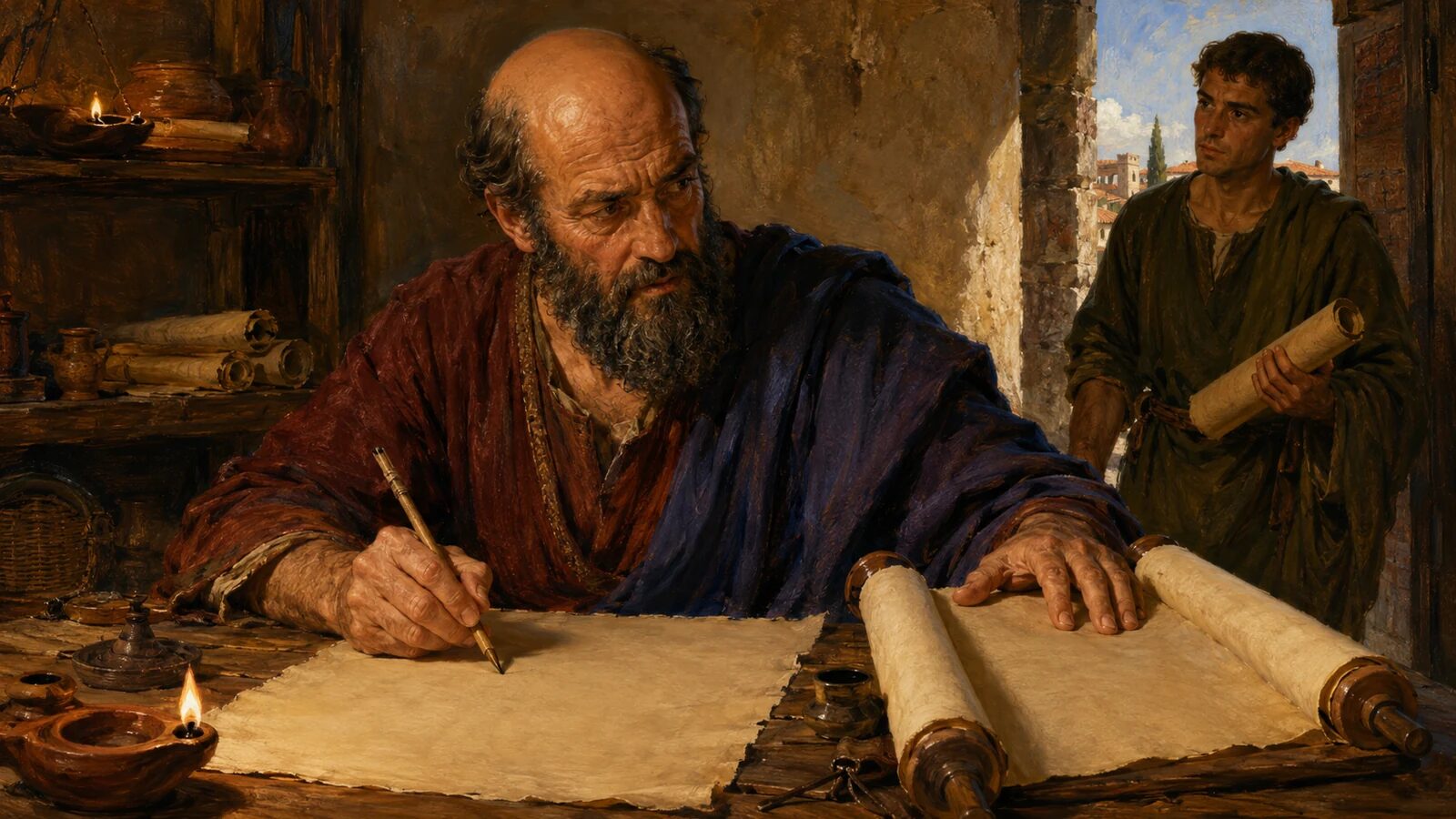
Hebrews does not name its human author in the opening, yet I believe Paul wrote it. That conclusion needs more than a familiar phrase or one promising clue. I want to look at what the book tells us alongside the rest of the New Testament and early Christian history, while being honest about what the text leaves unsaid.
Let Hebrews Set the Question in Its Proper Place
Hebrews opens with the Son as the Father’s final revelation and keeps bringing us back to His greatness. Jesus is greater than the angels and Moses, and His priesthood surpasses the Levitical order. As the writer explains the tabernacle and covenant, he shows how Christ’s sacrifice fulfilled what the old offerings could only foreshadow. The teaching about His blood and high priesthood leads to an invitation to approach the throne of grace. This is part of what makes Hebrews such a majestic book to me: its teaching calls us to enduring faith, with the steady concern that we not drift from Christ.
The first readers appear to have been Jewish believers under pressure to draw back. They knew the Old Testament worship system, so comparisons with angels, Moses, Joshua, and the Levitical priests concerned more than distant history. The tabernacle and animal sacrifices also helped them understand the writer’s appeal. Returning to those shadows would mean turning away from the Son and the finished work they had pointed toward.
Yet Hebrews does not begin, “Paul, an apostle of Jesus Christ,” as many of his letters do. The absence of that opening signature has raised questions for centuries. I cannot supply a name in the text simply because I have reached a conclusion about its author.
We do have evidence to examine. The closing verses connect the writer with Timothy and Italy, then end with grace in a way that fits Paul. Other New Testament passages help us understand his ministry. Early Christian writers also tell us how Hebrews was received and debated, while ancient copies placed it within collections of Paul’s letters. Those sources give us ways to weigh the question even without an opening signature.
Before going further, I want to keep the authorship question in its proper place. God inspired Hebrews and preserved it for the church, so its authority does not depend on our resolving every historical detail. We receive it as Scripture because God has spoken through His Son.
God, who at various times and in various ways spoke in time past to the fathers by the prophets, has in these last days spoken to us by His Son.
The opening directs us to Christ. He is far more than another prophet in a succession of messengers: He is the heir of all things, and God made the worlds through Him. The Son shines with the brightness of God’s glory. Having purged our sins, He sat down at the right hand of Majesty.
That does not make the human author unimportant. God used real men in history to write Scripture, and the Bible often tells us who they were. Luke refers to sources and eyewitnesses, while Paul normally signs his letters. Peter identifies Paul’s writings as Scripture, and John names himself in Revelation. Knowing the author can help me understand a book’s first audience and purpose, including why certain truths receive particular attention. I want to pursue that understanding without letting the question draw me away from the Son whom Hebrews exalts or place my judgment above the text.
The Clues Inside Hebrews Point Toward Paul
Several passages need to be read together here. Hebrews 1 directs us to Christ, while Hebrews 2:3 raises the strongest internal objection to Paul as the writer. The closing evidence in Hebrews 13 includes the description of the work as a word of exhortation. Its references to Timothy and Italy, followed by a greeting of grace, help us consider the writer’s connections. We can compare those clues with Acts, where Paul described his call before different audiences. Galatians 1 insists that his gospel came by direct revelation, while 1 Corinthians 9 explains how he adapted his approach without changing that gospel. The case depends on how these passages fit together.
In 2 Peter 3:15-16, Peter calls Paul “our beloved brother Paul” and says he wrote with wisdom given to him. He acknowledges that some of those letters are difficult to understand and that unstable people twist them as they do “the rest of the Scriptures.” I need to distinguish what that establishes from what it does not say. Paul’s letters were already recognized as apostolic writings with scriptural weight, but Peter does not directly identify him as the author of Hebrews.
Peter’s description fits the demands Hebrews makes on its readers. Its argument develops carefully from the Old Testament, but the writer is also urgently warning against drifting and unbelief. He confronts apostasy and dullness of hearing in passages a careless reader can badly mishandle. Paul had the scriptural training to write such a work. He had been zealous in the Scriptures before his conversion, and the risen Christ then confronted him and appointed him to preach. God used him to write letters the churches received as Scripture.
Acts 9 records the risen Lord confronting and commissioning Paul. In Acts 22 and 26, Paul explained that same call before very different hearers. Galatians 1 makes clear that Jesus Christ Himself revealed the gospel to him. These accounts show both his direct call and his ability to explain it to different audiences. That helps me understand how Hebrews 2 can address the whole believing community in language suited to them without denying his direct call.
The writer of Hebrews knew the Old Testament deeply and treated it as God’s living voice. His readers were familiar with the priesthood and sacrifices, as well as the covenant and wilderness generation. He knew them well enough to warn them and expected to see them again. His mention of Timothy adds a personal connection, while the greeting links him with Italy and ends with grace.
I see those clues coming together around a Jewish Christian apostolic worker with deep scriptural training and a particular concern for Hebrew believers. His close connection with Timothy narrows the question further. Paul fits that description better than any other named candidate.
And I appeal to you, brethren, bear with the word of exhortation, for I have written to you in few words.
The Greek behind “word of exhortation” is logos tes parakleseos. Its range includes an appeal or exhortation that can encourage and warn. Similar wording appears in Acts 13:15 after the Law and the Prophets were read in a synagogue, which helps us hear Hebrews as a Scripture-filled sermon calling for a response. Yet the author also says, “I have written to you.” The work serves as both a written sermon and a letter, which helps explain why it does not begin like Romans or Galatians.
The teaching about priesthood and covenant was meant to move the readers to respond. Drifting from Christ would be deadly, but He had opened the way to God so they could draw near and hold fast. They were being urged to continue instead of turning back. When I read Hebrews with that appeal in mind, its rhythm makes sense as a sermon prepared for written circulation rather than a letter beginning with a sender and recipients.
Timothy is one of the strongest personal clues. The writer mentions him naturally because both he and the readers already know this trusted coworker.
Know that our brother Timothy has been set free, with whom I shall see you if he comes shortly.
Timothy’s connection with Paul runs through the New Testament. Paul called him a beloved son in the faith and sent him as a trusted coworker. His name appears alongside Paul’s in several letter openings, and Paul wrote two inspired letters directly to him. Of course another apostolic worker could have known Timothy. But I need to ask which author best explains the whole pattern, and this familiar reference brings us very close to Paul’s ministry.
Greet all those who rule over you, and all the saints. Those from Italy greet you. Grace be with you all. Amen.
The closing words of grace fit Paul’s regular practice, though that alone cannot identify the author. Italy also fits his imprisonment and Roman connections. I would leave the location itself open: the writer may have been in Italy, or people from Italy may have been with him elsewhere. Both readings allow the connection without making the greeting tell us more than it does.
Taken together, the writer’s scriptural training and apostolic authority fit Paul, as do his concern for Hebrew believers and familiarity with Timothy. The sermon-letter form explains why we are not reading an ordinary note. Italy and the closing grace add to that picture without proving it individually. Paul remains the explanation I find most convincing when all of those details are considered together.
The Main Objections Are Real but Not Decisive
I take the objections to Paul’s authorship seriously. Hebrews lacks his usual greeting and remains anonymous in the wording we possess. Its polished Greek and sermon-like arrangement differ from his letters written to address particular situations. Most challenging is Hebrews 2:3, which can sound as though the writer received the message through eyewitnesses rather than directly from Christ. I don’t believe these objections overturn the case, but they deserve an answer.
how shall we escape if we neglect so great a salvation, which at the first began to be spoken by the Lord, and was confirmed to us by those who heard Him.
Paul says in Galatians 1:12 that he received the gospel through revelation from Jesus Christ, not from a man or through ordinary instruction. That makes the objection understandable. How could Paul say salvation “was confirmed to us by those who heard” the Lord? Some readers consider the question decisive against him.
In Hebrews 2, the writer is warning the whole community against neglecting salvation. He includes himself with his readers in that shared responsibility rather than giving an account of how he first received the gospel. Paul could speak that way without denying his direct call or revelation from Christ. The message began with the Lord and was publicly confirmed by apostolic witnesses, with divine signs accompanying it. The warning appeals to that public confirmation, not to a message privately invented in a corner.
Style is probably the objection that persists most strongly. Hebrews sounds different from Galatians, with language more elevated than Paul’s ordinary letters. But before treating that difference as decisive, I need to consider what kind of work he was writing and whom he was addressing. The way a work was put into writing could also affect its final form.
Hebrews describes itself as a word of exhortation, and its extensive use of Psalms and the Prophets suits a formal sermon. A synagogue-style message built from the Law would naturally sound different from a letter correcting disorder in Corinth. It also had a different task from Paul’s urgent response to Galatian legalism. I would not expect those works to sound alike at every point.
Paul was a Hebrew of Hebrews who had trained under Gamaliel and become deeply familiar with Scripture. Acts repeatedly shows him reasoning with Jewish hearers from the Old Testament. He could address Hebrews tempted to retreat from Christ with a different emphasis from the one needed by Gentile churches struggling with idolatry or discipline. The audience helps explain the difference in approach.
A secretary or translator could also affect the final Greek wording. Romans gives us a simple example.
I, Tertius, who wrote this epistle, greet you in the Lord.
Tertius put Romans into writing without becoming its apostolic author. In the same way, a skilled helper could have expressed Paul’s exhortation to Hebrew believers in polished Greek. The helper’s choice of words would help explain a difference in style without changing whose teaching it was. I cannot tell you exactly how that might have happened in Hebrews, and Scripture does not name a secretary or translator for us. The possibility shows that a different final style can be compatible with Paul’s authorship; it does not establish the writing process as a fact.
Paul’s missing name is another difference to account for, since he usually identified himself. But the audience and purpose of Hebrews offer a reasonable explanation. In Acts 22, the Jewish crowd listened until Paul mentioned being sent to the Gentiles, then erupted against him. If he wanted Hebrew readers to hear the scriptural argument before reacting to his name, an unsigned opening would let him do that. It would be a pastoral strategy rather than deceit, fitting a work already different from his ordinary church letters.
Paul himself described this kind of adjustment in his approach.
and to the Jews I became as a Jew, that I might win Jews; to those who are under the law, as under the law, that I might win those who are under the law.
Paul adjusted his approach so people could hear the truth, without changing the gospel to avoid offense. An unsigned exhortation centered on Christ’s supremacy would fit that purpose by letting Hebrew readers hear the scriptural case before reacting to Paul’s name. I don’t take anonymity itself as proof. I do see why it need not conflict with the way Paul carried out his ministry.
Early Christian Witness Strengthens the Pauline Case
Early Christian testimony helps us understand how Hebrews was received closer to the time it first circulated, though it cannot overrule Scripture. The Greek-speaking churches of the East strongly associated the book with Paul. Clement of Alexandria explained the missing name as humility and strategy in addressing Hebrews. His explanation was later preserved by the fourth-century historian Eusebius. Clement also suggested that the polished language reflected the process by which the work reached its final Greek form.
Origen’s statement that God knows who wrote the epistle needs to be heard with the rest of his discussion. I would not hide that caution, but neither would I make it sound as though he rejected every conclusion. He said the thoughts belonged to the apostle and commended churches that received the epistle as Paul’s. His reservation concerned the final wording and how the letter was put together, rather than a simple rejection of Paul’s teaching.
The Latin-speaking churches of the West did have doubts. Tertullian associated Hebrews with Barnabas, and others proposed Luke or Clement. Apollos was suggested much later. These alternatives show that Christians recognized the same questions about style, audience, and the unnamed author that we discuss today. I don’t want to dismiss those questions, but none of the other candidates explains the full pattern as well as Paul.
The early papyrus manuscript P46, usually dated around the late second or early third century, contains a collection of Paul’s letters, also called a corpus. Hebrews appears after Romans within that collection. I would not build doctrine on the order of books in a manuscript or treat the order as proof of authorship. It does give us meaningful evidence that early copyists and readers associated Hebrews with Paul’s letters.
Tradition does not make someone a book’s author, and early writers do not stand in judgment over Scripture. Still, the strong Eastern association with Paul and the placement of Hebrews in P46 add historical weight to the evidence within the book. The testimony is not uniform, but it comes from Christians nearer the period of its circulation. I can value that witness without allowing it to replace the internal case.
Neither Clement nor Origen can settle the matter for us, and manuscript order cannot command our conclusion. Yet dismissing those witnesses simply because they are historical would also discard relevant evidence. They show that Paul’s connection with Hebrews was discussed early, not invented long after its origins had been forgotten. Questions about style were already recognized while the Pauline association remained strong.
Paul’s Gospel and the Purpose of Hebrews Belong Together
What most persuades me is the agreement between Hebrews and Paul’s teaching about Christ. Hebrews presents the Son as God’s final revelation, while Paul proclaims Him as the image of the invisible God in whom all fullness dwells. The teaching about salvation fits as well. Animal sacrifices could never perfect the worshiper, but Hebrews declares Christ’s offering sufficient. Paul places redemption in Christ’s blood and teaches that sinners are justified by grace through faith rather than works of the law.
Hebrews treats the Law with respect while showing how its priesthood and sacrifices point to Christ. The tabernacle and covenant do the same, along with the promises. That way of reasoning from the Old Testament fits Paul, who shows that Abraham was justified by faith. He explains the Law’s role in exposing sin while directing us to the fulfillment of God’s promise in Christ.
Hebrews 9-10 explains why Christ’s once-for-all offering fulfills what animal sacrifices foreshadowed. Romans 3 approaches the same gospel through God’s righteousness in Christ’s blood, received by faith. I see more than similar religious vocabulary in that agreement. Both works deny that the old system can provide the finished salvation God has accomplished in His Son.
Hebrews also combines warning and comfort in a way that fits Paul’s care for the churches. Drifting is deadly, yet Christ is sufficient. His blood has opened access to God, so believers can draw near. They must hold fast because God remains faithful. The reasoning serves people tempted to retreat by showing them why they can continue in faith.
The gospel center must remain precise. Jesus is the eternal Son, fully God and fully man. He was born of a virgin and remained completely sinless. Wicked men physically tortured, punished, and killed Him. Jesus willingly bore that real punishment for our sins in His innocent body. He shed His blood, died, was buried, and rose bodily. The Father did not punish, curse, abandon, strike, bruise, or pour wrath on Jesus.
Christ died for the whole world, and people can resist or reject God’s genuine offer. Whoever repents and believes is forgiven and justified before God. That person is born again and made new. The Holy Spirit indwells and seals the believer, who is eternally secure. Security never gives permission for lawlessness, and a superficial profession does not prove that someone was genuinely born again. The warnings in Hebrews call hearers to real faith and expose false profession. They do not teach that a truly born-again believer repeatedly falls in and out of salvation.
let us draw near with a true heart in full assurance of faith, having our hearts sprinkled from an evil conscience and our bodies washed with pure water.
Because Christ has offered Himself, believers can draw near with a conscience cleansed through His sufficient blood. That is the invitation I hear in this verse. With Him as our great High Priest, we must not retreat to the shadows now that the One they pointed to has come.
The objections have not persuaded me to set Paul aside. An anonymous opening requires care, but it does not make the author impossible to identify. The style can be understood in light of the sermon-like form and the possible help of a secretary or translator. Hebrews 2:3 speaks to a shared responsibility without denying Paul’s direct revelation from Christ.
Paul’s scriptural training and apostolic authority fit the work, while his concern for Jewish people fits its audience. His theology agrees with the book’s teaching, and Timothy’s familiar presence gives the argument a personal connection. The closing grace fits too. Paul had a pastoral reason to leave his name out, and the formal sermon-letter helps explain the style even before considering possible help with the Greek. Early Christian testimony and the book’s place in Pauline manuscript collections strengthen a case already grounded in those details.
I therefore believe Paul wrote Hebrews, not merely someone associated with him. We may not be able to reconstruct exactly how it reached its final written form, but that does not require abandoning the conclusion about Paul. We can be clear about the author while acknowledging what remains unknown about the process.
For related studies, see A Complete Bible Study on Melchizedek, How to Study the Bible Properly, and Textus Receptus or Received Text.
My Final Thoughts
I believe Paul wrote Hebrews because the internal clues fit him and withstand the main objections, with early Christian testimony adding weight to that conclusion. I cannot explain exactly how a secretary or translator may have helped shape the Greek, and I don’t want to invent an answer Scripture has not given us. What we have is a deeply Pauline exhortation that exalts Christ and calls Hebrew believers away from the danger of drawing back. Its authority rests on the God who spoke, even where historical details remain beyond our reach. I want to receive its message with that humility and with confidence in the Son who is greater than every shadow. His sacrifice is finished, so we should draw near through His blood and hold fast in faith.