
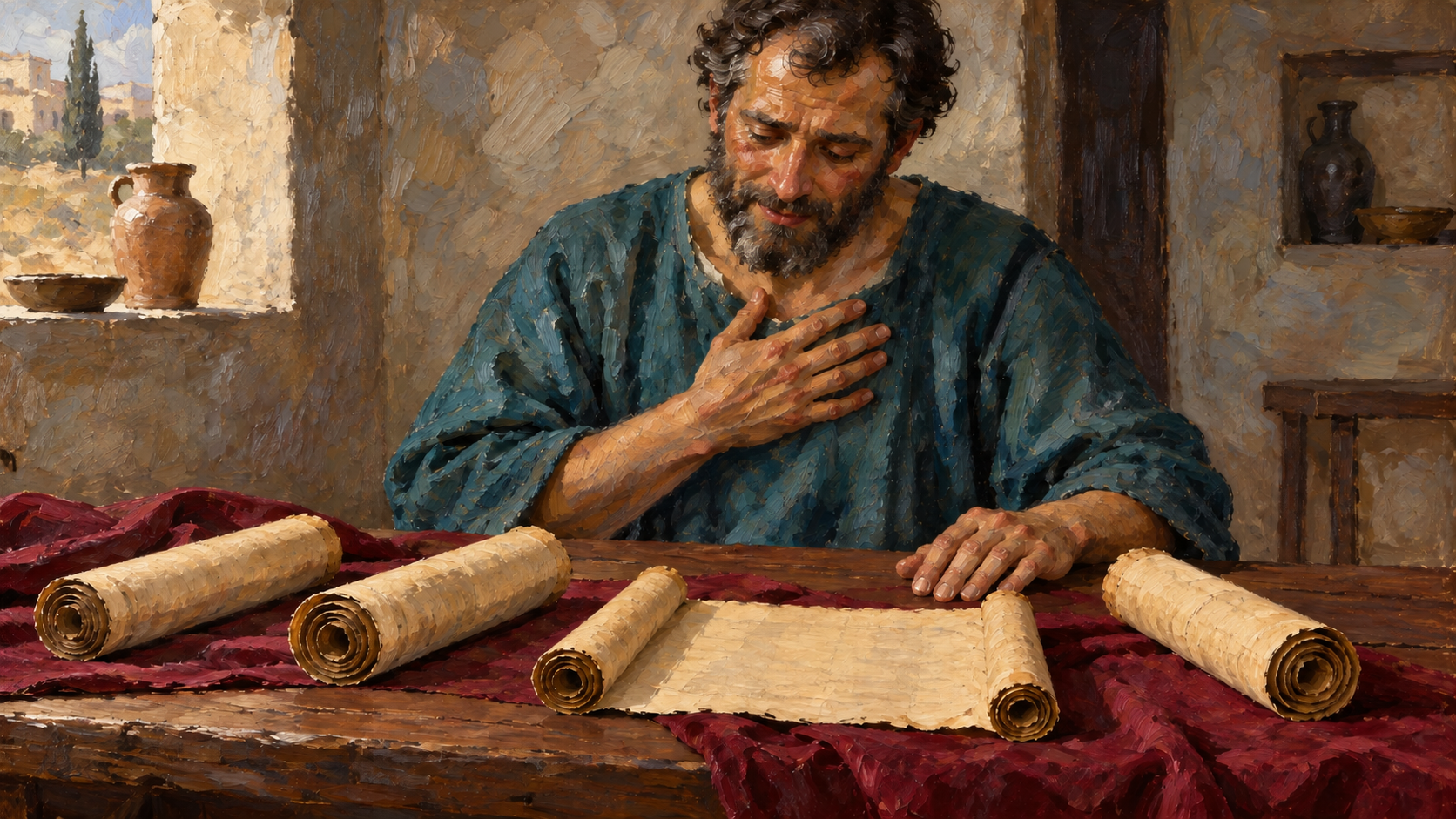
Why did God give us four Gospel accounts instead of one? I keep coming back to that question because the differences are not mistakes we need to smooth away. Matthew, Mark, Luke, and John each lead us to the same Jesus, and together they help us see Him more fully.
Four Gospels, One Historical Jesus
The New Testament begins with the accounts according to Matthew, Mark, Luke, and John. They bear truthful witness to the same Jesus, Israel’s promised Messiah and the eternal Son who became flesh. He lived without sin and willingly gave Himself on the cross before rising bodily from the dead. These accounts do not compete with one another or offer four different ways to be saved.
All four accounts take place in the same first-century world. Judea and Galilee were Jewish lands under Roman power, and Jerusalem’s temple was central to Israel’s worship. Synagogues served communities throughout the land and beyond it. The Law and the Prophets shaped how people understood God, while the appointed feasts ordered their worship. Roman taxes and competing religious groups also affected daily life as Israel waited for the promised Messiah. The writers assume we know much of that setting. When a feast or custom appears, I need to understand its place in their world, just as I need to recognize the ruler or Old Testament quotation they mention.
The accounts overlap because the writers describe the same public ministry. Their differences reflect the material each chose and how he arranged and emphasized it for a Spirit-guided purpose. Inspiration did not require them to use one vocabulary or include every detail in every account.
Some modern readers treat a difference as a contradiction or expect harmony to mean identical wording. Neither assumption is necessary. Truthful witnesses can describe different parts of the same event without disagreeing. They can also accurately summarize someone’s words or arrange material by topic and still write without error.
Reading all four helps me avoid reducing Jesus to just one part of what Scripture reveals about Him. Matthew presents Him as King and shows how He fulfills God’s promises. Mark shows His authority alongside His suffering and service. Luke carefully investigates the events and gives an orderly account of the Savior who seeks the lost. John reveals Him as the eternal Word and invites readers to believe in Him for life.
The Greek word euangelion means good news, and these books explain that good news by recounting what God did in history to save us through Jesus Christ. They preserve His teaching and signs, then show how opposition grew and led to the cross. His death and burial are followed by the proclamation of His bodily resurrection. The mission He gave His followers grows out of that good news.
An evangelist is someone who bears or writes this good news. Matthew, Mark, Luke, and John did not invent a religious message to suit four different communities. They received and testified to saving events God had accomplished in Christ. As they explain those events, they name the rulers and places involved and identify witnesses and public acts. Their explanation stays connected to what happened.
The Gospels resemble ancient biographies because they focus on a person’s identity and deeds. But they also explain Jesus in light of the inspired Scriptures and call for our response. We are summoned to repent and believe in Him, then worship Him and live as His disciples.
The title “Gospel” therefore identifies both the one apostolic message and the four canonical books that bear witness to it. There are four Gospel accounts, but one gospel by which sinners are saved.
Scripture does not give us a single sentence explaining why there are four accounts, so I wouldn’t pretend it does. We can see the benefit, though. Multiple inspired witnesses strengthen the historical testimony, and each writer’s emphasis helps us understand more of Christ’s person and work than one condensed volume could show. One account also preserves teaching and events that another writer did not need to include.
John openly says Jesus did many signs he did not record, and some degree of selection is unavoidable in every historical account. Selecting particular events does not weaken the testimony when the writer tells the truth and uses those events to accomplish his stated purpose.
That fuller witness asks something of me as a reader. I cannot take a few favorite sayings and use them to make Jesus into whoever I want Him to be. The Lord who speaks with authority also shows mercy, and His holiness and judgment belong with His suffering on the cross. We need to receive all that these witnesses tell us about His deity and humanity, including His death and resurrection.
The Holy Spirit’s inspiration worked through careful investigation and human memory. The evangelists listened to testimony and deliberately chose words as they wrote. God oversaw that work so that everything they wrote is true and authoritative, yet each account genuinely carries its author’s voice.
Inasmuch as many have taken in hand to set in order a narrative of those things which have been fulfilled among us, just as those who from the beginning were eyewitnesses and ministers of the word delivered them to us, it seemed good to me also, having had perfect understanding of all things from the very first, to write to you an orderly account, most excellent Theophilus, that you may know the certainty of those things in which you were instructed.
Luke had earlier narratives available to him, along with testimony from eyewitnesses who had become ministers of the Word. After gaining a careful understanding of the events, he arranged his account to give Theophilus certainty. I see his use of sources as strengthening the account’s historical credibility. Inspiration guarantees the Scripture that resulted without requiring dictation detached from evidence.
Matthew and John witnessed Jesus directly. Mark preserves apostolic testimony closely connected with Peter, while Luke investigates the eyewitness tradition and writes as a companion of Paul. When I weigh the evidence, these traditional authors make far better sense than theories that place the books in anonymous late communities.
The books support those identifications in different ways. Matthew is named among the Twelve and identified as the tax collector. In Acts, passages describing Luke’s companionship move into the first person plural, while Paul’s letters name him as the beloved physician and a fellow worker. John closes his account by identifying the beloved disciple as the witness who wrote these things.
Mark was not one of the Twelve, but the New Testament places John Mark within the apostolic mission. The early church also connected his account with Peter’s preaching. We can state this evidence honestly without pretending that every author supplied a modern title page inside the narrative.
The Four Evangelists and Their Emphases
Matthew, an apostle and former tax collector, presents Jesus as the Son of David and Son of Abraham. He is the promised Messiah whose teaching carries authority. By the end of Matthew’s account, this King commissions His disciples to make disciples among all nations.
John Mark’s energetic account is closely associated with Peter’s testimony. People repeatedly misunderstand Jesus even as He acts with unmistakable authority. Mark helps us follow His mission as a servant through suffering and the cross to the victory of resurrection.
Luke was a physician and Paul’s companion. In writing his orderly account to Theophilus, he places Jesus in public history and gives close attention to prayer and the Holy Spirit. He also shows the Savior’s mercy reaching people others had regarded as lost or unimportant.
John was an apostle and the beloved disciple. He selects signs and preserves extended teaching so that readers will believe Jesus is the Christ, the Son of God. Through that faith, they may have life in His name.
Matthew, Mark, and Luke are called Synoptic because large portions can be “seen together” in parallel. All three begin Jesus’ public ministry with His baptism and temptation, then follow His teaching and miracles in Galilee. Many of the same parables appear in each. They record Peter’s confession before turning toward the journey to Jerusalem, where their accounts converge on the Last Supper and then the crucifixion and resurrection.
Synoptic is a descriptive term, not an inspired one, and it does not tell us exactly how the writers used their sources. Shared apostolic preaching and eyewitness memory help explain the overlap, along with written records and the events the writers have in common. Scripture never requires us to accept the lost hypothetical document called Q.
Nor does the overlap prove Mark wrote first. Composition dates and literary priority remain debated. We can affirm first-century apostolic origin and the truth of each Gospel without adopting speculative source criticism.
Matthew’s opening names Jesus Christ as the Son of David and Son of Abraham. His genealogy places Jesus within the royal line and God’s covenant promise. As Matthew recounts His birth, he repeatedly connects what happened with what the Lord had said through the prophets.
Jesus taught with authority and announced God’s kingdom. His works identified Him as the promised Messiah, and His words exposed religious hypocrisy. He was also preparing disciples to carry His message beyond Israel. At His entry into Jerusalem, He openly presented Himself as the promised King before giving His life and rising from the dead. Matthew ends with His declaration that all authority in heaven and on earth belongs to Him.
Matthew’s account is deeply rooted in Jewish life, but I notice how often it looks beyond Israel. Gentile women appear in the genealogy, and Gentile Magi came to worship the child. Later, a Roman centurion displayed faith. The risen King’s command to make disciples among all nations fits that worldwide scope.
Do not think that I came to destroy the Law or the Prophets. I did not come to destroy but to fulfill. For assuredly, I say to you, till heaven and earth pass away, one jot or one tittle will by no means pass from the law till all is fulfilled.
By “Law or Prophets” Jesus refers to Israel’s Scriptures. He did not come to tear them down. He perfectly obeys them and fulfills their promises and prophecies, bringing their sacrificial and covenant patterns to their intended goal. His teaching also shows their true moral depth.
Fulfillment does not place the church under the Sinai covenant. Christ establishes the new covenant in His blood, and believers serve under His authority. The Old Testament remains inspired, profitable, and necessary for understanding Him.
Matthew’s phrase “kingdom of heaven” ordinarily means the same divine reign described elsewhere as “kingdom of God.” Reverent Jewish wording may have influenced his expression. I would still let the context show any particular nuance instead of assigning it a fixed meaning by formula.
Mark passes over a birth account and begins directly with the ministry of Jesus Christ, the Son of God. His fast pace gives the account urgency, but we shouldn’t mistake that for shallow or careless writing. He describes settings vividly and pays attention to people’s reactions. He also lets us hear private explanations as the disciples slowly grow in understanding.
Jesus commanded unclean spirits and forgave sins by His own authority. The sea obeyed Him, and disease yielded to His word. He raised the dead and fed a multitude, while His teaching carried authority no merely human servant could possess. Mark’s question “Who can this be?” leads us toward Peter’s confession and the centurion’s recognition at the cross.
After Peter confessed Jesus as the Christ, Jesus began to explain what His mission required. The Son of Man had to suffer and be rejected. He would be killed, then rise from the dead. We cannot separate His glory from His cross. Nor can I call mere admiration discipleship if I refuse the self-denial that following Him requires.
But Jesus called them to Himself and said to them, “You know that those who are considered rulers over the Gentiles lord it over them, and their great ones exercise authority over them. Yet it shall not be so among you; but whoever desires to become great among you shall be your servant. And whoever of you desires to be first shall be slave of all. For even the Son of Man did not come to be served, but to serve, and to give His life a ransom for many.”
The disciples wanted rank, but Jesus taught them to measure greatness by service and pointed to His own mission as the reason. The word translated ransom is the Greek lytron, meaning the price paid to secure someone’s release. Understanding that word helps us see what He was giving, while “for many” identifies His life as given on behalf of others.
At the cross, wicked men physically tortured and punished the sinless Son of God before killing Him. Jesus willingly bore that real punishment in His innocent body for our sins. In this bodily sacrifice He shed His blood for the whole world and died. He was buried, and God raised Him bodily from the dead. The Father did not punish or curse Jesus, abandon Him, strike or bruise Him, or pour wrath on Him. Christ’s willing death accomplished its saving purpose.
Luke recounts Jesus’ birth in the public history of named rulers and towns, with attention to the priestly service and family lines surrounding it. Heaven’s announcement came into those ordinary human settings. Luke also gives careful attention to women and children and to people who were poor or sick. He includes tax collectors and other public sinners without overlooking Samaritans or Gentiles. All of this belongs to his account of the gospel, which he never turns into a political program.
And Jesus said to him, “Today salvation has come to this house, because he also is a son of Abraham; for the Son of Man has come to seek and to save that which was lost.”
In Zacchaeus we see grace producing repentance. Jesus sought a despised tax collector, and salvation came to his house. The change in how Zacchaeus used money then showed a change in his allegiance. His restitution did not buy salvation; it was fruit of receiving the Savior.
Luke’s attention to vulnerable people should help us see what Jesus’ mercy produces. Practical compassion follows that mercy, while the problem He came to answer remains sin and lostness. I would not turn Luke’s concern into a social gospel that replaces reconciliation to God. Luke presents Jesus Himself as the answer.
Luke addressed both of his volumes to Theophilus. The Gospel tells what Jesus began to do and teach in His earthly ministry. Acts continues with the risen Lord working through the Holy Spirit and the witnesses He commissioned.
Acts opens by deliberately recalling Luke’s “former account.” Jesus spent forty days giving the apostles evidence that He had risen and teaching them about the kingdom. Before ascending, He told these same disciples that their witness would spread from Jerusalem into Judea and Samaria, then to the end of the earth. Acts follows that movement. What began as the Gospel’s closing commission becomes the mission we watch unfold in Luke’s second volume.
Luke repeatedly brings us to prayer and the Holy Spirit. Jesus was conceived by the Spirit and later anointed for public ministry. He rejoiced in the Spirit and prayed at decisive moments. Near the Gospel’s end, He promised His disciples power from on high and told them to wait for it. Those details prepare us for Pentecost and the mission described in Acts.
The road to Emmaus helps me understand how Luke connects these things. Jesus explained to the travelers what Moses and the Prophets had written concerning Himself. Later, with the disciples gathered in Jerusalem, He opened their understanding of His necessary suffering and resurrection. He also showed them that repentance and remission of sins were to be preached to all nations. Luke brings the Old Testament together with the cross and resurrection, then shows why that message must go throughout the world.
In the beginning was the Word, and the Word was with God, and the Word was God. He was in the beginning with God. All things were made through Him, and without Him nothing was made that was made.
John takes us back before Bethlehem, even before creation. The Word already existed with God as a distinct Person, and He was God. Every created thing came into being through Him, so He cannot be a created intermediary. I need to keep both parts of John’s statement together: personal distinction and full deity.
And the Word became flesh and dwelt among us, and we beheld His glory, the glory as of the only begotten of the Father, full of grace and truth.
The eternal Son became truly human while remaining God. “Dwelt” translates a verb related to pitching a tabernacle, connecting the wording with God’s glory once associated with the sanctuary. That glory is now revealed personally in Jesus. John does not describe this from a distance; he speaks as one of the apostles who beheld His glory.
John builds much of his account around selected signs. Jesus turned water into wine and healed the sick. He multiplied bread and crossed the sea. Later, a man born blind received his sight, and Jesus raised Lazarus from the dead. These remarkable works reveal who Jesus is and the authority He possesses. They call us to trust Him, not simply marvel at the works themselves.
John usually calls a miracle a “sign” because it points us beyond the event itself. After multiplying bread, Jesus explained that He is the bread of life. Healing the blind man exposed spiritual blindness, while raising Lazarus displayed Him as the resurrection and the life. Yet the people who saw these things did not all respond alike. Some believed, but others hardened themselves or sought to kill Him. A sign confronted them with Christ’s identity without forcing them to believe in Him for salvation.
And truly Jesus did many other signs in the presence of His disciples, which are not written in this book; but these are written that you may believe that Jesus is the Christ, the Son of God, and that believing you may have life in His name.
John tells us plainly why he selected those events. He wasn’t trying to record everything Jesus did. He gives truthful evidence sufficient to establish who Jesus is and invites the reader to the faith through which we receive life.
John also preserves Jesus’ memorable “I am” sayings. The Greek expression ego eimi can be ordinary speech or a weighty claim, depending on where it is used. To understand it honestly and accurately, I need to look beyond the words alone. Does the setting echo God’s self-revelation? Does the claim provoke a hostile response, or does Jesus identify Himself as the unique source of life? The context establishes its force. We should neither weaken the expression everywhere nor assign it a meaning without reading its setting.
The Four Accounts Are Historically Reliable
All four writers connect Jesus with John the Baptist’s ministry and describe His public works along with the conflict around Him. Each follows the final movement toward Jerusalem with key disciples beside Him. They recount the setting of the Last Supper and the betrayal that followed, then testify to His crucifixion under Pontius Pilate and His burial by Joseph of Arimathea. Every account ends with the empty tomb and the proclamation that Jesus rose bodily.
John includes material the Synoptics leave out, and they include much that John omits. We should expect that from writers selecting what to record. An omission is not a denial: Mark does not reject the virgin birth by leaving out a birth account, any more than John denies that Jesus taught parables by omitting many of them.
The traditional description of Matthew’s King, Mark’s Servant, Luke’s Son of Man, and John’s Son of God can help us recognize each writer’s emphasis. I would use it as a guide, though, without confining each account to that description. Matthew also teaches Christ’s deity, and Mark presents His kingship. Luke affirms His divine identity, while John insists that He is genuinely human.
One writer may concentrate on a representative speaker where another mentions two people. The same is true when one focuses on an angel while another tells us two were present. A writer may also summarize a sequence of events. A true statement can be narrower than another true statement without contradicting it.
Ancient writers sometimes grouped material by theme. Matthew brings extended teaching together into major discourses, while Mark often moves quickly from one scene to another. Luke promises an orderly account without saying every paragraph will follow moment-by-moment chronology. John chooses particular festivals and signs to develop the purpose he states.
Jesus likely taught the same truth more than once as He traveled and ministered over the years. A teacher speaking to different crowds naturally repeats central instruction with suitable variation. So similar sayings in different settings need not be competing accounts of a single occasion.
When I compare the accounts, I want to begin by letting each writer speak in his own context. Then I can ask how the details fit together. We should not invent facts merely to remove every unanswered question, but neither should we announce a contradiction simply because a detail requires thought.
Matthew follows Jesus’ ancestry from Abraham through David and the royal line, arranging the names in memorable groups. Luke works backward from Jesus to Adam and finally to God. That fits his broad emphasis on the Savior for humanity. Both record real descent and place Jesus within history.
Their starting points fit what each writer is explaining. Matthew presents the Son of Abraham and Son of David within Israel’s covenant and royal history, so he begins with Abraham. Luke places the genealogy after Jesus’ baptism and goes back beyond Abraham to Adam, connecting Christ’s true humanity with the whole human family. Neither writer means that Jesus began to exist with His human ancestry. The eternal Son entered that family line through the virgin conception.
After David the lines differ: Matthew follows Solomon, and Luke follows Nathan. Faithful interpreters have proposed that Matthew records the royal and legal succession through Joseph, while Luke gives another family line. That second line is often understood to come through Mary, with Joseph named according to legal convention. Others explain the difference through levirate family relationships, which could give a man one legal father and another biological father.
I want to acknowledge what we aren’t told here: Scripture does not explain every link in those genealogies. Still, their difference does not establish a contradiction. A genealogy could trace legal succession instead of biological descent. Marriage and adoption could affect the record, as could the duty of levirate marriage. Both accounts present Jesus as David’s rightful heir and a truly human person, miraculously conceived without a human father.
Matthew describes the Sermon on the Mount, while Luke describes teaching on a level place. Some wording overlaps, but the settings and surrounding details differ. Jesus may have given similar instruction on separate occasions. It is also possible for a broad elevated area to include a level place. Neither writer says the other’s description is false.
The final two temptations appear in a different order in the two accounts. Matthew frequently uses a sequence that can be read chronologically, while Luke can arrange the scenes to finish at Jerusalem. I would look at how they connect those scenes before assuming a conflict. Their connective language does not require us to read both as asserting incompatible chronologies.
Matthew, Mark, and Luke place the temple cleansing near the final week of Jesus’ ministry. John records one early in His ministry. Two cleansings are entirely possible, and the different words and responses fit that explanation. Someone may instead argue that John arranged the event by topic, but showing a different placement still doesn’t show that one account denies another.
Judas’s death raises another familiar question. Matthew says he hanged himself, while Acts describes his body falling and bursting open in the field associated with his betrayal money. A hanging can be followed by a fall, so those are compatible descriptions of his death and its aftermath. Matthew focuses on the priests purchasing the field. That does not conflict with its being acquired through money from Judas’s transaction.
The Synoptics tell us that the disciples prepared and ate the Passover with Jesus. John refers to leaders avoiding defilement so they could eat the Passover, and he also mentions the day of Preparation. Some readers take those statements to mean John places Jesus’ death before the meal the Synoptics describe.
We need to consider how those terms are used. Passover can mean the lamb or the meal, but it can also describe the larger festival period. Preparation can refer to getting ready for a Sabbath during the feast. Different Jewish ways of reckoning a day have also been proposed. These considerations make coherent readings possible without rewriting the text.
The central testimony remains clear. Jesus knowingly went to Jerusalem and shared the meal with His disciples, establishing the remembrance of His body and blood. He was then betrayed and condemned. Under Pilate, He suffered physical abuse before being crucified. He shed His blood and died, and His body was buried before the Sabbath. All four writers describe a public event in a real time and place.
Each writer names women relevant to his account, which explains why the lists differ. Naming Mary Magdalene does not mean she came alone. In the same way, concentrating on the angel who spoke does not mean no other angel was there.
The women arrived early to find the stone moved and the tomb empty. Angels told them Jesus had risen, and they carried that news to His followers. Jesus Himself appeared to His followers in a real body. His disciples saw and heard Him, touched Him, and ate with Him before receiving His commission. We can understand the witnesses’ surprise and fear. Their movement between different messengers and the several distinct appearances explain why the accounts emphasize different details and sequences.
The appearances in Jerusalem and Galilee also fit together. Jesus appeared first in and around Jerusalem, then met His disciples in Galilee as He had promised. No account says every appearance took place in a single morning or a single location. Paul later names additional witnesses, including more than five hundred brethren at once. His summary confirms that the Gospel writers chose from a larger history of resurrection appearances.
If someone were fabricating an account, they would likely remove the initial confusion and make socially prominent men the first witnesses. Instead, these candid details have the character of remembered testimony. For all their different emphases, the writers agree that the crucified Jesus truly rose in His body and will never die again.
Modern editions often bracket Mark 16:9-20 or place a warning around John 7:53-8:11 because of Alexandrian critical-text judgments. I receive these passages as canonical Scripture because they belong to the Textus Receptus and the received Byzantine tradition.
Mark’s longer ending records resurrection appearances and the commission, followed by the disciples’ witness. I read it alongside the rest of Scripture, including the descriptions of signs accompanying the apostolic mission. It gives us no permission to test God recklessly, nor does it make any particular sign the universal proof that a person is saved.
In the account of the woman caught in adultery, Jesus answered a malicious trap with wisdom and called the woman to leave sin. His grace did not excuse adultery or set aside lawful standards of evidence. He refused the accusers’ corrupt proceeding while still commanding a changed life.
Textual questions deserve honest discussion. After weighing them, however, I do not allow speculative reconstruction or the Septuagint to overrule the received New Testament base text and the Hebrew Masoretic Text.
Jesus grew from childhood into adulthood under ordinary human conditions. He knew hunger and sleep, and His grief was genuine. His body bled, and He truly died. Those details describe real humanity, not the appearance of it. Born of the virgin Mary in David’s line, He nevertheless remained completely sinless.
The same Jesus forgave sins by His own authority, and both nature and unclean spirits obeyed Him. He knows what is in the human heart and rightly receives worship. He claimed rights belonging to God and gave life before rising bodily from the dead. John states His deity directly, but we encounter that same divine identity throughout the Synoptics.
None of the four presents a human teacher who was gradually promoted into divinity. Matthew’s child is Immanuel, God with us. Mark calls Him the Son of God and applies the prophecy about the Lord’s way to His arrival. In Luke, the promised child is holy and the Son of God. John identifies Him as the eternal Word who is God and became flesh.
Christian confession must preserve both natures without division or confusion. The one Mediator is fully able to reveal God because He is God and fully able to represent humanity because He truly became man.
The One Gospel They Proclaim
For I delivered to you first of all that which I also received: that Christ died for our sins according to the Scriptures, and that He was buried, and that He rose again the third day according to the Scriptures,
Paul’s summary agrees with the four Gospels. The saving message depends on who Christ is and what actually happened: He died for our sins, was buried, and rose bodily according to Scripture.
Because Christ died for the whole world, God’s offer of salvation is genuine, though people can resist and reject it. Everyone who repents and believes in Jesus Christ is forgiven and justified, receiving the new birth by grace rather than personal merit. Ancestry cannot save us, and neither can obedience to the law. Religious works and water baptism cannot earn salvation. The person who truly believes becomes a new creation, indwelt and sealed by the Holy Spirit and eternally secure in Christ.
Eternal security is no permission for lawlessness, and a superficial profession is no proof of new birth. The Gospels call disciples to follow the Lord they trust. Obedience is the fruit of life received, never its purchase price.
Reading the Gospels Well
I would begin by reading one Gospel all the way through. Pay attention to how the writer opens and how he develops the themes that keep returning. Follow the turn toward Jerusalem and the way he presents the cross. Then notice how the resurrection witness leads into the closing commission. Familiar verses become easier to understand when we keep them within that whole argument.
After that, compare parallel events. Record what each account actually says before proposing a harmony. One writer may give more detail or follow a different participant. Jesus may also have repeated the same teaching on more than one occasion. Explicit statements should govern the inferences we draw.
Give the Old Testament references that same attention. God’s covenants with Israel are assumed throughout the Gospels, and the sacrificial system gives us essential context for understanding the cross. The appointed feasts shape the events being recounted as well. When we recognize the promises of a coming King and the prophetic hope of God’s saving arrival, we can understand what Jesus fulfills. He did not appear apart from that history.
Reading carefully should also lead me to respond. The evangelists do more than give us a chronology. They call us to recognize Jesus and turn to Him in repentance and faith. Having believed, we are called to follow and worship Him, remembering His words and bearing witness to His death and resurrection.
My Final Thoughts
God has given us four truthful witnesses to the same Lord, and I find encouragement in how their different emphases deepen our confidence in Him. Matthew helps us recognize the promised King. Mark shows His authority through service and suffering, while Luke follows Him as He seeks the lost. John takes us back before creation to the eternal Word who became flesh. Each account brings us to His real death and bodily resurrection. As we read them carefully, all four lead us to the Savior we are called to trust and obey.