
What are we supposed to make of the Bible’s accounts of giants? Some readers explain them away, while others pursue every strange claim. I want to follow what Scripture tells us from Noah’s day through David’s reign, paying attention to the people and the places where these battles happened. The details of Genesis 6 receive fuller treatment in A Complete Bible Study on the Nephilim. Here we will consider the God whose covenant promises the giants could not stop.
The Nephilim and the Rebellion of Genesis 6
The first major passage is Genesis 6:4. The NKJV uses the word “giants,” and the Hebrew word behind it is Nephilim. Genesis places them on the earth before the Flood and then adds that they were there “also afterward.” It connects their appearance with the sons of God taking the daughters of men and with the mighty men of renown who came from those unions.
The way I understand this passage, the sons of God were heavenly beings who crossed a boundary God had established. This was not a description of ordinary marriages between men from the line of Seth and women from the line of Cain. Job uses the phrase “sons of God” for heavenly beings. Jude and 2 Peter then warn about angels who sinned and left the place God gave them, placing their judgment beside God’s judgment of the ancient world.
And the angels who did not keep their proper domain, but left their own abode, He has reserved in everlasting chains under darkness for the judgment of the great day.
For if God did not spare the angels who sinned, but cast them down to hell and delivered them into chains of darkness, to be reserved for judgment; and did not spare the ancient world, but saved Noah, one of eight people, a preacher of righteousness, bringing in the flood on the world of the ungodly.
Comparing these biblical passages is what leads me to this conclusion, rather than an appeal to mythology. Genesis describes a serious corruption of the created order, and Jude and Peter speak of angels who sinned and left the place God had given them. The giants belonged to that ancient world, where supernatural rebellion was real and fed its violence. God judged that rebellion while preserving Noah through the Flood.
Scripture says the Nephilim were present before the Flood and also appeared afterward, including in the spies’ report from Canaan. It does not give us a complete biological or historical explanation for every later appearance. I am willing to leave that question where Scripture leaves it. We can affirm what God revealed without filling in what He has not told us with folklore or speculation.
Understanding the Hebrew words helps us avoid treating every mighty person as a giant. Nephilim is translated “giants” in Genesis 6:4 and Numbers 13:33 in the NKJV, whereas gibbor means a mighty or dominant person. The latter word may describe unusual strength without identifying someone as a giant. We need to read the passage itself to understand whom it describes.
Giant Peoples in Lands God Named
As Scripture follows Israel toward Canaan, it names several peoples associated with giants. Moses, Joshua, and the later writers do not use all these names as a single definition, so we need to follow each one in context. The Anakim descended from Anak and were the people Israel feared most at the border. Moses described them as great and tall. Their reputation was so fearsome that people asked, “Who can stand before the descendants of Anak?”
A people great and tall, the descendants of the Anakim, whom you know, and of whom you heard it said, "Who can stand before the descendants of Anak?"
The Rephaim appear to be a broader classification connected with giants. Deuteronomy explains that neighboring nations used different regional names. The Emim had once lived in the land later associated with Moab, and the Zamzummim had lived in the region associated with Ammon. Both peoples were compared with the Anakim.
The Emim had dwelt there in times past, a people as great and numerous and tall as the Anakim. They were also regarded as giants, like the Anakim, but the Moabites call them Emim.
That was also regarded as a land of giants; giants formerly dwelt there. But the Ammonites call them Zamzummim, a people as great and numerous and tall as the Anakim.
These names identify whole peoples and family lines in regions their neighbors knew. That is why I do not want to gather them all under one loose label and lose the details. Different nations could use different names for people of the same general kind, but Scripture still places them in concrete history. It connects them with real places and events rather than fairy tales.
Amos describes the Amorite’s height and strength by comparing him with great trees. I would not take that imagery to mean every Amorite was a giant in the same sense as the Anakim or Rephaim. It shows how overwhelming some Amorite power appeared to Israel, and God reminded His people that He was the One who destroyed it.
Yet it was I who destroyed the Amorite before them, whose height was like the height of the cedars, and he was as strong as the oaks; yet I destroyed his fruit above and his roots beneath.
Og king of Bashan is one of the clearest named examples. Scripture says that he remained from the remnant of the giants, then gives the dimensions of his iron bedstead. A bed nine cubits long and four cubits wide was a known object in Rabbah, not a vague symbol of fear.
For only Og king of Bashan remained of the remnant of the giants. Indeed his bedstead was an iron bedstead. Is it not in Rabbah of the people of Ammon? Nine cubits is its length and four cubits its width, according to the standard cubit.
Og had both imposing physical strength and a powerful kingdom, yet he was still subject to the Lord. His defeat was part of Israel receiving the land God had promised to Abraham, Isaac, and Jacob. I notice that God did not ask His people to pretend their enemy was small. He showed them that even this formidable king remained under His word.
The Anakim, Rephaim, Emim, and Zamzummim occupied lands where neighboring nations remembered them. Their kings ruled actual territory, and Israel met their armies in battle. Scripture even identifies places where remnants remained. These details keep the names from becoming merely a list of unfamiliar words. They let us see God’s promise holding firm through events in real places.
Fear at the Border and Obedience in the Land
Numbers 13 brings the problem into sharp focus. The spies saw the descendants of Anak in Canaan, used the name Nephilim in their report, and said that they felt like grasshoppers beside them. They were not wrong to see danger. They sinned when they allowed the danger to outweigh the promise of God, then spread their fear through the congregation until Israel refused to enter the land.
The spies’ words reveal how fear had already reshaped their thinking. They first described how small they felt in their own sight, then assumed that the giants must have seen them the same way. Their report moved from observation into a conclusion God had never given them. The enemy’s size became the standard by which they judged both themselves and the Lord’s ability to keep His oath.
That generation had seen the Lord judge Egypt and open the sea. He had fed them in the wilderness and promised them the land. Yet they treated fortified cities and tall enemies as more reliable than His word. That helps me see where fear became unbelief: the danger changed how they judged what God had said.
Joshua later faced the Anakim and obeyed the Lord. The danger was still real, but he understood it in light of God’s promise. His campaign reached the mountains of Judah and Israel, including the named places of Hebron, Debir, and Anab.
And at that time Joshua came and cut off the Anakim from the mountains: from Hebron, from Debir, from Anab, from all the mountains of Judah, and from all the mountains of Israel; Joshua utterly destroyed them with their cities.
Joshua removed the Anakim from Israel’s land, but remnants remained in several Philistine cities. Where they remained helps us connect Joshua’s campaign with the later history of David.
None of the Anakim were left in the land of the children of Israel; they remained only in Gaza, in Gath, and in Ashdod.
Goliath came from Gath, one of the cities where those remnants remained. His appearance in 1 Samuel 17 continues the conflict Scripture had already traced through Moses and Joshua. We are not suddenly leaving that history for an isolated episode in David’s life. Once again, an enemy whose strength terrified Israel stood against the promise and honor of the living God.
Joshua’s obedience shows that the wilderness generation had no justification for its unbelief. He faced people who were just as great and tall, but he believed the Lord who had spoken. Under God’s command, Joshua accomplished what the earlier generation had called impossible. The difference was his trust in God, not a smaller enemy.
David and the Giant Warriors of Gath
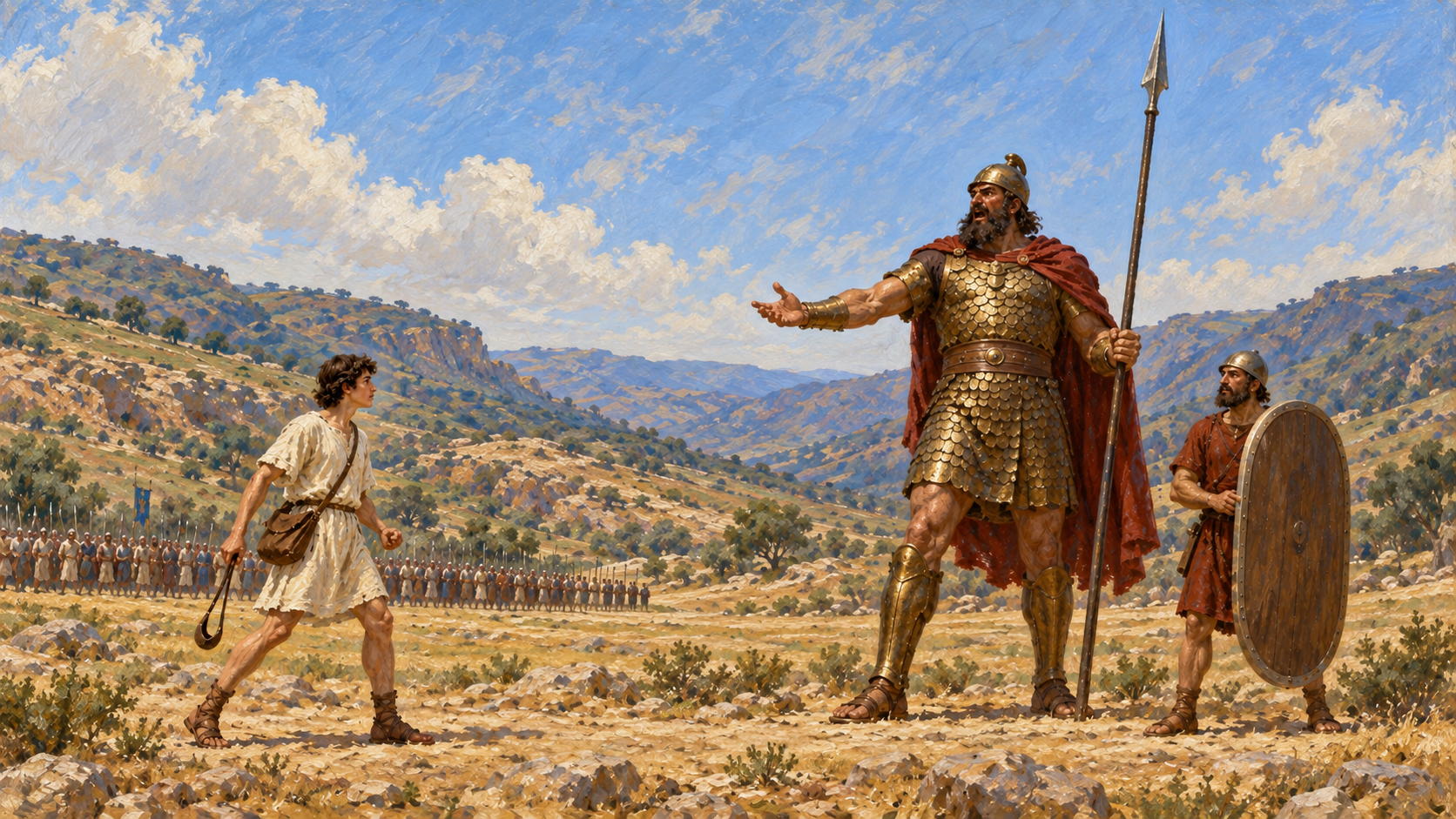
Goliath is the best-known giant in the Bible. Scripture calls him a champion and gives his height as six cubits and a span. Saul and the army heard his challenge and trembled. David heard the same words and wanted to know why an uncircumcised Philistine was being allowed to defy the armies of the living God.
David heard an attack on God’s covenant honor when Goliath challenged Israel. That is what holds my attention in the way he understood the battle. He knew Goliath’s size and could see his armor, and he did not deny the man’s experience. But he refused to judge those advantages as though God were absent. David came in the Lord’s name. The battle was not a contest between his own hidden strength and Goliath’s visible power.
Goliath was not the last warrior tied to the giant line in Gath. Later, Ishbi-Benob tried to kill David, but Abishai struck him down. Saph, called Sippai in 1 Chronicles 20:4, fell to Sibbechai. According to 1 Chronicles 20:5, Elhanan killed Lahmi, the brother of Goliath. Another man of great stature had six fingers on each hand and six toes on each foot. Jonathan the son of Shimea killed him after he defied Israel.
These four were born to the giant in Gath, and fell by the hand of David and by the hand of his servants.
David’s victory was the beginning of a larger conflict that his servants continued. Through His anointed king and the men loyal to him, God preserved His people. I also need to keep David’s place in the royal line in view. The Messiah would come through that line, so Goliath’s defeat belonged to God’s preservation of the promise fulfilled in Jesus Christ, the true Son of David.
David remembered how the Lord had delivered him before, and his confidence rested in Him. He recognized Goliath’s defiance of God and acted in faith, rather than relying on his own youth or skill or courage. The victory magnified the Lord and protected the people through whom the Davidic promise would continue. If I turn this into a lesson about believing in myself, I lose the reason David was confident.
What Scripture Lets Us Say—and Where We Must Stop
Some people in the Bible are associated with unusual might, great stature, or a giant family without being explicitly called giants. Nimrod is called a mighty one and a mighty hunter before the Lord. His kingdom began with Babel, so Scripture places his strength in a setting marked by human domination and rebellion. Still, the Bible never directly calls him a Nephilim or a giant, so I would not present that as settled fact.
Arba, Sheshai, Ahiman, and Talmai have stronger ties to Anak’s family and territory. Scripture also describes Benaiah’s Egyptian opponent as a man of great height. We should notice those details while keeping the distinctions clear. Unusual height or strength does not by itself put every man in the same bloodline.
I want to take the measurements and named people and places seriously. Explaining these accounts away as symbols or exaggerations out of embarrassment does not do that. But accepting them is no reason to let folklore or noncanonical writings determine what we believe. Online claims and modern rumors must not govern the subject either. We need to submit to what the Bible actually says without dismissing it or making it sensational.
The biblical record describes real, formidable giants, often standing where God’s covenant promises seemed impossible to fulfill. We see that conflict in the corruption of Noah’s day and in Israel’s fear at Canaan. It continued through Joshua’s campaigns and David’s battles. Their history lets us follow the way visible power kept rising against the word God had spoken.
Og’s bedstead shows that he was no imagined threat, and the remnant in Gath explains why giant warriors later confronted David. I find those details useful because they let us follow the Lord’s rule through the conflict. They belong to a chain of evidence, not an invitation to become fascinated with size or bloodlines.
Yet the giants’ power never escaped God’s authority. God judged the rebellious angels and the ancient world while saving Noah. Generations later, He brought Israel through peoples greater and mightier than they were. The Anakim lost their hold on the land, and Og’s kingdom fell. When Goliath defied the Lord’s name, God raised up David. The many historical details serve this larger testimony to His rule.
The wilderness generation treated danger as more certain than God’s oath. Joshua and David faced real danger too, but they let the Lord’s word govern how they understood it. Their obedience helps me see what faith asks of us when history is frightening. It does not require us to erase the facts or pretend an enemy is harmless.
David did not discover a greater power hidden inside himself, and Joshua did not win because Israel was naturally superior. Their confidence rested in the Lord. That is the sober courage we need when strange claims or frightening opposition confront us. I need Scripture to govern how I judge what I hear so that fear does not draw me away from trusting the King God has promised.
For connected studies, see A Complete Bible Study on the Nephilim, A Complete Bible Study on the Canaanites, A Complete Bible Study on Nimrod, and A Complete Bible Study on Goliath.
My Final Thoughts
After following these accounts, I believe the Bible leaves us with confidence rather than fascination or fear. The giants were real, and some of them were stronger than God’s people could overcome by their own power, but none stood outside His judgment or stopped His covenant purpose. Jesus Christ came through the line God preserved and shed His blood for sinners. He rose bodily and will reign as King over every enemy. When something in front of us looks overwhelming, we do not need to deny the danger or invent strength within ourselves. We need to judge what we see in light of the Lord who always keeps His word.