
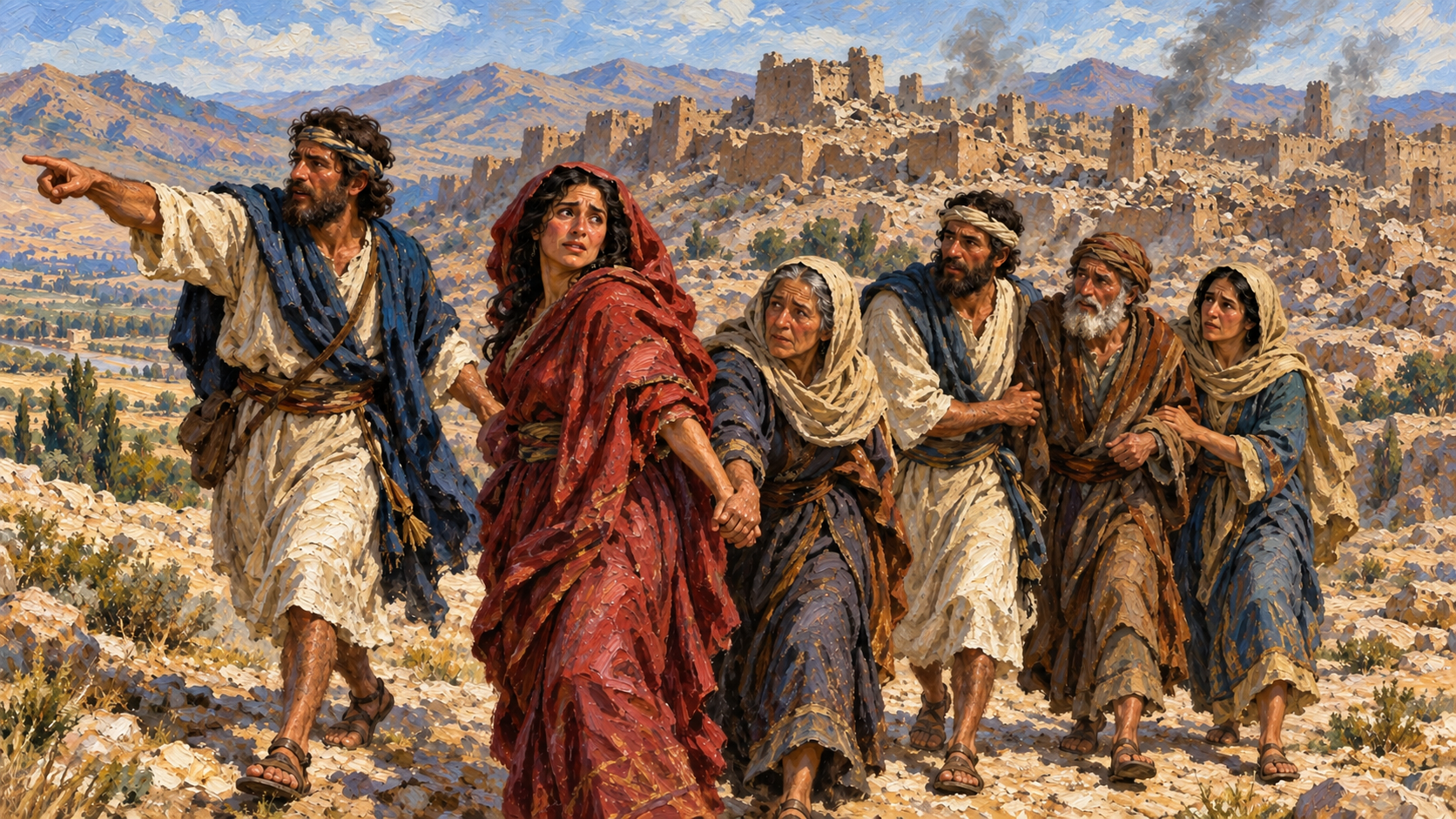
The conquest of Canaan can be hard to read. Who were these people, and why did God wait centuries before judging them? We also need to ask whether anyone can claim that command today. I don’t want to hide the severity of what happened. As we follow Scripture’s account, we will see why Israel could not claim to have earned the land, and how God’s patience and mercy toward those who came in faith appear even in this difficult history.
Peoples, Land, and the Curse on Canaan
The sons of Ham were Cush, Mizraim, Put, and Canaan. Canaan begot Sidon his firstborn, and Heth; the Jebusite, the Amorite, and the Girgashite; the Hivite, the Arkite, and the Sinite; the Arvadite, the Zemarite, and the Hamathite. Afterward the families of the Canaanites were dispersed. And the border of the Canaanites was from Sidon as you go toward Gerar, as far as Gaza; then as you go toward Sodom, Gomorrah, Admah, and Zeboiim, as far as Lasha. These were the sons of Ham, according to their families, according to their languages, in their lands and in their nations.
Genesis places the Canaanites inside the history of Noah’s family after the Flood. Ham’s sons were Cush, Mizraim, Put, and Canaan. Canaan’s line included Sidon and Heth, followed by peoples whose names recur throughout the Old Testament: Jebusites, Amorites, Girgashites, Hivites, and others.
As Genesis moves from family names to cities and territory, we see descendants becoming clans and nations over generations. That helps me understand why Canaanite does not always name exactly the same group. It can refer broadly to inhabitants associated with the land, or more narrowly to one people listed alongside Hittites, Amorites, Perizzites, Hivites, Jebusites, and Girgashites. We need the context to know how broadly the name is being used.
The Canaanites belonged to the same human family traced through Noah. They were not a mythical race created for Israel to defeat. They built cities and formed kingdoms, cultivating the land and raising households. They also went to war and practiced religion. Like every nation, they remained accountable to the Creator for how they lived.
Scripture does not make the Canaanites less human so their destruction will be easier to accept. God judged real people after giving them generations to turn, and He showed mercy to individuals and households who came to Him in faith.
As I read Noah’s words about Canaan, I want to keep their shared humanity in view.
And Noah began to be a farmer, and he planted a vineyard. Then he drank of the wine and was drunk, and became uncovered in his tent. And Ham, the father of Canaan, saw the nakedness of his father, and told his two brothers outside. But Shem and Japheth took a garment, laid it on both their shoulders, and went backward and covered the nakedness of their father. Their faces were turned away, and they did not see their father's nakedness. So Noah awoke from his wine, and knew what his younger son had done to him. Then he said: "Cursed be Canaan; A servant of servants He shall be to his brethren." And he said: "Blessed be the LORD, The God of Shem, And may Canaan be his servant. May God enlarge Japheth, And may he dwell in the tents of Shem; And may Canaan be his servant."
After the Flood, Noah became drunk and lay uncovered. Ham saw his father’s nakedness and told his brothers outside. Shem and Japheth walked backward and covered Noah without looking. When Noah awoke and knew what his younger son had done, he pronounced a curse upon Canaan.
The difficulty is that Ham is named as the offender, yet Canaan received the curse. Many explanations have been proposed, but Scripture does not tell us every reason for that wording. Some say God foresaw the later wickedness of Canaan’s descendants. Genesis does not give that explanation, so I don’t want to present it as something God has revealed.
Noah pronounced the curse, but the passage does not say Canaan was a different kind of human or lacked God’s image. Genesis 10 places his named descendants among ancient Near Eastern peoples. Nothing here gives one modern ethnicity perpetual ownership of another.
The so-called curse of Ham has been used to defend racial slavery and contempt, but notice what that interpretation changes. The curse names Canaan, not Ham. That misuse separates the words from Genesis 10 and imposes modern racial categories while ignoring the Bible’s condemnation of man-stealing. Noah said nothing about skin color, and his words give no reader permission to enslave a people.
The account warns us about dishonor and the shame and consequences sin can bring into a family. Its effects can reach far beyond the original act. It also prepares us for conflict involving Canaan’s line, but ancestry alone was not the reason for the later judgment. The conquest passages explain the moral reasons and the length of God’s patience.
The same name also became attached to a recognizable land.
Genesis 10 traces the Canaanite border from Sidon toward Gerar and Gaza, then toward Sodom, Gomorrah, Admah, Zeboiim, and Lasha. Those settlements and directions give us an ancient geographic description. Other passages describe the promised land’s boundaries for different purposes, whether covenant promises or administration, so we need to attend to what each description is explaining.
The land lay along a strategic corridor connecting regions in every direction. Communities lived among its valleys and uplands, supported by grazing areas and water sources as well as trade routes. Scripture’s description of a land flowing with milk and honey speaks of agricultural abundance. It does not mean that every district looked alike.
Canaan was not governed as one centralized empire. Joshua often faced kings who ruled individual cities and joined coalitions for war. Jericho and Ai had their own rulers or local power, as did Jerusalem, Hebron, Lachish, Hazor, and other centers. That helps explain why the conquest required repeated campaigns rather than a single battle at one national capital.
Archaeology and later historical sources can help us understand ancient settlements, but Scripture controls the theological conclusions I draw here. We can state the boundaries and name the peoples, rulers, and events it gives us. Where it does not supply a precise modern map or a detailed reconstruction of the culture, I don’t want to sound more certain than the evidence allows.
Promise, Patience, and the Cause of Judgment
Then He said to Abram: "Know certainly that your descendants will be strangers in a land that is not theirs, and will serve them, and they will afflict them four hundred years. And also the nation whom they serve I will judge; afterward they shall come out with great possessions. Now as for you, you shall go to your fathers in peace; you shall be buried at a good old age. But in the fourth generation they shall return here, for the iniquity of the Amorites is not yet complete." And it came to pass, when the sun went down and it was dark, that behold, there appeared a smoking oven and a burning torch that passed between those pieces. On the same day the LORD made a covenant with Abram, saying: "To your descendants I have given this land, from the river of Egypt to the great river, the River Euphrates– the Kenites, the Kenezzites, the Kadmonites, the Hittites, the Perizzites, the Rephaim, the Amorites, the Canaanites, the Girgashites, and the Jebusites."
God promised the land to Abraham’s descendants, but they did not take possession immediately. They would first live as strangers under affliction in another land, then be brought out with possessions. Abraham himself would die in peace. God said four generations would pass because the Amorites’ iniquity was not yet complete.
I notice that the delay belonged to God’s judgment as well as His promise. Israel had not seized desirable territory and attached God’s name to its ambition. The promise came centuries before the exodus, and God gave the existing peoples generations before the appointed judgment. His patience was genuine, without making their conduct acceptable to Him.
Amorite can name a prominent people or, in some settings, describe the inhabitants more broadly. Here Genesis focuses on their iniquity reaching its full measure. God knew the land’s moral condition perfectly and determined when to judge it. Israel did not receive the land because its army grew stronger, and an expanding nation cannot simply claim that its success proves God’s approval.
The promise continued through Isaac and Jacob, not through every biological line descended from Abraham. Its fulfillment belongs to God’s revealed purpose for Israel. The later exile disciplined Israel’s enjoyment of the land without canceling the unconditional grant to Abraham or transferring it to the church.
The later law explains the kind of iniquity that had filled the land.
'Do not defile yourselves with any of these things; for by all these the nations are defiled, which I am casting out before you. For the land is defiled; therefore I visit the punishment of its iniquity upon it, and the land vomits out its inhabitants. You shall therefore keep My statutes and My judgments, and shall not commit any of these abominations, either any of your own nation or any stranger who dwells among you (for all these abominations the men of the land have done, who were before you, and thus the land is defiled), lest the land vomit you out also when you defile it, as it vomited out the nations that were before you. For whoever commits any of these abominations, the persons who commit them shall be cut off from among their people. 'Therefore you shall keep My ordinance, so that you do not commit any of these abominable customs which were committed before you, and that you do not defile yourselves by them: I am the LORD your God.'"
Leviticus gives moral reasons for the judgment rather than leaving us with an unexplained preference for one ethnicity. The chapter forbids incestuous unions and adultery, along with child sacrifice to Molech. It also prohibits male homosexual relations and bestiality. God says these practices had defiled the nations and brought punishment upon the land for its iniquity.
The charge concerns evil the people practiced, not impurity in Canaanite blood. The picture of the land vomiting out its inhabitants describes the result of their defilement. I also notice that Israel received the same warning. If they adopted those abominations, they too would be cut off and expelled.
We should not pass quickly over child sacrifice. Burning sons and daughters in worship makes devotion an act of murder. The forbidden sexual acts also violated God’s created order, damaging marriage and kinship and dishonoring human bodies. Idolatry bound these practices to false worship until communities learned to treat evil as sacred.
I don’t need to claim that every Canaanite committed every listed act in order to take the judgment seriously. Scripture does not say that, nor does it say there was no ordinary affection in their homes. The judgment fell on a culture whose entrenched public rebellion had reached the point at which God acted. We should face that without turning each individual into a caricature.
God knows what we could never fully know. He sees every deed and every victim, and He knows every opportunity to repent. Motives and consequences hidden from us are open to Him. Understanding why He judged teaches me about His holiness, but it does not give me His complete knowledge or the right to copy His sentence with only part of the facts.
None of this meant that Israel had earned the land through superior character or ancestry.
"Hear, O Israel: You are to cross over the Jordan today, and go in to dispossess nations greater and mightier than yourself, cities great and fortified up to heaven, a people great and tall, the descendants of the Anakim, whom you know, and of whom you heard it said, 'Who can stand before the descendants of Anak?' Therefore understand today that the LORD your God is He who goes over before you as a consuming fire. He will destroy them and bring them down before you; so you shall drive them out and destroy them quickly, as the LORD has said to you. "Do not think in your heart, after the LORD your God has cast them out before you, saying, 'Because of my righteousness the LORD has brought me in to possess this land'; but it is because of the wickedness of these nations that the LORD is driving them out from before you. It is not because of your righteousness or the uprightness of your heart that you go in to possess their land, but because of the wickedness of these nations that the LORD your God drives them out from before you, and that He may fulfill the word which the LORD swore to your fathers, to Abraham, Isaac, and Jacob. Therefore understand that the LORD your God is not giving you this good land to possess because of your righteousness, for you are a stiff-necked people.
Moses anticipated that Israel might congratulate itself after victory. They were about to cross the Jordan and face nations greater and mightier than themselves, with fortified cities and the sons of Anak. Defeating them could tempt Israel to think it had earned the land through righteousness.
God repeatedly denied that explanation. He was driving the nations out because of their wickedness and to fulfill His word to Abraham, Isaac, and Jacob. In the same paragraph He called Israel stiff-necked. I cannot read His choice of Israel as proof that the people were good in themselves. They had received grace and responsibility.
There is no basis here for racial superiority. The judgment did not fall because Israelites had better blood than Canaanites. Israel soon sinned in the land and adopted practices God had condemned. They tolerated idolatry while oppressing the vulnerable and shedding innocent blood. Later, the prophets explained the Assyrian and Babylonian conquests as covenant judgment upon Israel itself.
God’s impartiality does not give every nation the same role in history. Israel had unique covenants and promises, but that privilege never made its evil acceptable to Him. It made the people more accountable.
The Severe and Unique Conquest
"When you go near a city to fight against it, then proclaim an offer of peace to it. And it shall be that if they accept your offer of peace, and open to you, then all the people who are found in it shall be placed under tribute to you, and serve you. Now if the city will not make peace with you, but war against you, then you shall besiege it. And when the LORD your God delivers it into your hands, you shall strike every male in it with the edge of the sword. But the women, the little ones, the livestock, and all that is in the city, all its spoil, you shall plunder for yourself; and you shall eat the enemies' plunder which the LORD your God gives you. Thus you shall do to all the cities which are very far from you, which are not of the cities of these nations. "But of the cities of these peoples which the LORD your God gives you as an inheritance, you shall let nothing that breathes remain alive, but you shall utterly destroy them: the Hittite and the Amorite and the Canaanite and the Perizzite and the Hivite and the Jebusite, just as the LORD your God has commanded you, lest they teach you to do according to all their abominations which they have done for their gods, and you sin against the LORD your God.
Deuteronomy treats distant cities differently from the named peoples living within Israel’s inheritance. Distant cities were first to receive an offer of peace. The Hittite, Amorite, Canaanite, Perizzite, Hivite, and Jebusite cities were under a separate command of complete destruction, so that their abominations would not teach Israel to sin.
I don’t want vague wording to conceal how severe that command was. It affected whole communities. Scripture presents the conquest as judgment ordered by God, not ordinary migration or merely a defensive dispute over a border.
God is the Creator who gives life and has authority to judge it. Every human life already stands under the sentence of death because of sin. He alone knows when and how judgment should fall in this earthly life. No conclusion we reach on our own can reproduce the authority of His command through Moses and Joshua.
Calling the conquest God’s judgment gives me no reason to celebrate suffering. Scripture records centuries of delay and explains why judgment came, while denying that Israel had earned the land. It also records Rahab’s rescue and requires Israel to honor the oath to Gibeon. Later God expelled Israel for similar corruption. Taken together, those details rule out ethnicity itself as the target.
People use the term ethnic cleansing for modern campaigns aimed at removing an ethnic group. It does not express the cause or authority Scripture gives for this conquest. But rejecting that label must not become a way to avoid the difficult details. We still have to face the particular claim Scripture makes: God ordered a unique judgment as part of Israel’s covenant commission.
Mercy for Rahab and the Gibeonites
Now before they lay down, she came up to them on the roof, and said to the men: "I know that the LORD has given you the land, that the terror of you has fallen on us, and that all the inhabitants of the land are fainthearted because of you. For we have heard how the LORD dried up the water of the Red Sea for you when you came out of Egypt, and what you did to the two kings of the Amorites who were on the other side of the Jordan, Sihon and Og, whom you utterly destroyed. And as soon as we heard these things, our hearts melted; neither did there remain any more courage in anyone because of you, for the LORD your God, He is God in heaven above and on earth beneath. Now therefore, I beg you, swear to me by the LORD, since I have shown you kindness, that you also will show kindness to my father's house, and give me a true token, and spare my father, my mother, my brothers, my sisters, and all that they have, and deliver our lives from death." So the men answered her, "Our lives for yours, if none of you tell this business of ours. And it shall be, when the LORD has given us the land, that we will deal kindly and truly with you."
Rahab lived in Jericho, but she recognized what its rulers resisted. She had heard that the LORD dried up the Red Sea and defeated kings east of the Jordan. Fear had spread through the land. Her response went further as she confessed that the LORD is God in heaven above and on earth beneath.
Rahab protected the spies and asked them to show covenant kindness to her family. Scripture commends her faith and her reception of the messengers, so I don’t want to turn that commendation into approval of her lie. Falsehood is not held up as a moral ideal. Her faith acted courageously with the light she had.
When Jericho fell, Rahab and the people gathered in her house were spared, and she lived among Israel. Matthew names her in the Messiah’s genealogy, while Hebrews remembers her faith and James points to her active response. This Canaanite woman became an ancestor in the royal line that led to Jesus.
Rahab’s rescue makes it impossible for me to say Canaanite ancestry put someone beyond mercy. She could not save Jericho by denying the coming judgment, and changing ethnicity did not earn her grace. She believed Israel’s God and sought refuge in Him, and she was received.
Her concern extended to her household. She gathered her father and mother, her brothers and relatives, into the marked house. Her concern makes me consider how urgently I speak about faith to the people I love. Faith did not leave her indifferent to the people she loved.
The Gibeonites survived under very different circumstances, but what happened to them also limits racial interpretations of the conquest.
Then the men of Israel took some of their provisions; but they did not ask counsel of the LORD. So Joshua made peace with them, and made a covenant with them to let them live; and the rulers of the congregation swore to them. And it happened at the end of three days, after they had made a covenant with them, that they heard that they were their neighbors who dwelt near them. Then the children of Israel journeyed and came to their cities on the third day. Now their cities were Gibeon, Chephirah, Beeroth, and Kirjath Jearim. But the children of Israel did not attack them, because the rulers of the congregation had sworn to them by the LORD God of Israel. And all the congregation complained against the rulers. Then all the rulers said to all the congregation, "We have sworn to them by the LORD God of Israel; now therefore, we may not touch them. This we will do to them: We will let them live, lest wrath be upon us because of the oath which we swore to them." And the rulers said to them, "Let them live, but let them be woodcutters and water carriers for all the congregation, as the rulers had promised them."
The Gibeonites heard what had happened to Jericho and Ai and disguised themselves as travelers from a distant country. Israel’s leaders inspected their provisions without asking counsel of the LORD. Joshua made peace with them, and the rulers swore an oath.
Israel learned of the deception three days later. Although the congregation complained, the rulers refused to attack the Gibeonites because they had sworn in the LORD’s name. The Gibeonites became woodcutters and water carriers, living under the protection of that treaty.
The Gibeonites were wrong to deceive Israel, and Israel had seriously failed by not seeking God. Yet the leaders could not discard their sworn covenant when it became inconvenient. Centuries later, Saul tried to destroy the Gibeonites and brought bloodguilt upon his house and famine upon the land. I notice that the passage of time did not release Israel from its word. God still treated the oath as binding.
Here a Canaanite community survived within Israel’s ordered life, which again prevents us from explaining the conquest in racial terms. Their position involved service and consequences. Even so, once Israel had given its word, it could no longer choose to exterminate them.
We should keep Rahab and the Gibeonites distinct. Scripture expressly commends her faith, whereas they acted through fear and deception. Both accounts nevertheless show that mercy and covenant obligations belonged within the conquest record. Israel remained accountable for how it treated survivors.
Giants, Unbelief, and Joshua’s Campaigns
Then the LORD said to me, 'Do not harass Moab, nor contend with them in battle, for I will not give you any of their land as a possession, because I have given Ar to the descendants of Lot as a possession.'" (The Emim had dwelt there in times past, a people as great and numerous and tall as the Anakim. They were also regarded as giants, like the Anakim, but the Moabites call them Emim. The Horites formerly dwelt in Seir, but the descendants of Esau dispossessed them and destroyed them from before them, and dwelt in their place, just as Israel did to the land of their possession which the LORD gave them.)
Deuteronomy remembers the Emim as a great and numerous people, tall like the Anakim. They were regarded as Rephaim, although the Moabites called them Emim. The chapter also identifies Zamzummim in Ammon’s territory and later describes Og of Bashan as a remnant of the Rephaim.
The names overlap, but I don’t want to treat them as interchangeable. Anakim identifies descendants of Anak, while Emim and Zamzummim are regional names. Rephaim can name ancient peoples of unusual stature. In poetry, however, the same Hebrew form can refer to the dead. Reading each passage in context keeps us from mixing those meanings together.
These people were genuinely intimidating, but the passages do not give us a modern biological chart or identify a bloodline surviving after Joshua. Nor do they authorize us to call every tall warrior a supernatural hybrid. Speculating about genetics can draw our attention away from what the inspired text emphasizes.
Deuteronomy also says the LORD gave territory to Moab, Ammon, and Edom, where earlier peoples had been displaced. Israel was therefore not alone in inhabiting land once occupied by others. God governs the boundaries and times of nations, though only Israel received the particular covenant and conquest revelation we are examining.
Joshua later cut off the Anakim from the hill country, leaving remnants in Gaza, Gath, and Ashdod. That helps us understand the later appearance of giant warriors associated with Gath, including Goliath’s setting. It does not mean that every Philistine was a giant or that every giant was a Canaanite.
Those formidable peoples help explain why the spies’ report frightened Israel, but danger was not the same thing as defeat.
Then they told him, and said: "We went to the land where you sent us. It truly flows with milk and honey, and this is its fruit. Nevertheless the people who dwell in the land are strong; the cities are fortified and very large; moreover we saw the descendants of Anak there. The Amalekites dwell in the land of the South; the Hittites, the Jebusites, and the Amorites dwell in the mountains; and the Canaanites dwell by the sea and along the banks of the Jordan." Then Caleb quieted the people before Moses, and said, "Let us go up at once and take possession, for we are well able to overcome it." But the men who had gone up with him said, "We are not able to go up against the people, for they are stronger than we." And they gave the children of Israel a bad report of the land which they had spied out, saying, "The land through which we have gone as spies is a land that devours its inhabitants, and all the people whom we saw in it are men of great stature. There we saw the giants (the descendants of Anak came from the giants); and we were like grasshoppers in our own sight, and so we were in their sight."
The spies confirmed that the land was fruitful, but they also reported fortified cities and descendants of Anak. Those dangers were real. Israel faced organized peoples in defended settlements, with warriors who made the spies feel as small as grasshoppers.
Ten spies took those observations and concluded that Israel could not go up. Caleb urged them to obey immediately because God could fulfill His promise. I notice that their disagreement was not finally about the inhabitants’ strength. It was about whether they would trust the LORD to be faithful.
The report’s reference to Nephilim and the grasshopper comparison comes from frightened spies whose evil report led the congregation into rebellion. The words belong in Scripture and should not be deleted, but I do not think we should ignore the setting in which they were spoken. Numbers 14 identifies the real crisis: the people despised God and refused His promise, even proposing a return to Egypt.
Faith does not require us to pretend there are no fortified walls or warriors and no risk. It means refusing to make visible strength the highest authority. Israel’s children eventually entered that same land because God remained faithful. They had not discovered that the danger their parents faced was fictional.
After the forty years in the wilderness, Joshua led the next generation into the land.
Joshua’s campaigns took place in stages. Jericho fell through God’s extraordinary command, while Ai was taken after Israel dealt with Achan’s sin and followed a military plan. After the treaty with Gibeon, southern kings formed a coalition. Northern forces later gathered under Hazor. God worked through miracles and also gave Israel military plans. Carrying out His judgment required sustained obedience throughout those campaigns.
Joshua 11 says Joshua cut off the Anakim from the mountains of Judah and Israel, leaving them only in Gaza, Gath, and Ashdod. The chapter also says the land rested from war. I understand that as a description of decisive victory, without taking it to mean every Canaanite settlement had disappeared.
Joshua 21 declares that the LORD gave Israel the land He had sworn to give and that no good thing failed. Judges then describes peoples who remained and land the tribes had not yet possessed locally. Those statements fit together. God had established Israel and fulfilled His promise to Joshua’s generation, while individual tribes still had land to possess and enemies to remove.
The victories depended on God’s faithfulness, yet Israel still had to obey Him as they marched and fought. That obedience included resisting covetousness and keeping their oaths, as well as remaining separate from idolatry. I see no basis for either pride in their own strength or a passive belief that their choices did not matter.
Joshua’s decisive victories did not mean that every tribe finished the work entrusted to it.
Then the Angel of the LORD came up from Gilgal to Bochim, and said: "I led you up from Egypt and brought you to the land of which I swore to your fathers; and I said, 'I will never break My covenant with you. And you shall make no covenant with the inhabitants of this land; you shall tear down their altars.' But you have not obeyed My voice. Why have you done this? Therefore I also said, 'I will not drive them out before you; but they shall be thorns in your side, and their gods shall be a snare to you.'" So it was, when the Angel of the LORD spoke these words to all the children of Israel, that the people lifted up their voices and wept. Then they called the name of that place Bochim; and they sacrificed there to the LORD.
Judges opens with tribes failing to drive out inhabitants from many cities. Some subjected Canaanites to forced labor rather than completing the command. The Angel of the LORD then confronted Israel for making covenants with the inhabitants and failing to tear down their altars.
The distinctive Angel of the LORD speaks as the very God who brought Israel out of Egypt and made the covenant. This is a Christophany, an appearance of the eternal Son before He became man. He announced that the peoples who remained would become thorns to Israel and their gods a snare.
Rahab already lived among Israel, so ordinary contact with someone of different ancestry was not the central danger. Israel was disobeying the covenant by tolerating idolatry. Intermarriage that served false gods and the gradual acceptance of condemned practices drew the people further into that disobedience.
Judges shows the pattern repeatedly. Israel served the Baals and Ashtoreths and fell under oppression. They cried out and received deliverance, only to return to corruption. The snare caught them through false worship and moral compromise.
That history warns me against confusing mercy toward people with acceptance of their false worship. Christians are to love their neighbors and proclaim Christ to every nation. We cannot do that faithfully while calling idolatry harmless or allowing cultural pressure to change God’s commands.
That unfinished possession also explains why Canaanite communities appear later in Israel’s history.
The Old Testament never says every Canaanite disappeared immediately. Judges names communities that remained, and 1 Kings 9 describes Solomon placing survivors under forced labor. These included Amorites, Hittites, Perizzites, Hivites, and Jebusites whom Israel had not been able to destroy completely.
Solomon’s labor policy belonged to Israel’s monarchy; it is not a social model for Christians. His reign included covenant blessings, but also serious failures. Later chapters expose the burden of forced labor and his multiplied wealth, along with foreign wives and idolatry. We need to read that record as a whole.
Over the centuries, war and intermarriage changed these identities. Migration and imperial conquest brought further changes, as did exile and resettlement. Even political names changed. Scripture gives us no simple chart linking every ancient Canaanite group to a modern population. I cannot use speculative ancestry to assign guilt to people now without going beyond the text and abandoning personal moral accountability.
Scripture follows the land and its peoples into Phoenician and coastal settings, sometimes retaining older names to explain the events. We see this clearly when the Gospels describe one Gentile mother in both Jewish and regional terms.
The Woman of Canaan and the Church’s Mission
Then Jesus went out from there and departed to the region of Tyre and Sidon. And behold, a woman of Canaan came from that region and cried out to Him, saying, "Have mercy on me, O Lord, Son of David! My daughter is severely demon-possessed." But He answered her not a word. And His disciples came and urged Him, saying, "Send her away, for she cries out after us." But He answered and said, "I was not sent except to the lost sheep of the house of Israel." Then she came and worshiped Him, saying, "Lord, help me!" But He answered and said, "It is not good to take the children's bread and throw it to the little dogs." And she said, "Yes, Lord, yet even the little dogs eat the crumbs which fall from their masters' table." Then Jesus answered and said to her, "O woman, great is your faith! Let it be to you as you desire." And her daughter was healed from that very hour.
Matthew deliberately calls her a woman of Canaan, while Mark calls the same woman Greek and Syro-Phoenician by birth. Those descriptions complement one another. Matthew recalls Israel’s ancient regional categories, and Mark places her in the Gentile world of the first century.
Her daughter was severely demon-possessed, and she cried out to Jesus as Lord and Son of David. His initial silence, followed by His words about Israel’s lost sheep and the children’s bread, brought her faith into the open. She did not claim priority in the covenant. Instead, she appealed humbly to the Master’s abundance.
Jesus called her faith great and healed her daughter. Her Canaanite identity did not keep her from receiving mercy. At the same time, He preserved Israel’s place in the covenant program. Giving grace to this Gentile woman did not overturn the promised order of His mission to Israel.
I see no room for racial pride in Jesus’ response to this woman. No ancestry puts a sinner beyond Christ’s compassion, and His welcome to a Gentile does not erase Israel. The Messiah who fulfilled His promises to Israel also gave Himself for the whole world.
Jesus’ mercy toward this Gentile woman does not turn the church into a new army with Joshua’s commission.
The conquest concerned a defined land promise and named peoples. It rested on direct revelation within Israel’s unique covenant administration. Patriotic enthusiasm cannot recreate those conditions, nor can claims of private revelation or divine favor. A historical grievance gives no leader that commission either.
Jesus gives the church a different commission. His disciples are to preach the gospel and make disciples among all nations, baptizing believers and teaching His commands. They are to love enemies and endure persecution, overcoming evil with good. Weapons cannot bring anyone to repentance or produce the new birth.
Modern governments have limited civil authority to restrain wrongdoing and defend their populations. That responsibility does not make a state the new Israel. No government can appeal to Canaan’s conquest to justify territorial ambition or ethnic removal, killing unbelievers or forcing conversion.
Nor can we assign the guilt of that historical judgment through guessed ancestry. A person does not inherit criminal guilt because an ancestor belonged to a wicked society. God judges truthfully. Every person living now still bears His image and needs the gospel.
This history should deepen my reverence for God’s holiness and my trust in His patient faithfulness. It gives me reason to grieve entrenched evil and speak the gospel urgently. It gives me no reason to despise a neighbor because of ethnicity.
The church’s message is not conquest but reconciliation through the crucified and risen Christ.
God’s patience with Canaan did not mean He approved of its sin. Generations passed, but the appointed day of judgment came. That warning applies to every person, including me. His delay is mercy calling us to repent, not evidence that sin will go unanswered forever.
Rahab received refuge through faith. The woman of Canaan received Christ’s mercy beyond Israel, without His promises to Israel being canceled. Neither woman’s ancestry or moral achievements saved her, nor did either receive mercy by denying judgment.
Jesus is the eternal Son, fully God and fully man. He was born of a virgin and is completely sinless. Wicked men physically tortured and punished Him, then killed Him. He willingly bore that real punishment for our sins in His innocent body. He shed His blood and died, was buried, and rose bodily. The Father did not punish, curse, abandon, strike, bruise, or pour wrath on Jesus.
Christ died for the whole world, and God’s offer is genuine even though people can resist and reject Him. Everyone who repents and believes is forgiven and justified. That person is born again as a new creation, indwelt and sealed by the Holy Spirit, and eternally secure.
Eternal security neither excuses lawlessness nor makes a superficial profession proof of salvation. Rahab acted on her faith, and genuine new birth changes the direction of a person’s life. Obedience grows from the life God gives; it does not purchase salvation.
Jesus will return bodily and judge in righteousness. He will deliver Israel and establish His literal thousand-year reign. That perfect judgment belongs to Him. Until He comes, the church is to announce reconciliation through His blood to every people.
My Final Thoughts
This account leaves me no room for racial pride or a modern claim to holy war. The Canaanites were real people within Noah’s family, and God gave them generations before bringing a unique judgment upon their entrenched evil. Israel received the land because He kept His covenant word, not because its people had better blood or better hearts. The God who judged also received Rahab and required Israel to keep its oath to Gibeon. He later praised the faith of a woman of Canaan. Those accounts do not excuse sin, but they show that ancestry never shut anyone out of mercy. I want to take His holiness seriously without mistaking patience for approval or claiming Joshua’s commission for a church or nation today. Our calling is to take the gospel to every people, pointing sinners to refuge in Jesus Christ. He is the risen Son who shed His blood for the whole world and will judge with perfect righteousness.