
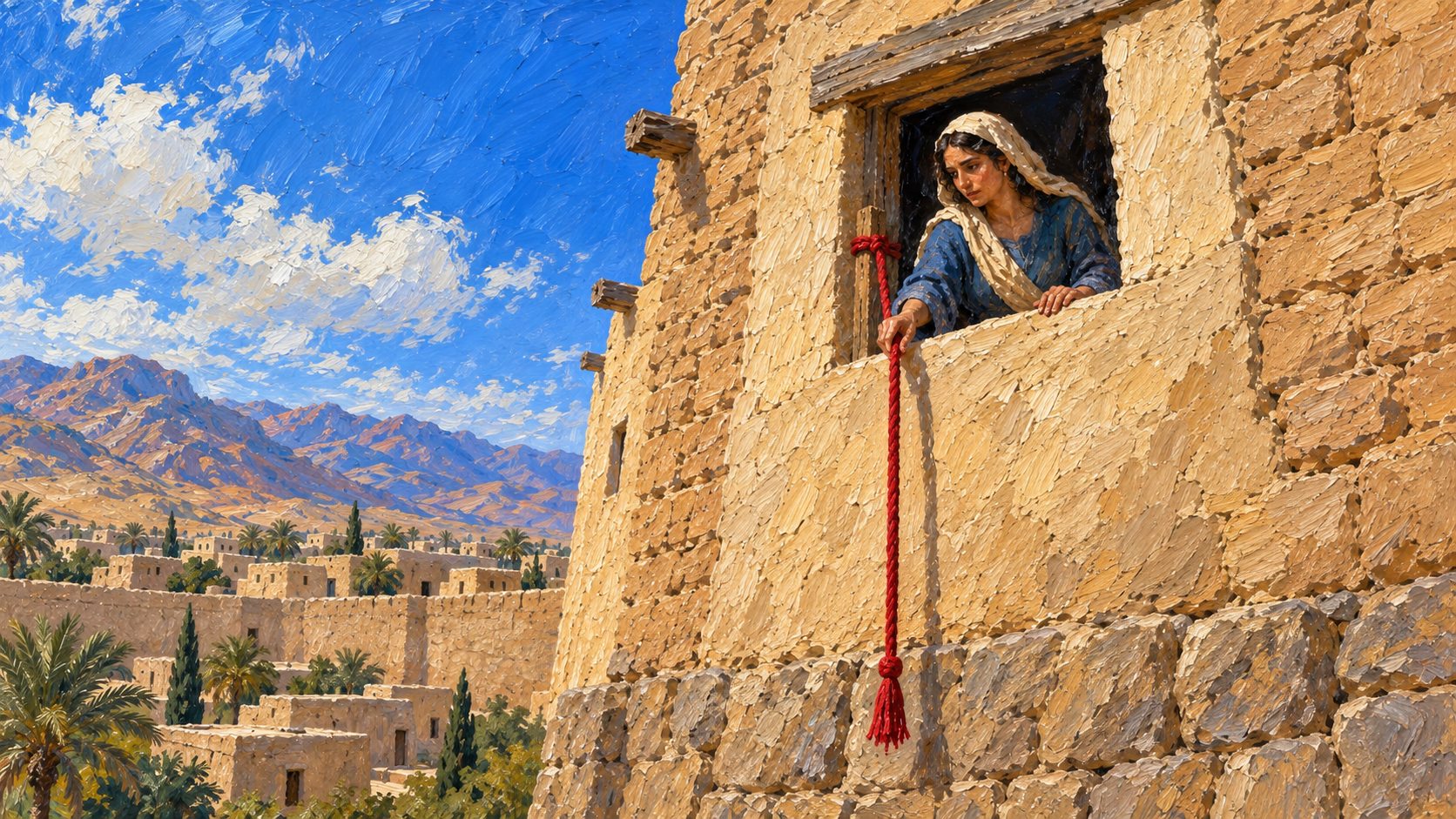
Rahab’s scarlet cord is easy to remember, but what exactly did it mean? It hung from a window in a city under judgment, marking the house of a woman who believed what the LORD had done and asked for mercy. Before asking how her rescue points to Christ, we need to understand what happened in Jericho.
The cord was the visible sign connected to the spies’ oath. It had no magical power, and Rahab had not painted blood on her wall. Her family had to gather in the house and remain there while judgment fell outside. Through her rescue we see grace reaching an outsider whose faith led her to act on God’s word before she could see deliverance.
Scripture is also honest about Rahab herself. Joshua calls her a harlot, and Hebrews and James repeat that description while commending her faith. We should not clean up her past until grace seems unnecessary. We also should not keep her forever under the name of her sin after God records her rescue and brings her into the Messiah’s family line. Her past is real, but it is not the final word over her life.
Rahab Believed the LORD Before Jericho Fell
Joshua 2 begins after the wilderness years, when Israel was preparing to enter the promised land. Moses had died, and Joshua now led the people. Jericho was the first major fortified city in the conquest account. God had promised the land to Abraham’s descendants long before this. He had waited until the Canaanites’ iniquity reached its appointed time before judging them, and now He had brought Israel to the edge of that land.
Joshua secretly sent two men from Shittim to examine Jericho. They entered Rahab’s house, and the king soon heard that Israelite spies were there. Rahab hid the men under stalks of flax on her roof, then sent the king’s pursuers in another direction.
Rahab lied to those pursuers, and I do not want to overlook the moral question that raises. Hebrews and James commend her faith and the way she received the spies peacefully and sent them out. They do not tell every believer to imitate her deception or present her as sinless. The account shows us a woman in a city under judgment who believed the LORD’s revealed power and placed herself with His people before their victory was visible.
Before the spies went to sleep, Rahab came to them on the roof. She had heard how the LORD dried up the Red Sea and what Israel did to Sihon and Og. Others in Jericho had heard those reports too and lost courage. Rahab was also afraid, but she turned toward the LORD and asked for mercy.
Now before they lay down, she came up to them on the roof, and said to the men: "I know that the LORD has given you the land, that the terror of you has fallen on us, and that all the inhabitants of the land are fainthearted because of you. For we have heard how the LORD dried up the water of the Red Sea for you when you came out of Egypt, and what you did to the two kings of the Amorites who were on the other side of the Jordan, Sihon and Og, whom you utterly destroyed. And as soon as we heard these things, our hearts melted; neither did there remain any more courage in anyone because of you, for the LORD your God, He is God in heaven above and on earth beneath."
Rahab’s faith began with hearing what God had already done. The Red Sea was more than distant news to her, and the defeat of the Amorite kings showed that Israel’s God was no small tribal deity. She confessed that He is God in heaven above and on earth beneath while she was still living inside Jericho’s walls.
The rest of Jericho had heard enough to know that danger was coming. Their hearts melted, yet the city remained set against Israel. Rahab did more than recognize that Israel was strong. She understood that the LORD had given the land and that His rule reached heaven and earth. Her request for mercy grew out of that confession, not merely out of a desperate wish to survive.
The same reports reached people who responded very differently. That helps me see why fear alone is not trust in the LORD. Rahab believed what she heard and confessed who God is, then acted on that confession. Biblical faith receives God’s testimony and turns toward Him; it is more than a vague hope that things will work out.
The Cord Marked the House Under the Oath
Rahab asked the spies to show her kindness because she had shown kindness to them. Her plea included her father and mother, her brothers and sisters, and everyone who belonged to them. The spies made a solemn promise with conditions she needed to follow. She was to bind the scarlet cord in the window and gather her family inside the house. No one was to go into the street, and she must not betray the spies’ business.
"unless, when we come into the land, you bind this line of scarlet cord in the window through which you let us down, and unless you bring your father, your mother, your brothers, and all your father’s household to your own home. So it shall be that whoever goes outside the doors of your house into the street, his blood shall be on his own head, and we will be guiltless. And whoever is with you in the house, his blood shall be on our head if a hand is laid on him. And if you tell this business of ours, then we will be free from your oath which you made us swear." Then she said, "According to your words, so be it." And she sent them away, and they departed. And she bound the scarlet cord in the window.
Rahab bound the cord in the same window through which the spies had escaped. It marked the house covered by their oath, so admiring it or keeping it hidden as a private reminder would not have been the response she was told to make. Her obedience did not purchase mercy. It showed that she trusted the promise enough to act on it.
The warning about blood-guilt tells me how seriously the spies took their oath. Anyone who left the house would bear responsibility for his own blood, but the spies accepted that responsibility if someone remained inside and was harmed. The marked house was where life would be spared while judgment fell outside. We need to understand the cord in relation to that promise and the household gathered under its warning.
Understanding the original Hebrew words helps us read this passage accurately, provided we let the account explain how they are being used. The word often transliterated tiqvah can refer to hope elsewhere, but here it names the line itself. Chut can mean a thread or cord, and shani gives its scarlet or crimson color. The possible echo of hope is memorable, but I would not base the doctrine on that wordplay. We can see from what happened that the scarlet line was the appointed sign of the promised rescue.
When Jericho’s walls were destroyed, the promise to Rahab was remembered. Joshua 6 names her before the walls fell, making clear that the judgment of the city did not cancel the oath made to her.
Now the city shall be doomed by the LORD to destruction, it and all who are in it. Only Rahab the harlot shall live, she and all who are with her in the house, because she hid the messengers that we sent.
But Joshua had said to the two men who had spied out the country, "Go into the harlot’s house, and from there bring out the woman and all that she has, as you swore to her." And the young men who had been spies went in and brought out Rahab, her father, her mother, her brothers, and all that she had. So they brought out all her relatives and left them outside the camp of Israel.
Rahab asked for her household to be spared along with her, and her faith led her to bring them under the warning. They heard it and gathered in the protected house. Her concern for them made her faith visible, but we should not take their rescue to mean that one person’s faith automatically saves every relative in every setting. Each person must respond to God.
Joshua later says that Rahab lived in Israel, so her rescue went beyond getting out of danger. She left a condemned Canaanite city and joined the covenant people. Scripture still calls her a harlot when recalling her past, but it also remembers her as a woman who believed the LORD. Her past did not keep her from belonging among His people.
Passover Helps Us See the Pattern Without Replacing the Story
The connection between Rahab’s cord and the Passover is useful when we keep the two events distinct. In Exodus 12, the blood of an unblemished lamb was placed on the doorposts and lintel. The LORD judged Egypt, but the blood marked the houses where the firstborn would be spared.
Joshua 2 does not say that Rahab put blood on her window. It describes a scarlet cord tied to a sworn promise, while Passover gives us the clearer pattern of blood on a doorway. I can recognize the connection without making the two signs identical. Both households received a warning before judgment came, and both had to believe the word they were given before they could see deliverance. Neither account offered safety in the street outside the appointed house.
Biblical typology means that real people and events can form patterns God later brings to fuller meaning. That helps us compare Passover with Rahab’s rescue while taking each event seriously. Rahab was a real woman in Jericho, and the spies made their oath in Joshua’s day. I do not need to erase those facts to reach Christ. The gospel connection honors that history by showing how God’s repeated pattern of judgment and mercy becomes fully clear in His Son.
Scarlet has biblical associations with blood and sin. Isaiah 1:18 says that sins like scarlet can become white as snow, though that does not make every scarlet object a direct prophecy of the cross. Rahab’s rescue sign belongs within this wider biblical treatment of blood-guilt and cleansing. As we follow the relationship between judgment and mercy, we are being prepared to understand Christ.
Rahab’s Works Showed That Her Faith Was Alive
The New Testament does not treat Rahab as a minor character. Hebrews includes her in its great witness to faith. James places her beside Abraham as an example of faith made visible through action. Neither passage teaches that her deeds became the price of salvation.
By faith the harlot Rahab did not perish with those who did not believe, when she had received the spies with peace.
Likewise, was not Rahab the harlot also justified by works when she received the messengers and sent them out another way?
Hebrews says “by faith” and contrasts Rahab with those who did not believe. She trusted what God had already done and what He was about to do, so her faith had definite content. She received the spies in peace because her allegiance had changed before the city fell.
James addresses someone who claims to have faith but shows no mercy or obedience and no spiritual life. Such dead faith cannot save. Rahab’s actions showed that her confession was alive, without replacing grace or becoming a second savior. She received the messengers and sent them away safely. Then she bound the cord in her window and gathered her family in response to the warning.
I do not see a conflict between James and Paul here because they are answering different claims. Paul opposes self-righteous confidence and teaches that sinners are justified before God by faith apart from works. James confronts an empty claim to faith that produces nothing. Rahab acted because she believed God’s word, not because she was earning His acceptance.
Matthew adds a remarkable outcome. Rahab appears in the genealogy of Jesus Christ.
Salmon begot Boaz by Rahab, Boaz begot Obed by Ruth, Obed begot Jesse, and Jesse begot David the king.
Rahab was a Canaanite woman rescued from Jericho. Ruth was a Moabite woman who took refuge under the wings of the LORD. Matthew places both women in the line leading to David and then to Jesus. Their inclusion does not erase Israel’s covenant line. It shows God’s mercy bringing outsiders into the blessing promised through Abraham.
Rahab could not have seen all of that when she tied the cord in her window that night. God’s mercy gave her a future far beyond escape from Jericho. Through Boaz and Obed, her family line led to Jesse and David, and eventually to the Lord Jesus Christ. Grace does not erase what happened in the past, but it can give a person a future that sin and judgment could never produce.
The Scarlet Cord Leads Us Toward Christ’s Blood
Nothing in this account gives the cord magical power. Its meaning depended on the spies’ oath and Rahab’s response as she gathered her household under the warning. If I separate the sign from God’s word, I lose the reason it was there and turn it into superstition.
Nor should we turn every detail into a hidden code. The window and roof belonged to Rahab’s house, and the flax, rope, and city wall were part of what happened there. Some details have clear theological significance because the passage or later Scripture draws attention to them. We can let the other details remain part of the account without forcing each one to stand for something else.
The same care is needed when we read James. His concern is dead profession, while Paul confronts self-righteous confidence before God. Rahab’s actions display living faith. They do not make works the ground of salvation or become the price of mercy, as though we needed a second savior beside Christ.
Rahab’s lie also needs to stay in its place in the account. Scripture records it without declaring her sinless, but Hebrews and James direct us to her faith and peaceful reception of the spies. They show us how she acted on what she believed. I would not make her deception the main lesson or build a universal ethic from the crisis when Scripture’s own applications direct our attention elsewhere.
Rahab’s cord was scarlet, but the blood of Christ for salvation is the reality to which biblical rescue finally points. The spies’ oath spared Rahab from the destruction of Jericho. Jesus saves sinners from sin, death, and judgment by His own precious blood.
knowing that you were not redeemed with corruptible things, like silver or gold, from your aimless conduct received by tradition from your fathers, but with the precious blood of Christ, as of a lamb without blemish and without spot.
And they cried with a loud voice, saying, "Salvation belongs to our God who sits on the throne, and to the Lamb!"
Jesus is the eternal Son, fully God and fully man, and He was completely sinless. Wicked men betrayed Him. They mocked, beat, and scourged Him before they crucified and killed Him. In His innocent body He willingly bore the punishment for our sins and shed His blood. He died and was buried, but on the third day He rose bodily from the dead.
We receive salvation by grace through faith. Neither ancestry nor an attempt to repair our morals can obtain it, and ritual or religious courage cannot supply what we need. Rahab had no respectable past to offer God. She heard the truth about the LORD and believed it, asking for mercy and acting on the promise. I come to Christ just as empty-handed, confessing my guilt and trusting the risen Savior whose blood was shed for me.
Rahab’s concern for her household also challenges me. She did not ask for herself alone. A believer cannot make another person believe, but living faith warns the people it loves and points them toward mercy. Rahab gathered her family into the house because she believed judgment was coming and trusted the promise of rescue.
My Final Thoughts
When I read about Rahab’s rescue in its own setting, the scarlet cord first means the visible sign of an oath-bound rescue. She heard what the LORD had done and confessed who He is before Jericho fell. That faith moved her to act on the promise and gather her household under the warning; it did not make the cord magical or earn God’s mercy. Her rescue fits the wider pattern that leads us to Jesus, whose precious blood saves every sinner who comes to Him by faith. Rahab’s place in Israel and in the Messiah’s line reminds me that God’s grace does more than bring believers out of judgment. He brings them into His people and gives them a future they could never create for themselves.