
Passover began on a hard night of judgment and rescue. Enslaved Israelites ate behind blood-marked doorways while they waited for the LORD to act. I want us to understand what happened that night before following its connection to Jesus, whom later Scripture names as the Lamb of God and “Christ, our Passover.” Scripture itself makes that connection, but we need to preserve what it actually says about the sacrifice. Exodus never says the Father punished the lamb, and Scripture never says the Father punished the Son.
The First Passover in Exodus
To understand Exodus 11, we need to remember how Pharaoh had treated Israel. He saw the people’s growth as a threat and subjected them to bitter bondage. He even commanded the death of Hebrew male children. When Moses first demanded Israel’s release, Pharaoh responded by increasing their labor and openly asking who the LORD was.
Through the plagues, God answered Pharaoh’s defiance. The Nile and the land were under the Creator’s command, as were Egypt’s animals and weather. He ruled over light and human health, and neither the nation’s economy nor its royal authority could resist Him. Exodus describes this as judgment against Egypt’s gods. I can accept that explanation without trying to match every plague to a named deity as though Scripture supplied such a chart.
Each warning gave Pharaoh another opportunity to yield, yet he kept hardening his heart and trying to bargain. Even when he temporarily confessed his wrong, he later reversed himself. We should keep that history in view when we reach the final plague. God was not acting impulsively against an unsuspecting nation. Years of oppression and murder lay behind this judgment, and Pharaoh had stubbornly refused the clear signs and commands God gave him.
Before Moses returned to Egypt, the LORD told him how to explain why Pharaoh must release Israel. God called Israel His son, His firstborn, and commanded Pharaoh to let His people go so they could serve Him. If Pharaoh refused, judgment would come upon his own firstborn.
The firstborn commonly received the inheritance and represented a family’s strength and continuation into the next generation. Egypt had tried to destroy Israel’s sons while keeping God’s firstborn nation in slavery. When Pharaoh refused to release God’s son, the last plague struck his own nation’s future strength.
Calling Israel God’s son did not make the nation divine or morally innocent. God had chosen Abraham’s descendants, and His promise continued through Isaac and Jacob. He had bound His name to their people. Their redemption depended on His faithfulness to that covenant, not on their being superior to others.
At midnight, death reached from Pharaoh’s firstborn to the firstborn of a female servant, and even the firstborn livestock died. Wealth and social rank could not protect a household. Political influence was equally helpless, and Egypt’s great cry exposed the failure of the power and gods it had relied upon.
I understand why a reader would find this judgment severe. We are not told that every firstborn who died had committed the same personal offenses, nor are we told the eternal destiny of each person. Scripture presents a judgment upon the nation, carried out by the Creator who gives life and has righteous authority over it.
We also cannot separate that judgment from Egypt’s state-imposed slavery and its order to kill Hebrew babies. Pharaoh had repeatedly rejected God’s Word and refused to release the people he oppressed. God’s patience gave him time, but it did not allow him to rebel forever without consequence.
God had announced when the judgment would come and how far it would reach. He made a distinction within the land and gave Israel a specific place of refuge. The events of that night were under His control, showing His covenant mercy even as He carried out holy judgment.
Your lamb shall be without blemish, a male of the first year. You may take it from the sheep or from the goats. Now you shall keep it until the fourteenth day of the same month. Then the whole assembly of the congregation of Israel shall kill it at twilight. And they shall take some of the blood and put it on the two doorposts and on the lintel of the houses where they eat it.
Each household was to select an animal according to the number of people and how much they could eat. If a household was too small, it could share with a neighbor. Notice that the animal could come from either the sheep or the goats. I don’t want a familiar picture of the Passover lamb to make me overlook a detail Scripture actually gives us.
The Hebrew word commonly transliterated tamim describes an animal that is sound and complete, without blemish. God was not asking Israel to give Him a diseased or damaged leftover. They were to keep the animal until the fourteenth day and kill it at twilight. The Hebrew phrase for that time means “between the evenings.” Whatever questions later readers have raised about the exact time, the command plainly required this preparation.
The whole congregation took part through its households. God was the One redeeming Israel, but His command called for a response from the people. Each household chose and killed the lamb, then placed its blood where He had specified before eating the meal.
Moses told the elders to use hyssop to put the blood on the lintel and the two doorposts. Everyone was then to stay inside until morning. Being an Israelite was not itself the sign God named. The people were safe as they received His word and entered the refuge He provided.
Exodus 12:13 calls the blood a sign for the households and connects it to the LORD’s promise. When He saw the blood, the plague would not destroy those inside. Their safety rested on the God who gave that promise and kept it, not on a chemical with magical power to force His hand.
A frightened household still needed to put the blood on its doorway, and sincere religious feeling could not make some other sign acceptable. God had established the refuge before Israel responded. They were trusting Him enough to act on His command, not inventing a ceremony and asking Him to honor it.
The blood meant that a life had actually been given. Later Scripture explains that life is in the blood and that blood belongs to God. That connection begins a major biblical pattern here at Passover. We should understand it in relation to the living God, rather than treating blood as an impersonal spiritual substance.
Then Moses called for all the elders of Israel and said to them, "Pick out and take lambs for yourselves according to your families, and kill the Passover lamb. And you shall take a bunch of hyssop, dip it in the blood that is in the basin, and strike the lintel and the two doorposts with the blood that is in the basin. And none of you shall go out of the door of his house until morning. For the LORD will pass through to strike the Egyptians; and when He sees the blood on the lintel and on the two doorposts, the LORD will pass over the door and not allow the destroyer to come into your houses to strike you.
Exodus says the LORD would pass through Egypt to strike it, while also speaking of a destroyer. These are not competing explanations of the judgment. God was responsible for it, and He set limits on the agent who carried it out.
The destroyer could not act independently or bargain over where God allowed him to go. When the LORD refused him entry into a marked house, he could not overcome that mercy. Even in this severe judgment, every boundary remained under God’s control and served His purpose.
Who was the destroyer? Scripture doesn’t name him, so I would be going beyond this passage if I identified him as Satan. Calling him the Angel of the LORD or naming another particular angel would have the same problem. We can affirm that a real agent carried out God’s judgment under His authority without claiming to know an identity He has not revealed.
Israel was to roast the animal with fire and eat it with unleavened bread and bitter herbs. God forbade eating it raw or boiled, and anything left over had to be burned rather than kept until morning. The meal followed the LORD’s instructions, down to what they ate and how they prepared it.
The people ate with their belts fastened and their sandals on, holding their staffs because they were ready to leave. They were still inside their houses awaiting God’s decisive act. They ate this farewell meal before their deliverance, rather than as a leisurely festival developed afterward.
Bitter herbs fit the memory of Israel’s bitter bondage, although Exodus does not explain every flavor as a symbol. Unleavened bread soon reflected both God’s ordinance and the haste of departure. I would not take the next step and turn every instruction into a secret code about Christ. The directions about roasting and clothing need to be read with the same restraint as those about the staff and the morning disposal of leftovers.
I believe typology is strongest where later Scripture supplies the connection. Historical details should first be allowed to explain what Israel did that night.
The Passover sacrifice was killed in connection with the fourteenth day of the first month. Beginning on the fifteenth, the Feast of Unleavened Bread continued for seven days. Both observances recalled the same deliverance within the same calendar season, which explains why Scripture can speak of the wider period together.
Even so, Passover and Unleavened Bread had distinct features. Passover centered on the lamb and the blood that marked the protected houses during the meal on the night of deliverance. Unleavened Bread continued the remembrance of Israel’s hurried departure and required the people to remove leaven.
Leaven often pictures corruption spreading through something, as it does in 1 Corinthians 5. But Jesus also used it to describe the spread of the kingdom, so we cannot assume it always means sin. I need to follow how a passage uses the image instead of assigning it one fixed meaning wherever it appears.
God established Passover as a memorial for Israel’s generations. The Hebrew idea of remembrance reaches beyond recalling a fact. Keeping the feast brought God’s saving act before the community so that it shaped how they worshiped and expressed gratitude. It also shaped their identity as His people and their obedience to Him.
When children asked what the service meant, their parents were to explain how the LORD had struck Egypt while passing over the Israelite houses. He had delivered their households and brought the nation out with a strong hand. The meal was meant to give parents an occasion to tell what God had done, rather than leave their children with an unexplained ritual.
A later generation could speak of what the LORD did “for me” when Israel came out of Egypt. Those children had not personally stood in Egypt, but their present life within the covenant rested on that deliverance. They inherited both the identity and the responsibilities of the people God had redeemed.
Christian parents can learn from that responsibility without treating the church as Israel under the Mosaic calendar. Children need to hear what God has done in biblical history and what the gospel means. We should explain our ordinances from Scripture so that they understand the truth behind the practice.
And when a stranger dwells with you and wants to keep the Passover to the LORD, let all his males be circumcised, and then let him come near and keep it; and he shall be as a native of the land. For no uncircumcised person shall eat it. One law shall be for the native-born and for the stranger who dwells among you."
Passover was not an ordinary public meal that anyone could join on their own terms. Yet it was not a racial privilege closed to every outsider either. A foreigner could receive Israel’s covenant sign and then keep the feast as a native, while an uncircumcised person could not eat it.
The native-born Israelite and the resident stranger lived under the same ordinance. I notice that God made room for the outsider without making His covenant terms negotiable. Those boundaries did not mean that His mercy was limited to one ethnicity.
Numbers 9 later provided a second-month observance for an Israelite who had been ceremonially unclean through contact with a corpse or who was away on a journey. God protected the holiness of Passover while providing a real path for someone prevented from keeping it at the normal time.
Passover in Israel’s Life and Worship
Israel kept Passover in the wilderness. Joshua 5 records another observance after they entered Canaan. The same feast accompanied the people from slavery through their years of dependence in the wilderness and into the land God had promised.
In later years, neglect of Passover revealed Israel’s spiritual decline. Hezekiah restored the feast during a time of cleansing and invited people from across Israel to take part. Josiah also kept a remarkable Passover as he brought Judah back to the Book of the Covenant. After the exile and the rebuilding of the temple, Ezra records another observance.
These renewals recovered the LORD’s command and the memory of the deliverance that had formed Israel. They did not give Passover a new meaning. I cannot call enthusiasm genuine reform if it never brings people back to revealed truth or leads them to remove practices that contradict it.
By the first century, Jewish pilgrims were gathering in Jerusalem for Passover. Jesus’ final week and the Last Supper took place in that setting. The feast also helps us understand the background of His crucifixion and why the New Testament speaks of Him as the Lamb.
What Passover Means and What the Sacrifice Shows
Understanding the Hebrew words helps us read the account accurately. The word pesach can refer to the Passover sacrifice or the feast itself, depending on the context. In Exodus 12, the related verb pasach describes the LORD passing over the marked households to spare and protect them. He was doing more than overlooking those homes: Exodus 12:23 says He would not allow the destroyer to enter.
The Greek New Testament uses pascha. That word can name the Passover meal, the sacrifice, the particular day, or the wider festival season. I find it helpful to let the surrounding sentence tell us which sense is intended instead of assuming the word always refers to one part of the observance.
Our English word Passover vividly expresses the action. Some discussions of the word emphasize passing over, while others emphasize sparing or protecting. The account brings those ideas together as the LORD actively protects the refuge He promised. Since the word can name the slain sacrifice as well as the annual observance, each sentence must show whether the animal, the meal, or the wider season is in view.
Passover is called a sacrifice to the LORD, so its lamb clearly belongs to the Bible’s teaching about sacrifice and redemption. Still, Exodus 12 does not call it a Levitical sin offering. Israel kept that first Passover before the priesthood and altar system given at Sinai, placing the blood on household doorways.
An unblemished animal died, and its blood marked a household where the firstborn was spared from judgment. We can see a genuine substitutionary pattern in the lamb’s death and the firstborn’s continued life. But I cannot turn that pattern into a claim that God transferred guilt to the animal. Exodus does not say that, nor does it say He transferred wrath or punishment to it.
Later Scripture connects Passover with the Bible’s wider teaching on sacrifice and identifies Christ as its fulfillment. We should receive that connection without making Exodus say what it does not say.
We need that same precision when we speak about Christ’s death for sins. His physical suffering and death were real, and wicked men punished and killed the innocent Son. The Father did not punish Him. Keeping those actions with the ones who performed them protects our explanation of the gospel from an account of the atonement Scripture does not give.
Christ Our Passover
Therefore purge out the old leaven, that you may be a new lump, since you truly are unleavened. For indeed Christ, our Passover, was sacrificed for us. Therefore let us keep the feast, not with old leaven, nor with the leaven of malice and wickedness, but with the unleavened bread of sincerity and truth.
Paul explicitly identifies Jesus as our Passover. He is not simply another animal in a continuing series of sacrifices. The Passover pattern finds its fulfillment in Him, the Christ who finally accomplishes the salvation to which it pointed.
John the Baptist called Jesus the Lamb of God who takes away the sin of the world. Revelation shows the slain Lamb being worshiped because His blood redeems people from every tribe and tongue, and His redeemed people come from every nation without distinction. We have moved from a refuge for households at Passover to a gospel offered throughout the world. That worldwide reach does not mean everyone is automatically saved.
Jesus’ blood saves because He gave His spotless life in a real body. We cannot reduce that blood to a decorative way of describing sacrificial feeling. Wicked men scourged Him and then pierced and crucified His innocent body. He actually bled and died before rising bodily.
How, then, does a person receive what Christ has done? A person receives Christ and His saving work through repentance and faith. The New Testament does not call for painting literal blood or performing an “application” ritual.
knowing that you were not redeemed with corruptible things, like silver or gold, from your aimless conduct received by tradition from your fathers, but with the precious blood of Christ, as of a lamb without blemish and without spot.
Peter connects our redemption to the blood of an unblemished lamb. Silver and gold can buy human goods, but they cannot free a sinner from guilt or bondage. That makes me consider why he calls Christ’s blood precious. The value lies in the life He gave and in His divine Person, both of which are precious.
Jesus is the eternal Son, fully God and fully man, who was born of a virgin and remained completely sinless. He never broke God’s law or shared Adam’s corruption. With no need for forgiveness Himself, He could willingly give His innocent life for sinners.
Calling Jesus the Lamb does not mean He was unaware of what would happen or helpless like an animal. He deliberately laid down His life and had authority to take it up again. We need to keep both His willingness and His sinlessness in view when we recognize Him as Passover’s fulfillment.
But when they came to Jesus and saw that He was already dead, they did not break His legs. But one of the soldiers pierced His side with a spear, and immediately blood and water came out. And he who has seen has testified, and his testimony is true; and he knows that he is telling the truth, so that you may believe. For these things were done that the Scripture should be fulfilled, "Not one of His bones shall be broken."
Exodus and Numbers forbade breaking the Passover animal’s bones, while Psalm 34 speaks of the LORD preserving the righteous man’s bones. John brings these Scriptures to bear on what happened to the crucified Christ. He also insists that the account rests on truthful eyewitness testimony.
The soldiers intended to hasten death by breaking the legs of those crucified. When they came to Jesus, He was already dead, so they did not break His legs. The spear that pierced His side brought out blood and water and confirmed His real physical death.
God’s written purpose was certain, but its fulfillment did not make the soldiers’ violence righteous or imaginary. They remained responsible for what they did even as Scripture was fulfilled.
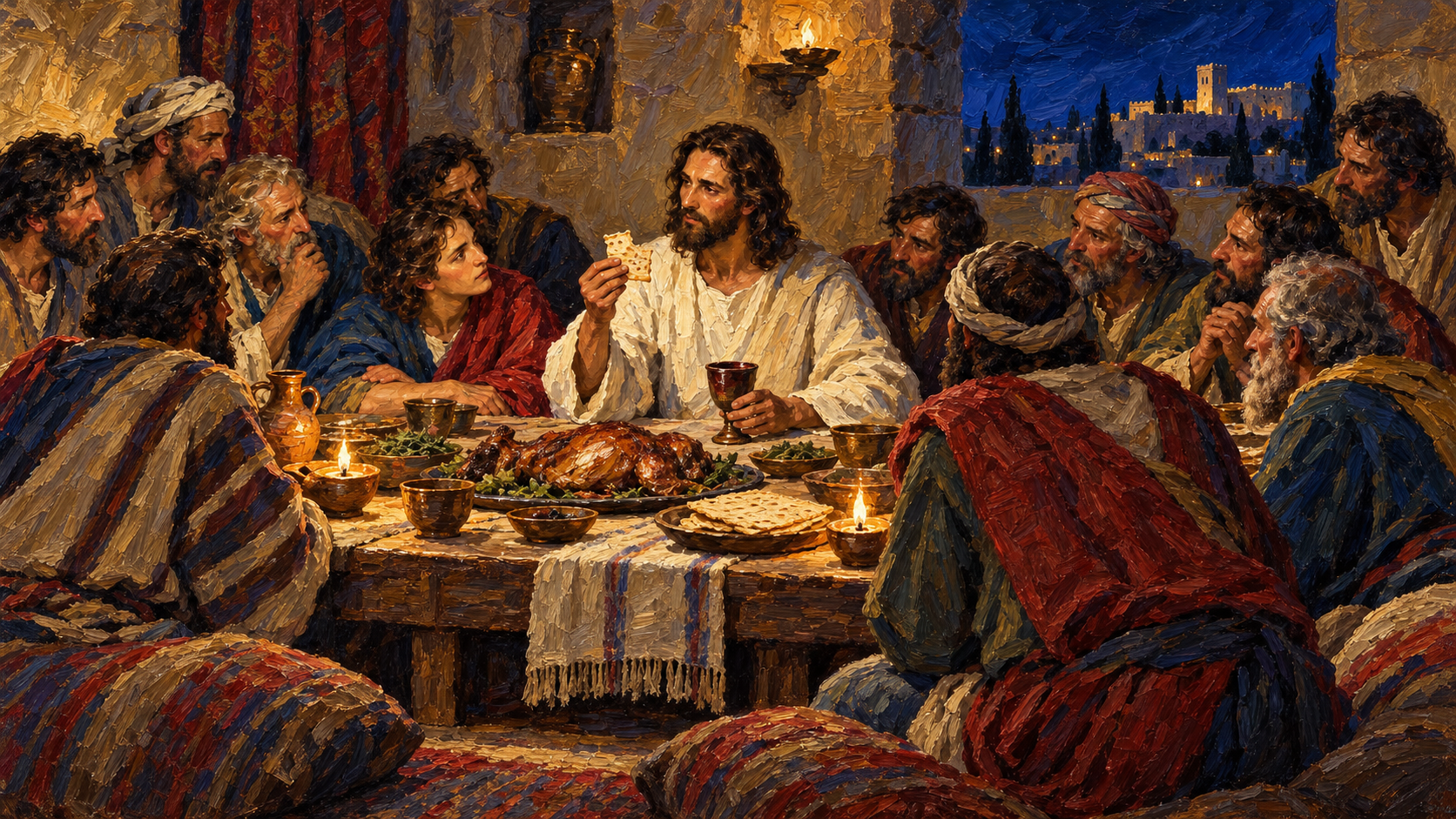
Matthew and Mark describe the disciples preparing Passover and Jesus eating with them before His arrest. Luke records the same setting, in which Jesus took the bread and the cup and directed their meaning toward the new covenant. He connected those signs with His own body and blood.
Jesus was not erasing the exodus by doing this. Israel’s memorial had been pointing toward the fulfillment now before them. Through His death and bodily resurrection, He was about to accomplish a greater deliverance.
The Gospel accounts name bread and the fruit of the vine, telling us that Jesus gave thanks and directed His followers to remember Him. His words connected the covenant with His blood shed for remission of sins, while also pointing forward to hope in the kingdom. I want to distinguish those recorded details from the elements of a later Seder. Modern customs may carry meaningful Jewish tradition, but the Gospels do not give us a complete Seder manual or record every later practice in the upper room.
Matthew, Mark, and Luke, often called the Synoptic Gospels, directly describe the Last Supper as Passover. John emphasizes preparation language around the crucifixion and records that some leaders wanted to avoid defilement so they could eat the Passover. Readers have offered several explanations for how these accounts fit together. Some appeal to different calendars or ways of reckoning the day, while others point to the broader use of festival language.
As we have seen, the Greek word pascha can name the meal or sacrifice as well as the broader festival period. “Preparation” can also be the ordinary word for Friday. Those ranges of meaning leave legitimate room to understand the accounts together.
I don’t want to claim more precision than Scripture gives us here. It does not explicitly choose among every detailed reconstruction, so we should neither manufacture a contradiction nor treat one speculative timeline as though a verse stated it directly.
All four Gospels place Jesus’ death in the Passover setting. The Synoptics show Him explaining the meal’s meaning, while John develops its fulfillment in the Lamb at the cross. These different emphases bring us to the same Christ.
Communion and the New Covenant
Jesus commanded His followers to remember Him with bread and the cup. Paul explains that whenever the church eats and drinks, it proclaims the Lord’s death until He comes. At Communion, I am remembering a sacrifice already finished while looking forward to the risen Lord’s bodily return.
The bread remains bread, and the cup remains the fruit of the vine. They do not become physical flesh and blood, nor does receiving them cause salvation or repeat Calvary. Paul writes in Hebrews that Christ offered one sacrifice for sins forever and then sat down.
Calling Communion symbolic does not make it empty. Christ Himself chose the bread to represent His body given for us and the cup to represent His shed blood. Believers receive them in remembrance and self-examination, sharing the ordinance together as a united church with gratitude and hope.
In John 6, Jesus calls people to come to Him and believe in Him as the Bread of Life. That invitation does not command cannibalism or literal blood drinking. It also leaves the biblical prohibition against consuming blood intact.
The church addressed in 1 Corinthians 5 was tolerating notorious sexual immorality and taking pride in its condition. Paul used the way a little leaven spreads through a whole lump to explain why they must remove unrepentant evil from their fellowship.
Paul’s command begins with what Christ has done for them: our Passover has been sacrificed, and believers truly are unleavened. They are not being told to purchase redemption by removing sin. Because Christ has redeemed them, they must live with sincerity and truth.
Paul’s words “Let us keep the feast” apply the imagery to ongoing Christian life and the purity of the church. He is not placing Gentile congregations under Israel’s annual calendar or food rules.
I cannot appeal to grace as a reason to shelter wickedness in the church. Our eternal security rests in Christ, but that gives us no permission to celebrate the very things He died to save people from.
God commanded Israel to keep Passover as an enduring memorial within the Mosaic covenant. The New Testament does not give the church a corresponding requirement to keep an annual Passover or a reconstructed Seder. Keeping one is not a condition of Christian obedience and cannot produce holiness or salvation.
A Christian may study Passover or attend an educational observance with a clear conscience when Christ is honored. We should treat Jewish people respectfully and explain later customs honestly, without calling them biblical requirements. Another believer can choose not to attend without disobeying God.
Keeping a feast cannot earn God’s favor or complete salvation, and it does not make a Gentile spiritually Jewish. Colossians warns believers against submitting to judgment over festivals. Romans 14 likewise calls each believer to act before the Lord with a clear conscience concerning disputed days.
Christ gave His church Communion as its repeated remembrance of His body and blood. Christians should obey that ordinance without claiming it is a new sacrifice or a continuation of the Mosaic feast obligation.
The Gospel and Our Response
Passover does not let us dismiss judgment as imaginary or depend on human status for protection. Egypt could not resist the LORD, and Israel could not invent its own refuge. God warned the people first, then provided the refuge through which He delivered them.
Jesus Christ, the true Lamb, is the eternal Son who is fully God and fully man. He was born of a virgin and remained completely sinless, yet wicked men physically tortured Him. They punished and killed Him, and He willingly bore that real punishment for our sins in His innocent body. He shed His blood and died, was buried, and then rose bodily. The Father did not punish or curse Jesus. He did not abandon Him, strike or bruise Him, or pour wrath upon Him.
Christ died for the whole world, although people can resist God’s genuine offer. Everyone who repents and believes is forgiven and justified before God. That person is born again and made new. The Holy Spirit indwells and seals the believer, whose salvation is eternally secure. Ancestry cannot give us that salvation, nor can keeping a feast or painting blood on a doorway. Communion and church membership cannot save us either, and no amount of moral effort can earn it.
If you do not belong to Christ, come to Him and believe the gospel. Admiring the Lamb leaves you outside the salvation He gives unless you receive Him. If you have been born again, you can rest in Him without treating eternal security as an excuse for lawlessness. A superficial profession alone does not prove that someone has been born again.
Christ’s redemption should lead us to stop defending sin and pursue holiness. Remembering His body and blood also gives us reason to tell the next generation what God has done. Our confidence rests in the Lamb who was slain and now lives forever. He is worthy of our worship.
God told Israel to explain Passover to its children so that the next generation would know what He had done. Christian parents and churches likewise have a responsibility to teach Christ’s saving death accurately and gratefully, rather than keeping redemption as a private memory. A meal does not recreate His sacrifice. We remember and proclaim the sacrifice He offered once for all, which directs our sincere worship toward the crucified and risen Lamb. Our trust belongs in Him, not in ritual or ancestry, and neither our emotions nor our personal merit can take His place.
My Final Thoughts
After following Passover from Exodus to Christ, I see that God’s judgment is real and that He Himself provides the refuge sinners need. Israel did not escape Egypt by strength, heritage, or good intentions. They were safe beneath the blood God commanded. Christ is our Passover, sacrificed for us. His sinless body and precious blood provide the forgiveness that no ritual or human work can earn. Those who trust Him can remember His saving work with gratitude and live as people He has redeemed.