
The book of Ruth is often remembered for Ruth and Boaz’s marriage, but I don’t want to hurry past the famine and loss that left Naomi feeling empty. How did God begin restoring her through their ordinary faithfulness? We can follow that restoration from a barley field to the city gate, then see how their family became part of the line of David and Jesus Christ.
Ruth Begins in the Days of the Judges
Ruth records what happened to a real family whose future seemed to have ended. We need to understand their lives in relation to Israel’s land, covenant, and Law rather than read the book as a sentimental romance. Ruth’s loyalty led her to accompany Naomi back to Bethlehem, where her work in the harvest brought her into Boaz’s field. Their marriage followed a public act of family redemption. Through those events, the Lord was patiently carrying His promise toward David and ultimately toward Jesus Christ.
The opening words place these events “in the days when the judges ruled.” Israel repeatedly drifted into sin during that era, and the resulting oppression eventually drove the people to cry out. God would raise a judge and give them relief, but they returned to compromise after the judge died. Judges closes with the grim statement that everyone did what was right in his own eyes. Ruth shows us that the Lord was still at work during those dark public years.
None of the main people in Ruth held the office of judge or king, and the account doesn’t center on a prophet or priest. It follows a displaced household after death had left Naomi a grieving widow. Her foreign daughter-in-law stayed beside her, and a landowner who feared the Lord would soon enter their lives. Their decisions might seem small beside the national crises recorded in Judges, yet God was at work in them. I don’t want to overlook that ordinary faithfulness while looking for something more dramatic. These people were living in light of His covenant while He prepared something far larger than they could imagine.
Now it came to pass, in the days when the judges ruled, that there was a famine in the land. And a certain man of Bethlehem, Judah, went to dwell in the country of Moab, he and his wife and his two sons.
The book never identifies a particular judge or gives us an exact year. I’d like to know when these events happened, but Scripture hasn’t given us enough information to assign them to one judge. We can still understand the contrast. While much of Israel was suffering from choosing its own way, Ruth describes ordinary people making costly choices in light of God’s covenant Word. Its final genealogy looks ahead to David, the king Israel did not yet have.
The famine struck Bethlehem, a name commonly understood to mean “house of bread.” There is an obvious irony in the house of bread having no bread. The Law had warned that national covenant rebellion could bring famine as discipline, but Ruth never tells us the hidden cause of this particular famine. I can recognize that warning without assuming it explains more than the narrator tells us.
Elimelech took his wife, Naomi, and their two sons into Moab. His name carries the idea “my God is King,” which reminds me of what should have been true when Israelites often lived as though God were not King. Still, the narrator does not call Elimelech’s move sinful or say that the deaths which followed were God’s punishment for leaving Bethlehem. His name and the serious condition of Israel give us reason to think, but I would be going beyond the text if I used them to pronounce that judgment.
Moab carried painful memories for Israel. The nation traced its beginnings to Lot and later opposed Israel on the way to the promised land. Its king hired Balaam to curse God’s people, and Moabite women helped draw Israelites into idolatry. Moving from Bethlehem to Moab meant entering a country with that history, not simply traveling across a map.
The family did not find lasting safety there. Elimelech died, and his sons married Ruth and Orpah. After about ten years, both sons died as well, leaving Naomi without her husband or sons. Alongside her terrible grief, she faced the economic danger that often fell upon a widow with no adult son to support the household.
Then both Mahlon and Chilion also died; so the woman survived her two sons and her husband.
Naomi heard that the Lord had visited His people and given them bread, so she turned toward Bethlehem. She still believed in the Lord, but she spoke as someone crushed by loss. When the women of Bethlehem recognized her, she asked them to call her Mara, meaning bitter. Scripture lets us hear her pain without mocking it. Knowing what is true about God does not make grief disappear.
When Naomi said that she had gone away full and returned empty, Ruth was standing beside her. That helps me see something Naomi didn’t yet understand. The Lord had brought back the very woman through whom He would begin restoring her. His kindness was already present before Naomi could recognize it.
Naomi’s earlier words to her daughters-in-law help us understand the redemption that would follow. She asked whether she could bear sons who might become husbands for them, drawing on the family duty by which a brother could preserve the line of a deceased brother. She had no more sons and saw no realistic way to provide them. The answer would come through a close relative already living in Bethlehem rather than another son of Naomi.
Ruth Chooses Naomi’s People and God
Naomi urged Ruth and Orpah to return because she saw no future she could offer them. She spoke out of sorrow rather than cruelty. Orpah turned back, and the narrator does not condemn her for doing so. Ruth, however, clung to Naomi and refused to leave.
But Ruth said: “Entreat me not to leave you, Or to turn back from following after you; For wherever you go, I will go; And wherever you lodge, I will lodge; Your people shall be my people, And your God, my God. Where you die, I will die, And there will I be buried. The LORD do so to me, and more also, If anything but death parts you and me.”
The Hebrew verb dabaq, used when Ruth clung to Naomi, can describe holding fast or a strong attachment. That describes the commitment Ruth made when she bound her future to Naomi’s without knowing what it would hold. This was much more than a passing expression of affection.
Ruth’s words went beyond family loyalty. In choosing Naomi’s people and God, she used the covenant name of the LORD in her oath. She had been born in Moab, but she left her former allegiance and joined herself to the God of Israel in faith.
Ruth gives us one of the clearest Old Testament pictures of an outsider received by faith. Israel’s covenant privileges were real, but bloodline alone never saved anyone. We need to keep that distinction clear: personal trust in the Lord was always necessary. Ruth’s faith quietly rebuked the unbelief around her during the days of the judges.
Deuteronomy 23 had warned that an Ammonite or Moabite must not enter the assembly of the LORD because those nations opposed Israel and hired Balaam. Ruth’s faith didn’t erase that history or make Moab’s hostility harmless. She was turning away from that allegiance to call upon the LORD as her God. Seeking refuge under His wings brought her into the life of His people. By the end of the book, Bethlehem’s elders had received her, and the Lord had given her a son whose descendants included David. I may still have questions about the legal wording, but I cannot read what happened to Ruth and conclude that a repentant Moabite woman was beyond God’s mercy.
Ruth didn’t know whether Bethlehem would welcome her, and she had no agreement promising comfort there. She had no assurance of marriage or children either. She had Naomi beside her and the Lord to whom she had pledged herself. The people she was approaching might remember Moab’s history before they noticed her faith. Her decision helps me understand faith as a continuing allegiance to God when the future is uncertain, rather than a religious feeling that soon passes.
The two women reached Bethlehem at the beginning of barley harvest. Naomi was still looking at her life through famine and burial, yet a harvest was beginning as they arrived. Neither woman had received an explanation of the Lord’s plan. He had nevertheless brought them to the place where His provision in the Law could meet their immediate need.
Providence and Mercy Meet in Boaz’s Field
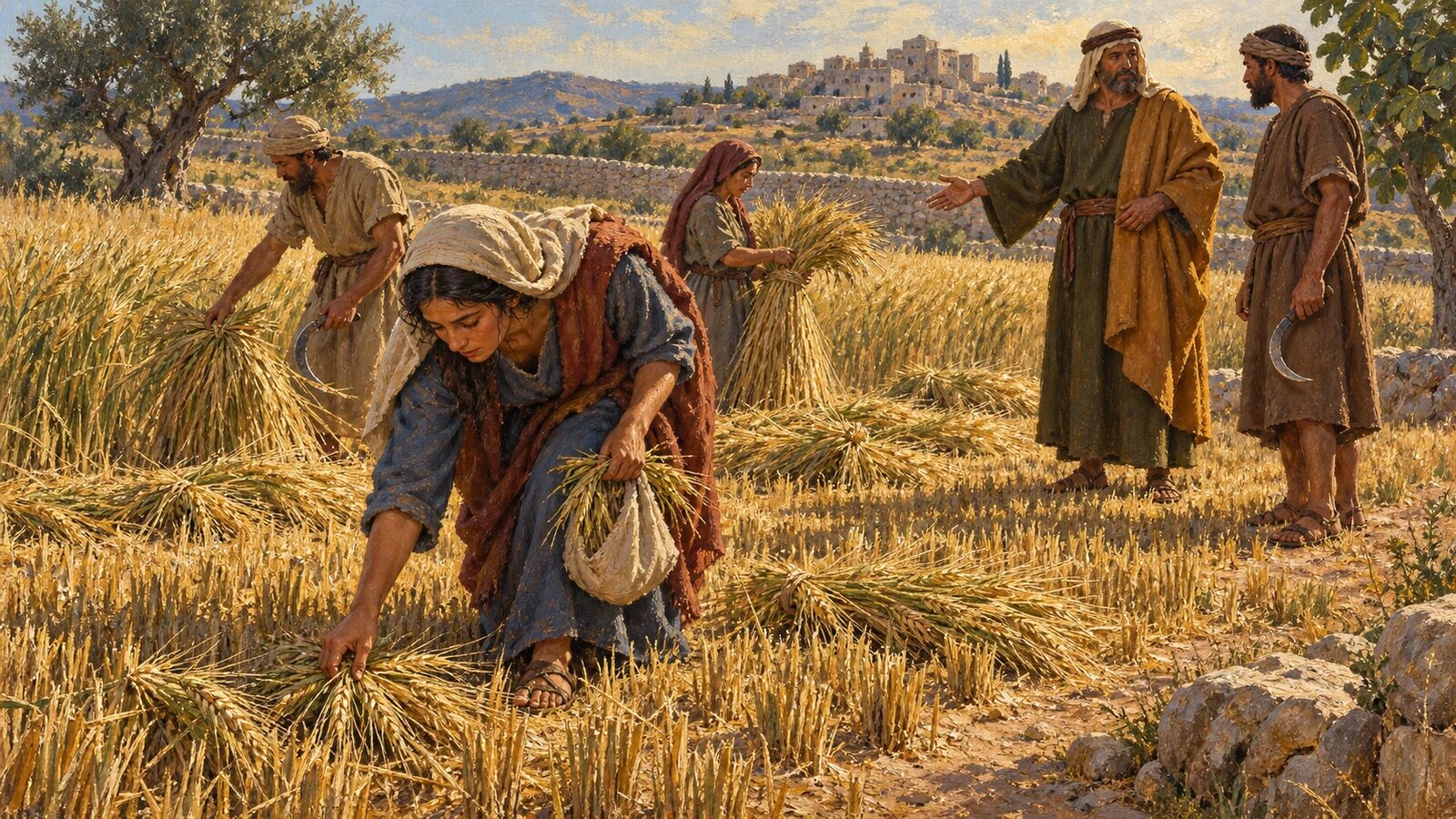
Ruth went out to glean because she and Naomi needed food. The Law of Moses required landowners to leave part of the harvest for people in need. Farmers were not to strip every edge of a field or return for every forgotten bundle. This provision cared for poor people while giving special protection to widows, orphans, and strangers. God had built mercy into Israel’s harvest.
When you reap the harvest of your land, you shall not wholly reap the corners of your field, nor shall you gather the gleanings of your harvest. And you shall not glean your vineyard, nor shall you gather every grape of your vineyard; you shall leave them for the poor and the stranger: I am the LORD your God.
Gleaning required work from Ruth. Harvesters cut and gathered the main crop, and people in need followed to collect what remained. The owner had to leave something behind for them, and the gleaner had to labor to gather it. Ruth asked permission and worked from morning, then carried the grain home to Naomi.
Ruth’s work was part of how God provided for the two women, but it wasn’t the price of His acceptance. She trusted Him and knew Naomi needed bread, so she took the humble path He had provided for someone in her position rather than sitting still and demanding a miracle. We should be able to recognize that faith leads to action without confusing faithful work with payment for salvation.
Ruth “happens” to reach the part of the field belonging to Boaz. From her point of view, that may have looked like ordinary chance. We know where the meeting led, so we can see God’s providence in it. His command in the Law gave Ruth the opportunity to glean, and she went out to work. Boaz then told his laborers to protect her and leave extra grain. Through those ordinary acts of obedience in one field, the Lord supplied Naomi’s needs.
I can see the Lord’s design because I’ve been given the complete account. I shouldn’t assume I can explain every ordinary encounter in my own life with the same certainty. Ruth teaches us to obey what God has revealed even when His larger purpose remains hidden for a long time.
Boaz is introduced as a man of standing and character. He greeted his workers in the name of the LORD, expressing his faith in the ordinary work of his field. After noticing Ruth, he asked who she was and heard about her loyalty to Naomi. He first made provision for her protection by inviting her to remain in his field and commanding the young men not to touch her. She could also drink from the water already drawn for the workers.
Boaz makes me think about how I treat someone who has less power than I do. He could have used his position to exploit Ruth, but instead he made sure she was safe in his field. His righteousness became visible in the way he treated her. In the violent and unstable days of the judges, that ordinary obedience stands out.
Boaz went beyond what the gleaning law required by telling his workers to pull out extra grain and leave it for Ruth to gather. He gave them specific instructions that respected her boundaries. She could gather food without being treated as a nuisance or having to surrender her dignity to receive his generosity.
When Ruth asked why he had shown such favor to a foreigner, Boaz spoke of what he had heard about her loyalty to Naomi. He then blessed her as someone who had come to the Lord for refuge.
The LORD repay your work, and a full reward be given you by the LORD God of Israel, under whose wings you have come for refuge.
Boaz pictured Ruth finding shelter under the Lord’s wings, a tender image of His strong protection. Later, at the threshing floor, she asked Boaz to spread his “wing” over her. The same Hebrew word can describe a wing or the edge of a garment, which helps us follow the connection between his blessing and her request. She was asking this close relative to take responsibility for her. I don’t understand that as Ruth replacing the Lord with Boaz. She was asking him to become one of the people through whom the Lord’s sheltering care reached her and Naomi.
The Hebrew word chesed can refer to loyal kindness or steadfast covenant mercy. We can see that kindness in Ruth’s commitment to Naomi and in Boaz’s willingness to protect Ruth and give generously at his own expense. Behind their actions was the Lord’s kindness, guiding events whose full purpose they could not yet see.
Naomi began to recognize that kindness when Ruth returned with an unusually large amount of grain and named Boaz. She knew he was one of their close relatives who could act as a redeemer. What had begun as food for another day now offered a lawful path toward the restoration she had thought impossible.
A Redeemer Acts with Honor
The Hebrew word goel refers to a redeemer within the family setting, someone who could buy back or reclaim what was in danger of being lost. A close relative could redeem family land so the inheritance would not disappear permanently. Understanding that responsibility helps us see why Boaz’s role was more than a private romance. Redemption belonged to Israel’s covenant life and required a qualified person willing to bear its cost.
Leviticus 25 describes a relative redeeming family property, while Deuteronomy 25 describes a brother’s duty to preserve the name of a deceased brother through offspring. Both concerns appear in Ruth’s situation, but we shouldn’t assume she followed the brother-in-law procedure word for word. Boaz was not Mahlon’s brother. In Bethlehem, the recognized practice connected the family’s property with a marriage that would preserve its line. A close relative had responsibility for both.
Naomi sent Ruth to appeal to Boaz at the threshing floor, where grain was separated and guarded after harvest. Modern readers often hesitate over this scene, and the nighttime setting did leave Ruth open to danger or misunderstanding. Naomi’s plan was unusual. To understand why Ruth went there, we need to listen to what she asked Boaz.
And he said, “Who are you?” So she answered, “I am Ruth, your maidservant. Take your maidservant under your wing, for you are a close relative.”
Ruth appealed to Boaz as a close relative rather than trying to trap him, and he did not take advantage of her. He called her a virtuous woman and protected the matter from needless public misunderstanding. I notice, too, that he immediately raised an obstacle a selfish man might have concealed: another relative had a nearer claim.
The scene involved risk and discretion, but it does not describe a sexual encounter. Boaz was willing to redeem, yet his desire did not give him permission to ignore the nearer relative’s right. He wanted to act righteously, so he promised to settle the matter lawfully in the morning.
Boaz went to the city gate, where elders witnessed agreements and legal matters. He called the nearer relative aside and gathered ten elders to witness the arrangement. Handling redemption publicly rather than through a secret promise protected Ruth and Naomi. It also preserved his integrity and that of the covenant community.
Now Boaz went up to the gate and sat down there; and behold, the close relative of whom Boaz had spoken came by. So Boaz said, “Come aside, friend, sit down here.” So he came aside and sat down.
The nearer relative first agreed to redeem the land, but he declined when he learned that the arrangement also involved Ruth and preserving the family line. I don’t need to make him into a caricature of a villain to understand the contrast with Boaz. Redemption would cost him something, and he was unwilling to bear that cost.
And the close relative said, “I cannot redeem it for myself, lest I ruin my own inheritance. You redeem my right of redemption for yourself, for I cannot redeem it.”
The sandal exchange confirmed the transfer of the right of redemption. The narrator explains the custom because later readers might not recognize it. That reminds me not to assume every biblical audience shared every practice. The nearer relative openly transferred his right in front of the elders, and Boaz committed himself before the town to acquire the property and take Ruth as his wife.
Boaz had both the ability and the willingness to bear the cost. He completed the redemption before witnesses, and the community blessed the marriage. We can see what his actions accomplished for this vulnerable household: the property transfer protected its inheritance, and the marriage preserved the line that had appeared to end. A qualified redeemer acted honorably and gave the family a future.
The Family Line Leads to David and Christ
The Lord gave Ruth conception, and she bore a son named Obed. The women of Bethlehem celebrated what this child meant for Naomi, who had said she returned empty. The book began with famine and death, but now a child had been born in Bethlehem. Bread had returned, and Naomi’s household had a future again.
When the women said that “a son has been born to Naomi,” they were celebrating her restoration after losing her husband and sons. Ruth was plainly the child’s mother and Boaz his father. Their words didn’t erase Ruth’s place or mean that Naomi had given birth. Naomi received Obed into her care, and the household line that had seemed finished now had a future.
The final genealogy helps us understand how far the Lord’s purpose reached. Obed fathered Jesse, and Jesse fathered David. During the days of the judges, when Israel lacked righteous kingship, God was preparing the family line from which David would come. That family record belongs to the account rather than being an extra note at the end.
Also Obed begot Jesse, and Jesse begot David.
It encourages me to see how much the Lord was doing beyond what Ruth and Naomi could understand. They had to travel from Moab, then Ruth needed to find food in someone else’s field. Neither the tense conversation at night nor the legal meeting at the gate gave them a view of everything God was doing. He saw beyond those moments to David and the coming of Christ. His providence reached far beyond what they knew.
Matthew names Ruth in Jesus’ genealogy, allowing us to see that God did more than rescue one household from poverty. He brought a Moabite widow into the line of Israel’s promised King.
Boaz begot Obed by Ruth, Obed begot Jesse, and Jesse begot David the king.
Boaz points toward Christ by pattern, not by equality. He was a righteous human redeemer who still needed redemption from his own sin. Jesus is the sinless Son of God who became truly man and came near enough to act on our behalf. He willingly bore redemption’s true cost. Because He is sinless, He is fully qualified to finish the work and fulfill redemption in its deepest and final sense.
Wicked men punished His innocent body, and Jesus willingly shed His blood and died for our sins before rising bodily. The Father did not punish or abandon Him. The Father and Son remained united in the work of redemption, and Jesus accomplished everything our salvation required.
In Him we have redemption through His blood, the forgiveness of sins, according to the riches of His grace
Ruth helps us understand redemption as something more than vague encouragement. A redeemer bears a real cost to restore what is in danger, and Christ redeemed us with His precious blood rather than silver or gold. We receive salvation by grace through faith. The good works that follow are its fruit, never its price. The related study on the blood of Christ for salvation examines that cost more fully.
Ruth’s labor and loyalty expressed her faith rather than earning her acceptance with God. She had turned to the LORD and taken refuge under His wings. We also need to remember that Boaz’s human redemption did not make Christ unnecessary. The book describes a costly restoration within one Israelite family, while the New Testament reveals how sinners are redeemed through Christ’s blood and brought into God’s family by grace.
We can recognize how Boaz points to Jesus without making every object or action in Ruth a direct symbol of Him. Boaz was a qualified and willing redeemer, but he remained a man within Israel. The pattern helps us understand Christ when we first let the historical account speak on its own terms. I would also miss much of the book if I read it mainly as advice about finding a spouse. The marriage is essential, yet Ruth begins with a covenant crisis and ends with David’s genealogy. The Lord guided these events through His providence, and Ruth and Boaz responded to His revealed truth with loyal kindness. At the gate, we see His provision accomplished through their faithfulness.
We also need to listen carefully to Naomi’s grief. Her bitter words don’t prove that sorrow canceled her faith, and not every conclusion she reached in pain was the narrator’s verdict. The Lord was already working through Ruth while Naomi still felt empty. The study on God’s providence and provision develops this patient work through ordinary events. Ruth also leads us into the life of King David, whose family line closes the book and carries the biblical account forward.
My Final Thoughts
What stays with me in Ruth is how little these people could see while they took the next faithful step. Naomi couldn’t yet see restoration even with Ruth beside her. Ruth entered a field without knowing the Lord was carrying David’s line through her life, and Boaz settled one family’s future at the gate without seeing the genealogy of Christ. The Lord used their faith and the loyal kindness it produced as they worked honestly and obeyed what He had revealed. He did not waste their grief or ignore redemption’s cost. Boaz gives us a beautiful human picture, but Jesus is the Redeemer who came near to us and willingly gave His own blood to finish the work that saves. When I cannot see God’s purpose, I can still take refuge under His wings and remain faithful to what He has already made clear.