
Jesus loved Lazarus and his sisters, yet He remained where He was for two days after hearing that Lazarus was ill. By the time He arrived, His friend had been in the tomb four days. I want to understand the reason Jesus gave for that delay without using this family’s experience to promise an immediate miracle to every grieving believer. John directs us to the One who could weep with the mourners and then command the dead man to come out.
The Bethany Family and Jesus’ Love
Lazarus and his sisters Martha and Mary lived in Bethany, near Jerusalem on the eastern side of the Mount of Olives. John places the village about two miles from Jerusalem. That proximity helps explain why many Judeans came to comfort the sisters and why news of what Jesus did soon reached the city’s religious leaders.
Luke describes an earlier visit in which Martha welcomed Jesus into her home and became distracted by the work of serving. Mary sat at His feet to listen. Lazarus is not named in that passage, so we should not assign him a place or a comment in the conversation.
Now it happened as they went that He entered a certain village; and a certain woman named Martha welcomed Him into her house. And she had a sister called Mary, who also sat at Jesus’ feet and heard His word. But Martha was distracted with much serving, and she approached Him and said, “Lord, do You not care that my sister has left me to serve alone? Therefore tell her to help me.” And Jesus answered and said to her, “Martha, Martha, you are worried and troubled about many things. But one thing is needed, and Mary has chosen that good part, which will not be taken away from her.”
The account introduces a family that received Jesus and heard His teaching. Mary of Bethany is the sister whom John later identifies with the anointing of Jesus’ feet. Scripture does not identify her as Mary Magdalene or as the unnamed woman in Luke 7. Keeping those women distinct allows each passage to describe the person actually before us.
John records no words spoken by Lazarus and gives us no age, occupation, marriage, or later ministry for him. Yet we can understand his place in the Gospel without filling those gaps. Jesus loved him and raised him from death, and his restored life became a public witness to the Lord’s authority.
John calls Jesus’ miraculous works signs because they reveal who He is and call people to believe in Him. The raising of Lazarus is therefore more than an astonishing event to admire. Its meaning concerns the Son who has authority to give life.
When Lazarus became ill, his sisters sent Jesus the message, “Lord, behold, he whom You love is sick.” They appealed to His love without specifying what action He must take. Jesus’ answer and His decision to wait are recorded together with John’s express statement that He loved the family.
Now a certain man was sick, Lazarus of Bethany, the town of Mary and her sister Martha. It was that Mary who anointed the Lord with fragrant oil and wiped His feet with her hair, whose brother Lazarus was sick. Therefore the sisters sent to Him, saying, “Lord, behold, he whom You love is sick.” When Jesus heard that, He said, “This sickness is not unto death, but for the glory of God, that the Son of God may be glorified through it.” Now Jesus loved Martha and her sister and Lazarus. So, when He heard that he was sick, He stayed two more days in the place where He was. Then after this He said to the disciples, “Let us go to Judea again.” The disciples said to Him, “Rabbi, lately the Jews sought to stone You, and are You going there again?” Jesus answered, “Are there not twelve hours in the day? If anyone walks in the day, he does not stumble, because he sees the light of this world. But if one walks in the night, he stumbles, because the light is not in him.” These things He said, and after that He said to them, “Our friend Lazarus sleeps, but I go that I may wake him up.” Then His disciples said, “Lord, if he sleeps he will get well.” However, Jesus spoke of his death, but they thought that He was speaking about taking rest in sleep. Then Jesus said to them plainly, “Lazarus is dead. And I am glad for your sakes that I was not there, that you may believe. Nevertheless let us go to him.” Then Thomas, who is called the Twin, said to his fellow disciples, “Let us also go, that we may die with Him.”
Why Jesus Waited and Returned to Judea
The words “This sickness is not unto death” cannot mean that Lazarus would never die during the illness. Jesus soon told the disciples plainly, “Lazarus is dead.” Death would occur, but it would not be the final result of what Jesus intended to do. The sign would reveal God’s glory and glorify the Son through the restoration of life.
God would reveal His glory by showing the disciples and the people at Bethany who His Son is. They would see Jesus exercise authority over death, and the disciples would come to understand Him more fully because He had not prevented Lazarus from dying. That is why Jesus could speak of His absence as serving their faith. He was not calling sickness and bereavement good in themselves.
John places Jesus’ love immediately before the two-day delay and joins the account with “So.” I would naturally expect love to result in an urgent departure. Here we have to allow Jesus’ stated purpose to explain the delay rather than conclude that He had stopped caring. He was glad for what the disciples would come to believe, not taking pleasure in the sisters’ grief.
Sometimes the four days in the tomb are explained by an appeal to a tradition about a soul hovering near the body for three days. John does not give that as Jesus’ reason for waiting. He records Jesus’ stated purpose concerning God’s glory and the disciples’ belief, then tells us how long Lazarus had been buried. Martha’s later objection about decay reinforces the fact that he was truly dead.
Going to Bethany also meant returning to Judea, where people had recently tried to stone Jesus. The disciples remembered that danger and questioned the journey. Jesus answered with the picture of a person walking during the day’s twelve hours of light. I understand Him to be describing the time and work the Father had allotted Him: He would carry out that work rather than let fear of His enemies determine where He went.
When Jesus said their friend Lazarus slept, the disciples understood ordinary rest and expected him to recover. Jesus corrected them by saying plainly that Lazarus was dead. He was describing the death from which He would awaken His friend, rather than teaching that a person remains unconscious until resurrection. His own explanation tells us how to read the image here.
Thomas urged the others, “Let us also go, that we may die with Him.” His words show that he expected danger, but he was willing to accompany Jesus into it. We should remember that willingness alongside his later difficulty believing the resurrection. The disciples still had much to learn, and the journey would deepen their knowledge of the Lord they followed.
Martha, Mary, and Jesus at the Tomb
When Jesus arrived, Lazarus had been in the tomb four days and many people were with the sisters. Martha heard that He was coming and went out to meet Him while Mary remained in the house.
So when Jesus came, He found that he had already been in the tomb four days. Now Bethany was near Jerusalem, about two miles away. And many of the Jews had joined the women around Martha and Mary, to comfort them concerning their brother. Now Martha, as soon as she heard that Jesus was coming, went and met Him, but Mary was sitting in the house. Now Martha said to Jesus, “Lord, if You had been here, my brother would not have died. But even now I know that whatever You ask of God, God will give You.” Jesus said to her, “Your brother will rise again.” Martha said to Him, “I know that he will rise again in the resurrection at the last day.” Jesus said to her, “I am the resurrection and the life. He who believes in Me, though he may die, he shall live. And whoever lives and believes in Me shall never die. Do you believe this?” She said to Him, “Yes, Lord, I believe that You are the Christ, the Son of God, who is to come into the world.”
Martha believed Jesus could have prevented her brother’s death, and she still trusted that God would hear Him. She understood His promise that Lazarus would rise as referring to the resurrection at the last day. Jesus affirmed the future she hoped for by identifying Himself as the One who would bring it about: “I am the resurrection and the life.”
That promise helps us understand how Jesus could speak of a believer dying and yet never dying. He was not denying the bodily death Martha had just witnessed or asking her to regard her loss as unreal. Those who belong to Him have everlasting life, and He will raise them. Their hope rests in His authority to give life, rather than their ability to prevent illness or death.
Martha confessed Him as the Christ, the Son of God who was to come into the world. She made that confession before anyone moved the stone. She did not yet know everything Jesus was about to do, but she already acknowledged who He was.
Martha then returned to call Mary quietly, telling her that the Teacher wanted her. When Mary rose quickly, the mourners followed because they thought she was going to the grave. She went instead to Jesus and fell at His feet, telling Him, as Martha had, that their brother would not have died if He had been there. Both sisters trusted His power to prevent the death; neither had yet seen what He would do for their brother now.
And when she had said these things, she went her way and secretly called Mary her sister, saying, “The Teacher has come and is calling for you.” As soon as she heard that, she arose quickly and came to Him. Now Jesus had not yet come into the town, but was in the place where Martha met Him. Then the Jews who were with her in the house, and comforting her, when they saw that Mary rose up quickly and went out, followed her, saying, “She is going to the tomb to weep there.” Then, when Mary came where Jesus was, and saw Him, she fell down at His feet, saying to Him, “Lord, if You had been here, my brother would not have died.” Therefore, when Jesus saw her weeping, and the Jews who came with her weeping, He groaned in the spirit and was troubled. And He said, “Where have you laid him?” They said to Him, “Lord, come and see.” Jesus wept. Then the Jews said, “See how He loved him!” And some of them said, “Could not this Man, who opened the eyes of the blind, also have kept this man from dying?”
Jesus saw Mary and the mourners weeping, groaned in spirit, and was troubled. The verb embrimaomai carries forceful emotion, including indignation, as Thayer’s Greek lexicon explains. It should not be reduced to a mild feeling of sadness. The word itself, however, does not identify one exclusive target of that indignation.
Some readers understand His indignation chiefly as a response to death’s devastation, while others emphasize the unbelief expressed around Him. John describes the sisters’ grief and Jesus’ love alongside questions about why He had not prevented the death. I would not reduce His response to just one of those features or accuse all the mourners of hypocrisy when the passage does not do so.
What John plainly records is that “Jesus wept” with the mourners. The eternal Son is fully God and fully man, and knowing He would raise Lazarus did not make their present sorrow unreal to Him. He could grieve with the people He loved even as He knew what He was about to do.
Jesus came to the tomb, a cave with a stone against it, and directed that the stone be removed. Martha objected that four days had passed and there would be a stench. Jesus reminded her of His promise that she would see God’s glory if she believed. She would witness His power through faith; her faith would not supply the power to raise the dead.
Lazarus, Come Forth
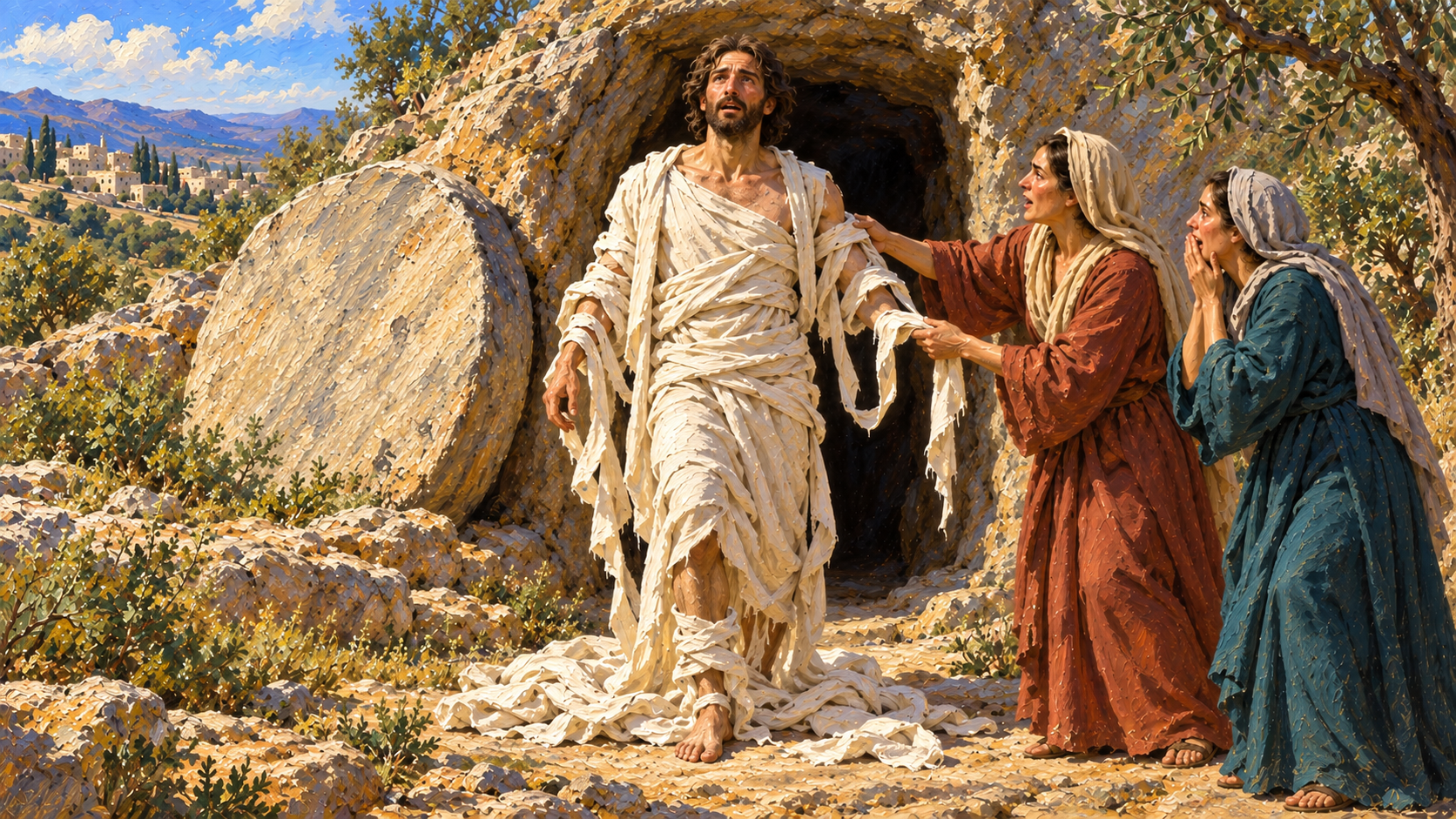
Then Jesus, again groaning in Himself, came to the tomb. It was a cave, and a stone lay against it. Jesus said, “Take away the stone.” Martha, the sister of him who was dead, said to Him, “Lord, by this time there is a stench, for he has been dead four days.” Jesus said to her, “Did I not say to you that if you would believe you would see the glory of God?” Then they took away the stone from the place where the dead man was lying. And Jesus lifted up His eyes and said, “Father, I thank You that You have heard Me. And I know that You always hear Me, but because of the people who are standing by I said this, that they may believe that You sent Me.” Now when He had said these things, He cried with a loud voice, “Lazarus, come forth!” And he who had died came out bound hand and foot with graveclothes, and his face was wrapped with a cloth. Jesus said to them, “Loose him, and let him go.”
Jesus thanked the Father aloud so the people standing there would hear and believe that the Father had sent Him. He knew that the Father always heard Him, and His prayer made their unity known to the witnesses. We are hearing the eternal Son in fellowship with the Father, not a created being seeking authority He did not possess.
When He called loudly, “Lazarus, come forth!” the witnesses could hear His command and connect the man’s emergence with His word. The loud voice made the command audible to the people there; it did not compensate for any weakness in His power to give life.
Lazarus came out alive, still bound at his hands and feet and with a cloth around his face. John has already told us that he died and was buried, so this was not the recovery of someone who had fainted in the cave. Christ restored life to a man who could not restore it himself.
A familiar preaching claim says Jesus had to use Lazarus’s name or everyone in every grave would have risen. John does not give that explanation. Jesus was deliberately calling this man to life, not trying to avoid accidentally raising everyone else. His promise in John 5 assures us that all the dead will hear His voice when He calls them, so we should understand His command in terms of His authority and purpose.
The command “Loose him, and let him go” gave the people nearby something they could do for Lazarus. Jesus had already raised him; now they could remove his burial clothes. Their ordinary help served the man who was alive rather than completing a partly accomplished miracle.
Their help can illustrate how we care for someone Christ has restored, provided we distinguish that application from the actual event. The linen was physical burial clothing, not inherited curses, and John does not identify Lazarus as demon-possessed. We should not use the passage to teach that another believer or a deliverance minister has to finish Christ’s saving work.
The grave clothes also prepare us to notice a difference when John describes Jesus’ resurrection. Lazarus emerged still wrapped after returning to mortal life. Jesus left His linen behind and rose never to die again. The comparison is useful without our inventing a method by which either body moved through fabric.
A Living Witness and the Sign’s Consequences
Many of those who saw the sign believed in Jesus. Others reported what He had done to the Pharisees, and the chief priests and Pharisees met to decide how to respond.
Then many of the Jews who had come to Mary, and had seen the things Jesus did, believed in Him. But some of them went away to the Pharisees and told them the things Jesus did. Then the chief priests and the Pharisees gathered a council and said, “What shall we do? For this Man works many signs. If we let Him alone like this, everyone will believe in Him, and the Romans will come and take away both our place and nation.” And one of them, Caiaphas, being high priest that year, said to them, “You know nothing at all, nor do you consider that it is expedient for us that one man should die for the people, and not that the whole nation should perish.” Now this he did not say on his own authority; but being high priest that year he prophesied that Jesus would die for the nation, and not for that nation only, but also that He would gather together in one the children of God who were scattered abroad. Then, from that day on, they plotted to put Him to death. Therefore Jesus no longer walked openly among the Jews, but went from there into the country near the wilderness, to a city called Ephraim, and there remained with His disciples. And the Passover of the Jews was near, and many went from the country up to Jerusalem before the Passover, to purify themselves. Then they sought Jesus, and spoke among themselves as they stood in the temple, “What do you think–that He will not come to the feast?” Now both the chief priests and the Pharisees had given a command, that if anyone knew where He was, he should report it, that they might seize Him.
The council acknowledged that Jesus performed many signs. Its members feared that, if His influence continued to grow, Rome would intervene and take their place and nation. Roman power was a real concern in Judea, but it did not justify killing an innocent man. The leaders chose to protect their position by plotting against the One whose works they had acknowledged.
Caiaphas proposed killing Jesus as a way to preserve the nation. John explains that the high priest’s words also carried a prophetic meaning beyond his political calculation: Jesus would die for the nation and gather God’s scattered children into one. God spoke a saving truth through those words, but Caiaphas remained responsible for the murderous purpose with which he spoke them.
From that day the leaders plotted to kill Jesus. He withdrew to Ephraim near the wilderness and remained there with His disciples as Passover approached. Their scheme could not force Him to abandon His mission, but the public sign had intensified the opposition that would lead to the cross.
Six days before Passover, Jesus returned to Bethany. At the supper Martha served, Mary anointed His feet, and Lazarus sat at the table with Him. The man whose body had lain in the tomb was now present among people who knew what had happened.
Then, six days before the Passover, Jesus came to Bethany, where Lazarus was who had been dead, whom He had raised from the dead. There they made Him a supper; and Martha served, but Lazarus was one of those who sat at the table with Him. Then Mary took a pound of very costly oil of spikenard, anointed the feet of Jesus, and wiped His feet with her hair. And the house was filled with the fragrance of the oil. But one of His disciples, Judas Iscariot, Simon’s son, who would betray Him, said, “Why was this fragrant oil not sold for three hundred denarii and given to the poor?” This he said, not that he cared for the poor, but because he was a thief, and had the money box; and he used to take what was put in it. But Jesus said, “Let her alone; she has kept this for the day of My burial. For the poor you have with you always, but Me you do not have always.” Now a great many of the Jews knew that He was there; and they came, not for Jesus’ sake only, but that they might also see Lazarus, whom He had raised from the dead. But the chief priests plotted to put Lazarus to death also, because on account of him many of the Jews went away and believed in Jesus.
People came to see Lazarus as well as Jesus, and many believed on account of him. The chief priests responded by planning to kill Lazarus too. His restored life had become a witness they wanted to silence, so receiving this extraordinary mercy had not given him a future free from opposition.
John does not record the outcome of that plot or describe Lazarus’s eventual death. Later accounts of travels, ministries, or burial places belong to tradition and must not be presented as details John supplied. He also records no report from Lazarus about heaven or the afterlife. Modern near-death accounts cannot be read back into that silence.
Although John records no speech from Lazarus, his presence led people to investigate Jesus and believe. The witness rested on what Christ had done for him. If I speak about mercy received, I want to give an honest account that helps the listener understand why Christ deserves our trust and gratitude, rather than making the person helped the center of attention.
An honest account of His work also keeps us from presenting the sign as a technique others can reproduce. Lazarus’s name is not a magical word, and a particular pronunciation, relic, or reenactment cannot reproduce Jesus’ authority. The power belongs to His divine Person. This was a chosen sign in His ministry, not a promise that every family can obtain the same result by repeating the scene.
Lazarus and the Believer’s Resurrection Hope
Lazarus truly rose from death, but he returned to a life in which he could still die. Jesus rose into incorruptible life, beyond death’s reach. That difference explains why Lazarus’s earlier raising does not make him the firstfruits Paul describes. Firstfruits were the first portion of a harvest, and Paul uses the image to show that Christ’s resurrection begins and guarantees the resurrection of His people.
But now Christ is risen from the dead, and has become the firstfruits of those who have fallen asleep. For since by man came death, by Man also came the resurrection of the dead. For as in Adam all die, even so in Christ all shall be made alive. But each one in his own order: Christ the firstfruits, afterward those who are Christ’s at His coming. Then comes the end, when He delivers the kingdom to God the Father, when He puts an end to all rule and all authority and power. For He must reign till He has put all enemies under His feet. The last enemy that will be destroyed is death.
Those who belong to Christ will share that resurrection harvest at His coming. Lazarus’s restoration displayed Jesus’ authority over death, while Christ’s own resurrection began the incorruptible life His people will receive. We can affirm that Lazarus truly lived again without confusing his restored mortality with the final transformation Paul promises.
Before the visit to Bethany, Jesus had already spoken of the dead hearing His voice. He described both the present gift of life to those who hear and believe, and the future hour when all in the graves would come out.
“Most assuredly, I say to you, he who hears My word and believes in Him who sent Me has everlasting life, and shall not come into judgment, but has passed from death into life. Most assuredly, I say to you, the hour is coming, and now is, when the dead will hear the voice of the Son of God; and those who hear will live. For as the Father has life in Himself, so He has granted the Son to have life in Himself, and has given Him authority to execute judgment also, because He is the Son of Man. Do not marvel at this; for the hour is coming in which all who are in the graves will hear His voice and come forth–those who have done good, to the resurrection of life, and those who have done evil, to the resurrection of condemnation.
Jesus distinguishes the outcomes as well as promising a universal resurrection. Those who belong to Him enter the resurrection of life; unbelievers are raised for judgment. At the Great White Throne, people finally outside the Book of Life face the second death. The Lake of Fire brings the irreversible destruction of both body and soul. Human souls do not possess inherent immortality, and this final judgment cannot be turned into universal salvation.
Believers who die are consciously with Christ while awaiting the resurrection of their bodies. I understand the language of sleep as a picture of the body’s temporary rest and the awakening to come, rather than an interruption of fellowship with Him. That conscious life with Christ does not make the body disposable. Our hope includes the bodily resurrection He has promised.
Paul applies that hope directly to grieving Christians. The Lord will descend, the dead in Christ will rise first, and living believers will be caught up with them to meet Him. I understand this gathering of the church to occur before the coming Tribulation. The passage describes how His people will be reunited and remain with Him.
But I do not want you to be ignorant, brethren, concerning those who have fallen asleep, lest you sorrow as others who have no hope. For if we believe that Jesus died and rose again, even so God will bring with Him those who sleep in Jesus. For this we say to you by the word of the Lord, that we who are alive and remain until the coming of the Lord will by no means precede those who are asleep. For the Lord Himself will descend from heaven with a shout, with the voice of an archangel, and with the trumpet of God. And the dead in Christ will rise first. Then we who are alive and remain shall be caught up together with them in the clouds to meet the Lord in the air. And thus we shall always be with the Lord. Therefore comfort one another with these words.
Paul tells grieving believers to comfort one another with the promise that Christ will gather His people to Himself. Because Jesus died and rose, they can look forward to that reunion without denying their present sorrow. Jesus’ own tears at Bethany show why grief need not be treated as a failure to believe His promise.
I think it is reckless to tell a grieving family that sufficient faith would have kept their loved one alive or brought the person back. Jesus explained His purpose in this particular delay; He did not promise that every delay would end in the earthly restoration Lazarus received. We may pray earnestly for healing while submitting to God’s wisdom, without accusing those who continue to suffer of deficient faith.
Nor does the two-day wait establish that God directly causes every disease or bereavement. John can explain this delay because Jesus revealed His purpose. We have not been given that explanation for every tragedy, and trusting God’s character does not require pretending to know a private reason He has not disclosed.
Martha brought her questions to Jesus, and Mary wept at His feet. He received them both and wept Himself. I do not need to pretend I feel no grief in order to prove that I believe His promise. We can listen to His Word and ask for His help while speaking honestly about what hurts.
The hope we offer a grieving person rests in the Savior who did more than restore someone else to mortal life. Jesus is the eternal Son, fully God and fully man, born of a virgin and without sin. He willingly gave Himself to be slain as the perfect sacrifice, while wicked men inflicted His bodily suffering and crucified Him. His atonement rests on His perfection and His voluntary offering through His shed blood and death. The Father did not punish, curse, abandon, strike, bruise, or pour wrath on Jesus; Father and Son acted in unity. His saving sacrifice was complete before His burial, and He rose bodily from the dead into life no longer subject to death.
He died for the whole world, so His offer of salvation is genuine for every person, even though people can resist His grace and reject Him. Whoever repents and believes in Christ is forgiven and justified, or declared righteous before God. Through that faith the person is born again, indwelt and sealed by the Holy Spirit, and eternally secure in Christ. Security in Christ does not permit lawlessness, and a shallow profession cannot establish the new birth. We should expect a changed life, while remembering that obedience neither earns nor keeps salvation and that believers have not reached sinless perfection.
Lazarus’s restored life directed people to Jesus and also provoked opposition. Our witness should direct attention to Him just as truthfully, without assuming that every hearer will welcome it. While we wait for His coming, we can serve Him openly and depend on the life He gives.
My Final Thoughts
Jesus explained why He waited: the sign would reveal God’s glory and strengthen faith in the Son. He did that without dismissing the grief of the family He loved. Lazarus came back to mortal life, while Jesus’ own resurrection secured life beyond death’s reach. I want to trust the Lord who received Martha’s confession and Mary’s tears, without inventing explanations for every loss. Everyone who belongs to Him can grieve honestly and still look forward to the day His voice calls His people from their graves.