
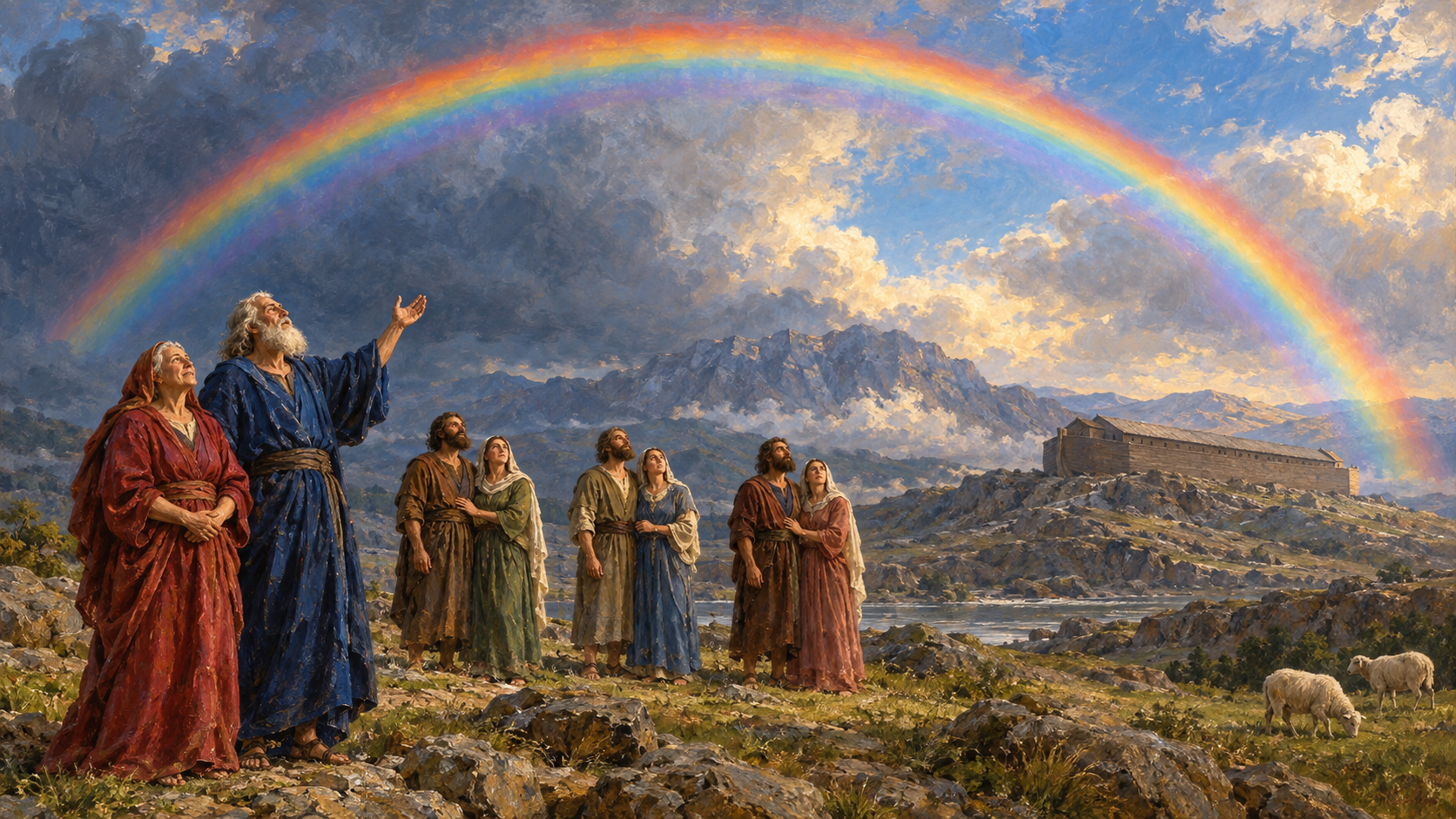
When I see a rainbow, Genesis gives me a definite promise to remember: God will never again destroy all flesh and the earth by a flood. He gave that sign after judging a world filled with violence, and He gave it knowing that human beings would still sin. Its beauty should draw our attention to His faithfulness without making us forget either the judgment that came before it or the judgment Scripture says is still ahead.
The Rainbow and the World After the Flood
Genesis introduces Noah in a world where human wickedness had spread unchecked. God saw both the violence people committed and the evil intentions behind it, and He announced what He would do.
Then the LORD saw that the wickedness of man was great in the earth, and that every intent of the thoughts of his heart was only evil continually. And the LORD was sorry that He had made man on the earth, and He was grieved in His heart. So the LORD said, “I will destroy man whom I have created from the face of the earth, both man and beast, creeping thing and birds of the air, for I am sorry that I have made them.” But Noah found grace in the eyes of the LORD. This is the genealogy of Noah. Noah was a just man, perfect in his generations. Noah walked with God. And Noah begot three sons: Shem, Ham, and Japheth. The earth also was corrupt before God, and the earth was filled with violence. So God looked upon the earth, and indeed it was corrupt; for all flesh had corrupted their way on the earth. And God said to Noah, “The end of all flesh has come before Me, for the earth is filled with violence through them; and behold, I will destroy them with the earth.
Violence had spread across the earth because people had corrupted their ways. Genesis describes the intentions of their hearts as continually evil and tells us that their wickedness grieved God. He announced judgment against the world He had made, while Noah found grace in His eyes.
Noah was just, walked with God, and was blameless in his generation. That does not mean he was sinless or that he earned God’s favor by building an ark. God warned him, supplied instructions for his preservation, and Noah believed Him. Paul later describes his obedience in Hebrews as an act of faith in a warning about things not yet seen.
I understand this as a global flood. The judgment concerns the earth and all flesh, and the covenant afterward answers that same worldwide destruction. Reducing it to one region would leave the promise unable to explain why later regional floods have not broken it. God preserved Noah’s household and the creatures with them in the ark, then told them when they could leave. The study on Noah and the Ark follows that account in greater detail.
Then God spoke to Noah, saying, “Go out of the ark, you and your wife, and your sons and your sons’ wives with you. Bring out with you every living thing of all flesh that is with you: birds and cattle and every creeping thing that creeps on the earth, so that they may abound on the earth, and be fruitful and multiply on the earth.” So Noah went out, and his sons and his wife and his sons’ wives with him. Every animal, every creeping thing, every bird, and whatever creeps on the earth, according to their families, went out of the ark. Then Noah built an altar to the LORD, and took of every clean animal and of every clean bird, and offered burnt offerings on the altar. And the LORD smelled a soothing aroma. Then the LORD said in His heart, “I will never again curse the ground for man’s sake, although the imagination of man’s heart is evil from his youth; nor will I again destroy every living thing as I have done. “While the earth remains, Seedtime and harvest, Cold and heat, Winter and summer, And day and night Shall not cease.”
Noah’s first recorded action after leaving the ark was to build an altar and offer clean animals and birds to the LORD. He and his family began their life in the world after the flood by worshiping the God who had preserved them. God accepted the offering and declared that He would not again destroy every living thing as He had done.
He made that commitment even though the imagination of man’s heart remained evil from youth. The flood had judged human wickedness; it had not given the survivors and their descendants new hearts. They still needed God’s grace and the Savior He would send.
God also promised the continuing order on which ordinary life depends. Farmers could plant with an expectation of harvest, and families could live through the succession of seasons and days. The words “while the earth remains” give the promise its setting. God would preserve life in this world without promising that its fallen condition would last forever.
Genesis 9 then records His blessing upon Noah’s family, the responsibilities He gave them, and the covenant He established with them and the earth.
So God blessed Noah and his sons, and said to them: “Be fruitful and multiply, and fill the earth. And the fear of you and the dread of you shall be on every beast of the earth, on every bird of the air, on all that move on the earth, and on all the fish of the sea. They are given into your hand. Every moving thing that lives shall be food for you. I have given you all things, even as the green herbs. But you shall not eat flesh with its life, that is, its blood. Surely for your lifeblood I will demand a reckoning; from the hand of every beast I will require it, and from the hand of man. From the hand of every man’s brother I will require the life of man. “Whoever sheds man’s blood, By man his blood shall be shed; For in the image of God He made man. And as for you, be fruitful and multiply; Bring forth abundantly in the earth And multiply in it.” Then God spoke to Noah and to his sons with him, saying: “And as for Me, behold, I establish My covenant with you and with your descendants after you, and with every living creature that is with you: the birds, the cattle, and every beast of the earth with you, of all that go out of the ark, every beast of the earth. Thus I establish My covenant with you: Never again shall all flesh be cut off by the waters of the flood; never again shall there be a flood to destroy the earth.” And God said: “This is the sign of the covenant which I make between Me and you, and every living creature that is with you, for perpetual generations: I set My rainbow in the cloud, and it shall be for the sign of the covenant between Me and the earth. It shall be, when I bring a cloud over the earth, that the rainbow shall be seen in the cloud; and I will remember My covenant which is between Me and you and every living creature of all flesh; the waters shall never again become a flood to destroy all flesh. The rainbow shall be in the cloud, and I will look on it to remember the everlasting covenant between God and every living creature of all flesh that is on the earth.” And God said to Noah, “This is the sign of the covenant which I have established between Me and all flesh that is on the earth.”
A covenant is a solemn commitment with stated terms. Here God established the terms Himself, addressing Noah and his sons, their descendants, and every living creature with them. He repeatedly included all flesh and the earth. This was not a private assurance for Noah’s lifetime or a promise confined to one future nation.
The promise was specific: floodwaters would never again cut off all flesh or destroy the earth. Rivers can still overflow, storms can devastate coastlines, and families can lose everything in a flood. I would not tell a suffering family that the rainbow guaranteed their town’s safety. Those disasters are terrible, but they are not another worldwide destruction of the kind God ruled out.
God appointed the rainbow in the cloud as the visible sign of that commitment for perpetual generations. The sign does not make Him faithful or supply power to the promise. It directs our attention to what He has said. The Hebrew word ot means sign; in this passage God explains the message His sign carries, so we do not need to invent one.
God also said that He would see the rainbow and remember His covenant. That does not describe an all-knowing God recovering information He had forgotten. Earlier, God “remembered Noah” and acted to bring the floodwaters down. Later, He remembered His covenant as Israel groaned in bondage and acted to deliver them. Remembering in these accounts involves carrying out His commitment.
When He says He will look on the rainbow and remember, He assures us that He honors the covenant He established. Its continuance does not depend on whether everyone below the clouds understands it. I can remember His promise when I see the sign because He remains faithful to His own word.
Every nation lives in the world this promise preserves, including people who do not acknowledge its Creator. The covenant with Noah therefore has a different reach and purpose from the later covenants with Abraham, Israel at Sinai, and David, or the New Covenant promised to Israel and Judah. Those commitments belong together in God’s work, but their recipients and terms cannot simply be exchanged.
The animals’ inclusion also helps us understand what God was giving: continued life in the present world, rather than automatic forgiveness and eternal life. Someone can enjoy the seasons, raise a family, and see many rainbows while remaining unreconciled to God. Salvation still requires repentance and faith in Jesus Christ. The study on the Noahic Covenant examines its provisions more fully.
Covenant Preservation and Human Accountability
God’s pledge did not relieve Noah’s descendants of responsibility for their conduct. He blessed them and commanded them to multiply and fill the earth. He permitted animals as food, while forbidding them to eat flesh with its life, identified with its blood. They could receive His provision without treating life as though it belonged to them to use however they pleased.
His demand for an accounting of human lifeblood was especially serious. God grounded the punishment of murder in the fact that He made man in His image. The fall and the flood had not erased that image or made human life disposable. Murder attacks a fellow human being who bears the Creator’s image, and the passage requires human judgment upon the murderer.
This gives a foundation for public justice and capital punishment, rather than permission for personal revenge. Lawful authority must establish guilt and administer justice honestly. Evidence, wrongful convictions, favoritism, and the abuse of power are real concerns when governments exercise that authority. They do not change the reason God gave for protecting human life.
I cannot assign someone’s worth by intelligence, health, age, ancestry, or usefulness. An unborn child, a disabled person, and an elderly neighbor all bear God’s image. So does someone whose conduct I rightly oppose. We must protect life and hold wrongdoing accountable without deciding that an unpopular person has ceased to be human.
Genesis 9 establishes these duties within the world God promised to preserve. It does not provide an exhaustive civil code for every later nation, and its commands must be read alongside the rest of Scripture. But God’s patience gives no one permission to disregard His moral authority. The same Lord who promised not to repeat the flood required people to honor life and answer for bloodshed.
What the Bow in the Cloud Means
Genesis calls the sign God’s bow in the cloud. The Hebrew word qeshet can also refer to a bow used as a weapon. Psalm 7 uses it in a description of God’s judgment.
God is a just judge, And God is angry with the wicked every day. If he does not turn back, He will sharpen His sword; He bends His bow and makes it ready. He also prepares for Himself instruments of death; He makes His arrows into fiery shafts.
In the psalm, God sharpens a sword, bends His bow, and prepares arrows against the unrepentant wicked. The surrounding words identify a weapon and its purpose. Genesis 9 identifies the bow in the cloud as the sign of a promise concerning floodwaters. The shared word does not make every detail of the psalm part of the rainbow’s meaning.
Some explanations picture God hanging up a war bow or aiming its arrow toward heaven and ultimately toward His Son. Genesis says none of that. God did not surrender His right to judge, and the passage does not describe an arrow or identify a heavenly target. I would not use an imagined weapon to teach that the Father later directed His punishment against Jesus.
The rainbow itself forms as sunlight enters water droplets, bends, reflects inside them, and bends again on leaving. The bending is called refraction. Different colors bend by slightly different amounts, separating the sunlight into a visible spectrum, a process called dispersion. The observer sees the light that reaches the eye from the appropriate droplets. We usually see part of a circle, though a full circle can sometimes be visible from an elevated viewpoint. The Met Office’s explanation of rainbows describes these processes.
Explaining how light and water produce a rainbow does not explain away God’s use of it. He created light, water, the atmosphere, and the eyes with which we see. Genesis tells us why He appointed this phenomenon as a sign. We can understand its physical formation and still receive the meaning He attached to it.
Nor does Genesis settle whether a rainbow had been visible before the flood. “I set My rainbow” identifies God’s appointment of the sign; the passage does not require us to conclude that light and water had previously behaved differently. The related study on the literal six days of creation considers the Creator’s work at the beginning.
The rainbow appears in the world God spared from a second global flood. That is mercy toward people who continue to sin, not a declaration that sin has become acceptable. This widely shared kindness is sometimes called common grace: God supplies rain, food, and the stable conditions in which human life can continue. Such gifts are real benefits to people who reject Him, even though receiving them does not mean they are saved.
In that preserved world Abraham would be called, Israel would become a nation, the prophets would speak, and the Messiah would come. The gospel could then be carried to the nations. God’s patience allows human life and His redemptive work to continue, while leaving every generation responsible to respond to Him.
Rainbow Glory in Isaiah, Ezekiel, and Revelation
Isaiah does not describe a visible rainbow in the following passage. He recalls the promise about Noah’s waters to assure Zion of God’s enduring mercy after judgment.
“For a mere moment I have forsaken you, But with great mercies I will gather you. With a little wrath I hid My face from you for a moment; But with everlasting kindness I will have mercy on you,” Says the LORD, your Redeemer. “For this is like the waters of Noah to Me; For as I have sworn That the waters of Noah would no longer cover the earth, So have I sworn That I would not be angry with you, nor rebuke you. For the mountains shall depart And the hills be removed, But My kindness shall not depart from you, Nor shall My covenant of peace be removed,” Says the LORD, who has mercy on you.
The LORD compares His sworn commitment concerning the flood with His assurance that His kindness and covenant of peace will not depart. Mountains and hills may be removed, but His promise of mercy will stand. The comparison gives the people reason to trust the restoration He announces, because the God who speaks has kept His earlier word.
Isaiah uses one faithful commitment to assure them of another. He does not make the covenant with Noah contain every later promise or remove the particular future He announces for Zion. God’s reliability connects the two assurances without making their terms identical.
Ezekiel describes a different encounter. Among the exiles, far from Jerusalem, he saw a vision of the LORD’s glory. Above the living creatures and the expanse was the likeness of a throne.
And above the firmament over their heads was the likeness of a throne, in appearance like a sapphire stone; on the likeness of the throne was a likeness with the appearance of a man high above it. Also from the appearance of His waist and upward I saw, as it were, the color of amber with the appearance of fire all around within it; and from the appearance of His waist and downward I saw, as it were, the appearance of fire with brightness all around. Like the appearance of a rainbow in a cloud on a rainy day, so was the appearance of the brightness all around it. This was the appearance of the likeness of the glory of the LORD. So when I saw it, I fell on my face, and I heard a voice of One speaking.
The likeness of a man was seated on the throne, surrounded by fire-like brightness. Ezekiel compared that radiance to a rainbow in a cloud on a rainy day. He repeatedly used words such as “likeness” and “appearance” as he described what he saw. He was reporting a vision of God’s glory, not reducing God to an ordinary human body or an atmospheric event.
Ezekiel fell on his face and heard the One speaking. The rainbow-like brightness belongs to this display of the LORD’s radiant majesty. Covenant faithfulness is consistent with that image, but the passage does not explain every color or repeat the terms of Genesis 9. We should receive the comparison Ezekiel gives without assigning a separate hidden doctrine to each feature.
John also saw a rainbow in a vision of God’s throne. Revelation places it in a scene of heavenly worship before the Lamb opens the seals.
After these things I looked, and behold, a door standing open in heaven. And the first voice which I heard was like a trumpet speaking with me, saying, “Come up here, and I will show you things which must take place after this.” Immediately I was in the Spirit; and behold, a throne set in heaven, and One sat on the throne. And He who sat there was like a jasper and a sardius stone in appearance; and there was a rainbow around the throne, in appearance like an emerald. Around the throne were twenty-four thrones, and on the thrones I saw twenty-four elders sitting, clothed in white robes; and they had crowns of gold on their heads. And from the throne proceeded lightnings, thunderings, and voices. Seven lamps of fire were burning before the throne, which are the seven Spirits of God. Before the throne there was a sea of glass, like crystal. And in the midst of the throne, and around the throne, were four living creatures full of eyes in front and in back.
The One seated on the throne had an appearance like jasper and sardius, and the rainbow around the throne appeared like an emerald. John also saw the elders, the lamps of fire, the living creatures, and the sea like glass, while lightning, thunder, and voices came from the throne. The rainbow belongs within that whole scene of God’s glory and authority.
I do not read it as a sign that the throne has become harmless or that God will overlook evil. The following chapters describe judgments proceeding under the Lamb’s authority. The God who keeps His covenant concerning the flood also judges righteously. His mercy and His justice express the character of the same faithful Lord.
Later, during the trumpet judgments, John saw rainbow imagery associated with a mighty messenger coming down from heaven.
I saw still another mighty angel coming down from heaven, clothed with a cloud. And a rainbow was on his head, his face was like the sun, and his feet like pillars of fire. He had a little book open in his hand. And he set his right foot on the sea and his left foot on the land, and cried with a loud voice, as when a lion roars. When he cried out, seven thunders uttered their voices. Now when the seven thunders uttered their voices, I was about to write; but I heard a voice from heaven saying to me, “Seal up the things which the seven thunders uttered, and do not write them.” The angel whom I saw standing on the sea and on the land raised up his hand to heaven and swore by Him who lives forever and ever, who created heaven and the things that are in it, the earth and the things that are in it, and the sea and the things that are in it, that there should be delay no longer, but in the days of the sounding of the seventh angel, when he is about to sound, the mystery of God would be finished, as He declared to His servants the prophets.
The angel was clothed with a cloud, had a rainbow on his head, and shone with a face like the sun and feet like pillars of fire. With a little book open in his hand, he stood with one foot on the sea and the other on the land. His cry was followed by seven thunders, but John was forbidden to write what they said. Some information remained unrevealed even to the readers of Revelation.
Some readers identify this messenger as Christ because his appearance resembles descriptions of divine glory. I understand him as a mighty angel sent with God’s authority. John calls him “another mighty angel,” and he swears by the eternal Creator of heaven, earth, and sea. Those features favor distinguishing the messenger from the One whose purpose he announces. John Walvoord discusses both readings and gives the reasons for understanding him as an angel.
The rainbow suits a messenger of the Creator who keeps His word. His oath announces that there will be no further delay: in the days of the seventh trumpet, God’s mystery will be finished as He declared to His prophets. Here a mystery is a purpose known through God’s revelation, not a puzzle we can solve by guessing what the seven thunders said. God will carry out what He has made known.
A different kind of bow appears earlier, when the first seal is opened. The setting identifies it as a weapon of conquest rather than a rainbow.
Now I saw when the Lamb opened one of the seals; and I heard one of the four living creatures saying with a voice like thunder, “Come and see.” And I looked, and behold, a white horse. He who sat on it had a bow; and a crown was given to him, and he went out conquering and to conquer. When He opened the second seal, I heard the second living creature saying, “Come and see.” Another horse, fiery red, went out. And it was granted to the one who sat on it to take peace from the earth, and that people should kill one another; and there was given to him a great sword. When He opened the third seal, I heard the third living creature say, “Come and see.” So I looked, and behold, a black horse, and he who sat on it had a pair of scales in his hand. And I heard a voice in the midst of the four living creatures saying, “A quart of wheat for a denarius, and three quarts of barley for a denarius; and do not harm the oil and the wine.” When He opened the fourth seal, I heard the voice of the fourth living creature saying, “Come and see.” So I looked, and behold, a pale horse. And the name of him who sat on it was Death, and Hades followed with him. And power was given to them over a fourth of the earth, to kill with sword, with hunger, with death, and by the beasts of the earth.
The white horse’s rider carries a bow, receives a crown, and goes out conquering. Within the futurist reading of Revelation, I understand him as the counterfeit conqueror associated with the Antichrist. The following riders bring war, scarcity, and death. His success begins a period of terrible judgment before Christ’s true return.
The English word “bow” can obscure the difference between these passages. The rider carries a weapon; he is not carrying the covenant sign from Genesis. John does not mention arrows, which has led some readers to suggest bloodless conquest or an initial appearance of peace. The absence of a detail cannot establish how he conquers. What John does describe is the conquest and the disasters that follow.
The Days of Noah and the Judgment Still Ahead
The rainbow’s promise rules out another global flood, but Jesus warned of judgment still to come. He used the days of Noah to explain how unprepared people would be for His coming.
“But of that day and hour no one knows, not even the angels of heaven, but My Father only. But as the days of Noah were, so also will the coming of the Son of Man be. For as in the days before the flood, they were eating and drinking, marrying and giving in marriage, until the day that Noah entered the ark, and did not know until the flood came and took them all away, so also will the coming of the Son of Man be. Then two men will be in the field: one will be taken and the other left. Two women will be grinding at the mill: one will be taken and the other left. Watch therefore, for you do not know what hour your Lord is coming. But know this, that if the master of the house had known what hour the thief would come, he would have watched and not allowed his house to be broken into. Therefore you also be ready, for the Son of Man is coming at an hour you do not expect.
The people were eating and drinking, marrying and arranging marriages, right up to the flood. Food and marriage were not themselves their wrongdoing. They carried on with ordinary affairs without taking God’s warning seriously, until judgment overtook them. Jesus treated Noah’s experience as real history and warned that His coming would likewise find people unready.
I can become so occupied with work, plans, and the next family responsibility that I give little thought to answering to God. His patience does not mean His warning has expired. Christ calls us to remain watchful, without pretending to know the day or hour that He says we do not know.
Noah responded differently to the warning he received. Paul describes his faith and the action it produced.
By faith Noah, being divinely warned of things not yet seen, moved with godly fear, prepared an ark for the saving of his household, by which he condemned the world and became heir of the righteousness which is according to faith.
Noah prepared the ark because he believed God about things he had not seen. Godly fear moved him to undertake the work that would preserve his household. His conduct exposed the world’s refusal to heed the same God, and Hebrews calls him an heir of righteousness according to faith.
His obedience did not buy the grace Genesis says he found. He trusted God’s warning and used the refuge God provided. The rainbow came afterward, so looking at that sign could never have been the means of escape from the flood. I should appreciate the sign without placing my confidence in a visible object instead of the God who speaks.
Peter later answered people who dismissed the promise of Christ’s coming because they assumed the world would always continue as it had.
Beloved, I now write to you this second epistle (in both of which I stir up your pure minds by way of reminder), that you may be mindful of the words which were spoken before by the holy prophets, and of the commandment of us, the apostles of the Lord and Savior, knowing this first: that scoffers will come in the last days, walking according to their own lusts, and saying, “Where is the promise of His coming? For since the fathers fell asleep, all things continue as they were from the beginning of creation.” For this they willfully forget: that by the word of God the heavens were of old, and the earth standing out of water and in the water, by which the world that then existed perished, being flooded with water. But the heavens and the earth which are now preserved by the same word, are reserved for fire until the day of judgment and perdition of ungodly men. But, beloved, do not forget this one thing, that with the Lord one day is as a thousand years, and a thousand years as one day. The Lord is not slack concerning His promise, as some count slackness, but is longsuffering toward us, not willing that any should perish but that all should come to repentance. But the day of the Lord will come as a thief in the night, in which the heavens will pass away with a great noise, and the elements will melt with fervent heat; both the earth and the works that are in it will be burned up. Therefore, since all these things will be dissolved, what manner of persons ought you to be in holy conduct and godliness, looking for and hastening the coming of the day of God, because of which the heavens will be dissolved, being on fire, and the elements will melt with fervent heat? Nevertheless we, according to His promise, look for new heavens and a new earth in which righteousness dwells.
The scoffers deliberately leave creation and the flood out of their reasoning. God made the world by His word, and the flood had already overturned their claim that it had always continued undisturbed. The same word now preserves the heavens and earth for fire and the judgment of ungodly people.
Peter explains the delay in terms of God’s patience and desire that people repent. We should not mistake the time He gives us for either inability or indifference. The promised day will come, and the certainty of it calls for holy conduct now. Believers look beyond the destruction to God’s promised new heavens and new earth, where righteousness dwells.
Judgment by fire does not break a promise against destruction by floodwaters. Genesis never guaranteed that the fallen world would escape all further judgment or remain in its present condition forever. Peter announces its dissolution and the righteous creation God has promised afterward.
Unbelievers will be raised bodily and face the judgment Revelation 20:11-15 describes at the Great White Throne. The Lake of Fire is the second death, the final and irreversible destruction of human body and soul. I do not believe human souls are inherently immortal or that human beings will endure endless conscious torment. This does not mean the dead are unconscious while awaiting resurrection, and it does not mean everyone will eventually be saved. Final judgment is real and irreversible.
Modern Uses and the Need for Christ
People reproduce rainbow colors in art, children’s materials, clothing, advertising, and political symbols. A person can use the same colors to communicate many different messages. Those uses do not take the rainbow away from God or gain authority to revise His words in Genesis. He calls it His sign, and His promise continues regardless of the meanings people attach to their own designs.
When a rainbow is used to celebrate sexual relationships outside God’s design, I cannot endorse that message simply because the image is attractive or familiar. Marriage is the covenant union of one man and one woman, and sexual relations belong within that union. Desire, social approval, and a colorful symbol cannot give us authority to redefine what God established.
Nor does disagreement permit contempt for the people involved. Everyone bears God’s image and needs the same Savior. Christians should refuse mockery, threats, and selective outrage while speaking honestly about sin. If I condemn someone else’s conduct while excusing sexual sin in my own life, I am disregarding the authority I claim to defend. We should speak with self-control and patiently offer the gospel.
The world God preserved was the world into which His Son came. Jesus is the eternal Son, fully God and fully man. Born of a virgin, He remained completely sinless. Wicked men physically tortured, punished, and killed Him, and He willingly bore that real bodily punishment for our sins. He shed His innocent blood and died. His saving work through His blood and death was complete before His burial and bodily resurrection.
The Father did not punish, curse, abandon, strike, bruise, or pour wrath on Jesus. Christ willingly endured what wicked people inflicted, giving Himself for the sins of the whole world. God’s offer of salvation is genuine for every person, though people can resist His grace and reject the Savior.
Everyone who repents and believes is forgiven and justified, declared righteous before God. That person is genuinely born again, with the Holy Spirit dwelling within and sealing him. Every genuine believer is eternally secure in Christ. A superficial Christian profession does not establish new birth, and security gives no permission for lawlessness. Obedience is evidence of new life, not a payment that earns salvation or keeps us saved.
My Final Thoughts
The rainbow gives me reason to thank God for keeping His word in a world that still sins against Him. I need to remember the promise He actually gave, honor the human life He requires us to protect, and use His patience as an opportunity to respond to Him. The sign promises preservation from another worldwide flood; Christ gives forgiveness and resurrection life to everyone who repents and believes. I can admire the rainbow’s beauty while trusting the Savior I still need.