
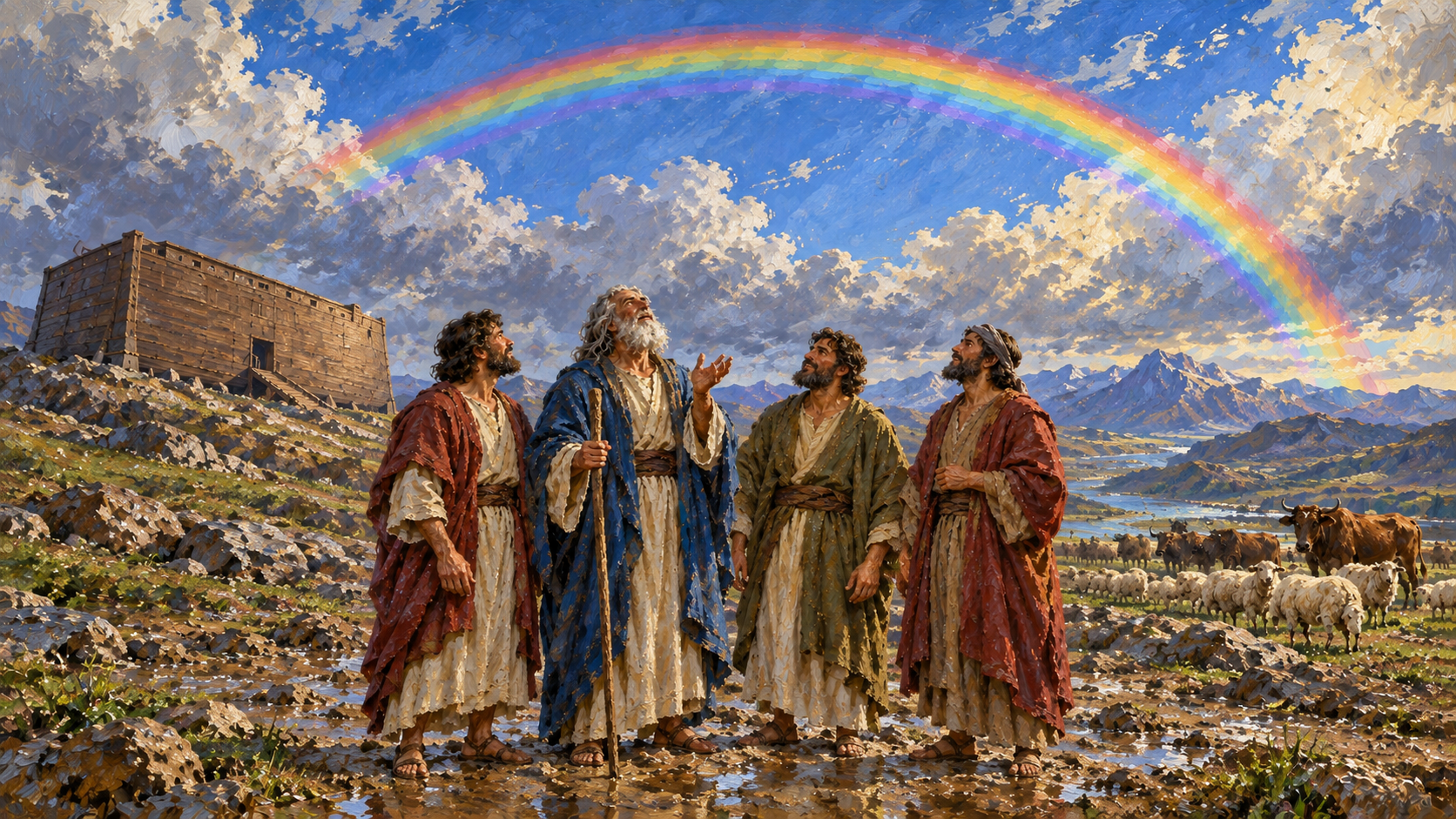
What did God promise Noah after the flood? The rainbow is the part most people remember, but Genesis explains both the promise and the world in which God made it. He had judged human wickedness, preserved Noah’s household, and brought them out of the ark. The people who stepped onto dry ground still had sinful hearts. I want to keep that in view as we consider why God pledged to sustain the earth and what He required of those living on it.
The Covenant Comes After Real Judgment
The flood was God’s judgment on a corrupt and violent world. Genesis does not describe an unfortunate stretch of weather or a disaster that caught God by surprise. It tells us why He acted.
Then the LORD saw that the wickedness of man was great in the earth, and that every intent of the thoughts of his heart was only evil continually.
The earth was filled with violence, and its corruption reached into people’s intentions. God judged wrongdoing that people were actually practicing. We cannot read the flood honestly while treating that wickedness as a minor fault or God’s response as a sudden loss of temper.
Yet Noah found grace in His sight. Genesis 6:8 says, “But Noah found grace in the eyes of the LORD.” Noah was not a sinless man who had made himself deserving of rescue. He believed God’s warning and obeyed it. Hebrews 11:7 explains that he prepared the ark by faith, moved with godly fear. God provided the means of deliverance, and Noah trusted Him enough to build what He commanded.
Noah’s household and the animals with them survived because God preserved them through the waters. Their deliverance did not make the judgment less real. The world they had known had been destroyed, and the family now depended on God for life after the flood as fully as they had depended on Him inside the ark. The wider account is examined in A Complete Bible Study on Noah and the Ark.
God Preserves a World That Still Needs Mercy
After leaving the ark, Noah built an altar to the LORD and offered burnt offerings from clean animals and birds. Worship was his first recorded act on coming out. He acknowledged the God who had delivered him, and Genesis places God’s promise of restraint beside His acceptance of the offering.
Then Noah built an altar to the LORD, and took of every clean animal and of every clean bird, and offered burnt offerings on the altar. And the LORD smelled a soothing aroma. Then the LORD said in His heart, “I will never again curse the ground for man’s sake, although the imagination of man’s heart is evil from his youth; nor will I again destroy every living thing as I have done.”
The flood had not cured the human heart. God expressly acknowledged its continuing evil when He promised not to destroy every living thing as He had just done. He was not relying on Noah’s descendants to become innocent enough to deserve a stable world. If every generation received the full judgment its wickedness deserved, mankind could not secure its own future. God mercifully pledged to preserve the world in which His purpose of redemption would unfold.
Noah did not compel that promise by bringing an offering. God initiated the covenant, a binding pledge that set out His commitment. Noah’s sacrifice also belongs to the biblical pattern that later becomes clearer in Israel’s sacrifices and Christ’s death: a life is given, and approach to God is connected with sacrifice. I would not put a complete understanding of the gospel into Noah’s mind or treat his altar as the complete sacrificial law later given to Israel. We can recognize the developing pattern without claiming that Genesis says more than it does.
God then spoke to Noah and his sons about the people and creatures included in His covenant.
And as for Me, behold, I establish My covenant with you and with your descendants after you, and with every living creature that is with you: the birds, the cattle, and every beast of the earth with you, of all that go out of the ark, every beast of the earth.
This promise was not confined to Noah’s lifetime or to people who would share his faith. His descendants were included, along with every living creature that had come out of the ark. God also identified the earth as a party to the covenant in Genesis 9:13. Israel did not yet exist as a nation. This was a commitment concerning the world where all nations would live.
God stated what He would never do again.
Thus I establish My covenant with you: Never again shall all flesh be cut off by the waters of the flood; never again shall there be a flood to destroy the earth.
The promise concerns another flood destroying the earth and cutting off all flesh. It does not say that rivers will never overflow, homes will never be swept away, or people will never die in a local flood. Those tragedies are dreadful, but they do not contradict the promise God actually made. He had judged the whole world by water and pledged not to repeat that destruction.
Along with this restraint, God promised the continuation of the earth’s ordinary rhythms.
While the earth remains, seedtime and harvest, cold and heat, winter and summer, and day and night shall not cease.
Farmers can sow and gather because God sustains an ordered world. Day follows night, and the seasons continue. That does not guarantee a successful crop in every field or mild weather in every place. A failed harvest can leave a family hungry without bringing seedtime and harvest across the earth to an end. I should be grateful for God’s provision without turning His covenant into a promise that faithful people will never suffer loss.
Within the world He promised to preserve, God gave the later covenants. Abraham received promises concerning his descendants and the land. The Mosaic Covenant ordered Israel’s national life under the Law, and the Davidic Covenant promised the royal line leading to the Messiah. Through the New Covenant, Christ provides forgiveness and inward transformation. The Noahic Covenant allowed those promises to unfold in history without replacing their distinct purposes.
Believers and unbelievers both receive food and the benefit of this continuing order. Receiving those mercies does not mean that everyone is reconciled to God. A person can live for years on what God provides while refusing the Savior he needs. Preservation gives us time to respond to His grace; it cannot take the place of salvation.
The Covenant Protects Life That Belongs to God
God’s promise of preservation did not leave mankind free to live however it pleased. In Genesis 9:1, He commanded Noah and his sons to be fruitful, multiply, and fill the earth, echoing His command to Adam and Eve. They were to live under their Creator’s authority in the world He sustained.
God permitted animals for food, but He placed a boundary on that provision. Genesis 9:4 says, “But you shall not eat flesh with its life, that is, its blood.” The blood represents the creature’s life, which belongs to God. The instruction was given to Noah’s household long before the Law at Sinai. We should receive the food God provides without disregarding the limit He placed on its use.
Permission to eat animals does not allow mankind to despise the creation placed under its care. God gave animals for food and also included them in His covenant. Human beings have a distinct place as His image bearers, but our authority to use what He provides remains subject to Him. We do not own life independently of its Giver.
Human bloodshed receives a still more serious treatment. God requires an accounting for human life and gives the reason in His command concerning murder.
Whoever sheds man’s blood, by man his blood shall be shed; for in the image of God He made man.
Murder attacks someone made in God’s image. The victim’s worth does not depend on being wealthy, healthy, productive, or well liked. Nor does it disappear when someone becomes old or dependent on care. God grounds the protection of human life in what He made mankind to be, rather than in a person’s usefulness to the rest of us.
The command authorizes punishment of the murderer by death. I understand it as a foundation for public justice, not permission for a bereaved person to take private revenge. Later biblical laws require witnesses, distinguish murder from accidental killing, and forbid partiality in judgment. The seriousness of the penalty requires faithful attention to justice; an accusation by itself cannot establish guilt.
Nations and their courts remain accountable to the Creator for how they treat people. If the wealthy can buy protection while the weak are dismissed, justice has been corrupted. And if I assign greater worth to a person because he is powerful or influential, I am using a standard God did not give me. His image is the reason to protect human life, including the life that other people find inconvenient.
God’s instruction about blood also helps us understand the sacrificial teaching that follows later. In Leviticus, He explained its place on Israel’s altar.
For the life of the flesh is in the blood, and I have given it to you upon the altar to make atonement for your souls; for it is the blood that makes atonement for the soul.
Atonement concerns dealing with sin so that the guilty can be reconciled to God. The blood represented a life given in the sinner’s place. God provided those sacrifices, but animal offerings could not finally remove sin. They taught Israel its need for the perfect sacrifice Christ would offer. When we speak of His blood, we mean that He really shed it and gave His life for sinners. We are not using a decorative expression for kindness. See A Bible Study on Life Being in the Blood for more on this connection.
The Rainbow Is God’s Visible Covenant Sign
God gave Noah a visible sign of His pledge. The clouds from which rain came would also display the rainbow He appointed.
I set My rainbow in the cloud, and it shall be for the sign of the covenant between Me and the earth.
The Hebrew word translated sign is oth, a sign, token, or pledge. The same word is used for the mark God gave Cain in Genesis 4:15. That does not make Cain’s mark the same covenant as Noah’s; it illustrates how a visible sign can assure someone of what God has said. Here God Himself explains what the rainbow signifies.
The rainbow shall be in the cloud, and I will look on it to remember the everlasting covenant between God and every living creature of all flesh that is on the earth.
God did not need help remembering a promise He might otherwise forget. In this passage, remembering His covenant means acting faithfully toward those included in it. He sees the sign and honors His word. The assurance rests on His commitment, rather than on whether every person who sees a rainbow understands its meaning.
For someone who had lived through the flood, rain could have recalled the judgment. God placed His sign in the clouds and attached a promise to it. Another storm could come, but it could not turn into a second worldwide destruction by floodwaters. I can look at the same sign knowing that His pledge has not expired.
The word translated rainbow, qesheth, is also the Hebrew word for a bow used in hunting or warfare. I see a fitting picture of restraint in a bow set in the clouds after judgment. Still, the shape does not give us permission to invent further promises. Genesis states the assurance we can rely on: God will keep His covenant with the earth and every living creature. A Bible Study on The Rainbow as a Covenant considers the sign more fully.
Preservation Does Not Cancel Future Judgment
Genesis 8:22 promises the earth’s continuing rhythms “while the earth remains”; it does not say the present world will last forever. Nor does the pledge about floodwaters rule out a different judgment. In his second letter, Peter addresses mockers who appeal to the world’s continuing order as though it proved that nothing will change and the Lord will never come. Peter answers that they deliberately overlook both creation and the flood. God’s word brought the world into existence, and by His word judgment fell upon it.
But the heavens and the earth which are now preserved by the same word, are reserved for fire until the day of judgment and perdition of ungodly men.
The same God who preserves the present heavens and earth has reserved them for a coming judgment. Their stability cannot prove that His warning is empty, because that stability depends on the word which also announces their end. Peter explains why the promised judgment has not yet come.
The Lord is not slack concerning His promise, as some count slackness, but is longsuffering toward us, not willing that any should perish but that all should come to repentance.
God’s patience gives people time to repent. I would be reckless to use that time as evidence that He approves of my sin or will never call me to account. His faithfulness gives us assurance about the covenant, but it also requires us to take His warnings seriously. The One who keeps His word concerning the flood will not forget what He has said about judgment. Peter goes on to describe new heavens and a new earth where righteousness dwells (2 Peter 3:13). God is preserving this world as He carries His purpose toward that promised new creation.
In his first letter, Peter also uses the flood to explain deliverance through Christ. He recalls the ark’s preparation and the eight people saved through the waters, then connects that event with baptism. He calls baptism an antitype, meaning a corresponding picture, and distinguishes the believer’s response to God from an outward washing.
There is also an antitype which now saves us, baptism, not the removal of the filth of the flesh, but the answer of a good conscience toward God, through the resurrection of Jesus Christ.
Peter says he is not describing dirt being washed from the body. He connects salvation with a good conscience toward God through Jesus Christ’s resurrection. I understand baptism here as the believer’s outward identification with Christ’s saving work. The water does not cause the new birth, and submitting to a ritual cannot replace faith in the crucified and risen Lord.
Noah’s family passed through judgment in the refuge God provided. In a greater fulfillment, Christ suffered for sins, “the Just for the unjust,” to bring us to God (1 Peter 3:18). Baptism identifies the believer with His death and resurrection. We should follow Peter’s explanation of the connection rather than make the ark or the water into a saving power of its own. The Savior is the refuge we need.
The Covenant World Still Needs the Gospel
The Noahic Covenant preserves life in a world where people still need forgiveness. Food, seasons, and another day to live are gifts, but receiving them does not remove our guilt. The sinful heart acknowledged in Genesis 8 needs more than a change of surroundings. God provides salvation through His Son.
Jesus Christ, the eternal Son of God, became fully man without ceasing to be fully God. He lived without sin and willingly gave Himself for us. His enemies mocked, beat, and scourged Him, then nailed Him to the cross. He bore the punishment for our sins in His innocent body, shedding His blood and truly dying. The Father did not punish or abandon Him. His saving sacrifice was complete in His death; afterward He was buried and rose bodily from the dead on the third day.
Knowing the covenant’s terms or admiring its rainbow cannot save me. Neither can moral improvement or baptismal water. We receive salvation by grace through repentance and faith in the Lord Jesus Christ.
That if you confess with your mouth the Lord Jesus and believe in your heart that God has raised Him from the dead, you will be saved.
For with the heart one believes unto righteousness, and with the mouth confession is made unto salvation.
For “whoever calls on the name of the LORD shall be saved.”
Paul’s promise directs us to Christ, who gives new and eternal life to those who receive Him. The God who preserved Noah’s descendants has provided the Savior those descendants need. See A Complete Bible Study on The Gospel for a fuller explanation.
Receiving that salvation should also affect how I live in the world God sustains. A meal, another growing season, and the ordinary arrival of morning give me reason to thank Him. The people around me deserve to be treated as His image bearers, even when they cannot advance my interests. And His patience should move me to repent of known sin rather than put off obedience because judgment has not yet fallen.
My Final Thoughts
God made His covenant with full knowledge that the human heart was still sinful. He promised to preserve the earth and never again destroy all flesh by a flood, while calling mankind to honor the life He had created. When I see the rainbow, I want to remember the promise God actually gave and trust Him to keep it. I also need to respond to the mercy that allows me another day to hear His word. The world has been preserved, and the Savior has come; repent and believe in Him.