
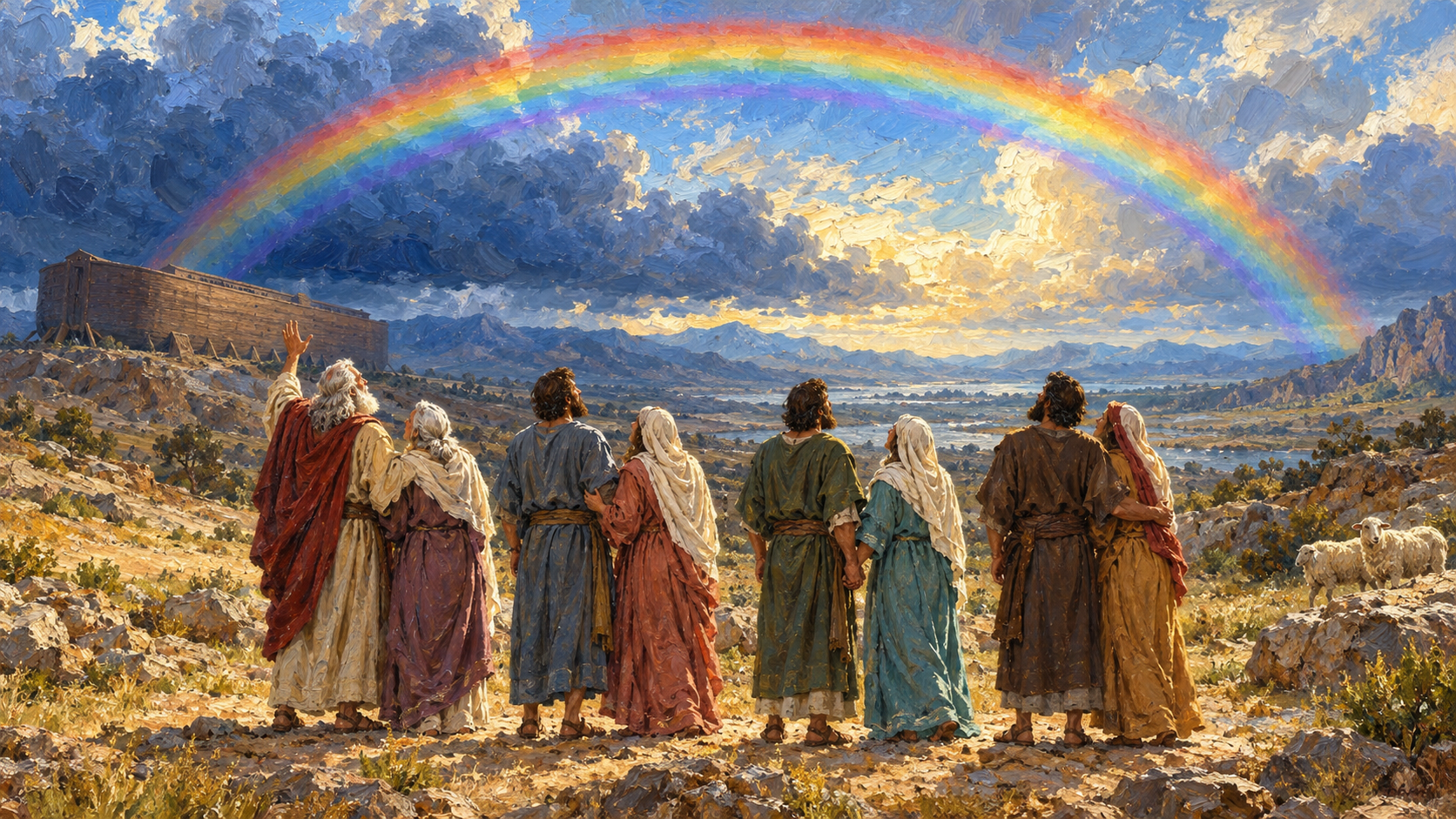
When a rainbow appears, we may admire its colors without considering the promise God attached to it. Genesis does not leave its meaning to our imagination. After judging the earth through the flood, God appointed the bow in the cloud as a sign of what He had promised Noah, his descendants, and every living creature. I want to understand that promise on His terms, including what it does and does not assure us.
Judgment, Grace, and a World Preserved
The rainbow belongs to an account that begins with human wickedness. Genesis describes an earth filled with corruption and violence, where the intentions of the human heart were continually evil. God announced judgment on the world He had made:
Then the LORD saw that the wickedness of man was great in the earth, and that every intent of the thoughts of his heart was only evil continually. And the LORD was sorry that He had made man on the earth, and He was grieved in His heart. So the LORD said, “I will destroy man whom I have created from the face of the earth, both man and beast, creeping thing and birds of the air, for I am sorry that I have made them.” But Noah found grace in the eyes of the LORD.
Noah found grace in the LORD’s eyes. Scripture describes him as a just man who walked with God, but he was not sinless or able to make himself deserving of rescue. God warned him, told him how to build the ark, and preserved his family and the creatures sheltered with them. Noah believed God’s warning and acted on it. His obedience expressed faith in the provision God had made. The study on Noah and the Ark follows those events more fully.
The flood was God’s judgment on rebellion, not a disaster that had escaped His control. When the waters receded, God brought Noah’s family and the creatures with them out into a world He had judged. Noah’s first recorded act after leaving the ark was to build an altar and offer burnt offerings to the LORD.
And the LORD smelled a soothing aroma. Then the LORD said in His heart, “I will never again curse the ground for man’s sake, although the imagination of man’s heart is evil from his youth; nor will I again destroy every living thing as I have done. “While the earth remains, Seedtime and harvest, Cold and heat, Winter and summer, And day and night Shall not cease.”
God promised to sustain the seasons and the continuing order of life while the earth remained. He made that commitment while still acknowledging that the imagination of the human heart was evil from youth. The flood had not made humanity innocent or given everyone a new heart. God was preserving a world that still needed His mercy.
What God Promised and Who It Covers
Genesis 9 begins with God’s instructions for life after the flood. Noah’s family was to be fruitful and multiply. God gave them animals for food but forbade eating blood, because life belongs to Him. Human bloodshed also demanded a reckoning, and God grounded the value of human life in His image:
But you shall not eat flesh with its life, that is, its blood. Surely for your lifeblood I will demand a reckoning; from the hand of every beast I will require it, and from the hand of man. From the hand of every man’s brother I will require the life of man. “Whoever sheds man’s blood, By man his blood shall be shed; For in the image of God He made man. And as for you, be fruitful and multiply; Bring forth abundantly in the earth And multiply in it.”
People remained accountable for how they treated one another. God’s decision to preserve the world did not give them permission to return to the violence He had judged. His image in humanity also meant that a person’s life had value regardless of how powerful or useful that person seemed to others.
God then stated His covenant with Noah and his sons. The Hebrew word berit means covenant, a binding commitment. Here, God committed Himself to a specific promise whose benefits extended beyond the family hearing it:
Then God spoke to Noah and to his sons with him, saying: “And as for Me, behold, I establish My covenant with you and with your descendants after you, and with every living creature that is with you: the birds, the cattle, and every beast of the earth with you, of all that go out of the ark, every beast of the earth. Thus I establish My covenant with you: Never again shall all flesh be cut off by the waters of the flood; never again shall there be a flood to destroy the earth.”
Noah’s descendants, the animals, and the earth were included. This covenant would preserve life within the world by assuring that floodwaters would never again destroy all flesh and the earth as they had done. Its continuation did not depend on humanity becoming sinless. The God who knew the condition of the human heart undertook to keep His word.
That broad protection should not be confused with forgiveness or eternal life. Animals and the earth share in the promise, but the covenant does not declare every human being reconciled to God. We can benefit from His preservation while still needing salvation. The study on The Noahic Covenant develops its scope and place in God’s dealings with humanity.
The Bow in the Cloud
After giving His promise, God appointed its visible sign. The bow did not create the covenant or make God faithful. It pointed to the commitment He had already made:
And God said: “This is the sign of the covenant which I make between Me and you, and every living creature that is with you, for perpetual generations: I set My rainbow in the cloud, and it shall be for the sign of the covenant between Me and the earth. It shall be, when I bring a cloud over the earth, that the rainbow shall be seen in the cloud; and I will remember My covenant which is between Me and you and every living creature of all flesh; the waters shall never again become a flood to destroy all flesh. The rainbow shall be in the cloud, and I will look on it to remember the everlasting covenant between God and every living creature of all flesh that is on the earth.” And God said to Noah, “This is the sign of the covenant which I have established between Me and all flesh that is on the earth.”
God called it “My rainbow.” Its meaning was tied to His word: the waters would never again become a flood to destroy all flesh. People who have never read Genesis still live in the world He preserves, though seeing the colors does not itself teach them what He promised. The related study on The Significance of the Rainbow considers that testimony further.
When God said He would remember His covenant, He was not suggesting that He might forget it until a rainbow appeared. The all-knowing God does not lose information. Remembering here describes His faithful attention to the covenant and His acting according to it. We are being assured that He will keep the promise, not asked to imagine Him needing a reminder.
The Hebrew word qeshet means “bow.” It can describe a weapon or the bow in the cloud, as the Brown–Driver–Briggs lexicon entry shows. Psalm 7 uses that word in a description of God’s judgment:
God is a just judge, And God is angry with the wicked every day. If he does not turn back, He will sharpen His sword; He bends His bow and makes it ready. He also prepares for Himself instruments of death; He makes His arrows into fiery shafts.
The shared word allows an illustration of mercy after judgment, but Genesis gives no description of God hanging up a literal weapon, removing its arrows, or aiming it somewhere else. Those details should not become the explanation of the covenant. God Himself tells us what His bow signifies, and His promise is sufficient to establish its meaning.
Genesis calls the rainbow a sign, using the Hebrew word ot. The same word is used for the mark given to Cain, though that sign had a different purpose:
And the LORD said to him, “Therefore, whoever kills Cain, vengeance shall be taken on him sevenfold.” And the LORD set a mark on Cain, lest anyone finding him should kill him.
God gave Cain the mark to protect him from being killed in vengeance. We are told what it was for, even though the passage does not describe its appearance. The rainbow, by comparison, concerns God’s promise to all flesh and the earth after the flood. In both passages, God assigns a purpose to a sign; the common word does not make the two signs interchangeable.
Revelation also contains rainbow imagery. John saw a rainbow around God’s throne, and Revelation 10 describes a mighty angel with a rainbow on his head. The throne scene places the rainbow within a display of heavenly glory:
Immediately I was in the Spirit; and behold, a throne set in heaven, and One sat on the throne. And He who sat there was like a jasper and a sardius stone in appearance; and there was a rainbow around the throne, in appearance like an emerald.
I see that imagery as consistent with God’s faithfulness even while Revelation describes coming judgments. His authority to judge has not canceled His covenant. We must still read each scene on its own terms, especially when John describes a different kind of bow in Revelation 6.
Now I saw when the Lamb opened one of the seals; and I heard one of the four living creatures saying with a voice like thunder, “Come and see.” And I looked, and behold, a white horse. He who sat on it had a bow; and a crown was given to him, and he went out conquering and to conquer.
The first seal rider carries a weapon of conquest. The passage does not call it a rainbow or identify it as a covenant sign. Comparing the wider prophetic passages in Daniel, Matthew 24, 2 Thessalonians 2, and Revelation 13, I understand this rider as Antichrist beginning his conquest. Revelation 6:2 itself, however, does not name him; it describes him armed with a bow, receiving a crown, and going out to conquer.
It mentions neither a treaty nor whether the rider has arrows. We should not use that silence to construct a doctrine of bloodless conquest, false peace, or a counterfeit rainbow. The study on The Four Horsemen examines the prophetic setting. Whatever power a human ruler receives, he cannot replace the Creator or provide the salvation found in Jesus Christ, the true King.
Knowing God’s meaning for the rainbow also helps us respond when the same colors carry other messages. They appear in art, products, flags, and personal designs, so we should consider what a particular use actually conveys. None of those uses can rewrite the covenant in Genesis. When the image celebrates sexual relationships outside God’s design, Christians should speak truthfully and without contempt. Marriage is one man and one woman, and every person bears God’s image and needs the same Savior.
I can appreciate a rainbow’s beauty and teach a child that it recalls God’s faithfulness without turning it into a charm or an omen. Seeing one is not permission to invent a private prophecy. Its covenant meaning comes from God’s written Word. Gratitude for the sign should lead us to listen to the God who gave it, including His warnings and His invitation to repent.
What the Rainbow Does Not Promise
The scope of God’s promise explains why local floods do not contradict it. Such floods can destroy communities and cause terrible suffering, but Genesis 9 promises that a flood will never again destroy all flesh and the whole earth. It does not promise that no river will overflow or that every person will be spared a disaster.
Nor does the covenant mean that God has abandoned judgment. Peter describes scoffers who deliberately disregard the flood and mistake the apparent delay of Christ’s coming for a failure of God’s word. The word that brought judgment by water now preserves the present world for a coming judgment:
For this they willfully forget: that by the word of God the heavens were of old, and the earth standing out of water and in the water, by which the world that then existed perished, being flooded with water. But the heavens and the earth which are now preserved by the same word, are reserved for fire until the day of judgment and perdition of ungodly men.
Judgment by fire does not break a promise that God will not again destroy all flesh by floodwaters. He never promised to preserve this fallen order without end. Peter therefore calls believers to holy conduct and godliness while they wait for the day of the Lord. We should respond to God’s patience with obedience rather than assume that judgment has become impossible.
The sign also gives no guarantee of personal salvation. In Matthew 24, Jesus described people eating, drinking, and arranging marriages until Noah entered the ark. Those activities were not sinful in themselves. The warning concerns people carrying on with ordinary life without responding to the danger God had announced.
Paul explains in Hebrews 11:7 that Noah believed God’s warning about events he had not yet seen and prepared the ark in godly fear. The rainbow came after his preservation through the flood; it was not the refuge God told him to enter. His faith led him to act on God’s word. We likewise need to respond to God’s warning and receive the Savior He provides.
The Preserved World Still Needs Christ
God’s preservation allowed human history to continue, including the unfolding of His work of redemption. He called Abraham, formed Israel, sent the prophets, and brought the Messiah into the world in the fullness of time. The gospel is now proclaimed in the world He continues to sustain. His patience has given people an opportunity to hear and respond.
A person can enjoy rain, harvests, family life, and many years of good health while remaining separated from God. Those gifts cannot remove sin or reconcile us to Him. They should give us reason for gratitude and repentance. The Creator who preserves the earth also commands people everywhere to repent, because He has appointed a day of righteous judgment through the risen Christ.
Jesus is the eternal Son, fully God and fully man, born of a virgin and without sin. Wicked men physically tortured, punished, and killed Him. He willingly bore the punishment for our sins in His innocent body, shed His blood, and completed His saving work in His death before He was buried and rose bodily. The Father did not punish, curse, abandon, strike, bruise, or pour wrath on Jesus. The Father and Son remained united as Christ gave Himself as the perfect sacrifice for the sins of the whole world.
God’s offer of salvation is genuine for every person, though people can resist His grace and reject Christ. Everyone who truly repents and believes is forgiven and born again. The Holy Spirit indwells and seals that believer, who is eternally secure. Obedience is the fruit of this new life, not a payment that earns salvation or keeps it in force. That assurance gives us no permission to continue in lawlessness.
Because God preserves the world, we can care for our families, work honestly, and make the gospel known in the time He gives us. I do not want to spend that time assuming that there will always be another opportunity to respond. The mercy that sustains ordinary life should make us attentive to Him as we wait for the Lord.
My Final Thoughts
The rainbow recalls both a real judgment and a promise God continues to keep. I want its beauty to remind me that we live by His patient mercy, while remembering that preservation is not the same as salvation. He will not again destroy all flesh by floodwaters, but we still answer to Him and need the forgiveness He offers through Christ. The right response to the sign is to trust what God has said and turn to the Savior who gives eternal life.