
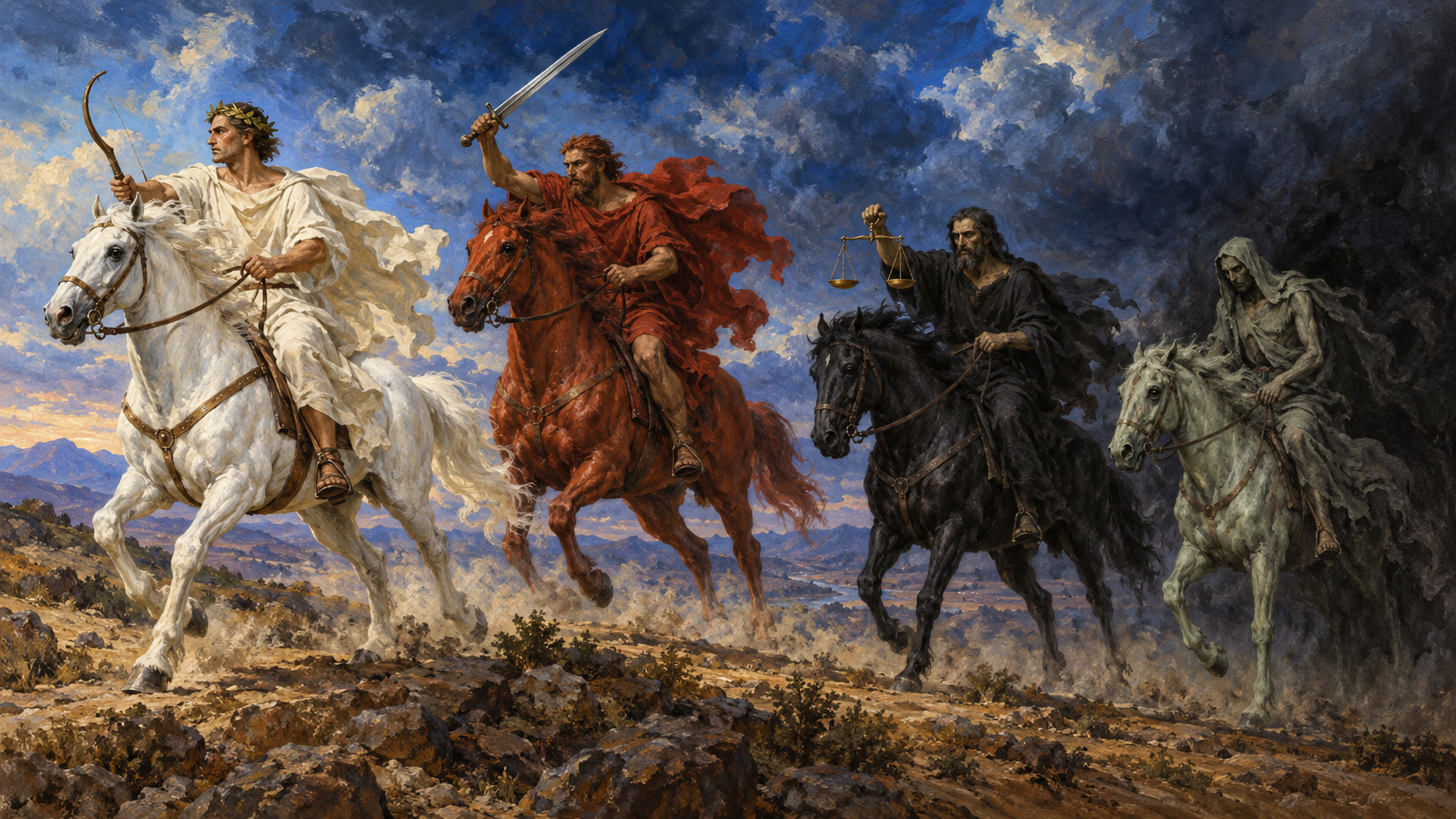
The four horsemen in Revelation 6 are often discussed as though our first task were to match them with today’s leaders and disasters. I want to begin where John begins: with the Lamb who opens the seals. The riders go out under His authority, and their actions form a connected sequence. Understanding that setting helps us consider the disputed first rider without claiming details John never supplies.
The Worthy Lamb Opens the Seals
Apocalypse means an unveiling and comes from the Greek title of Revelation. What John is shown includes terrible judgments, but he sees heaven’s throne and the worthy Lamb before the horsemen appear. Revelation 4–5 therefore supplies the setting we need for chapter 6.
John saw a scroll sealed with seven seals in the right hand of the One on the throne. When no created person could open it, he wept. An elder directed him to the Lion of Judah, the Root of David, and John looked to see a Lamb bearing the marks of slaughter yet standing alive.
And I saw in the right hand of Him who sat on the throne a scroll written inside and on the back, sealed with seven seals. Then I saw a strong angel proclaiming with a loud voice, “Who is worthy to open the scroll and to loose its seals?” And no one in heaven or on the earth or under the earth was able to open the scroll, or to look at it. So I wept much, because no one was found worthy to open and read the scroll, or to look at it. But one of the elders said to me, “Do not weep. Behold, the Lion of the tribe of Judah, the Root of David, has prevailed to open the scroll and to loose its seven seals.” And I looked, and behold, in the midst of the throne and of the four living creatures, and in the midst of the elders, stood a Lamb as though it had been slain, having seven horns and seven eyes, which are the seven Spirits of God sent out into all the earth. Then He came and took the scroll out of the right hand of Him who sat on the throne. Now when He had taken the scroll, the four living creatures and the twenty-four elders fell down before the Lamb, each having a harp, and golden bowls full of incense, which are the prayers of the saints. And they sang a new song, saying: “You are worthy to take the scroll, And to open its seals; For You were slain, And have redeemed us to God by Your blood Out of every tribe and tongue and people and nation, And have made us kings and priests to our God; And we shall reign on the earth.”
Heaven worships the Lamb because He was slain and redeemed people to God by His blood. Jesus is the eternal Son, fully God and fully man, born of a virgin and completely sinless. Wicked men physically tortured and punished Him before killing Him on the cross. He willingly bore that real punishment for our sins in His innocent body, shed His blood, and died. His saving work was complete before He rose bodily. The Father did not punish, curse, abandon, strike, bruise, or pour wrath on Jesus.
The risen Christ has the right to take the scroll and bring God’s purposes to their appointed completion. Each rider appears when He opens a seal, and each goes out with authority that has been granted and bounded. This does not make human wickedness innocent or make God the author of it. Those who kill remain responsible for their actions, while their rebellion cannot overthrow the Lamb’s authority.
I understand the horsemen as future judgments in the opening phase of the literal seven-year Tribulation, after Christ gathers His church. Conquest gives way to the removal of peace, crushing scarcity, and death on an immense scale. The later seals lead into the trumpets, and the bowls follow as the judgments unfold. That interpretation does not identify a current ruler, war, currency, or diplomatic agreement as a fulfilled seal.
We should not lose sight of whom heaven honors while studying those events. The horsemen receive no worship. If Antichrist becomes more fascinating to me than the Savior who opens the seals, my attention has departed from the center of the passage.
The White Horse and the First Conqueror
The first seal brings a white horse and a rider equipped for conquest.
Now I saw when the Lamb opened one of the seals; and I heard one of the four living creatures saying with a voice like thunder, “Come and see.” And I looked, and behold, a white horse. He who sat on it had a bow; and a crown was given to him, and he went out conquering and to conquer.
John does not name this rider. He records a bow, a crown given to him, and continuing conquest. The verse does not mention a peace treaty or say the bow has no arrows. Some argue that the unmentioned arrows prove a bloodless conquest through deception, but silence cannot establish that conclusion. The rider’s identity needs firmer grounds.
The Greek toxon means a bow; it does not mean an arrowless bow. Stephanos, the word for the crown, can describe a crown of honor, rank, or victory. Revelation uses such crowns positively elsewhere, so the term does not identify the rider as evil. White can also signify victory or purity in different settings. We have to read those details within the scene rather than make one color or Greek word decide the interpretation.
Some interpreters identify the rider as Christ, pointing to the white horse and His conquering work. Others see the gospel’s victorious advance, generic military conquest, or a succession of empires. The futurist identification with Antichrist also recognizes conquest, but places it within the final ruler’s rise.
I understand why readers connect a white horse and victory with Christ. Those details deserve consideration. Yet the Lamb is already opening the seal in heaven as this unnamed conqueror is summoned into a sequence followed by slaughter, scarcity, and death. John says nothing here about gospel preaching. That immediate setting leads me away from identifying the rider with either Christ or the gospel.
The wider prophetic passages then help identify the conquest. Daniel 9 describes a final ruler confirming a covenant, stopping sacrifice, and bringing desolation. Second Thessalonians 2 describes the man of sin exalting himself in a temple setting before the Lord destroys him at His coming. Revelation 13 presents the beast’s worldwide rule, blasphemy, and demand for worship. Read together, those passages lead me to identify the first rider with Antichrist’s opening conquest.
That remains an interpretation of Revelation 6:2, which does not use the name Antichrist. The expression “false peace” also comes from reading passages together. The second rider removes peace, Daniel’s ruler confirms a covenant before violating it, and 1 Thessalonians 5 describes sudden destruction while people speak of peace and safety. These support deceptive security during the ruler’s rise without making an unnamed modern treaty part of the first seal’s wording.
Revelation 19 gives us a second white horse, this time with a Rider John identifies unmistakably. Heaven opens for Christ’s public return, and His appearing brings the beast’s rule to its end.
Now I saw heaven opened, and behold, a white horse. And He who sat on him was called Faithful and True, and in righteousness He judges and makes war. His eyes were like a flame of fire, and on His head were many crowns. He had a name written that no one knew except Himself. He was clothed with a robe dipped in blood, and His name is called The Word of God. And the armies in heaven, clothed in fine linen, white and clean, followed Him on white horses. Now out of His mouth goes a sharp sword, that with it He should strike the nations. And He Himself will rule them with a rod of iron. He Himself treads the winepress of the fierceness and wrath of Almighty God. And He has on His robe and on His thigh a name written: KING OF KINGS AND LORD OF LORDS.
He is Faithful and True, the Word of God, and King of kings and Lord of lords. His many crowns are royal diadems, and heaven’s armies follow Him. The sword from His mouth portrays the authority of His spoken judgment. He comes to judge righteously and rule the nations, not to seek uncertain power.
The distinction rests on more than different weapons or crown terminology. In chapter 6, the Lamb releases an unnamed conqueror at the beginning of a chain of calamity. In chapter 19, Christ Himself arrives to defeat the beast. A shared horse color cannot erase the different identity, action, and place in the sequence. Antichrist’s temporary success ends when the rightful King returns.
War, Scarcity, and Death
Returning to Revelation 6, we see the second rider receive authority to remove peace from the earth.
When He opened the second seal, I heard the second living creature saying, “Come and see.” Another horse, fiery red, went out. And it was granted to the one who sat on it to take peace from the earth, and that people should kill one another; and there was given to him a great sword.
The red horse fits the bloodshed, but the rider’s stated action explains it: people slaughter one another after peace is taken away. The description need not be confined to one battlefield. International war may coincide with civil conflict and personal violence as order breaks down. It does not name an alliance or a modern weapon.
The great sword is given to the rider, just as the first rider received a crown. Their power is permitted and limited. That permission does not excuse the people who commit violence. The Lamb judges a rebellious world without making its slaughter righteous.
Conquest has not secured lasting peace. Political power may suppress conflict for a time, but it cannot cleanse sin or give people new hearts. The black horse then brings another consequence as the basic means of sustaining life become desperately expensive.
When He opened the third seal, I heard the third living creature say, “Come and see.” So I looked, and behold, a black horse, and he who sat on it had a pair of scales in his hand. And I heard a voice in the midst of the four living creatures saying, “A quart of wheat for a denarius, and three quarts of barley for a denarius; and do not harm the oil and the wine.”
The scales portray food being carefully weighed. Matthew 20:2 describes a denarius as the agreed wage for a full day’s work. At the price announced here, that wage buys roughly one person’s daily ration of wheat, as the NET translators’ notes explain. Cheaper barley buys a larger amount, yet a worker may still spend the entire wage without adequately feeding the household. The crisis is more severe than having to give up a luxury; ordinary food absorbs the income needed for other necessities.
John has not yet used the word famine for this rider, but the shortage is apparent, and the fourth seal names hunger among the causes of death. War can destroy planting, transport, trade, and ordinary employment. Those connections help us understand the progression without pretending to know every mechanism of the future economy.
The protection of oil and wine is less fully explained. Some readers see luxury goods spared while staples become unaffordable, exposing inequality. Others understand a limit on the judgment or protection for particular crops. At least we can say the destruction is not total and may be uneven. John has not given us enough to reconstruct a complete class system or predict a market from those commodities.
The fourth rider is the only one John names.
When He opened the fourth seal, I heard the voice of the fourth living creature saying, “Come and see.” So I looked, and behold, a pale horse. And the name of him who sat on it was Death, and Hades followed with him. And power was given to them over a fourth of the earth, to kill with sword, with hunger, with death, and by the beasts of the earth.
The Greek adjective chloros can describe green vegetation or a yellowish, pale color. Here it describes the horse ridden by Death, fitting the sickly pallor associated with a corpse. It does not identify a modern flag or provide a chemical formula or hidden disease code. Hades follows Death as the realm of the dead follows dying.
Their granted authority extends over a fourth of the earth, with killing by sword, hunger, death, and beasts. Interpreters debate whether the fraction refers to territory or population. Either way, the reach is immense. I would not convert the statement into a precise present-day body count or assume that every person within that reach must die. We should state the limit John gives without turning it into a calculation he has not supplied.
The combination recalls Ezekiel’s warning to Jerusalem during its persistent idolatry.
For thus says the Lord GOD: “How much more it shall be when I send My four severe judgments on Jerusalem–the sword and famine and wild beasts and pestilence–to cut off man and beast from it? Yet behold, there shall be left in it a remnant who will be brought out, both sons and daughters; surely they will come out to you, and you will see their ways and their doings. Then you will be comforted concerning the disaster that I have brought upon Jerusalem, all that I have brought upon it. And they will comfort you, when you see their ways and their doings; and you shall know that I have done nothing without cause that I have done in it,” says the Lord GOD.
Sword, famine, wild beasts, and pestilence were familiar forms of covenant judgment. Revelation applies that pattern to the worldwide Tribulation. The NKJV says “death” in Revelation 6:8; Ezekiel’s wording helps explain why discussions often include pestilence. We should use that background without silently replacing Revelation’s words or naming a particular modern disease.
The Sequence and Israel’s Future Trouble
The riders appear in an order, but an earlier force need not stop when the next appears. Violence can disrupt food production, scarcity can provoke further violence, and disease can spread among displaced people. Wild animals may also become a greater threat across devastated land. These are ways the judgments can overlap, not predictions of every cause Scripture leaves unspecified.
Jesus gives a similar progression in His Olivet Discourse, His teaching to the disciples on the Mount of Olives.
And Jesus answered and said to them: “Take heed that no one deceives you. For many will come in My name, saying, ‘I am the Christ,’ and will deceive many. And you will hear of wars and rumors of wars. See that you are not troubled; for all these things must come to pass, but the end is not yet. For nation will rise against nation, and kingdom against kingdom. And there will be famines, pestilences, and earthquakes in various places. All these are the beginning of sorrows.
Deception, wars, famines, pestilences, and earthquakes belong to the beginning of sorrows. Those parallels help me place the horsemen among the opening birth pains of the final crisis. I would not assign each phrase in Matthew to precisely one seal. Jesus gives His own discourse and John receives the seal vision, while both describe conflict and suffering before the end.
Revelation 6 continues with martyrs calling for judgment at the fifth seal. The sixth brings a great earthquake, blackened sun, bloodlike moon, falling stars, and terrified rulers seeking shelter. The seventh seal leads into the trumpets. The horsemen introduce the judgments rather than exhaust them.
Daniel 9 supplies the seven-year framework. The coming ruler confirms a covenant for one prophetic week, then violates it halfway through, stopping sacrifice and bringing desolation until his appointed end. I place the horsemen at the opening of that defined future period, with the beast’s full blasphemy and persecution developed later in Revelation.
That crisis affects the whole world, but Israel has a distinct place in the prophetic promises. Jeremiah addresses Israel and Judah, describes Jacob’s unparalleled trouble, and promises deliverance from it.
Now these are the words that the LORD spoke concerning Israel and Judah. “For thus says the LORD: ‘We have heard a voice of trembling, Of fear, and not of peace. Ask now, and see, Whether a man is ever in labor with child? So why do I see every man with his hands on his loins Like a woman in labor, And all faces turned pale? Alas! For that day is great, So that none is like it; And it is the time of Jacob’s trouble, But he shall be saved out of it. ‘For it shall come to pass in that day,’ Says the LORD of hosts, ‘That I will break his yoke from your neck, And will burst your bonds; Foreigners shall no more enslave them. But they shall serve the LORD their God, And David their king, Whom I will raise up for them. ‘Therefore do not fear, O My servant Jacob,’ says the LORD, ‘Nor be dismayed, O Israel; For behold, I will save you from afar, And your seed from the land of their captivity. Jacob shall return, have rest and be quiet, And no one shall make him afraid. For I am with you,’ says the LORD, ‘to save you; Though I make a full end of all nations where I have scattered you, Yet I will not make a complete end of you. But I will correct you in justice, And will not let you go altogether unpunished.’
God will correct His people without making a complete end of them. They will serve the LORD and David their king, as He promises restoration. I cannot read that promise as though Israel’s identity has disappeared into the church. Gentile believers share blessing through Israel’s Messiah, yet Daniel’s prophecy still concerns his people and holy city, and Paul anticipates Israel’s future turning to Christ in Romans 11.
Zechariah 12–13 describes Jerusalem mourning over the pierced One, a fountain opened for cleansing, severe judgment, and a remnant calling upon the LORD. These are suffering people, not merely positions on a chart. The judgment is dreadful, while grace preserves a remnant and brings them to recognize their Messiah.
The Church’s Hope and Our Response
Christians have already endured persecution, war, famine, disease, and death. Expecting Christ to gather the church before the future Tribulation must never make us smug toward believers suffering now. Present affliction is real even though the coming seven-year Tribulation is a distinct worldwide hour of divine judgment.
First Thessalonians 5 says believers are not appointed to wrath, and Revelation 3:10 promises keeping from the hour of trial coming on the whole world. I understand those promises to place the church’s gathering before that hour. Paul describes the gathering itself in 1 Thessalonians 4.
But I do not want you to be ignorant, brethren, concerning those who have fallen asleep, lest you sorrow as others who have no hope. For if we believe that Jesus died and rose again, even so God will bring with Him those who sleep in Jesus. For this we say to you by the word of the Lord, that we who are alive and remain until the coming of the Lord will by no means precede those who are asleep. For the Lord Himself will descend from heaven with a shout, with the voice of an archangel, and with the trumpet of God. And the dead in Christ will rise first. Then we who are alive and remain shall be caught up together with them in the clouds to meet the Lord in the air. And thus we shall always be with the Lord. Therefore comfort one another with these words.
Dead believers rise first, then living believers are caught up together with them, and all remain with the Lord. Paul gives that promise for the church’s comfort. I distinguish it from Revelation 19, where Christ returns publicly with heaven’s armies to end the beast’s reign.
The blessed hope is Jesus, not our ability to identify the first rider ahead of time. A war, epidemic, price increase, diplomatic agreement, or leader’s rise cannot be announced as a certain seal fulfillment merely because it resembles part of the description. The church is still here, and I understand Scripture to place its gathering before these judgments. Careless announcements encourage people eventually to dismiss the warnings themselves.
The first rider also warns us about attaching saving hope to conquest. People longing for restored order may readily transfer their loyalty to someone promising security. No ruler can cleanse sin or replace Christ. We can carry out public responsibilities without giving any political leader our worship or treating him as a savior.
The black horse should also move us beyond speculation. If we have food today, we have reason for gratitude and generosity toward those who lack it. We should resist waste and the habit of defining ourselves by luxury. The coming shortage does not give us permission to neglect people now or use prophecy to justify selfish hoarding.
Above all, the warnings call us to proclaim Christ while mercy is offered. Severe judgments do not automatically bring repentance. Christ died for the sins of the whole world, and God genuinely offers salvation to every person, although people can resist and reject Him. Those who turn from sin and trust Jesus are forgiven and born again. The Spirit indwells and seals the believer, whose salvation is eternally secure. That gives no permission for lawlessness, and a superficial profession does not establish genuine new birth.
The Lamb seen before the seals will also have the final word after them. Christ returns as Faithful and True, defeats the beast, and reigns for a literal thousand years before the lost are judged at the Great White Throne. Revelation 20 depicts Death and Hades thrown into the Lake of Fire, and death is removed in the final new creation. Human souls are not inherently immortal: unbelieving humanity faces the irreversible destruction of body and soul in the Lake of Fire, while those in Christ receive eternal life with Him. The pale horse does not overturn that promise.
My Final Thoughts
I understand the first rider as Antichrist’s opening conquest while recognizing that John does not name him. The absence of any mention of arrows cannot prove an arrowless bow, and no modern leader or treaty is identified in the passage. Every rider goes out under the worthy Lamb’s authority. Our hope rests in Christ gathering His people and returning publicly to end the beast’s rule. Until then, I want these warnings to deepen our worship, encourage generosity, and keep us proclaiming the salvation He offers.