
Why does the Bible speak about blood with such seriousness? The answer begins with life itself, because God says that life is in the blood and He alone is its giver. If we follow that truth from Noah through the sacrifices and into the New Testament, we can understand why the physical blood of Jesus stands at the center of redemption.
Blood Belongs to God Because Life Belongs to Him
Before Scripture explains the sacrificial system, it makes us face the murder of Abel. In Genesis 4:10, God tells Cain that his brother’s blood cries out from the ground. Innocent blood already testifies that a life was taken and that the killer must answer to the Judge of all the earth. Blood can have ordinary uses in Scripture, but bloodshed is never treated casually.
Hebrews 12:24 says that the blood of sprinkling speaks better things than Abel’s blood. Abel’s blood cried for justice against his murderer, whereas Christ’s announces mercy purchased for sinners. Both testify to a real death. Jesus willingly gave His innocent life, and His sacrifice brings mercy where Abel’s blood called for judgment.
After the Flood, God gave Noah and his sons permission to eat meat, but He immediately restricted what they could eat. This is Scripture’s first direct command against eating blood.
"But you shall not eat flesh with its life, that is, its blood."
Genesis 9:4, NKJV
This command did not begin as a temple ritual or a custom limited to Israel. Noah stood at the beginning of the post-Flood world, long before Sinai or the priesthood. God had just judged a world filled with violence and preserved Noah’s family through that judgment. By joining blood directly to life, He taught the renewed human race to handle life with reverence.
Genesis 9 then moves from the blood of animals to accountability for shedding human blood. A human life carries special dignity because man is made in God’s image. No private person owns another life or has the right to destroy innocent life at will. The passage also authorizes judicial accountability for murder, so its defense of life should not be confused with a denial of every civil penalty God appoints.
Blood was already connected with life and accountability before God gave Israel the altar. That order helps me understand what Leviticus is teaching. It applies the sacredness of blood to worship rather than inventing it, and explains how a life given before God relates to sin and atonement.
A doctrine this central rests on more than one verse. Genesis 4 and 9 introduce life and accountability. Exodus 12 presents deliverance through the blood of an unblemished lamb, while Exodus 24 joins blood to covenant. Leviticus 1, 4, and 16 develop sacrifice and atonement, and Isaiah 53 points to the Servant who pours out His soul unto death. Matthew 26 and John 19 bring the pattern to Christ’s own words and physical death. Hebrews 9–13 then explains cleansing, access to God, and the everlasting covenant. Each passage adds something that should not be forced into the language of another.
I need to let each of these passages explain its own part of the subject. A verse about murder cannot explain the altar by itself, and a verse about the altar cannot erase the human life taken in murder. Passover emphasizes shelter from judgment, while covenant blood shows the seriousness of belonging to God. Hebrews explains the finished sacrifice and the believer’s access to Him. We can draw these truths together in Christ without making each passage say exactly the same thing.
Passover, Covenant, and the Blood on the Altar
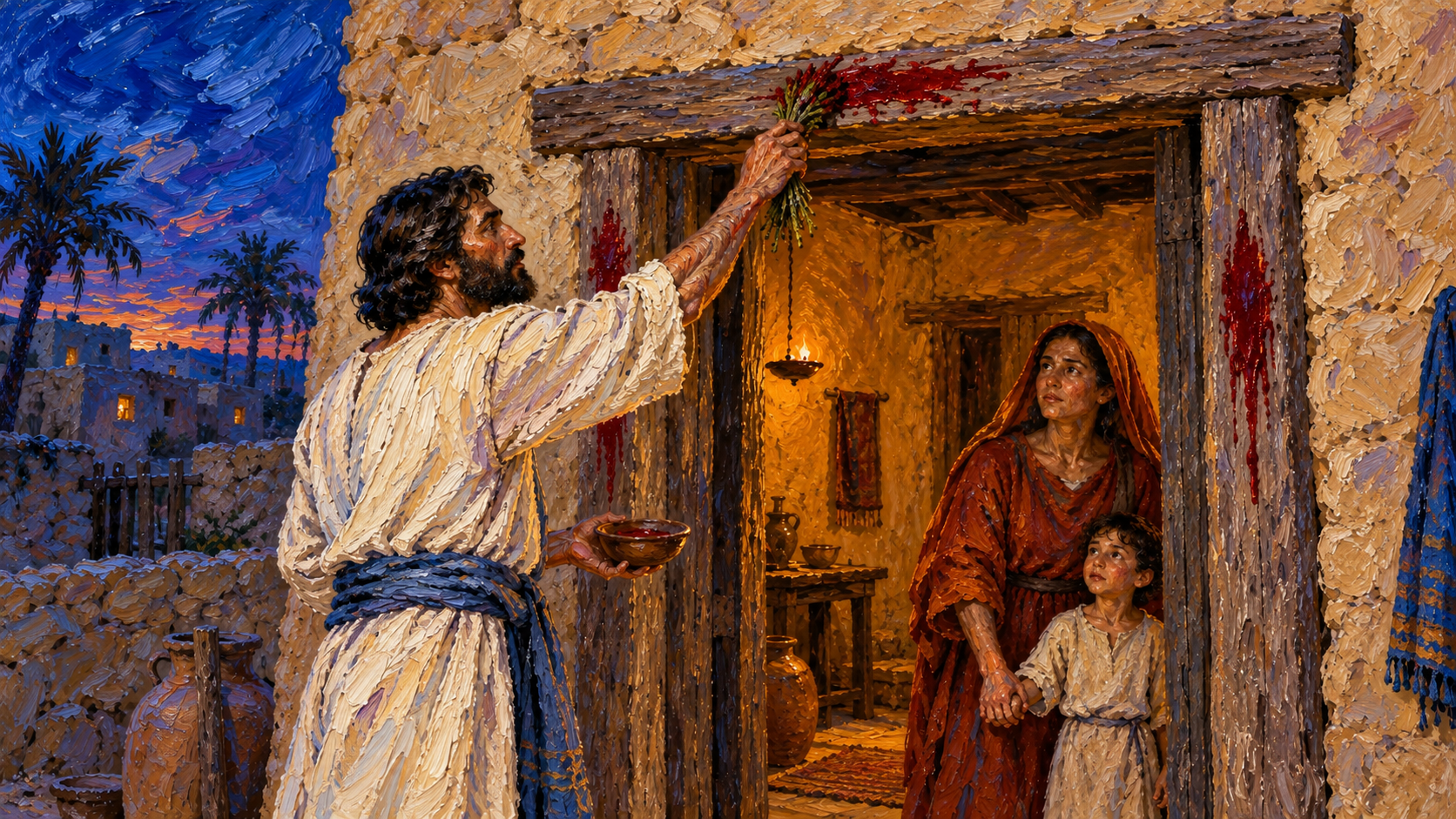
In Exodus 12, Israel was enslaved in Egypt when God provided deliverance from judgment. The Passover lamb had to be without blemish, and its blood was placed on the doorposts and lintel. God was providing shelter, not declaring Israel morally better than Egypt. Judgment passed over the household where the blood had been applied.
The lamb gave its life, and its blood marked the place where God had promised shelter. After sparing the household, the Lord brought His people out of bondage. This was a real rescue in Israel’s history, but the New Testament also tells us where the pattern leads. John the Baptist calls Jesus the Lamb of God in John 1:29. Paul says in 1 Corinthians 5:7 that Christ our Passover was sacrificed for us. Peter describes His redeeming blood as that of a lamb without blemish and without spot. Revelation then worships the Lamb who was slain and redeemed people to God by His blood.
The blood on the door was not a charm. God had spoken, the lamb had to die, and the household had to take shelter where He promised judgment would pass over. That makes me consider the difference between admiring the Passover account and trusting the provision God has made. A person can admire it and still remain outside that shelter. The New Testament directs us to trust the Lamb Himself for salvation, not an object or ceremony.
In Exodus 24, Moses read the Book of the Covenant and sprinkled blood as Israel entered a serious relationship before the living God. Hebrews 9 returns to that event to explain the connection between covenant, death and cleansing. Zechariah 9:11 also speaks of prisoners freed by the blood of the covenant, pointing toward the larger hope of the coming King. Jesus drew these older themes together when He called the cup the new covenant in His blood.
Leviticus 17 gives the central Old Testament explanation. The chapter requires Israel to bring sacrifices to the place God appointed. It forbids idolatrous sacrifice and the eating of blood, then states the reason plainly.
"For the life of the flesh is in the blood…"
Leviticus 17:11, NKJV
God goes on to say that He gave the blood on the altar to make atonement for the soul. I notice both reasons for treating it as sacred: blood is identified with the creature’s life, and God appointed sacrificial blood for His altar. Israel could not treat as common something the Giver of life had reserved for that holy purpose.
Leviticus regulates slaughter and the food Israel could eat, then explains sacrifice within the worship God appointed. It is not a complete lesson in modern physiology. Nor does it claim that blood lives apart from the creature or that it is a separate spiritual substance. The life belongs to God. He forbade consuming its blood and gave sacrificial blood a distinct purpose on the altar.
Nor does blood have magical power by itself. The death of the sacrifice teaches that sin brings death and that mercy comes through the substitute God provides. An animal did not morally equal a human being, and its blood could not finally remove human sin. The sacrifice was a true act of worship under the covenant, but it pointed beyond itself to a sinless Man who would give His life for the world.
Atonement is God’s provision for dealing with sin so that guilty people may approach Him. I notice that God Himself gave the blood on the altar. The worshiper was not inventing a sacrifice to persuade an unwilling God to be merciful. Nor could he redesign what God gave or replace it with sincere feelings. Mercy came on God’s revealed terms, and the substitute’s death showed that forgiveness did not mean sin had no consequence.
The Hebrew word nephesh can refer to creaturely life, a living being or the person receiving atonement, depending on its context. Understanding that range helps us read Leviticus 17 accurately. Here blood is identified with the life of the flesh, and the sacrifice’s life is given before God. The word does not establish that a human soul is inherently immortal.
The details across Leviticus build that understanding. In Leviticus 1, the blood of a burnt offering is sprinkled around the altar. Leviticus 4 brings the blood of sin offerings before the Lord, applies it to the altar’s horns, and pours the rest at the altar’s base. Leviticus 5 and 6 address guilt, including restitution when it is required, before pointing the worshiper toward forgiveness. Sin disrupts fellowship with God, and access depends on the provision He appoints.
Leviticus 16 gives the fullest annual picture. The high priest may not enter the Most Holy Place casually. He brings blood within the veil as the sins of the people are confessed. Blood is placed at the mercy seat, while the living goat bears away the people’s iniquities into an uninhabited land. Hebrews 9 explains that the Holy Spirit was teaching through this restricted access: the way into the Holiest had not yet been made open while the first tabernacle still stood.
The slain goat supplied the blood taken within the veil, while the living goat carried the confessed iniquity away from the camp. I need both parts of that picture to understand what God was teaching. Together they taught that sin must be answered before God and that He removes guilt from His people. Yet the ceremony had to be repeated the following year. It taught these truths while leaving Israel waiting for the final sacrifice.
As Israel prepared to live in the land, Deuteronomy repeated the command. Moses says in Deuteronomy 12:23 that “the blood is the life.” Blood from ordinary slaughter was to be poured on the ground like water instead of eaten. Neighboring nations treated blood superstitiously or used it in occult practices, but God forbade Israel to use it as food or as a means of manipulating spiritual power. Sacrificial blood belonged at His altar as He commanded.
Isaiah 53 carries the sacrificial pattern into prophecy. The Servant is wounded for transgressions and bruised for iniquities. He is led like a lamb to slaughter, makes His soul an offering for sin, and pours out His soul unto death. In the fulfillment, wicked men inflicted the wounds as Jesus willingly submitted to torture and death. The Father did not strike or bruise His Son. The prophecy points beyond animal offerings to an innocent and obedient Person who would suffer for the guilty.
The Apostles Still Treated Blood as Sacred
Acts 15 describes the apostles receiving Gentile believers without putting them under the Mosaic Law’s yoke. Salvation comes by grace through faith in Jesus Christ, not through circumcision or keeping the Law. Even so, the apostles instructed these believers to leave idolatrous pollution and sexual immorality behind. They were also to abstain from blood and meat taken from strangled animals.
Avoiding blood does not save anyone, and this instruction does not place Christians under the entire ceremonial law. The apostles still recognized conduct that contradicted the worship of the living God and deeply damaged Christian fellowship. They did not dismiss eating blood as a harmless preference.
Peter’s conclusion in Acts 15 is that Jews and Gentiles are saved through the grace of the Lord Jesus Christ. The apostles would not let circumcision or food laws become conditions for justification, nor would they allow any other work to take that place. I need to keep that clear without treating their command as meaningless. Grace did not make idolatry holy or empty every older command of its concern. Gentiles could be fully welcomed into the church while being called away from practices tied to pagan worship and disregard for blood.
God set blood apart before Moses and explained its meaning through Israel’s worship. The early church continued to treat it reverently. Christ fulfilled the animal sacrifices, so Christians no longer bring animal blood to an altar, but that fulfillment did not turn the prohibition into permission to drink literal blood. We honor what blood means by trusting Christ’s finished sacrifice and remembering Him as He commanded.
The apostles also use the blood of Christ to explain the blessings of salvation. Acts 20:28 says that God purchased the church with His own blood. Romans 3:25 describes Christ with the word hilasterion, a term also used for the mercy seat, and joins God’s provision to faith in His blood. This word should not be forced to teach that the Father transferred wrath onto Jesus. Romans 5:9 says believers are justified by His blood and will be saved from coming wrath through Him.
Ephesians 1:7 places redemption and forgiveness in Christ through His blood. Ephesians 2:13 says that people once far away are brought near by His blood. In the received wording of Colossians 1:14, believers have redemption through Christ’s blood, the forgiveness of sins. Colossians 1:20 adds that He made peace through the blood of His cross. The blood is not a vague metaphor for sincerity. Scripture presents it as the price of God’s purchase and His means of propitiation, which is God’s merciful provision for dealing with sin. Through Christ, sinners receive forgiveness and a right standing before God. He brings them near and establishes peace through reconciliation.
The theme continues into Christian fellowship and heavenly worship. 1 John 1:7 says the blood of Jesus Christ cleanses believers from all sin. Revelation 1:5 says that He washed us from our sins in His own blood. Revelation 5:9 centers worship on the Lamb who was slain and redeemed people by His blood. Revelation 7:14 pictures robes washed and made white in the Lamb’s blood, while Revelation 12:11 says the saints overcome through the blood of the Lamb and the word of their testimony.
John speaks about Christ’s blood in connection with ongoing fellowship and cleansing, and Revelation brings it into heaven’s worship and the endurance of suffering saints. That helps me see why blood belongs in our explanation of more than the moment a sinner is saved. The blood that purchased God’s people remains the basis of their confidence. Their victory rests first in the slain Lamb, not in their own strength or the force of their testimony by itself.
The apostles name Christ’s blood plainly, and I do not want our explanation of the gospel to hide the cross behind vague spiritual language. Jesus shed His blood and died for sinners, then rose bodily. He offers real forgiveness to everyone who will repent and believe.
Christ’s Blood and His Finished Sacrifice
Jesus Christ fulfills what these sacrifices anticipated. He is the Lamb of God, the completely sinless Son who is fully God and fully man. He came to give His life for the world, not simply to add one more offering to a long line.
Paul explains in Hebrews why the sacrifices under the Law had to give way to Christ’s offering of Himself. Those sacrifices involved purification and covenant ceremony, but their constant repetition showed that they could not cleanse the conscience or remove sin permanently. Christ offered Himself once.
When Paul says in Hebrews 9:22 that there is no remission without shedding of blood, he is drawing on Leviticus and the tabernacle, including the blood of the covenant. He has explained the priesthood and its repeated sacrifices before showing how Jesus fulfilled them. We should understand his statement through that reasoning rather than detach it as a slogan.
Sin is not forgiven because God decided to treat it as harmless. Jesus physically bore the punishment for our sins in His innocent body through real torture, the shedding of His blood, and death. The Father did not punish, curse, abandon, strike, or bruise Jesus, nor did He pour wrath upon His Son. Wicked men betrayed Him and beat Him. They scourged, crucified, and killed Him while Jesus willingly offered Himself to accomplish redemption.
The Father and Son were united in saving sinners. Jesus willingly gave Himself to do His Father’s will, so no one took His life apart from that voluntary offering. The men who tortured and killed Him remained guilty. I need to hold those truths together when I speak about the cross, without turning it into a conflict within the Godhead or saying the Father personally hated His beloved Son. Redemption reveals divine love through the Son’s obedient sacrifice.
Hebrews 9 walks through the history step by step. Verse 7 recalls the high priest entering with blood, and verse 12 contrasts that repeated approach with Christ entering the Most Holy Place once for all. Verse 14 then tells us that His blood cleanses the conscience. After returning to the covenant blood used by Moses in verses 18–21, Paul states the principle about remission and bloodshed in verse 22. The whole chapter teaches us to read the sacrificial order through Christ.
Hebrews 10 continues the same argument. The Law held a shadow of good things to come, so repeated sacrifices could never make the worshiper complete. Christ came to do the Father’s will. Believers are sanctified through the offering of His body once for all, and Hebrews 10:19 says they now have boldness to enter the Holiest by the blood of Jesus. Where sacrificial blood once accompanied restricted access, Christ’s blood now grounds confident access because He opened the way.
The warnings in Hebrews are just as serious. Hebrews 10:29 speaks of the guilt of treating the blood of the covenant as common. Hebrews 12:24 says Christ’s blood speaks better things than Abel’s. Hebrews 13:12 says Jesus sanctified the people with His own blood when He suffered outside the gate, and Hebrews 13:20 calls it the blood of the everlasting covenant. The book that explains Christ’s priestly work most deeply also warns us not to despise His blood.
Peter says believers were redeemed with Christ’s precious blood rather than corruptible silver or gold. That makes the cost of redemption definite. We cannot turn His blood into a vague symbol of divine kindness and lose the physical reality of the gospel. The incarnate Son, the spotless Lamb, poured out His blood through suffering and death.
Silver and gold can be counted and stored for later spending, and both are subject to corruption. The life Jesus gave cannot be measured in those terms. That helps me understand why His blood is called precious. He is the sinless Son, and His sacrifice accomplishes what no animal offering or human payment could accomplish. Scripture names a price that reveals both how serious our bondage was and how great our Redeemer is.
We also need to remember whose blood was shed. It belongs to the eternal Son made flesh, who lived obediently and truly died. His blood has no saving power detached from Him. As the sinless One, He did not deserve death, yet as a true man He could stand in our place. Because He is the eternal Son, His sacrifice is sufficient for the whole world.
John 19:34 records blood and water coming from Jesus’ side, then emphasizes eyewitness testimony to establish that He truly died. The Son of God had taken on genuine flesh and blood and endured real suffering. Yet He did not remain under death. He rose bodily, proving that His death was not defeat and that redemption was finished. His resurrection belongs to the same gospel, and no further suffering after the cross was needed to complete His work.
I would not soften the language of blood into a general statement that Jesus showed love. He certainly loved us, but His love took a concrete form. He gave His body for sinners and shed His blood until He died. The Bible keeps that truth before us because it will not hide the cost of redemption.
John 6, Communion, and the Response of Faith
In John 6, Jesus had fed the five thousand, and the crowd followed Him because they wanted more bread. He called Himself the bread of life in the synagogue at Capernaum. Throughout that discourse, He said that those who come to Him and believe in Him receive everlasting life. Keeping that setting in view helps us understand the difficult words that follow.
Jesus’ words about eating the Son of Man’s flesh and drinking His blood were intentionally startling. Some hearers were offended, and disciples turned away. But a command to practice cannibalism or drink literal blood would contradict the Scriptures He fulfilled. He was teaching that life is found only in Him and that each sinner must personally trust His sacrifice.
Jesus had already called His hearers to come and believe. Those calls explain what He meant by eating and drinking. Just as admiring bread cannot satisfy hunger, discussing His sacrifice while refusing Him cannot give us life. I need to depend entirely on the Savior and receive the life He gives. That is the personal participation by faith He calls for.
The Lord’s Supper gives the church a commanded way to remember Christ’s body and blood. Jesus established it during the Passover meal on the night He was betrayed. The bread does not repeat His sacrifice, and the cup does not become literal blood for Christians to drink. The meal proclaims His death. It remembers the body He gave and the blood He shed, while calling believers to examine themselves before God.
Remembering Christ in this meal is not an empty act. Believers truly share fellowship around His finished work, with the power resting in Him rather than in the bread and cup changing into physical flesh and blood. We look back to His one sacrifice and examine our present conduct in light of it. We also look forward to His return, since we are to proclaim His death until He comes.
Matthew 26:28 records Jesus saying that His blood of the new covenant is shed for many for the remission of sins. Luke 22:20 also speaks of the new covenant in His blood. In 1 Corinthians 10:16, Paul calls the cup the communion of Christ’s blood. Then 1 Corinthians 11:25–26 says the church proclaims the Lord’s death until He comes. Communion expresses fellowship and sober remembrance. It also turns the church’s hope toward Christ’s return without ever repeating Calvary.
The early believers could therefore obey Acts 15 and celebrate communion without any contradiction. They abstained from blood as food, yet in communion they remembered the blood Christ shed for their redemption. They had received Jesus by faith, and they proclaimed His death until He comes.
God gives life, which is why it is sacred. Sin is more than a small stain human effort can wipe away, because its penalty is death. In mercy, God provided substitutes that pointed to the true sacrifice. The Old Testament altar therefore taught the seriousness of sin along with God’s mercy. I need to keep both in view. Seeing only sin’s seriousness can lead to despair, while seeing only mercy can lead us to treat sin lightly.
At the cross, the pattern reaches its fullness. Jesus did not die because the Father stopped loving Him. He never ceased to be God or became sinful in His nature. He willingly offered Himself, and His blood was shed for the forgiveness and redemption of sinners. Nothing after the cross had to be added to complete His payment.
God genuinely calls every person to repent and believe in Jesus, although people can resist and reject Him. Those who receive Him by faith are forgiven and justified before God. They are born again as new creations, indwelt by the Holy Spirit and sealed for the day of redemption. Every genuine believer is eternally secure. That blood-bought grace gives no permission to live in lawlessness.
None of these blessings is earned by respecting blood as a subject or by taking communion. They are received by grace through faith in Jesus Christ. Repentance turns from unbelief and sin toward the Savior, while faith receives the One who died and rose again. Once a person is born of God, his security rests in Christ’s finished work rather than in his ability to keep himself saved. That security gives a reason to obey with gratitude; it never makes disobedience harmless.
Familiarity with religious language does not prove that someone has received the Savior it proclaims. Christ’s blood is not a charm or a spiritual substance that works apart from His Person. Saving power belongs to God and is received through faith in the crucified and risen Jesus. But neither may we reduce the blood to an optional metaphor, because it reveals that His life was truly given in death for our guilt.
Knowing that every life belongs to God should affect how carefully we treat human life. It should also make us serious about sin while keeping His mercy in view. I have reason for gratitude when I consider what Christ gave, and naming His blood and death plainly helps me explain the gospel clearly. When we take the cup, we remember the blood of the new covenant He shed for sinners. We are worshiping with confidence in His finished work, not simply repeating a religious habit.
When we speak to someone who does not yet know Christ, we can explain what He did plainly. The sinless Son gave His body for sinners and shed His blood. He died for them and rose bodily. Forgiveness is offered to all who receive Him by faith. Calling Him merely an example of love hides His suffering, while presenting His blood as a mysterious formula hides the Savior Himself.
This subject connects naturally with further study of the atonement of Jesus Christ, the Bible’s teaching about salvation, and Hebrews 9’s explanation of the better sacrifice. Together those themes show how substitution and covenant find their fulfillment in Christ, how grace is received through repentance and faith, and how His blood cleanses and brings believers near to God.
My Final Thoughts
After tracing these passages, I believe God set blood apart because life belongs to Him, and the blood of Jesus stands at the center of redemption because He gave His innocent life for sinners. Animal sacrifices could teach the cost of sin, but only Christ could offer the sinless and sufficient sacrifice that cleanses the conscience. He shed His blood and truly died, then rose bodily so that everyone who repents and believes can be forgiven and made alive in Him. We should never turn His blood into an empty phrase or a power detached from His Person. We should come to the Savior Himself and worship Him with gratitude. His finished work gives us confidence to pursue holiness without pretending that our obedience could ever add to His sacrifice.