
Israel had just seen God give them victory at Jericho when Ai, a much smaller city, sent their soldiers fleeing. They later returned to Ai and won, and I want to understand what changed between those two battles. Joshua 6–8 shows why receiving God’s gifts does not allow us to disregard His holiness. It also gives us reason to hope that God can restore His people after failure.
Jericho and the First Defeat at Ai
The trouble at Ai began with what happened at Jericho. Israel had marched as God commanded and watched the walls fall before taking the first fortified city in the land. The victory clearly came from Him, and He had given strict instructions about what belonged to Him afterward. Jericho and its contents were devoted to the LORD. The precious metals were to go into His treasury, and the Israelites were forbidden to take the devoted things for themselves (Joshua 6:17–19).
Ai stood near Bethel and was smaller than Jericho. Joshua sent scouts to examine it after the great victory, and they advised him to send only two or three thousand men because its population was small (Joshua 7:3). They judged it to be a manageable target. But Scripture does not identify either their scouting or the size of the force as the sin that brought defeat. It tells us plainly that Achan had taken what God had forbidden.
That stated reason for the defeat keeps me from blaming Israel’s planning or the decision to send a small force. Joshua does not condemn the use of scouts or practical judgment. God condemns covenant treachery, the betrayal of His covenant with Israel. The land was His gift, but receiving it did not free His people to disregard the holiness of the One who gave it.
About three thousand men went up, but Ai’s defenders drove them back and killed about thirty-six Israelites. The survivors fled, and “the hearts of the people melted and became like water” (Joshua 7:5). The words reverse the fear that had fallen on Canaan before Israel’s God. Israel may have expected another easy advance after Jericho, but Ai proved that victory was never something they possessed automatically.
Joshua tore his clothes in grief, and he and the elders fell before the ark of the LORD until evening. He asked why God had brought Israel across the Jordan only to allow them to suffer this defeat. The prayer was honest, but God’s answer required Joshua to get up and face what had happened. Israel’s problem was neither a lack of military power nor a mistake in geography. They had sinned and broken the covenant (Joshua 7:10–11).
Joshua’s prayer makes me think about whether I am willing to hear God’s answer when I bring Him my pain. Grief and prayer are right responses to disaster, but we may want relief while leaving untouched the disobedience He is exposing. Joshua could not lead Israel forward until he faced what God had revealed. Prayer did not remove his responsibility to act on that answer.
We know why Israel lost because God told Joshua directly. Hardship alone does not prove that someone today is concealing a particular sin. Job’s friends made that kind of judgment and spoke wrongly about God, and Jesus rejected the assumption that suffering always reveals a particular personal sin (John 9:1–3). I need to take sin as seriously as Joshua 7 teaches without claiming that I know something God has not revealed.
Hidden Sin and Covenant Judgment
The LORD said that Israel had stolen what was devoted to Him and concealed it among their own possessions. The man responsible was Achan, from the tribe of Judah. He had seen a beautiful Babylonian garment along with silver and gold, and he wanted them for himself. He took what he coveted and buried it under his tent, hiding the theft from others (Joshua 7:20–21).
Achan allowed his desire for those things to take precedence over God’s command, then tried to keep his disobedience secret. He had not simply found abandoned goods after a battle. God had expressly claimed the devoted things at Jericho, so stealing them betrayed the covenant loyalty Achan owed Him. Nor could that secret act remain a matter concerning Achan alone. Israel was God’s covenant people, and the LORD’s presence among them meant that his sin affected the whole nation.
James describes how our own desires draw us into temptation. When a person yields to that enticement, desire gives birth to sin, and sin brings forth death (James 1:14–15). That makes me consider what I am allowing myself to want before I have acted on it. I need to bring that desire under God’s Word before I act on it, rather than treat it as harmless and then become determined to conceal what I have done.
A hidden sin can damage family life or a workplace, and its effects may reach friendships or a church’s witness. Paul describes the spread of tolerated rebellion in a congregation through the picture of leaven in 1 Corinthians 5: “A little leaven leavens the whole lump.” A church cannot treat known rebellion as though it has no effect on anyone else. Yet the New Testament does not require every private failure to become a public spectacle. We are called to deal with sin truthfully and wisely because we want the person to be restored.
God told Joshua to sanctify Israel and bring the people forward, narrowing the search from the tribe to the family and then from the household to the individual man. Achan was not being selected merely to give the nation someone to blame. God knew what he had hidden and brought it into the light. When Joshua confronted him, he called him to give glory to the LORD by confessing what he had done (Joshua 7:19).
Achan confessed, and the stolen objects were found. Israel then took him to the Valley of Achor along with the members of his household named in the account. His possessions and the devoted items were taken there too. The severe judgment recorded in Joshua 7 belongs to Israel’s particular covenant setting: the LORD was directly governing the nation as it entered the land. He carried out the judgment He had already declared against covenant rebellion.
The church is not ancient Israel under Joshua, so this judgment gives Christians no authority to take revenge, use violence against another person, or punish that person’s family. A new-covenant congregation responds to known, serious sin that remains unrepented of through biblical admonition, calling the person to turn from it. Removal from fellowship may be necessary, but repentance and restoration remain part of its purpose (1 Corinthians 5; Galatians 6:1). Civil authorities carry a different responsibility for public justice. Neither role gives a person God’s perfect knowledge of every heart.
That difference in covenant setting does not lessen what Ai teaches about God’s holiness. I cannot treat rebellion as a small thing simply because other people cannot see it. The valley’s name, Achor, means trouble, and it became a lasting reminder of what sin had done. Yet God would later speak of hope in that very place.
Restoration and the Second Battle
Joshua 8 begins with a fresh word from God:
Do not be afraid, nor be dismayed; take all the people of war with you, and arise, go up to Ai. See, I have given into your hand the king of Ai, his people, his city, and his land
After Israel dealt with the trespass as God commanded, He renewed His promise and gave Joshua instructions for the next battle. He had exposed their sin without abandoning His people. I see mercy in that, but it does not make Achan’s sin insignificant or allow us to forget the thirty-six men who died. God’s righteous discipline brought Israel back to obedience instead of ending in permanent rejection, and He led them forward again.
Hosea later drew on the same place to describe hope:
I will give her her vineyards from there, and the Valley of Achor as a door of hope
God can make a place remembered for judgment become the beginning of restoration for people who turn back to Him. Consequences do not all disappear, but they do not put a repentant person beyond His mercy. Sin and failure cannot close the way back to Him.
After confessing sin, a believer may still fear that God will do nothing but point back to the past. Hebrews 12:10 gives us a different understanding of His correction: the Father disciplines His children for their good so that they may share His holiness. I need to remember that purpose when I think about discipline. His correction is serious, and its purpose is to restore fellowship and teach His children fruitful obedience.
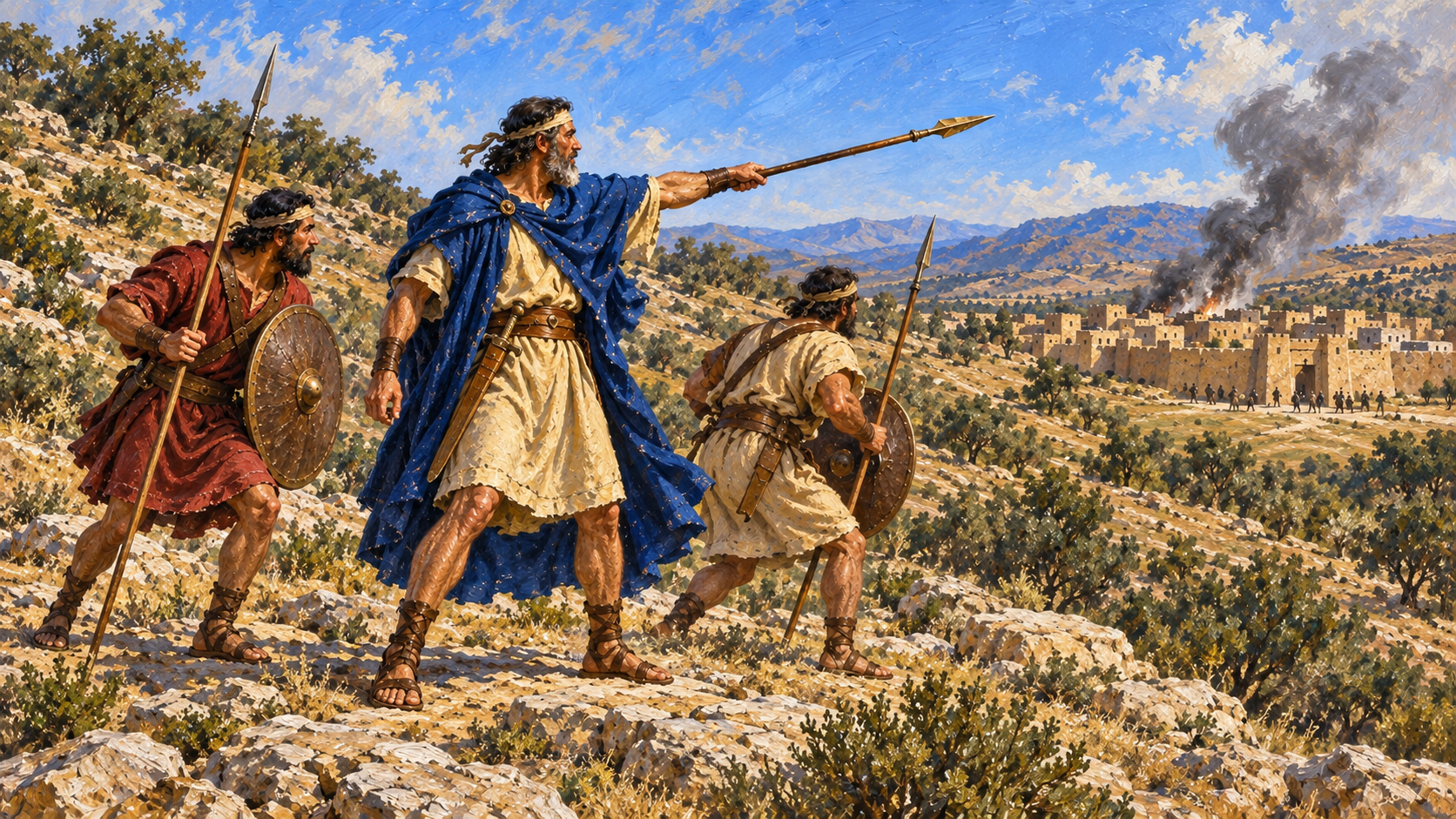
For the second battle, God told Joshua to set an ambush. Israel would appear to flee again, drawing Ai’s men away while another force waited behind the city. Once the defenders were in pursuit, that waiting force would enter Ai and take it before setting it on fire. The battle unfolded exactly as God had said. By the time Ai’s men turned and saw the smoke rising, they had nowhere to escape (Joshua 8:14–22).
God gave that ambush plan to Joshua for a particular historical battle. It is not a technique He has given Christians for overcoming whatever difficulty we face. We can learn from Israel’s obedience without turning the military details into an allegory for our own struggles.
What draws my attention is that Joshua kept his spear extended until the city was taken, just as God had commanded. Israel succeeded because the LORD spoke and the people obeyed His direction. They did not manufacture the victory. This gives me more to learn than a symbolic reading of their tactics would: obedience responds to God’s faithfulness and wisdom. It does not make Him serve our plans.
Joshua 8 records that God allowed Israel to keep the livestock and spoil from Ai (Joshua 8:2, 27), though He had forbidden that at Jericho. That difference helps me understand exactly what Achan did wrong. Possessing spoil was not sinful in every circumstance, but taking what God had specifically devoted to Himself was. God’s command determines what belongs to Him and what He gives us, so our appetite cannot decide that for us.
The Law Read at Ebal and Gerizim
After the victory at Ai, Joshua did not hurry on to the next battle. He built an altar to the LORD on Mount Ebal and wrote a copy of the Law on stones. Israel offered burnt offerings and peace offerings, and Joshua read all the words of the Law before the assembly. Half of the tribes stood before Mount Gerizim and the other half before Mount Ebal, following Moses’ command about blessing and curse (Joshua 8:30–35; Deuteronomy 27).
Israel’s life in the land depended on faithfulness to God’s covenant, which helps me understand why this ceremony followed the victory. The altar declared that sinners could approach Him only through the sacrifice He provided. With the Law written before them, the people could see His commands, and the blessings and curses reminded them that they answered to Him as their King. The LORD could not be treated as someone who merely helped them achieve their military ambitions.
Joshua read the Law to the whole community, including the men and women as well as the little ones and the foreigners living among them. God’s Word was not reserved for an educated few. Everyone needed to hear Him, and after the disaster at Ai this public reading gave Israel a way to worship and remember what He had said. Hearing the Law also renewed their submission to Him.
We are not under Israel’s Mosaic covenant or commanded to repeat this ceremony, but we share the need to hear God’s Word. A church cannot sustain its life through techniques or strong personalities, and memories of past blessings cannot sustain it either. We need Scripture read and taught so that we can believe what God has said and obey Him. Jesus said that people live by every word that proceeds from the mouth of God (Deuteronomy 8:3; Matthew 4:4).
Applying Ai and Finding Hope in Christ
Israel’s victory at Jericho gave them no reason to presume that God would overlook disobedience at Ai. Remembering His past blessings should make me more attentive to His present commands, not give me an excuse to ignore them. Success in ministry cannot take the place of a clean conscience before Him. Neither my family history nor my theological knowledge can do that, even if other people respect my reputation.
When the Holy Spirit uses Scripture to show us our sin, honest confession means acknowledging it instead of hiding it or blaming someone else. Acting miserable is no substitute for turning from what we have done. If I need help with the struggle, I should seek it, and if I have wronged someone I should make restitution where that is possible. A mature church can help us be honest by speaking truth gently and praying with us. Wise accountability gives us support as we learn to walk faithfully.
We can plan responsibly and use sound judgment while working hard, but none of that secures God’s blessing on its own. Proverbs 3:5–6 calls us to trust the LORD with all our heart and acknowledge Him in all our ways. Depending on Him means placing every plan under His rule, rather than relying on our own understanding. I do not have to reject planning in order to depend on God. I have to recognize whose authority my plans are under.
The second battle also gives me hope after failure, even when sin leaves painful consequences. Trust may take a long time to rebuild, and some losses cannot be undone in this life. Yet Christ receives those who come to Him. He restores repentant believers to fellowship and teaches them to obey, so an old defeat need not keep them from walking forward with Him.
Joshua 7 shows that sin brings judgment, and no Israelite could remove the covenant curse by pretending it did not exist. Our need reaches beyond what any sinner can do, but the gospel tells us that Jesus Christ did what we could not. He is the eternal Son of God, fully God and fully man, who lived without sin and obeyed the Father perfectly.
Jesus bore the punishment for our sins in His innocent body on the cross. He was physically tortured and shed His blood before He died and was buried. Galatians 3:13 says that Christ redeemed us from the curse of the Law by becoming a curse for us, because it is written, “Cursed is everyone who hangs on a tree.”
Christ bore the judgment sinners deserved, but Paul is not saying He became morally corrupt or comparing Him to the devoted objects Achan stole at Jericho. On the third day, Jesus rose bodily from the grave. Through faith in Him, sinners receive forgiveness and new life and are brought into peace with God. That is the deepest restoration these battles lead me to consider. I cannot overcome sin by devising my own battle plan. I need the Savior’s mercy and must learn to walk by the Holy Spirit in obedience to God’s Word.
Related Studies
The Sin of Achan examines Achan’s covenant trespass, confession, judgment, and the warning against hidden sin.
Mount Ebal and Mount Gerizim explores the covenant setting of blessing and curse, the altar, and Israel’s hearing of God’s Law.
Repentance explains confession and a biblical turning from sin toward God.
The Law considers the purpose of God’s Law in exposing sin and pointing people to Christ.
My Final Thoughts
The battles at Ai make me consider whether I am asking God to bless my direction while knowingly disregarding His Word. His restoration of Israel also gives me hope after failure: He brought them out of the Valley of Achor and led them back to worship and obedience. We cannot use their experience to explain every hardship or impose their covenant judgments on others. We can respond with honest confession and learn to depend humbly on Scripture, trusting Jesus Christ, who bore the curse sinners deserved. By His grace, even a painful place of failure can become a door of hope from which we begin to walk faithfully again.