
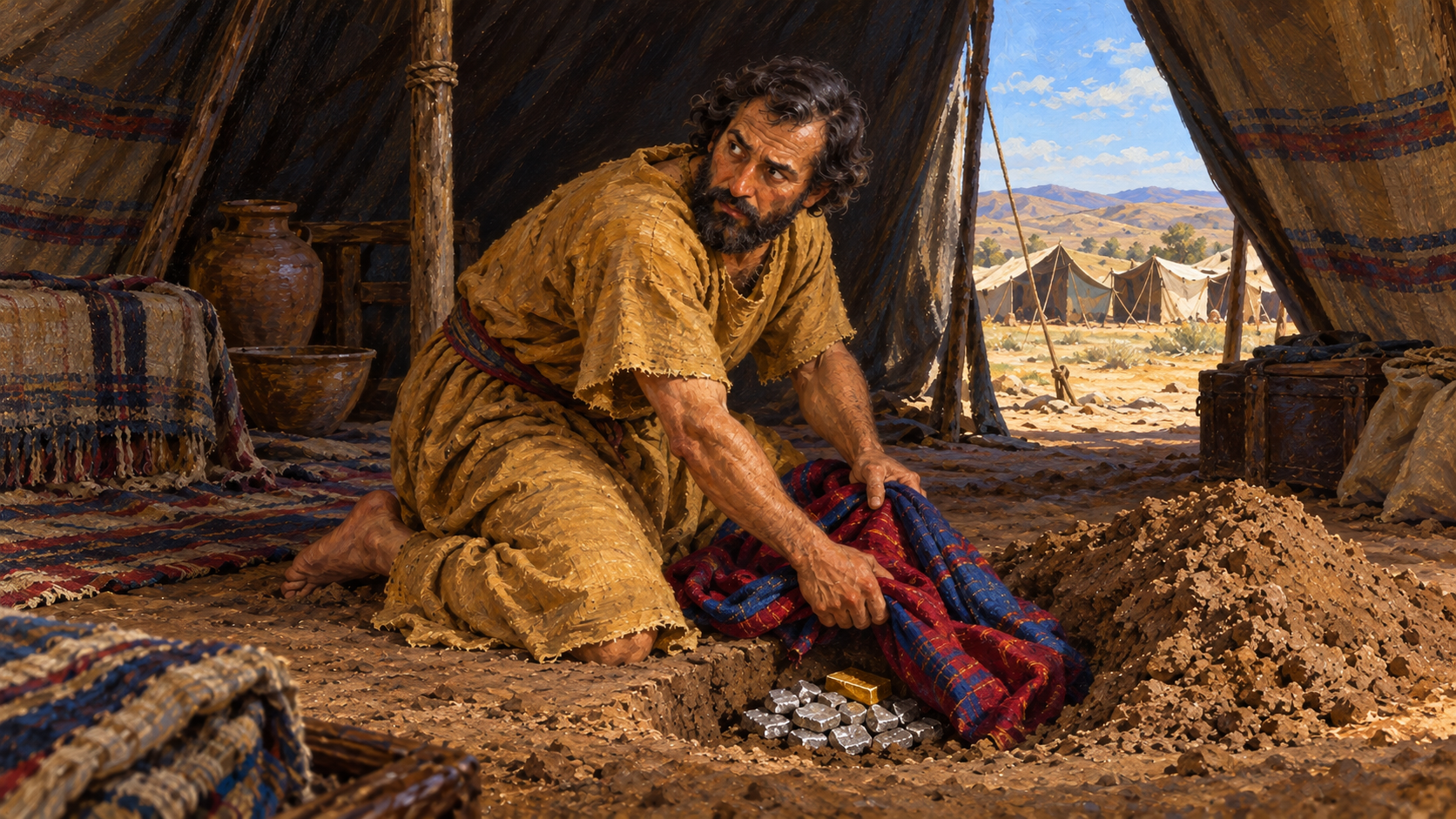
Achan hid stolen things beneath his tent, but the consequences reached the whole camp of Israel. Men died in battle, and the judgment that followed is difficult to read. We need to understand that judgment within Israel’s covenant with God. As we follow what happened from Jericho to the Valley of Achor, I also want us to see why confession matters and where we find hope in Christ.
The Sin Achan Hid
Joshua 6 and 7 take place near the beginning of Israel’s entrance into Canaan. After the LORD brought His people through the Jordan, they faced the fortified city of Jericho. Its walls did not fall because of Israel’s military skill. For seven days the people followed the LORD’s unusual command to march around the city. On the final day the priests blew the trumpets and the people shouted, and the walls fell. God had given them the victory.
Before Jericho fell, Joshua told Israel that the city and everything in it were to be devoted to the LORD. Silver and gold were to go into His treasury, along with bronze and iron, while the other devoted things were not to be taken as personal spoil (Joshua 6:17-19). This was the first city of the conquest. God had given Israel the victory, and they had no right to turn it into an opportunity to enrich themselves.
The Hebrew word often translated “accursed” or “devoted” is herem. Here it describes something set apart for the LORD’s judgment or treasury. We need to understand that word within the unique conquest of Canaan. God was judging Canaanite wickedness as the Judge of all the earth and giving Israel the land He had promised. Christians have no permission from this account to seize property or harm enemies, nor can we declare our own opponents devoted to destruction.
Achan took what God had directly claimed for Himself. His sin was a deliberate breach of covenant loyalty, not an ordinary mistake over someone else’s property. Notice how Joshua 7 introduces what he did:
But the children of Israel committed a trespass regarding the accursed things, for Achan the son of Carmi… took of the accursed things
The verse names Achan, a man from Judah, but describes the trespass as Israel’s. I don’t want to overlook that connection. God had formed this nation as His covenant people and dwelt among them, so one man’s deliberate rebellion against Him affected the whole camp.
When Achan finally confessed, he described the path his sin had taken:
When I saw among the spoils a beautiful Babylonian garment, two hundred shekels of silver, and a wedge of gold weighing fifty shekels, I coveted them and took them
Achan then buried the garment and the precious metals beneath his tent. His confession lets us follow how he reached that point. He saw something desirable and allowed that desire to become coveting. Once he had taken what God forbade, he tried to conceal what he had done.
We see a similar progression in Genesis 3. Eve saw that the tree was good for food and pleasant to the eyes. She also saw it as desirable to make one wise, and she took its fruit and ate. James explains that our own desire draws us into temptation and gives birth to sin when we allow it to grow (James 1:14-15). I need to take that seriously before a desire has grown into an action. What seems small at first can lead to ruin if I keep entertaining it instead of bringing it under God’s Word.
We can persuade ourselves that no one will know about a hidden sin or that it affects only us. We may even imagine we can deal with it later. Achan buried the evidence, but nothing beneath his tent escaped the LORD’s sight. Psalm 139 says darkness and light are alike to God, and He saw Achan’s heart as well as the stolen things. That is frightening if I intend to keep rebelling. But if I want to stop hiding, there is mercy in knowing that I can come honestly to the God who already knows the truth.
After Jericho, Israel went against the smaller city of Ai. Scouts advised Joshua that the whole army would not be needed, so about three thousand men went up. They were driven back, and about thirty-six men died (Joshua 7:4-5). Their confidence collapsed as their hearts melted and became like water. Earlier, Jericho had feared the God of Israel. Now Israel was the nation gripped by fear.
Joshua fell before the ark of the LORD in grief. His prayer expressed real anguish, but God directed him to the actual problem:
Israel has sinned, and they have also transgressed My covenant which I commanded them
The LORD told Joshua exactly what was wrong: devoted things had been taken and hidden. Israel had seen Him give them a miraculous victory at Jericho, but that did not excuse disobedience afterward. I cannot claim God’s power while refusing to listen to Him. Faith means obeying the Lord who gives the victory, rather than treating His past blessings as a substitute for obedience now.
In Joshua 7, God directly identified Achan’s trespass as the reason Israel could not stand before Ai. That is different from assuming that every illness or loss reveals hidden sin, or that conflict and defeat always prove someone’s guilt. Job’s friends made that kind of accusation and God corrected them. Jesus also rejected the assumption that a man’s blindness had to result from his sin or his parents’ sin (John 9:1-3). I can heed the warning about Achan without pretending to know God’s hidden reasons for every painful event.
God Brought the Trespass Into the Light
The LORD told Joshua to sanctify the people and bring them forward for examination. Israel would come tribe by tribe, then each clan and household in turn, until the process reached the individual man. Achan’s discovery was not an accident or a political accusation. God already knew what he had hidden and brought it into the open through this careful process.
When Achan was identified, Joshua spoke to him with solemn tenderness:
My son, I beg you, give glory to the LORD God of Israel, and make confession to Him
Achan admitted the theft, named the objects, and told Joshua where he had hidden them. Messengers ran to his tent and found the garment and the precious metals exactly where he said they were. What concerns me is that he confessed after he was exposed. Scripture does not say he felt no remorse, and I wouldn’t claim to know that. It does show the danger of waiting to tell the truth until concealed sin has become a public disaster.
Proverbs offers a better path:
He who covers his sins will not prosper, but whoever confesses and forsakes them will have mercy
Confessing sin means agreeing with God about it instead of trying to manage how we appear to others. We also need to forsake it, which means turning from it. Where repair is possible, that includes putting right the harm we have caused and accepting wise accountability. Regret after the consequences arrive is not the same as that willingness to change.
As a Christian, I don’t confess because Christ’s mercy has run out and I need to earn forgiveness again. 1 John 1:9 says that if we confess our sins, God is faithful and just to forgive and cleanse us. I can come into the light because Jesus has already made cleansing possible through His blood. His grace gives me reason to stop hiding, not reason to believe secrecy is harmless.
Judgment in a Holy Nation
Joshua 7:24-26 describes the severe judgment in the Valley of Achor. Achan was brought there with the devoted objects and everything he owned, including his livestock and tent. His sons and daughters are also specifically named. Verse 25 uses plural pronouns when it says that all Israel stoned “them” and then burned “them” after the stoning. We are seeing the gravity of covenant treachery in a nation directly governed by God as it entered the land under His judicial command.
We should not soften the severity of this judgment. God is holy, and hiding sin does not make it trivial. We also need to remember that Israel was a theocratic nation, directly governed by God under the Mosaic covenant. The church has not been given the sword to enforce religious purity. Civil government has a separate God-given duty to carry out public justice, while church discipline is spiritual and should seek restoration. This passage gives Christians no authority to punish secret sin with violence or take revenge on families, and it does not authorize claims of direct revelation about another person’s guilt.
The New Testament does tell churches to address known, serious, unrepentant sin. In 1 Corinthians 5, Paul commands a congregation to remove a man whose public sexual immorality was being celebrated. I want to take that command seriously while remembering that the sinner’s repentance is part of what we are seeking. Galatians 6:1 tells spiritual believers to restore a person caught in a trespass with gentleness. They must also watch themselves so they are not tempted. These instructions protect the church’s purity and pursue restoration without telling Christians to reenact Joshua 7.
Achan’s judgment teaches us to take holiness seriously, and the cross shows us where mercy and judgment meet. Jesus bore the punishment sin deserves. Because sin destroys people and harms the body, Christians must speak truthfully about it. We do so to seek repentance and restoration, not to retaliate against someone.
The mention of Achan’s sons and daughters makes this judgment especially difficult for me to read. Readers have long asked whether they were executed with their father or brought there as witnesses. The plural wording also leaves questions about how it applies to the people and property. Scripture records what happened without explaining every detail we might want to know.
I don’t believe we can settle those questions by supplying details the passage does not give. It never calls Achan’s children innocent victims, so I cannot state that as fact. It also does not describe their personal participation in his sin, and I cannot claim that has been proven either. What we can see is how a father’s concealed rebellion reached his household and how serious the judgment was for Israel as God’s covenant people.
Deuteronomy 24:16 gives Israel’s ordinary judicial rule: fathers were not to be put to death for their children, nor children for their fathers. Each person was to be put to death for his own sin. Ezekiel 18 also insists on personal moral responsibility. We need to retain those truths as we read the particular covenant event recorded in Joshua 7.
I cannot assume that a concealed sin affects only me. A hidden addiction can wound a family, and dishonesty may injure customers or coworkers. Trust in a home or church can be broken by sexual sin or by the bitterness and deception someone keeps concealing. Becoming better at hiding does nothing to protect those people. Walking in the light now does.
From the Valley of Trouble to a Door of Hope
After the judgment, Israel raised a great heap of stones over Achan, and the LORD turned from the fierceness of His anger. The place became known as the Valley of Achor. Achor means trouble, so the name itself preserved the memory of what covenant treachery had done.
God later used that same name in a promise of restoration. Speaking through Hosea to a faithless people, He said:
I will give her her vineyards from there, and the Valley of Achor as a door of hope
Hosea does not deny the judgment that happened there. He announces that God can bring His repentant people through judgment into renewed fellowship and hope. The gospel helps us see that hope more clearly. God judges sin rather than excusing it or giving it a harmless name. Its consequences are real, yet He provides a way for sinners to be reconciled to Him. I find hope in that promise because the place where rebellion is exposed is not beyond His power to become a doorway to mercy.
Achan’s sin affected the people around him, and Christians need to consider how their sin affects Christ’s body, the church. One believer’s sin can break the trust of others or cause them material harm. False teaching and public scandal also affect the people around us. A congregation can even learn to tolerate what God forbids. Paul describes that spreading influence through the picture of leaven:
A little leaven leavens the whole lump
When a church celebrates or protects known rebellion, its influence does not stay confined to one person. That calls for honest care, not suspicion about every detail of one another’s private lives. We need churches where truth and prayer are accompanied by wise shepherding, so believers can confess honestly and ask for help before temptation becomes a public collapse.
Church leaders need to protect vulnerable people as they confront sin according to Scripture. Covering it up fails those people, but becoming cruel is no faithful response either.
If you know you are hiding sin, bring it to God now rather than waiting for a crisis to expose it. Seek accountable help from a mature, trustworthy believer and make restitution where that is possible. The Spirit’s conviction calls you out of hiding into the light, so you do not have to answer it with despair.
Christ, Confession, and Cleansing
Returning the stolen things could not undo Achan’s trespass. His sin was first against God, and no sinner can repay that debt. Making restitution cannot settle my guilt before God. I need the Savior who can forgive it. Jesus Christ, the eternal Son of God, became fully man without ceasing to be God. He obeyed perfectly where Israel and Achan failed, and where every one of us has failed as well.
At the cross, Jesus willingly bore the punishment for our sins in His innocent body. He suffered physical torture and shed His blood before dying. He was buried and rose bodily from the grave on the third day. His resurrection declares that death has not won and that His sacrifice is sufficient. Anyone who comes to Him in repentance and faith receives forgiveness and cleansing and is made new.
Grace gives us reason to be honest with God. When I confess, I am not trying to purchase forgiveness from a reluctant Savior. I am trusting the faithfulness of the One who died for me and admitting that hidden sin cannot give the life it promises. Christ can forgive the covetous person and the deceiver. He can cleanse the hypocrite and the person who has tried to bury shame out of sight. We can come to Him and walk in His light.
Several related studies develop these themes further. What Sin Is explains sin as rebellion against God and our need for forgiveness through Christ, while Covetousness considers the desire for what God has not given and the contentment found in Him. Church Discipline explains the biblical purpose of confronting unrepentant sin and pursuing restoration, and The Battles at Ai follows Israel’s defeat and later victory at Ai in the continuing Joshua narrative.
My Final Thoughts
Achan’s sin makes me take seriously the things I might be tempted to hide. God sees it, and its effects can reach farther into a family or church than I expect. Joshua 7 does not command Christians to imitate Israel’s punishment. It warns us to confess truthfully and seek the cleansing Christ purchased with His blood. If we have concealed sin, His mercy gives us a reason to bring it into the light now. The promise concerning the Valley of Trouble assures us that God can open a door of hope even there.