
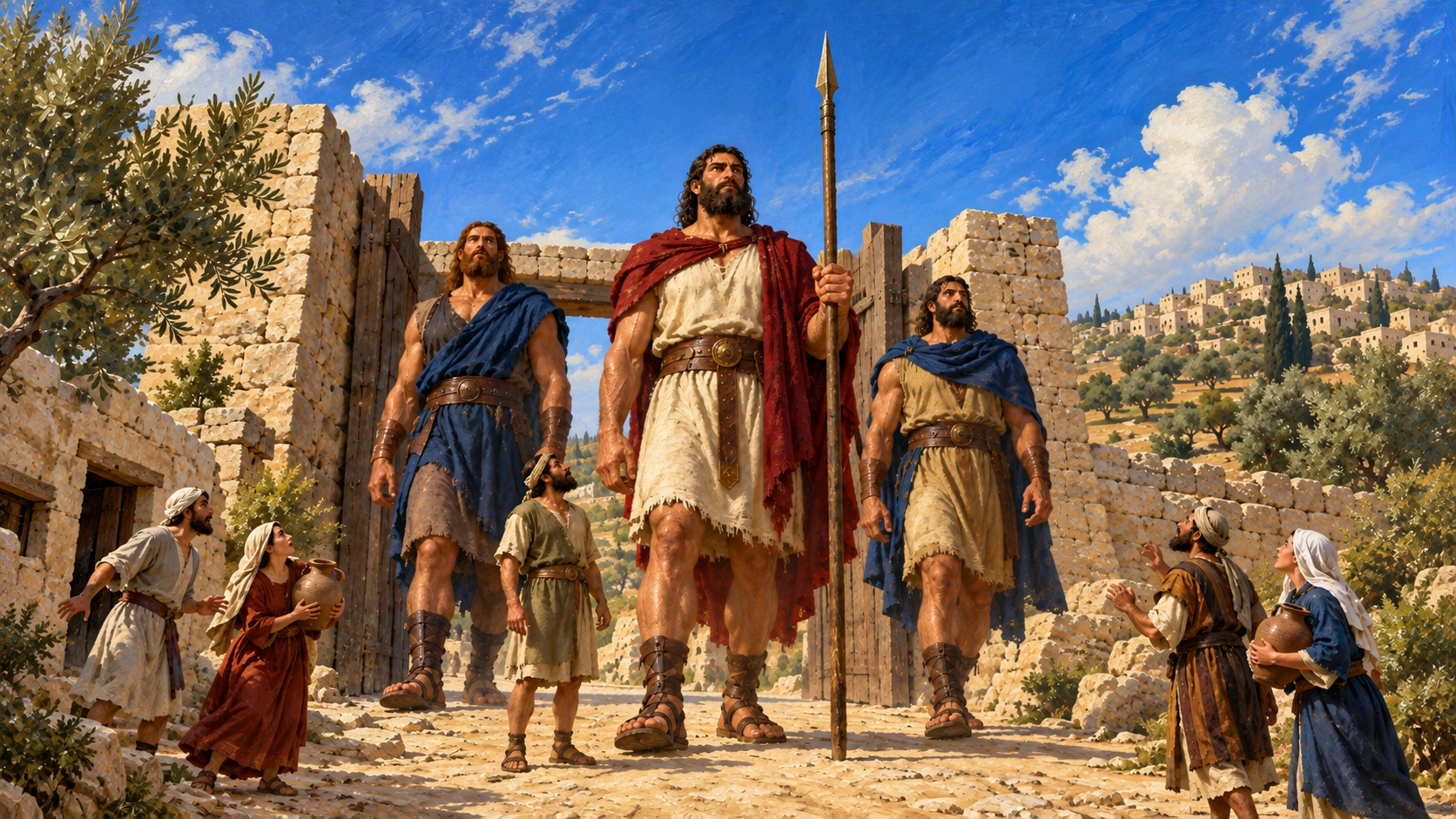
When Genesis 6 mentions the “sons of God” and the Nephilim, it leaves us with questions about who they were and how they relate to the giant clans named later in Scripture. I believe there is strong biblical support for understanding the sons of God as angelic beings. But I want to explain why that reading persuades me without filling in details the Bible does not give.
Genesis 6 and the Sons of God
Genesis 6 comes after the long genealogies from Adam and leads into Noah’s Flood. By then humanity had multiplied, violence filled the world, and every intent of the thoughts of man’s heart was only evil continually. Moses explains why God judged that world while preserving Noah by grace.
Genesis presents these events as history, not as a parable or vision. It names people and records their generations before describing the Flood as God’s judicial response to human wickedness. Jesus also treated Noah’s days and the Flood as real history when He warned about His own future coming.
Still, Genesis 6 is brief. God tells us what He intends us to know without explaining every being involved or every motive behind the events. Readers may want a biological explanation too, but the passage does not supply one. I need to receive what it says without making what it leaves unsaid the basis of a doctrine.
The opening verses of Genesis 6 begin with humanity multiplying and daughters being born. The sons of God then saw that the daughters of men were beautiful and took wives from all whom they chose. After that, the Lord announced that His Spirit would not strive with man forever, and Moses mentioned the Nephilim in connection with that era. What catches my attention is the move from ordinary human multiplication to this unusual description of the sons of God.
The words “of all whom they chose” suggest something troubling about the taking of wives. They can describe desire without restraint and domination that rejects God’s order. That concern remains whether we understand the actors as angels, tyrannical rulers, or people from a particular family line. Genesis moves directly to God’s assessment of human wickedness and violence, so none of those interpretations can set aside the moral rebellion.
Some understand the Lord’s statement about one hundred and twenty years as the time remaining before the Flood. Others connect it with human lifespan. I find the first reading stronger because the passage is moving toward the Flood, but the statement does not give us a full explanation of the Nephilim. It tells us that God was patient and that judgment would nevertheless come.
I don’t expect this short passage to settle every later question about evil spirits or ancient cultures. It cannot carry every argument someone wants to make about archaeology or the end times either. Moses gives us enough to understand Noah’s corrupt world and God’s righteous judgment. We should let the limits of his account govern how far we take our explanations.
Genesis 6:4 says that the Nephilim were on the earth in those days, and also afterward, when the sons of God came in to the daughters of men and they bore children to them. The verse then speaks of mighty men of old, men of renown. The Nephilim are presented as real inhabitants of the earth, not as a symbol for bad ideas or merely poetic language.
The Hebrew term Nephilim is often rendered giants, though its precise meaning is difficult to establish. Its use in Numbers 13 connects it with unusual size and fear in readers’ minds. People also discuss possible connections with falling or fallen ones, but Genesis gives no etymological definition. I would not make the word itself prove more than the passage tells us.
Genesis describes the associated figures as gibborim, mighty men, and as men of renown. Elsewhere, Gibbor can describe a warrior or mighty man without implying supernatural parents or extraordinary height. Understanding that range helps us read the description accurately. In Genesis 6, it identifies figures remembered for power and fame in the violent world before the Flood.
I also notice that the verse places the Nephilim on earth in those days and afterward, while describing the sons of God coming in to the daughters of men. It strongly connects the subjects, but it does not simply say, “the Nephilim were the offspring.” That grammatical distinction does not settle the interpretation. It does mean we should distinguish the connection Moses makes from a more explicit claim he does not make.
In Genesis 6:2, the sons of God saw that the daughters of men were beautiful and took wives for themselves of all whom they chose. Job uses the expression bene ha’elohim, sons of God, for heavenly beings who presented themselves before the Lord and rejoiced at creation. That usage is a substantial reason for understanding Genesis 6 as referring to rebellious angelic beings rather than simply one human family line.
We also know from Scripture that angels can appear in bodily form. The visitors in Genesis 18 ate with Abraham. In Genesis 19, the angels were visible and could be spoken to, and they physically seized Lot’s family. Those accounts show heavenly beings manifested in the human world. They do not explain reproduction, so I would not treat them as an answer to every question raised by Genesis 6.
Jude and 2 Peter describe angels who sinned and left their proper domain, and who were then reserved for judgment. Both writers place angelic rebellion alongside judgment on the ancient world. Jude follows it with Sodom’s pursuit of strange flesh. I take those connections seriously as evidence for the angelic view, but they do not give us permission to import a whole account from later tradition.
On the angelic reading, the sons of God were fallen angels who crossed a God-given boundary with human women. This fits Job’s use of the expression and helps explain why Genesis 6 places this unusual account just before the Flood. It also fits the connection many readers see with Jude and 2 Peter. The unanswered question is how the union occurred. Scripture does not explain that or fully describe the Nephilim’s relationship to it.
The Sethite view identifies the sons of God as godly descendants of Seth and the daughters of men as ungodly descendants of Cain. It draws on the contrast between faithful worship in Seth’s line and violence among Cain’s descendants. I can see why readers make that connection. The difficulty is that Genesis never calls Seth’s line sons of God, and ordinary intermarriage does not readily explain the unusual attention given to this paragraph.
Another interpretation sees the sons of God as ancient kings who claimed divine status and seized women in abusive polygamy. This royal-ruler view can explain the language about taking any wives they chose, and it fits the concern with violence in the surrounding passage. Its weakness is that Job’s specific use of sons of God gives it less direct biblical support.
For those reasons, I find the angelic reading most persuasive. We can affirm that rebellious angels crossed a boundary and that Genesis records grave corruption before the Flood. But the Bible does not name these beings or explain how the events took place. Accepting the angelic interpretation does not give me a basis for teaching secret bloodlines.
The Flood, Noah, and God’s Preserved Promise
Whatever part the Genesis 6 episode had in the events before the Flood, Moses plainly gives the reason for judgment. Human wickedness was great, every intent of man’s heart was continually evil, and violence filled the earth. God was judging a world in open rebellion against Him. He was not reacting to a mythic inconvenience or trying to repair a secret genetic problem.
When Genesis says that all flesh had corrupted its way, the context describes the pervasive ruin and violence of life under human sin. I do not read that as a technical claim that everyone except Noah had nonhuman ancestry. Noah is described as just and blameless in his generations, a man who walked with God. The emphasis is on integrity and wholeness in a righteous walk under grace, not biological purity.
God preserved Noah and his wife along with his sons and their wives. He also brought representatives of the animal kinds through the Flood in the ark. Preserving that family showed His faithfulness to the promised seed: humanity continued through Noah’s line, and ultimately the Messiah came as God had promised. Judgment did not defeat His plan.
Genesis 6:9 calls Noah a just man, perfect in his generations, and says he walked with God. The surrounding account contrasts a violent, corrupt earth with a man who found grace in the Lord’s eyes. That helps us understand tamim, the Hebrew word that can describe blamelessness, completeness, or integrity. Scripture uses it both for sacrificial animals without blemish and for people who walk uprightly before God.
The phrase “in his generations” locates Noah in his historical setting. It does not tell us that he alone had an uncorrupted genome or that the Flood primarily judged a population of biological hybrids. Nor does calling Noah blameless mean he was sinless. He received grace and needed God’s mercy, as his later failure after the Flood makes clear.
The preservation of Noah’s family belongs to God’s covenant purpose, through which humanity continued and the promised Messiah came. I want to keep that purpose in view when considering the difficult details of the passage. If genetic speculation takes priority over God’s faithfulness to His word and His stated judgment on human wickedness, we have lost the emphasis of the passage.
The Nephilim Report and the Later Giant Clans
The word Nephilim appears again in Numbers 13:33, where the ten unbelieving spies say that they saw the Nephilim, the sons of Anak, and that they seemed like grasshoppers in their own sight. The report is part of a speech that discouraged Israel from entering the land and led to God’s judgment on that generation.
I would not dismiss the spies’ entire report as invented. Deuteronomy and Joshua confirm that Anakim and other unusually tall clans lived in the land. But the comparison to “grasshoppers” expressed their fear and unbelief. Joshua and Caleb acknowledged the danger while insisting that the Lord could give Israel victory. The disagreement was over whether Israel would trust Him in the face of it.
Numbers leaves the connection with the pre-Flood Nephilim unexplained. The spies may have used an ancient name for the formidable people they saw, or there may have been a continuing historical connection that Scripture does not fully describe. I cannot supply the missing explanation. Without that explanation, I would not confidently deny a connection or claim to reconstruct one.
Deuteronomy names the Anakim and Rephaim, along with the Emim and Zamzummim, as peoples remembered for great size and strength. They appear in geographical and military accounts rather than fables. Israel faced intimidating opponents in an actual land, and God called His people to trust His power instead of relying on their own strength.
Og king of Bashan was associated with the remnant of the Rephaim. Deuteronomy describes his bed or couch to convey his unusual stature and lasting reputation. We may not be able to settle the exact modern length of a cubit or the furniture’s precise purpose, but the account clearly presents a formidable king.
The Anakim lived around Hebron and nearby hill-country cities. Joshua cut them off from much of the land, although remnants remained in Gaza, Gath, and Ashdod. That helps explain why the later accounts connect giant warriors with Philistine territory. It does not establish that every tall person was a Nephilim or that every clan was a hybrid people.
We also need to distinguish the names used for these peoples. The Anakim are connected with Anak and the hill country, while the Rephaim appear as an ancient people and, in some contexts, in language associated with the dead. Neighboring peoples used the names Emim and Zamzummim for ancient inhabitants east of the Jordan. The terms overlap in Scripture, but that does not make them interchangeable technical names for one exact species.
Deuteronomy 2 explains that the Moabites used the name Emim for people others regarded as Rephaim. The passage places those inhabitants within God’s ordering of nations and territories. He gave land to Lot’s descendants and to Esau’s descendants, just as He would give Canaan to Israel. The great size of a land’s inhabitants did not put it beyond His rule.
Israel had heard that no one could stand before the sons of Anak, whose size made them especially intimidating. Yet Caleb later asked for Hebron because the Lord would be with him, and Joshua records the Anakim’s defeat in specific towns. Those military and geographical details give us a historical account of formidable people. Receiving that account does not require accepting every later tradition about giants.
I can receive Scripture’s account of those people and campaigns without adding a biological chart it never gives. Nor do I need to assign every clan a supernatural origin. Taking the biblical record seriously means trusting the history it tells us and stopping where its explanation stops.
Deuteronomy 3 gives more detail about Og’s iron bedstead or couch: nine cubits long and four cubits wide, measured by the common cubit. The object was apparently still known in Rabbah when the account was written. That detail reinforces Og’s reputation among the Rephaim. Readers may debate the cubit’s exact size or whether the furniture was enlarged for honor as well as use. Neither question removes the point that Israel faced a ruler whose stature and strength inspired fear.
In 1 Samuel, Goliath’s height appears alongside a careful description of his armor and spear and his role as champion. The Masoretic Text reflected in the NKJV gives six cubits and a span. We do not need to settle a modern measurement to understand the challenge Israel faced. Goliath was visibly imposing and heavily armed, and he was confident no one in Israel would answer him.
David did not deny Goliath’s size. He refused to judge the outcome only by comparing the two men, because the Lord who had delivered him from a lion and a bear would deliver him from the uncircumcised Philistine. I see David’s trust in God’s name directing his response. The Lord uses what appears weak to show that the outcome rests with Him rather than human ability.
We can learn courage from David without calling every personal difficulty a Goliath or every strong opponent a demonic hybrid. His encounter with the Philistine calls us to trust the Lord in real conflict. Visible strength cannot overrule God’s promises, so it need not determine whether we obey Him.
Goliath’s size and military equipment terrified Saul’s army, but David saw more than a large champion from Gath facing a small boy. This Philistine was defying the armies of the living God. That defiance shaped David’s understanding of the conflict.
David came in the name of the Lord of hosts instead of trusting armor or human strength. God gave victory through a sling and stone so Israel would know that the battle belonged to Him. Goliath’s height helps us understand the threat, but the account directs our attention to the Lord’s faithfulness to His people and His judgment on defiant pride.
In 2 Samuel 21, David’s servants defeated large Philistine warriors associated with Gath. The accounts show God’s people overcoming enemies who had seemed invincible. I would not turn those victories into promises that Christians will physically conquer their opponents. They do show that even the most imposing enemy remains under God’s authority.
The giant clans had also been part of the challenge when Israel entered Canaan. Deuteronomy repeatedly describes inhabitants greater and taller than Israel, including descendants of Anak, and cities protected by fortifications. Moses did not minimize what Israel faced. He told the people that the Lord would go before them as a consuming fire and drive out the nations according to His promise.
The conquest was part of God’s covenant with Abraham. After long patience, He judged Canaanite wickedness and gave Israel a land in which to serve Him. Keeping that purpose in view prevents me from treating the giant battles as an independent mythology. The Anakim belonged to the historical setting, but they were not a hidden explanation for every command in Joshua.
Caleb asked for Hebron at eighty-five, remembering the report given forty-five years earlier. He requested the mountain where the Anakim lived. He was not boasting in his own strength. He said that the Lord might be with him and that he would drive them out as the Lord had said. I notice that he could acknowledge the threat and still make his request in reliance on God’s promise.
Joshua’s defeat of the Anakim in the hill country confirmed the Lord’s faithfulness to His word. Remnants remained in Philistine cities, but the land assigned to Israel was secured according to God’s command. The account shows Him keeping His covenant promise.
The accounts of David and the Philistine giants show God’s continuing protection at key points in Israel’s history. David’s victory over Goliath established that the Lord saves without sword or spear. Later, other warriors in David’s army defeated large men associated with Gath. Enemies who inspired fear did not bring God’s care for His people to an end.
The names and descriptions in 2 Samuel 21 need to be compared carefully with the parallel account in Chronicles. We should not force them together carelessly. What is clear is that David did not fight alone: loyal servants shared in the victories over Philistine champions. God worked through the king and his servants to end those particular threats.
God preserved the covenant line through every danger, and David’s house became the royal line of the Messiah. Even so, I cannot call every giant conflict an attempt to prevent the Messiah’s birth, because Scripture does not give that explanation. The accounts point most directly to God defending His people and judging those who defied Him.
That gives me confidence when I read about threats that appear impossible to overcome. God rules over those threats, and His purpose does not depend on human strength. He often works through people who obey with courage and faith, including faithful servants whose names receive only a brief mention. Their part in these victories should not be overlooked.
Jude, 2 Peter, and the Limits of Our Knowledge
Jude says that angels who did not keep their proper domain but left their own abode are reserved in everlasting chains under darkness for the judgment of the great day. 2 Peter likewise says that God did not spare angels who sinned and then refers to the ancient world and Noah. The passages make clear that angelic rebellion is real and that God judges it.
Neither passage names the Nephilim or quotes Genesis 6 in detail, and neither explains angelic reproduction. Their sequence and wording support the interpretation of a unique angelic transgression in Genesis 6, but their main purpose is to warn. God has judged rebellion before and will judge it again. False teachers and immoral rebels cannot presume on His patience, nor can people who approach Him arrogantly.
In 2 Peter 2, Peter moves from angels who sinned to the ancient world of Noah’s day, then to Sodom and Gomorrah. Jude also mentions angels leaving their proper domain before speaking of Sodom’s sexual immorality and pursuit of strange flesh. I find those parallels too substantial to dismiss simply because the passages are difficult.
Those parallels do not supply every explanation people attach to them. Peter does not name Genesis 6 or call the angels fathers of the Nephilim, and he says nothing about the later giant clans. Jude does not say all fallen angels committed the same sin or direct Christians to search for modern descendants. Both writers are concerned with how people live before God. He knows how to judge rebellion and rescue the godly.
I do not want the questions about ancient beings to make me miss that warning. False teachers promised freedom while serving corruption, and Jude and Peter warn against spiritual confidence divorced from obedience. If God judged angels, no creature can claim to be beyond His authority. That should make me humble before Him and concerned with holiness, trusting Christ rather than pursuing sensation.
Believers do face spiritual warfare. Scripture calls us to put on the whole armor of God and resist the devil, testing spiritual claims by God’s word. We do that with confidence in Christ’s completed triumph. Ancient powers have not become stronger than our risen Lord.
1 Enoch gives an elaborate account of watchers and forbidden unions, along with giants and judgment. It shows that some Second Temple Jewish readers understood Genesis 6 in terms of angelic rebellion, which makes it useful historical evidence. But it is not inspired Scripture. We cannot give its names or chronology the authority of Moses and the prophets, and its account of the universe and explanations do not carry apostolic authority either.
Jude’s quotation of a prophecy attributed to Enoch does not make the whole book bearing Enoch’s name part of Scripture. Paul cited Greek poets without declaring their works inspired. In the same way, a biblical writer may refer to a known statement or a true element in a tradition without endorsing everything around it. Scripture remains sufficient for doctrine.
Accounts of Greek heroes and Mesopotamian kings may invite historical comparisons, as may folklore and reports of giant skeletons. Those comparisons need to remain tentative; they cannot prove what Genesis 6 means. Many modern claims depend on altered photographs or undocumented reports, and others rest on assumptions that do not withstand examination.
We are free to study ancient history, but I would not make confidence in Genesis 6 depend on discovering an artifact or finding a parallel in a myth. A newspaper report cannot establish its authority either. God’s word is true because He has spoken, and fascination with outside material must not take the place of faith in Him.
The Bible does not teach that Noah alone was genetically pure or that everyone else was a hybrid. Nor does it describe the Flood as a way to eliminate a particular bloodline. It leaves the post-Flood appearance of Nephilim unexplained and does not identify Nimrod as one of them. The claim that demons are disembodied spirits of dead Nephilim also goes beyond what Scripture says.
We should apply the same restraint to Greek gods and Gilgamesh, or to later folklore and modern claims about skeletons. None of those sources, including newspaper reports and archaeological accounts, is identified in Scripture as proof of its giant traditions. Some ancient myths may preserve distorted memories of events, but that remains a possibility to discuss, not revelation to preach. It must not become a reason to create fear.
Jesus used Noah’s days to warn about ordinary unbelief continuing until judgment overtakes people at His return. He did not predict that the Nephilim would return. The response He calls for is readiness for the Son of Man, not a search for hidden signs or speculative conspiracies.
Christ, Coming Judgment, and Spiritual Confidence
Jesus explained the comparison by describing people eating and drinking, marrying and giving in marriage until the Flood took them all away. Ordinary life continued in unbelief right up to the sudden arrival of judgment. That is the warning He gave about the coming of the Son of Man.
Christ did not tell His disciples to expect returning Nephilim or hybrid beings as a mark of the last days. They did not need ancient myths to decode His coming. We need to watch in faith and remain ready because He will come at an hour people do not expect. That calls for repentance and belief in the gospel now, with obedience growing from that faith.
I want this subject to bring me back to what God has revealed. Tracking conspiracies can consume attention that belongs to prayer and Scripture. That is distraction, not greater readiness to do the work He has actually given us.
God warned before the Flood, and Noah found grace and obeyed while judgment was still ahead. The ark was prepared during that time, so the account speaks of mercy as well as warning. Today God offers salvation through Jesus Christ, who bore sin and rose from the dead. He will return, and we should come to Him while His mercy is offered instead of delaying.
Knowing that angels rebelled does not make demons or secret genealogies the center of Christian life. We are not called to pursue hidden knowledge. The New Testament calls us to submit to God and resist the devil, praying and standing against his schemes in the whole armor God provides. That armor includes truth and righteousness, the gospel of peace and faith, salvation and God’s word.
Those commands concern how we live. We stand firm by believing God’s truth and rejecting sin, with prayer and faithful service in the local church as part of that obedience. I do not need a special technique or an extra-biblical book to be protected. A theory about Nephilim ancestry cannot give me what Jesus, who has all authority in heaven and earth, provides.
Uncertainty can feed fear, especially in a passage as difficult as Genesis 6. Christians may disagree about details while sharing confidence in Scripture’s authority. I want to acknowledge what I do not know with humility instead of panic. God has given us everything necessary for salvation and faithful living, and He has not left us defenseless against unseen evil.
Christ will return bodily and judge every evil power. He will raise the dead and establish His righteous kingdom, so final victory belongs to Him. No ancient rebellion or giant warrior can change that future, and no modern spiritual claim can overturn it. We can study difficult passages seriously while trusting the King who has already overcome the world.
From Genesis 6 and the Flood through Canaan’s giant clans and David’s victories, we see God judging rebellion and preserving His purposes. Secret knowledge about ancient beings is not the final answer to evil. That answer is Jesus Christ, the promised Seed who came as the sinless Savior and will come as Judge.
Christ bore the punishment for sin in His innocent body at the cross. He shed His blood and died, then rose bodily and now reigns, having disarmed the powers of darkness. His authority gives believers reason to resist the devil and stand in the truth as they trust the Lord. I do not need to treat angels or giants, myths or unseen powers, as though any could make His authority uncertain.
God saw the violence in Noah’s world and judged it righteously, yet He saved Noah by grace and kept His promise. He sees our world just as clearly. His offer of salvation through His Son is real, and so is the righteous judgment He will bring on the living and the dead. That calls us to worship Him and live with sober faithfulness.
Related Studies
The Mark of Cain: This study examines Cain’s judgment, mercy, and the limits of speculation.
Noah and the Flood: This study traces God’s judgment, grace, and covenant after the Flood.
Angels: This study explains angels, rebellion, and spiritual warfare from Scripture.
David and Goliath: This study follows David’s faith in the Lord against a formidable enemy.
My Final Thoughts
I believe the sons of God in Genesis 6 were involved in a real angelic rebellion, though Scripture does not explain how it happened. I want to honor both the strength of that reading and the limits of what God has told us. The Nephilim and later giant clans belonged to real history, but they never stood beyond His judgment or put His promises in jeopardy. We can leave secret-bloodline theories and modern conspiracies behind without avoiding the difficult passages themselves. Christ has authority over every visible and unseen power. That gives us reason to study humbly and confidently, free from fear and ready for His return.