
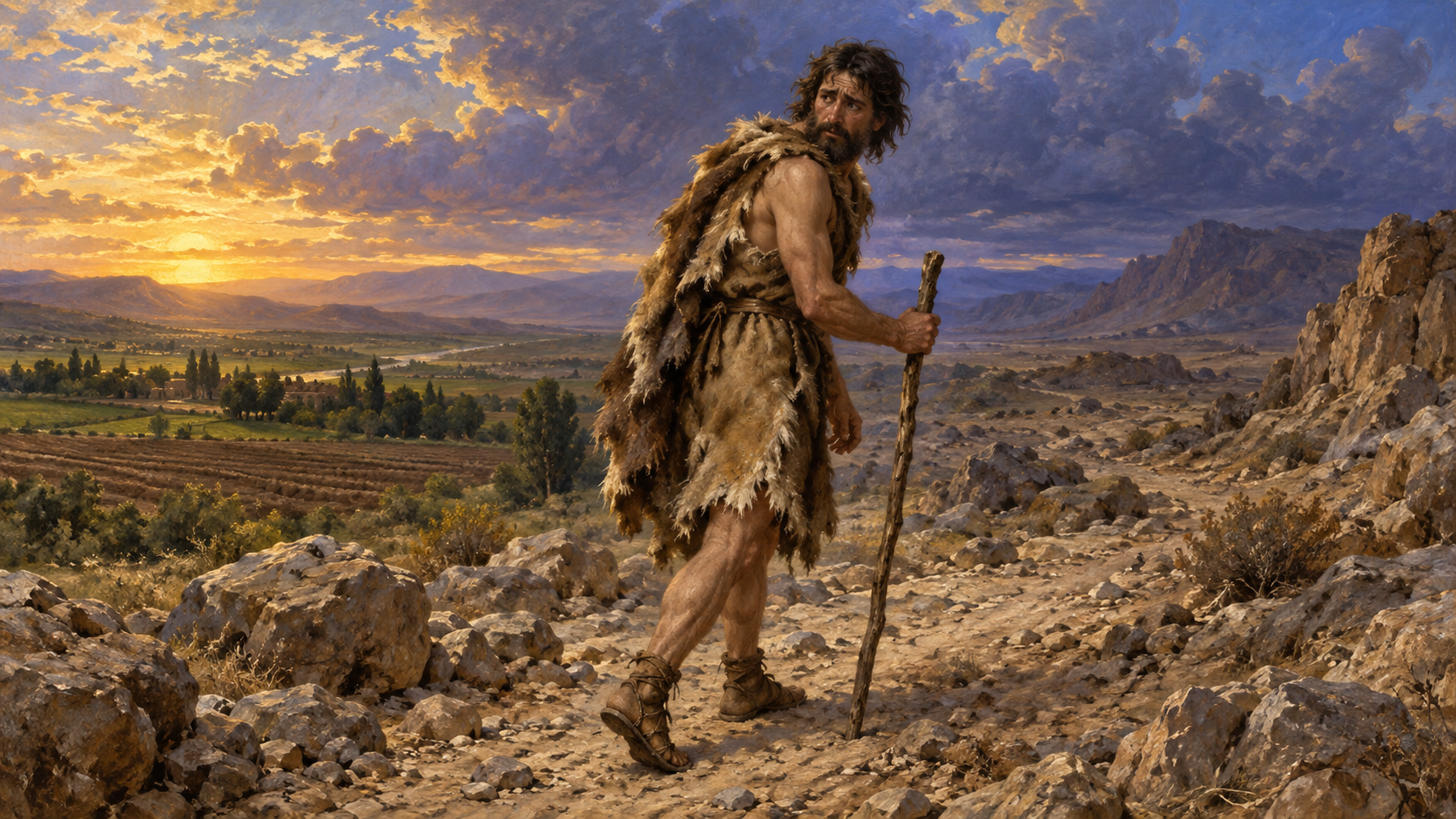
People have offered all kinds of ideas about the mark of Cain, but Genesis never tells us what it looked like. What it does explain is why God gave the mark after Cain murdered Abel. I want to follow that explanation from God’s warning before the murder to the judgment and mercy that followed, rather than guess at an appearance Scripture has not described.
Cain Rejected God’s Warning and Murdered Abel
Genesis 4 takes place after Adam and Eve were driven from the garden. Their sons Cain and Abel both brought offerings to the Lord. Cain worked the ground, while Abel kept sheep. God respected Abel and his offering but did not respect Cain and his offering. I would not explain that difference by looking only at what they brought. Hebrews 11 says Abel offered by faith, and Genesis shows Cain responding to God’s correction with anger rather than humble obedience.
Before any violence occurred, the Lord spoke to Cain about his downcast expression and anger. He asked why Cain was angry and said, “If you do well, will you not be accepted?” That was a real opportunity for Cain to turn from his sinful response. God warned him that sin was lying at the door and desired to rule him, but commanded Cain to rule over it.
Sin is pictured as a dangerous enemy waiting for an opening. Yet I do not read that image as an excuse for Cain, as though he had no choice. God’s warning made clear that Cain faced a moral decision and knew what he should do. He could receive correction and respond rightly instead of continuing to feed his resentment.
Before trying to understand the mark, I need to listen to the warning God gave Cain. Temptation often grows in the heart before it becomes a visible act. Anger can be nursed instead of confessed, and envy can turn another person into the target of bitterness. We cannot answer that danger by trusting our own strength. As soon as God brings resentment to light, we need to submit to Him and seek His help.
Cain spoke with Abel in the field. There he rose against his brother and killed him. Genesis records the first murder plainly. Abel’s death was not an accident or merely a family disagreement. Cain shed innocent blood, and the ground received that blood from his hand.
When the Lord asked, “Where is Abel your brother?” Cain lied: “I do not know. Am I my brother’s keeper?” He denied knowing what had happened and rejected responsibility, but the Creator had seen what he was trying to hide. God said Abel’s blood cried out to Him from the ground. Human courts may fail, and violence may remain hidden from other people for a time, but God knows every injustice.
The Curse and the Mark Were Not the Same Thing
After exposing the murder, God pronounced judgment on Cain. He was cursed from the earth that had received Abel’s blood. The ground would no longer yield its strength to him, and he would become a fugitive and a vagabond. This was the curse: his work would be frustrated, and the settled life he had known would give way to wandering.
Notice when the mark enters the account. God had already explained the curse before He gave Cain the mark. That order helps me keep the two separate. Genesis says the curse concerned Cain’s relationship to the ground and his life as an exile, not a change in his body or skin. A theory that makes the later mark itself the curse confuses what the passage distinguishes.
Cain answered that his punishment was greater than he could bear. He feared being driven from the ground and from God’s face, believing that anyone who found him as a fugitive might kill him. We can see the seriousness of murder here and the danger of retaliation spreading. But I would not mistake Cain’s fear for a saving confession. Genesis records his concern about the consequences, not repentance or faith in God.
The Lord responded by declaring that anyone who killed Cain would suffer vengeance sevenfold. He then set a mark on Cain so that no one who found him would kill him. Genesis gives us the purpose even though it does not give us the appearance: the sign restrained unauthorized human vengeance. God had judged Cain, and no one else had the right to take God’s place.
The mark did not remove Cain’s guilt or bring Abel back to life, and the curse remained. He still left the presence of the Lord and lived in Nod, east of Eden. I see mercy and judgment together in that outcome. Cain remained accountable for murder while God prevented another murder from setting off an expanding cycle of bloodshed.
The protection was therefore specific: it kept other people from killing Cain. Genesis never says God approved of him or gave him eternal security. Preserving a person’s life for His own purposes does not mean God has removed His judgment against that person. Cain’s continued life should not be confused with forgiveness.
Scripture Does Not Describe the Sign
The Hebrew word translated mark is owth, a common word for a sign or token that can also refer to a signal or distinguishing indicator. Scripture uses it elsewhere for the rainbow after the Flood and for signs in Egypt. It also describes the Sabbath as a sign. Understanding the word helps us read the passage accurately, but it cannot tell us what Cain’s sign looked like. It might have appeared on his body, been connected to his circumstances, or been recognizable in another way. Genesis does not disclose its form.
Because God did not reveal the mark’s appearance, we should not pretend to know it. Scripture never identifies a scar, tattoo, or horn as the mark. Neither does it describe a change in skin color or an inherited family trait. Yet people have twisted Cain’s mark into racist teaching and used it to stigmatize those with physical differences. Those claims have no support in Genesis and contradict the truth that every human being bears God’s image.
The fact that owth can describe covenant signs does not prove that God made a covenant with Cain. Genesis 4 never calls the mark a covenant and never gives covenant terms. We can state what the passage teaches without guessing: God gave Cain an unspecified sign that warned others not to kill him.
Genesis 1 has already told us that God made mankind in His image. Cain did not erase Abel’s dignity by murdering him, which helps explain why God treated the shedding of Abel’s blood with such gravity. But Cain’s crime did not erase his own humanity either. He remained a guilty image bearer under his Creator’s judgment. I cannot treat that guilt as permission for others to dehumanize him and destroy him at will.
That is why I cannot accept a racial interpretation of Cain’s mark. Genesis never connects his descendants with a modern racial group or identifies the sign as skin color. Nor does it permit one people to dominate another. All people descend from Adam and Eve, bear God’s image, and answer to the same Creator. Permission for prejudice has to be brought into Genesis 4 from somewhere else; it does not come from the passage.
God Restrained Vengeance Without Ignoring Justice
Cain’s sign introduces a principle we meet throughout Scripture: final vengeance belongs to the Lord. Deuteronomy records God saying, “Vengeance is Mine, and recompense.” Romans 12 applies that truth to believers by telling us not to repay evil for evil or avenge ourselves. We are to leave judgment in God’s hands.
This does not abolish lawful civil justice. Genesis 9 treats the shedding of human blood as a grave offense because man is made in God’s image. Romans 13 describes governing authority as God’s servant in punishing wrongdoing. The mark of Cain does not tell civil authorities to ignore murder. It forbids private retaliation that puts personal anger in the place of God’s judgment and rightful authority.
We should neither use Cain’s life to excuse private vengeance nor soften the evil of his murder. God did not overlook what Cain had done, but another person had no right to appoint himself judge and executioner. I can trust God’s justice to be holy and measured because He knows every fact, including what human witnesses and courts may never discover.
Cain remained guilty and became a fugitive whose work was cursed. God still limited the violence others could do to him. Genesis 4 helps me keep mercy and judgment together here: mercy did not make the murder harmless, and judgment did not give other sinners permission to murder Cain.
God’s patience gives time for repentance, but it does not promise that sin will never be judged. He does not delight in wickedness and remains the Judge of all the earth. Cain was still accountable to Him, yet he was also still a human being whom others could not treat as an object of private revenge. As a believer, I need to speak honestly about violence without taking pleasure in another person’s ruin.
Jesus teaches that murder begins in the heart, and 1 John warns that the person who hates his brother is a murderer. That makes the warning to Cain personal. I cannot protect hatred in my heart as though it were harmless simply because it has not become physical violence. We should pray for sinners to turn to the mercy offered in Christ while taking evil seriously and seeking justice through rightful means.
Cain’s Later Story Keeps the Warning Alive
After leaving the presence of the Lord, Cain lived in Nod, had a son named Enoch, and built a city. Scripture does not identify his wife, but the early chapters of Genesis already show the human family growing from Adam and Eve. I see no need to invent a separate population to explain whom Cain married.
Cain’s descendants became builders and herdsmen, and they developed skills in music and metalworking. Genesis does not condemn those ordinary developments of human culture. Cities and livestock were not inherently evil, nor were music and tools. The warning comes through Lamech, who boasted that he had killed a man and that his vengeance would exceed Cain’s. Human skill was growing, but so was violence in a world still east of Eden.
What catches my attention in this genealogy is that useful work and beauty developed after Cain’s murder while proud violence remained in the same culture. Human achievement could not heal the human heart. Later in Genesis, violence filled the earth before the Flood. The rest of Scripture points us toward the Redeemer who will finally defeat sin and death, answering a need human accomplishment could not meet.
Later biblical passages direct us to the path Cain took rather than the appearance of his mark. Hebrews 11 says Abel offered a more excellent sacrifice by faith and received witness that he was righteous. In 1 John, we are told that Cain was of the wicked one and killed his brother because his own works were evil while Abel’s were righteous. Jude warns about people who have gone in the way of Cain.
These passages help me understand how Cain’s unbelief led to envy and hatred that became violence. They do not describe his sign. Hebrews 12 directs us instead to Jesus, whose blood speaks better things than Abel’s. Abel’s blood cried from the ground for justice, whereas Christ’s blood secures forgiveness and reconciliation for those who repent and believe.
The Blood of Christ Answers Guilt and Violence
Cain could not undo Abel’s death. Neither can any of us erase guilt through excuses or attempts to justify ourselves. The good news is that Jesus Christ came for guilty people. He lived without sin and bore the punishment for our sins in His innocent body. After shedding His physical blood and dying, He rose bodily from the grave. His sacrifice is sufficient for the whole world, and everyone who trusts Him receives forgiveness and eternal life.
Jesus was murdered by sinful men, yet He willingly gave His life according to the Father’s saving purpose. His blood does not deny justice. His sacrifice answers the righteous demand against sin, and His resurrection proves that death will not have the final word over those who belong to Him.
Those who believe are sealed with the Holy Spirit of promise. I see an important difference between that seal and Cain’s mark. Cain received temporary preservation while he remained under judgment. A believer receives new life and lasting security because the Savior’s work is finished. Scripture does not give us grounds to press the comparison further.
The Gospel offers no comfort to hatred, yet it gives hope even to a murderer or an angry person. Someone wounded by violence can find hope in Christ too, for all of us need the same righteous Savior. He calls sinners to repent and offers real forgiveness. While His people wait for His perfect judgment, He teaches them to overcome evil with good. Cain’s life should move us to bring our guilt to Christ and turn away from hatred, seeking reconciliation wherever it is possible.
For more study of the surrounding passages, see Cain and Abel and Killing and Murder. The study on Forgiveness considers repentance and reconciliation, while Salvation traces the promise of forgiveness and eternal life in Christ.
My Final Thoughts
I do not believe we can identify the appearance of Cain’s mark from Scripture. What Genesis does tell us is that the curse punished his murder, while the later sign restrained others from taking private vengeance. It was not a racial feature and is never called a covenant. Cain’s life makes me take seriously the danger of anger that refuses God’s correction, while reminding me that justice belongs to the Lord. Abel’s blood cried out for justice, but Jesus’ blood offers forgiveness and new life to everyone who trusts Him. We should turn from hatred to Christ, who meets guilty people with mercy and calls us to obey Him.