
Does “You shall not murder” mean that every killing is murder? Scripture distinguishes a treacherous attack from an accident, holds people responsible for dangerous negligence, and addresses defense, public punishment, and warfare in their own settings. Those distinctions protect innocent life. They cannot be used to excuse our anger or make any violence we favor seem righteous.
What the Sixth Commandment Forbids
The King James wording “Thou shalt not kill” can sound to a modern reader like a prohibition of every act that causes death. The NKJV’s “You shall not murder” states the command more precisely in present English. We can understand its scope by reading it alongside the laws God gave Israel about deaths that deserved punishment and deaths that did not.
And God spoke all these words, saying: “I am the LORD your God, who brought you out of the land of Egypt, out of the house of bondage. “You shall have no other gods before Me. “You shall not make for yourself a carved image–any likeness of anything that is in heaven above, or that is in the earth beneath, or that is in the water under the earth; you shall not bow down to them nor serve them. For I, the LORD your God, am a jealous God, visiting the iniquity of the fathers upon the children to the third and fourth generations of those who hate Me, but showing mercy to thousands, to those who love Me and keep My commandments. “You shall not take the name of the LORD your God in vain, for the LORD will not hold him guiltless who takes His name in vain. “Remember the Sabbath day, to keep it holy. Six days you shall labor and do all your work, but the seventh day is the Sabbath of the LORD your God. In it you shall do no work: you, nor your son, nor your daughter, nor your male servant, nor your female servant, nor your cattle, nor your stranger who is within your gates. For in six days the LORD made the heavens and the earth, the sea, and all that is in them, and rested the seventh day. Therefore the LORD blessed the Sabbath day and hallowed it. “Honor your father and your mother, that your days may be long upon the land which the LORD your God is giving you. “You shall not murder. “You shall not commit adultery. “You shall not steal. “You shall not bear false witness against your neighbor. “You shall not covet your neighbor’s house; you shall not covet your neighbor’s wife, nor his male servant, nor his female servant, nor his ox, nor his donkey, nor anything that is your neighbor’s.”
Exodus 20:13 gives the prohibition in two Hebrew words, lo ratsach. The surrounding commandments protect parents, marriage, property, and truthful dealings with our neighbors, while also condemning covetous desires. Human life belongs within that protection. We have no right to destroy another person because his existence frustrates what we want.
The verb ratsach does not always carry exactly the same sense. Forms of it describe both an intentional murderer and an unintentional manslayer in Numbers 35; the Brown-Driver-Briggs Hebrew lexicon records those uses. Defining it as culpable homicide in every occurrence would wrongly suggest that every person it names is morally guilty of the death. The circumstances and God’s judgments distinguish the cases.
Other Hebrew words, including harag, nakah, and forms of muth, can describe killing, striking, or putting to death. A list of words cannot decide whether a particular action was right. We still have to ask who acted, what he intended, what danger existed, and whether he had authority to use that force. Scripture does not acquit a killer merely because he calls himself a defender or a soldier.
Christians remain bound by the command against murder because it expresses God’s enduring moral will. The New Testament repeats it and addresses the hatred from which murder grows. That does not place the church under every civil penalty God assigned to national Israel. God’s reason for requiring an account of human bloodshed reaches further back than Sinai.
So God blessed Noah and his sons, and said to them: “Be fruitful and multiply, and fill the earth. And the fear of you and the dread of you shall be on every beast of the earth, on every bird of the air, on all that move on the earth, and on all the fish of the sea. They are given into your hand. Every moving thing that lives shall be food for you. I have given you all things, even as the green herbs. But you shall not eat flesh with its life, that is, its blood. Surely for your lifeblood I will demand a reckoning; from the hand of every beast I will require it, and from the hand of man. From the hand of every man’s brother I will require the life of man. “Whoever sheds man’s blood, By man his blood shall be shed; For in the image of God He made man. And as for you, be fruitful and multiply; Bring forth abundantly in the earth And multiply in it.”
God spoke these words to Noah’s family after the flood. The reason He gave was His creation of mankind in His image, not a privilege reserved for one nation. Human beings represent their Creator and possess the dignity He gave them. This does not mean God has a human body or that we physically resemble Him.
Our worth does not depend on strength, health, age, or usefulness. A weak person has as much claim to protection as a powerful one, and someone guilty of wrongdoing still bears God’s image. Even a ruler answers to the Creator for how he treats human beings. Government did not give us that dignity and cannot claim unlimited authority over our lives.
The first murder recorded in Scripture occurred before these words to Noah. Cain’s conduct shows why God judges more than the outward fact that one person has died.
Now Adam knew Eve his wife, and she conceived and bore Cain, and said, “I have acquired a man from the LORD.” Then she bore again, this time his brother Abel. Now Abel was a keeper of sheep, but Cain was a tiller of the ground. And in the process of time it came to pass that Cain brought an offering of the fruit of the ground to the LORD. Abel also brought of the firstborn of his flock and of their fat. And the LORD respected Abel and his offering, but He did not respect Cain and his offering. And Cain was very angry, and his countenance fell. So the LORD said to Cain, “Why are you angry? And why has your countenance fallen? If you do well, will you not be accepted? And if you do not do well, sin lies at the door. And its desire is for you, but you should rule over it.” Now Cain talked with Abel his brother; and it came to pass, when they were in the field, that Cain rose up against Abel his brother and killed him. Then the LORD said to Cain, “Where is Abel your brother?” He said, “I do not know. Am I my brother’s keeper?” And He said, “What have you done? The voice of your brother’s blood cries out to Me from the ground. So now you are cursed from the earth, which has opened its mouth to receive your brother’s blood from your hand. When you till the ground, it shall no longer yield its strength to you. A fugitive and a vagabond you shall be on the earth.” And Cain said to the LORD, “My punishment is greater than I can bear! Surely You have driven me out this day from the face of the ground; I shall be hidden from Your face; I shall be a fugitive and a vagabond on the earth, and it will happen that anyone who finds me will kill me.” And the LORD said to him, “Therefore, whoever kills Cain, vengeance shall be taken on him sevenfold.” And the LORD set a mark on Cain, lest anyone finding him should kill him. Then Cain went out from the presence of the LORD and dwelt in the land of Nod on the east of Eden.
God had warned Cain about his anger after rejecting his offering. Cain was responsible to rule over sin, yet he rose against Abel in the field and killed him. He then lied when God asked where his brother was. His question about being his brother’s keeper could not conceal what he had done; Abel’s blood cried to God from the ground.
God judged Cain, but He also marked him so that others would not kill him in retaliation. Cain’s guilt did not authorize everyone who met him to impose a sentence of his own. We need to keep that limit in view when grief and anger make revenge seem deserved.
Intent, Accident, and Responsibility
The laws following the Ten Commandments distinguish a fatal assault from a death without premeditation. God required justice for the person who had died while also protecting someone who was not a murderer.
“He who strikes a man so that he dies shall surely be put to death. However, if he did not lie in wait, but God delivered him into his hand, then I will appoint for you a place where he may flee. “But if a man acts with premeditation against his neighbor, to kill him by treachery, you shall take him from My altar, that he may die. “And he who strikes his father or his mother shall surely be put to death. “He who kidnaps a man and sells him, or if he is found in his hand, shall surely be put to death. “And he who curses his father or his mother shall surely be put to death. “If men contend with each other, and one strikes the other with a stone or with his fist, and he does not die but is confined to his bed, if he rises again and walks about outside with his staff, then he who struck him shall be acquitted. He shall only pay for the loss of his time, and shall provide for him to be thoroughly healed. “And if a man beats his male or female servant with a rod, so that he dies under his hand, he shall surely be punished. Notwithstanding, if he remains alive a day or two, he shall not be punished; for he is his property. “If men fight, and hurt a woman with child, so that she gives birth prematurely, yet no harm follows, he shall surely be punished accordingly as the woman’s husband imposes on him; and he shall pay as the judges determine. But if any harm follows, then you shall give life for life, eye for eye, tooth for tooth, hand for hand, foot for foot, burn for burn, wound for wound, stripe for stripe.
A man who treacherously planned his neighbor’s death could not use the altar as a hiding place from judgment. Numbers 35 further directs attention to prior hatred, an ambush, the weapon, and the manner of attack. A fatal blow with an iron implement or another deadly weapon could not be dismissed as harmless conduct merely because the killer denied intending the outcome. The evidence had to be examined.
Responsibility also extends beyond the hand that delivers the wound. David arranged for Uriah to be exposed to deadly fighting and abandoned, though an enemy weapon killed him. Jezebel arranged false testimony against Naboth so that public officials would put him to death. Using other people to carry out a killing did not make either arrangement innocent, and the appearance of lawful procedure could not turn Naboth’s murder into justice.
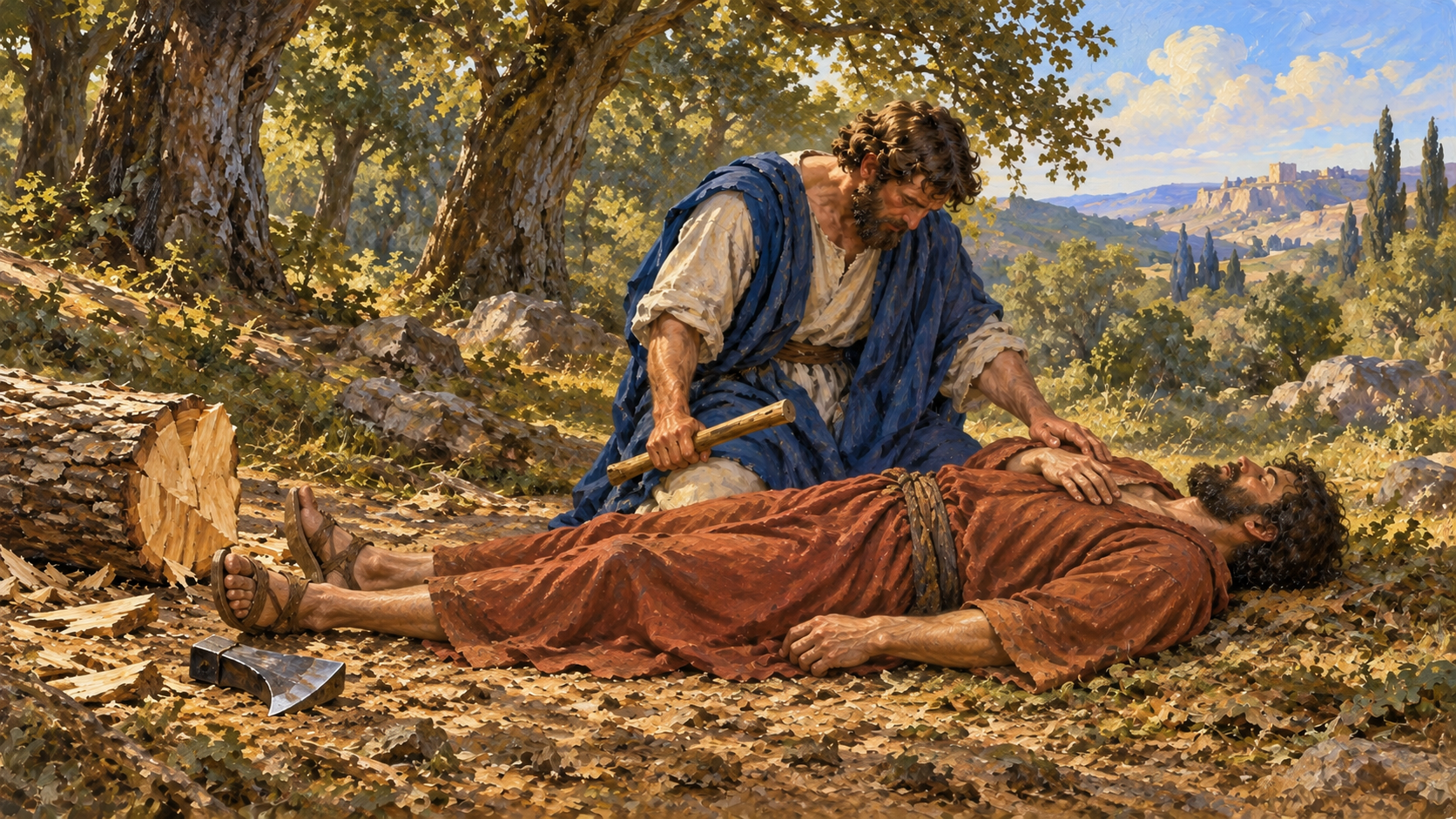
Deuteronomy gives a different case: two neighbors go into the woods to cut timber, and a tool fails without any prior hatred between them.
“When the LORD your God has cut off the nations whose land the LORD your God is giving you, and you dispossess them and dwell in their cities and in their houses, you shall separate three cities for yourself in the midst of your land which the LORD your God is giving you to possess. You shall prepare roads for yourself, and divide into three parts the territory of your land which the LORD your God is giving you to inherit, that any manslayer may flee there. “And this is the case of the manslayer who flees there, that he may live: Whoever kills his neighbor unintentionally, not having hated him in time past– as when a man goes to the woods with his neighbor to cut timber, and his hand swings a stroke with the ax to cut down the tree, and the head slips from the handle and strikes his neighbor so that he dies–he shall flee to one of these cities and live; lest the avenger of blood, while his anger is hot, pursue the manslayer and overtake him, because the way is long, and kill him, though he was not deserving of death, since he had not hated the victim in time past. Therefore I command you, saying, ‘You shall separate three cities for yourself.’ “Now if the LORD your God enlarges your territory, as He swore to your fathers, and gives you the land which He promised to give to your fathers, and if you keep all these commandments and do them, which I command you today, to love the LORD your God and to walk always in His ways, then you shall add three more cities for yourself besides these three, lest innocent blood be shed in the midst of your land which the LORD your God is giving you as an inheritance, and thus guilt of bloodshed be upon you. “But if anyone hates his neighbor, lies in wait for him, rises against him and strikes him mortally, so that he dies, and he flees to one of these cities, then the elders of his city shall send and bring him from there, and deliver him over to the hand of the avenger of blood, that he may die. Your eye shall not pity him, but you shall put away the guilt of innocent blood from Israel, that it may go well with you.
The loose axe head killed one of the men, but God said the survivor was not deserving of death. The death was real, and the victim’s family still had reason to grieve. Their grief did not make the other man a murderer. Israel had to prepare accessible roads to refuge so that an angry avenger would not overtake and kill him before his case could be heard.
Calling a death accidental must not become a way to hide recklessness. Exodus 21:28–29 holds an owner responsible when an ox known to gore kills someone after the owner has been warned and fails to confine it. He did not strike the victim, but he knowingly left a deadly danger unrestrained. Deuteronomy 22:8 likewise requires a parapet, a protective barrier around a usable roof, to prevent a fall from bringing bloodguilt on the household. Bloodguilt means responsibility for the shedding of blood.
If I drive recklessly or leave a dangerous machine where a child can reach it, saying that I never wanted anyone to die does not answer for my conduct. Reasonable precautions are part of caring for a neighbor’s life. That responsibility also applies to weapons, medication, and the care of people who depend on us. At the same time, an unforeseen tragedy does not prove that someone was negligent. We have to establish what danger he could reasonably have known and what he was responsible to do.
The cities of refuge provided a public way to examine these differences instead of leaving the outcome to whichever family could retaliate first.
Then the LORD spoke to Moses, saying, “Speak to the children of Israel, and say to them: ‘When you cross the Jordan into the land of Canaan, then you shall appoint cities to be cities of refuge for you, that the manslayer who kills any person accidentally may flee there. They shall be cities of refuge for you from the avenger, that the manslayer may not die until he stands before the congregation in judgment. And of the cities which you give, you shall have six cities of refuge. You shall appoint three cities on this side of the Jordan, and three cities you shall appoint in the land of Canaan, which will be cities of refuge. These six cities shall be for refuge for the children of Israel, for the stranger, and for the sojourner among them, that anyone who kills a person accidentally may flee there. ‘But if he strikes him with an iron implement, so that he dies, he is a murderer; the murderer shall surely be put to death. And if he strikes him with a stone in the hand, by which one could die, and he does die, he is a murderer; the murderer shall surely be put to death. Or if he strikes him with a wooden hand weapon, by which one could die, and he does die, he is a murderer; the murderer shall surely be put to death. The avenger of blood himself shall put the murderer to death; when he meets him, he shall put him to death. If he pushes him out of hatred or, while lying in wait, hurls something at him so that he dies, or in enmity he strikes him with his hand so that he dies, the one who struck him shall surely be put to death. He is a murderer. The avenger of blood shall put the murderer to death when he meets him. ‘However, if he pushes him suddenly without enmity, or throws anything at him without lying in wait, or uses a stone, by which a man could die, throwing it at him without seeing him, so that he dies, while he was not his enemy or seeking his harm, then the congregation shall judge between the manslayer and the avenger of blood according to these judgments. So the congregation shall deliver the manslayer from the hand of the avenger of blood, and the congregation shall return him to the city of refuge where he had fled, and he shall remain there until the death of the high priest who was anointed with the holy oil. But if the manslayer at any time goes outside the limits of the city of refuge where he fled, and the avenger of blood finds him outside the limits of his city of refuge, and the avenger of blood kills the manslayer, he shall not be guilty of blood, because he should have remained in his city of refuge until the death of the high priest. But after the death of the high priest the manslayer may return to the land of his possession. ‘And these things shall be a statute of judgment to you throughout your generations in all your dwellings. Whoever kills a person, the murderer shall be put to death on the testimony of witnesses; but one witness is not sufficient testimony against a person for the death penalty. Moreover you shall take no ransom for the life of a murderer who is guilty of death, but he shall surely be put to death. And you shall take no ransom for him who has fled to his city of refuge, that he may return to dwell in the land before the death of the priest. So you shall not pollute the land where you are; for blood defiles the land, and no atonement can be made for the land, for the blood that is shed on it, except by the blood of him who shed it. Therefore do not defile the land which you inhabit, in the midst of which I dwell; for I the LORD dwell among the children of Israel.'”
The “avenger of blood” was the family representative who acted in the matter of a relative’s death. Israel’s law gave him a role in executing the murderer, but it also protected the manslayer from him until the congregation judged the case. The judges were to rescue the person who killed without enmity from the avenger and return him to refuge. A murderer could not gain the same protection by running to the same city.
Even the unintentional manslayer remained within the city’s limits until the high priest died. He could not pay to return home early, just as a murderer could not buy his way out of the death penalty. The arrangements took the loss of life seriously without declaring every death the same offense.
Numbers 35 also refused a death sentence based on one witness. A relative’s anger or an official’s confidence could not replace the required testimony. Refuge and public judgment restrained the blood feud, in which one family answers a death with another and the violence continues.
The church is not charged with rebuilding Israel’s cities of refuge, but we should honor the justice those provisions required. An accused person needs protection from a mob while the evidence is heard. A truthful hearing should establish the offense, give the accused an opportunity to answer, and impose a judgment fitting what was proved. Modern legal categories differ from Israel’s, so these principles need careful application rather than a careless transfer of every penalty.
Nor does completing the required procedure guarantee justice. Naboth had a public accusation and witnesses against him, but the witnesses were liars. Forced or fabricated testimony, prejudice, and dishonest officials can corrupt a court. I cannot defend those means merely because I approve of the sentence someone wants to obtain.
Defense, Vengeance, and Civil Justice
Exodus 22 also considers a death during a break-in. The difference between darkness and daylight affects the judgment.
“If a man steals an ox or a sheep, and slaughters it or sells it, he shall restore five oxen for an ox and four sheep for a sheep. If the thief is found breaking in, and he is struck so that he dies, there shall be no guilt for his bloodshed. If the sun has risen on him, there shall be guilt for his bloodshed. He should make full restitution; if he has nothing, then he shall be sold for his theft. If the theft is certainly found alive in his hand, whether it is an ox or donkey or sheep, he shall restore double.
A householder who struck and killed a thief breaking in at night did not incur bloodguilt, while killing him after sunrise did. The usual explanation is that darkness left the householder unable to assess the intruder’s intentions and the danger to those inside. In daylight, the circumstances allowed a different assessment. The command concerning restitution also keeps theft in view as an offense to be repaid, rather than an automatic death sentence.
I understand this as support for protecting life against a genuine, immediate threat, with limits on the force used. It does not authorize killing someone merely to preserve property or punish him for entering. If safe escape ends the danger, it should be taken. Where restraint or lesser force can stop a threat without exposing an innocent person to greater danger, there is no justification for using more.
Emergencies can unfold quickly, and I would be cautious about judging the person who faced one as though every option had been obvious. Fear, however, cannot justify every response. Once the threat has ended, continuing to attack cannot be defended as necessary protection. The purpose of defense is to preserve life, and the force used must be proportionate to the threat.
Paul addresses the temptation to repay injury in his instructions to believers at Rome.
Bless those who persecute you; bless and do not curse. Rejoice with those who rejoice, and weep with those who weep. Be of the same mind toward one another. Do not set your mind on high things, but associate with the humble. Do not be wise in your own opinion. Repay no one evil for evil. Have regard for good things in the sight of all men. If it is possible, as much as depends on you, live peaceably with all men. Beloved, do not avenge yourselves, but rather give place to wrath; for it is written, “Vengeance is Mine, I will repay,” says the Lord. Therefore “If your enemy is hungry, feed him; If he is thirsty, give him a drink; For in so doing you will heap coals of fire on his head.” Do not be overcome by evil, but overcome evil with good.
Feeding a hungry enemy requires us to seek his good even after he has wronged us. Paul calls us to peace wherever it is possible and forbids taking vengeance into our own hands. I cannot keep nursing hatred while claiming that I have left judgment with God.
This does not require a victim to hide a crime or remain accessible to an abuser. Reporting violence, seeking protection, and testifying truthfully allow public authorities to carry out their responsibility. Forgiveness can coexist with boundaries and a desire for the offender’s repentance. It does not require pretending that the harm was small or that trust has already been restored.
Paul’s next chapter explains why renouncing private vengeance does not mean abandoning public justice.
Let every soul be subject to the governing authorities. For there is no authority except from God, and the authorities that exist are appointed by God. Therefore whoever resists the authority resists the ordinance of God, and those who resist will bring judgment on themselves. For rulers are not a terror to good works, but to evil. Do you want to be unafraid of the authority? Do what is good, and you will have praise from the same. For he is God’s minister to you for good. But if you do evil, be afraid; for he does not bear the sword in vain; for he is God’s minister, an avenger to execute wrath on him who practices evil.
Government is God’s servant for good, charged with restraining and punishing evil. Its sword represents coercive authority, including the power to impose punishment, that the church as a church has not received. An individual who seizes that public role makes himself a vigilante. A government that refuses to protect the innocent neglects the duty for which God holds it responsible.
Paul does not declare every official decision righteous. A ruler remains God’s servant and has no authority to require disobedience to Him. When the apostles were ordered to stop preaching Christ, they obeyed God rather than men. Respect for government cannot require the surrender of obedience to God.
Genesis 9 requires an account for human bloodshed, the Law assigns death for murder under requirements of evidence, and Romans 13 confirms the civil sword. I understand these passages to permit legitimate authority to impose capital punishment for proven murder. Such a punishment is not itself treated as murder merely because it takes a life.
That conclusion places a grave responsibility on the people deciding the case. A rushed hearing, fabricated evidence, prejudice, or unequal enforcement cannot be excused as zeal for justice. Cruelty remains wrong. If guilt is reasonably uncertain, execution should not proceed. Christians who recognize the biblical category may still disagree over whether a fallible modern system can apply it justly in a particular case.
We should welcome an offender’s genuine repentance and may seek mercy for him. Forgiveness in Christ does not automatically remove the civil consequences of his crime. A person may be reconciled to God while still owing restitution or facing a just sentence.
War, Canaan, and Unjust Orders
Warfare likewise requires more than observing that soldiers killed people. Scripture describes wars God approved, campaigns He directly commanded, and conflicts arising from human pride, lust, or rebellion. A government’s permission alone cannot establish that a war is righteous. In Deuteronomy 7, Moses told Israel what the LORD required of them as they prepared to enter Canaan.
“When the LORD your God brings you into the land which you go to possess, and has cast out many nations before you, the Hittites and the Girgashites and the Amorites and the Canaanites and the Perizzites and the Hivites and the Jebusites, seven nations greater and mightier than you, and when the LORD your God delivers them over to you, you shall conquer them and utterly destroy them. You shall make no covenant with them nor show mercy to them. Nor shall you make marriages with them. You shall not give your daughter to their son, nor take their daughter for your son. For they will turn your sons away from following Me, to serve other gods; so the anger of the LORD will be aroused against you and destroy you suddenly. But thus you shall deal with them: you shall destroy their altars, and break down their sacred pillars, and cut down their wooden images, and burn their carved images with fire. “For you are a holy people to the LORD your God; the LORD your God has chosen you to be a people for Himself, a special treasure above all the peoples on the face of the earth. The LORD did not set His love on you nor choose you because you were more in number than any other people, for you were the least of all peoples; but because the LORD loves you, and because He would keep the oath which He swore to your fathers, the LORD has brought you out with a mighty hand, and redeemed you from the house of bondage, from the hand of Pharaoh king of Egypt. “Therefore know that the LORD your God, He is God, the faithful God who keeps covenant and mercy for a thousand generations with those who love Him and keep His commandments; and He repays those who hate Him to their face, to destroy them. He will not be slack with him who hates Him; He will repay him to his face. Therefore you shall keep the commandment, the statutes, and the judgments which I command you today, to observe them.
Israel’s conquest of Canaan was a particular divine judgment tied to the promised land and God’s covenant purpose. Genesis 15:16 had already connected the timing of Israel’s return with the iniquity of the Amorites. God, the giver of life and righteous Judge, directed Moses and Joshua concerning the people, place, and time. Israel was not free to invent the commission or expand it wherever its rulers wanted land.
The church has received a different commission. Jesus sent His disciples to make disciples, teaching His Word and baptizing believers. He did not send them to seize territory or destroy people who refused the gospel. We are to bear witness faithfully, including when that obedience brings suffering.
Neither can a modern nation claim Joshua’s commission for its military ambitions. Its rulers must answer for their actions under the ordinary demands of justice. Invoking God’s name does not make aggression holy or remove responsibility for innocent deaths.
For ordinary warfare, I understand the Bible’s teaching on justice and love of neighbor to require a just cause, such as defending innocent people, and action through responsible public authority. Force must be proportionate, soldiers must distinguish combatants from civilians, and the aim must be a just peace. These principles are drawn from Scripture’s wider moral teaching; they are not a checklist quoted from one passage.
Christians disagree about military service and pacifism, the refusal to participate in war. I take the commands to love our enemies and pursue peace seriously while also recognizing the civil sword. We need to test our conclusions by Scripture, refuse to glorify violence, and listen fairly to a believer who is trying to obey God with a faithful conscience.
Human authority also has limits within a military campaign or a public office. The Hebrew midwives refused Pharaoh’s command to kill infants. Saul’s servants refused to strike the LORD’s priests, though Doeg carried out the slaughter. Those servants were not made guilty of disobedience to God because they refused a king’s murderous command.
A soldier, police officer, official, or employee remains responsible for what he does. Saying “I was ordered” may explain the pressure he faced, but it cannot make murder righteous. Orders to target innocent people, torture prisoners, fabricate evidence, or conceal an atrocity must be refused. Refusal may cost a person’s position, reputation, or safety, and the church should support those who suffer for doing right.
Protecting Innocent and Vulnerable Life
The dignity God gives human beings does not begin when they become independent. A child in the womb is already a human being whose worth is not reduced by size, development, disability, or dependence on the mother. Being unwanted cannot cancel that worth. Elective abortion intentionally ends innocent human life and violates the command against murder. The study on abortion examines that subject in more detail.
Rape and incest are violent crimes. The child conceived is not the offender, and the mother needs protection, compassionate care, and practical support rather than blame for violence committed against her. Medical emergencies also require accurate facts. We must distinguish directly intending a child’s death from treatment aimed at saving life when tragedy is already unfolding. The circumstances need assessment by competent clinicians; a broad label cannot decide the moral character of every treatment.
Our responsibility does not end when we have stated the prohibition. A mother may need food, safe housing, medical care, or help caring for her child. A father must accept his responsibilities rather than pressure her to remove what he regards as a problem. The church should help families bear those burdens. The related study on the sanctity of life explains the biblical grounds for protecting vulnerable people.
Severe pain does not make a person’s own life worthless or give him moral permission to end it. Suicide is self-killing and a grave wrong, though only God can perfectly judge a person’s mental capacity and guilt in a particular case. Someone in immediate suicidal danger needs compassionate presence and urgent professional help. Stay with him if it is safe to do so, contact emergency or crisis professionals, and help reduce access to an immediate means of harm when that can be done safely. We should take the danger seriously instead of answering suffering with a slogan.
Euthanasia deliberately causes death in order to end suffering. Relieving pain and allowing the natural dying process do not automatically do that. A treatment whose burden greatly exceeds its likely benefit may responsibly be declined, while the person continues to receive care and comfort. Intention, the means used, and the actual medical circumstances all need examination.
A do-not-resuscitate order, or DNR, directs clinicians not to attempt CPR when the patient’s heart or breathing stops. CPR means cardiopulmonary resuscitation, the attempt to restore circulation and breathing. The order concerns that intervention; it does not itself direct the withdrawal of pain relief, medicines, or nutrition. A responsible decision against CPR is therefore not automatically euthanasia. Patients and those caring for them need to discuss the expected benefits and burdens with the treating clinicians.
When a cure is no longer possible, dignity remains. The dying need relief, truthful counsel, prayer, and the faithful presence of people who love them. They also need protection from anyone who regards their continued existence as an inconvenience. Caring for someone until death is very different from deciding that his suffering makes his life expendable.
Jesus Brings the Command into the Heart
We can condemn the unlawful taking of life and still excuse the hatred in ourselves. Jesus addresses that evasion in the Sermon on the Mount.
“You have heard that it was said to those of old, ‘You shall not murder, and whoever murders will be in danger of the judgment.’ But I say to you that whoever is angry with his brother without a cause shall be in danger of the judgment. And whoever says to his brother, ‘Raca!’ shall be in danger of the council. But whoever says, ‘You fool!’ shall be in danger of hell fire. Therefore if you bring your gift to the altar, and there remember that your brother has something against you, leave your gift there before the altar, and go your way. First be reconciled to your brother, and then come and offer your gift. Agree with your adversary quickly, while you are on the way with him, lest your adversary deliver you to the judge, the judge hand you over to the officer, and you be thrown into prison. Assuredly, I say to you, you will by no means get out of there till you have paid the last penny.
Jesus will not let me claim righteousness simply because I have never physically killed anyone. Wrongful anger and contemptuous speech expose a heart that despises another person. God judges that inward rebellion as well as the outward act.
The Textus Receptus, the received Greek text underlying the New Testament of the King James Version, includes “without a cause” in Matthew 5:22, as does the NKJV. Scripture recognizes righteous anger, which Jesus displayed without sin. That does not make my anger righteous merely because I can explain why I am upset. Pride can turn a legitimate grievance into contempt, and calling the contempt justified does not cleanse it.
Alongside His warning about anger, Jesus calls for reconciliation. That requires me to confess my own wrong, tell the truth, put away contempt, and repair harm where I can, rather than cover my conduct with religious observance. It does not require a victim to announce that a dangerous offender is now trustworthy. Reconciliation cannot be forced while someone refuses to repent and continues to do harm. We can pursue peace as far as it depends on us while keeping necessary protection in place.
Jesus is exposing moral guilt, not assigning anger the same civil penalty as a completed murder. Hatred does not inflict every injury that a killing inflicts, but it cannot be defended as obedience to the sixth commandment. John develops the same teaching by returning to Cain.
In this the children of God and the children of the devil are manifest: Whoever does not practice righteousness is not of God, nor is he who does not love his brother. For this is the message that you heard from the beginning, that we should love one another, not as Cain who was of the wicked one and murdered his brother. And why did he murder him? Because his works were evil and his brother’s righteous. Do not marvel, my brethren, if the world hates you. We know that we have passed from death to life, because we love the brethren. He who does not love his brother abides in death. Whoever hates his brother is a murderer, and you know that no murderer has eternal life abiding in him. By this we know love, because He laid down His life for us. And we also ought to lay down our lives for the brethren. But whoever has this world’s goods, and sees his brother in need, and shuts up his heart from him, how does the love of God abide in him? My little children, let us not love in word or in tongue, but in deed and in truth.
John says Cain killed Abel because his own works were evil and his brother’s righteous. Hatred places a person alongside Cain rather than alongside Christ, who laid down His life for us. Calling the hater a murderer exposes the moral character of his hatred; it does not authorize a court to punish an unacted thought as though a physical killing had occurred.
John then asks about a brother who needs material help. If I possess what could help him and shut my heart against him, words about love cannot make that refusal loving. A life opposed to murder should protect and willingly serve other people. Christ’s self-giving love reaches into what I do with my time, possessions, and opportunities to care for someone.
Scripture also leaves room for mercy toward people guilty of bloodshed. Moses killed an Egyptian and fled to Midian; David arranged Uriah’s death and later confessed his sin. Paul consented to Stephen’s death and persecuted the church before Christ saved him. Their acts were not all presented in identical circumstances, but God’s grace did not depend on pretending that the harm was slight.
Even a murderer can receive complete forgiveness when he repents and believes in Jesus Christ. That does not compel a court to set aside a just sentence or a victim’s family to trust him immediately. Grace cannot be used to excuse abuse, hide evidence, or demand silence from those injured. A profession of faith should bring sin into the light and be followed by a changed life.
Jesus is the eternal Son, fully God and fully man, entirely sinless. Wicked men physically tortured and punished Him before killing Him, and He willingly bore that real punishment for our sins in His innocent body. He shed His blood and died; His saving work through that blood and death was complete when He died, before His burial and bodily resurrection. The Father did not punish, curse, abandon, strike, bruise, or pour wrath on Jesus.
Christ died for the whole world. God’s offer of salvation is genuine for every person, though people can resist and reject Him. A murderer, a person who has cherished hatred, and every other sinner who repents and believes is forgiven and justified, declared righteous before God. He is born again and made new, and the Holy Spirit permanently indwells and seals him for redemption. His security in Christ is eternal.
That security gives no permission for lawlessness. A Christian label does not establish that someone has been regenerated, or genuinely born again. We should look for the evidence of new life in his actions, while remembering that obedience neither earns salvation nor keeps him saved. Earthly consequences may remain severe, but a repentant believer is not beyond the saving power of Christ’s blood.
Further studies on the sanctity of life, abortion, and the Law examine these subjects in more detail.
My Final Thoughts
I cannot reduce the sixth commandment to “never cause a death,” or use its distinctions to defend whatever violence I favor. We need to examine intent, circumstances, responsibility, and authority through truthful evidence. Jesus also makes me examine whether hatred has taken hold in my own heart. The God who forbids murder calls us to protect life, pursue peace, and turn to Christ for mercy that produces an obedient response.