
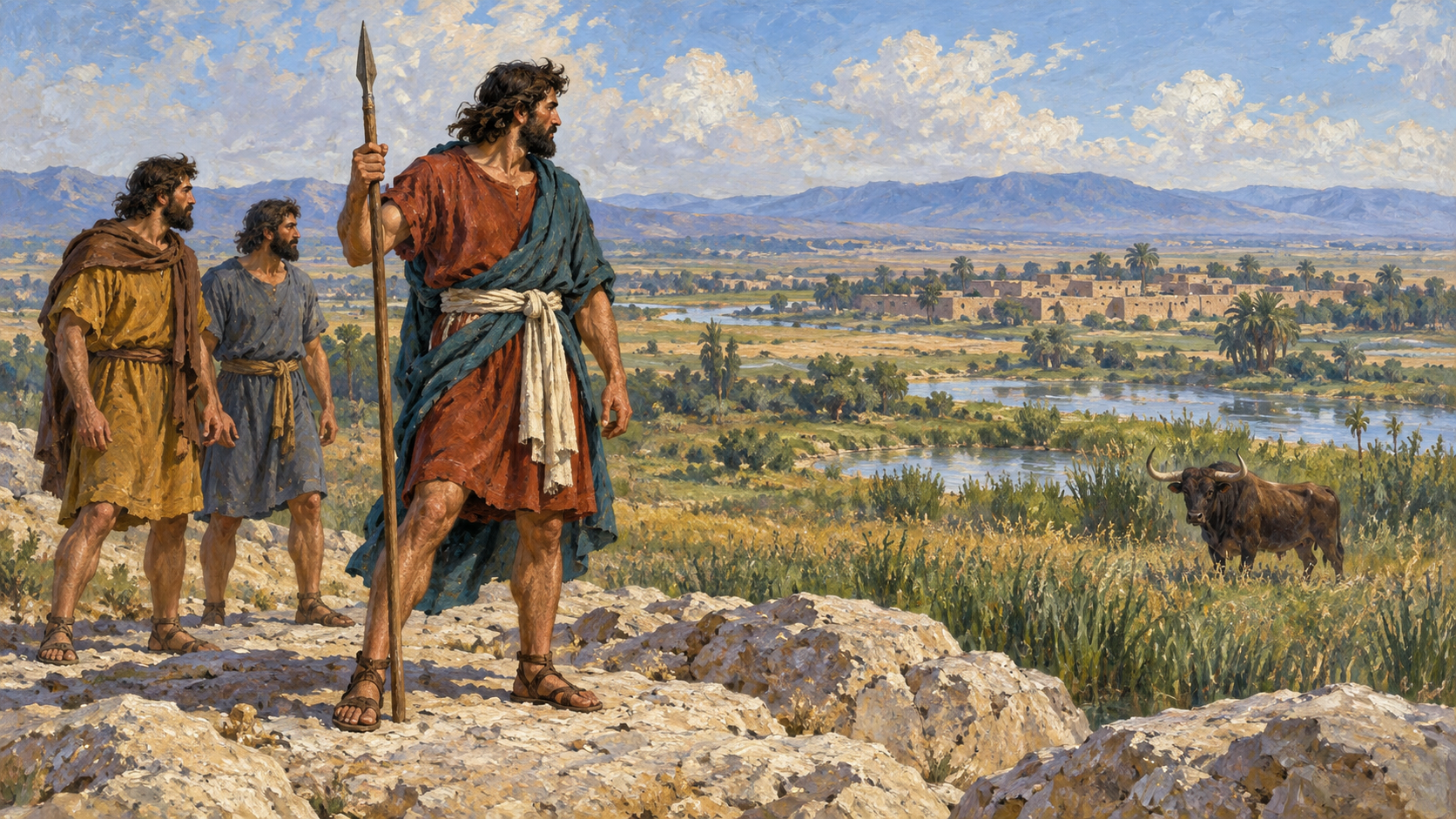
Who was Nimrod, and why does Genesis pause over him so early in the world after the Flood? We are told about his unusual might and the first named kingdom, which began at Babel. I want to understand those details without filling out the short biblical account with claims borrowed from later legends.
Nimrod Rose in the World After the Flood
Nimrod appears only a few generations after Noah. God had preserved human life through judgment and told Noah’s family to be fruitful and fill the earth. He also gave the rainbow as a sign of His covenant mercy. Yet Genesis soon shows people returning to pride and organized rebellion.
Cush begot Nimrod; he began to be a mighty one on the earth. He was a mighty hunter before the LORD; therefore it is said, “Like Nimrod the mighty hunter before the LORD.”
Nimrod descended from Cush through the line of Ham. Genesis tells us nothing about his childhood or family life, but it does describe the man he became. He rose as a mighty one on the earth and gained a reputation as a mighty hunter before the LORD. From there, the account turns directly to the kingdom that began under him.
The words “he began to be” suggest that Nimrod emerged as someone distinct among the people around him. Genesis 10 is often called the table of nations because it traces the families that came from Noah’s sons. Most people are simply named, so I notice that the Holy Spirit gives us more detail about Nimrod’s rise. We hear about him before Genesis 11 describes what happened at Babel.
Genesis is tracing how the nations spread from one family after the Flood, and Nimrod’s rise belongs within that account. His kingdom was one of the first great attempts to concentrate people and power again. That helps me understand why his account leads into Babel: the people there refused to scatter as God intended for the nations.
The Hebrew word translated “mighty one” is gibbor, which can describe a mighty man or warrior, or someone known for strength. Genesis 6:4 uses a related form for the mighty men of the world before the Flood. That connection raises a question about Nimrod’s ancestry, but gibbor is also used for ordinary human warriors such as David’s mighty men. I need to account for both uses before drawing a conclusion. The word alone cannot prove that Nimrod’s ancestry was unusual.
Genesis also calls Nimrod a mighty hunter, using the Hebrew word tsayid for hunting or game. A successful hunter in the ancient world could provide food and protect people from dangerous animals. Hunting also gave a ruler a public opportunity to show courage. Nimrod’s ability contributed to his reputation, but Genesis then directs our attention to the kingdom that grew under him.
The phrase “before the LORD” may describe the fame of Nimrod’s ability, as though his deeds were openly known before God. Other readers understand it as defiance, with Nimrod acting arrogantly before God’s face. I hear a warning in the description because of its connection to Babel, but these few words do not give us a full account of his motives. We should leave that limit in place.
Being strong and publicly courageous did not make Nimrod holy or obedient. His rise makes me think about how easily we can admire someone’s ability without considering how he uses it. A person can become mighty on the earth while gathering power apart from the God who rules it.
The Beginning of His Kingdom Was in Shinar
And the beginning of his kingdom was Babel, Erech, Accad, and Calneh, in the land of Shinar. From that land he went to Assyria and built Nineveh, Rehoboth Ir, Calah, and Resen between Nineveh and Calah (that is the principal city).
Nimrod is the first person whose rule Scripture explicitly calls a kingdom. His kingdom began long before Israel asked for a king. Babylon had not yet risen as an empire, nor had Assyria begun to terrify the nations. Though Genesis gives us only a brief account of his life, it places him at the beginning of kingdom-building in Shinar after the Flood.
Babel, Erech, Accad, and Calneh formed the beginning of his kingdom. Erech is commonly associated with Uruk, one of the great early cities of southern Mesopotamia. Accad points to the Akkadian world, while the location of Calneh remains debated. Genesis is not trying to answer every archaeological question. It is showing organized human rule gathering around cities in Shinar.
In Genesis 10:11, the Masoretic reading can be understood in two ways. Nimrod may be the one who went from Shinar into Assyria and built Nineveh with the surrounding cities, or Asshur may be the person who went out and built them. I understand the passage to refer to Nimrod because the paragraph is following his rise and the expansion of his kingdom. Even with that conviction, I want to acknowledge the other reading. Either way, Genesis connects these early Mesopotamian cities with expanding human power.
We should not conclude from Nimrod’s rise that all government is evil. Scripture gives civil authorities genuine responsibilities, and God raised judges for Israel before allowing the nation to have kings. He also promises the righteous reign of the Messiah. Nimrod’s rise warns us about what people use power to serve. When it serves human glory or false worship, it becomes wicked and may use violence to resist God’s command.
A leader’s strength and success are not enough for me to know whether his rule deserves praise. I need to consider how he uses power and whether he submits to God’s word. At the same time, I should not label every organized authority another Babel. Even a ruler whose fame persuades people to trust his ability remains accountable to God.
Nineveh later became Assyria’s capital and was known for cruelty. Yet God sent Jonah there and showed mercy when its people repented. Remembering that response keeps me from treating a wicked city as beyond His reach. The LORD confronts wicked power and calls people to repentance, and He can spare those who turn from evil.
Babel Gathered People Around a Name of Their Own
And they said, “Come, let us build ourselves a city, and a tower whose top is in the heavens; let us make a name for ourselves, lest we be scattered abroad over the face of the whole earth.”
Genesis 11 does not name Nimrod in the account of the tower, so I would not claim that it does. Genesis 10 has already identified Babel as the beginning of his kingdom. We can therefore connect his kingdom with the same world in Shinar where people gathered to build a city and make a name apart from God.
Building a city and tower was not itself the sin at Babel. God had told humanity to fill the earth, but the builders wanted to avoid being scattered. They wanted a name for themselves even though the highest name belongs to God. He had given humanity life and mercy after the Flood, and they used that opportunity to organize their strength against Him.
The tower whose top was “in the heavens” expressed the builders’ ambition. They were not going to reach God’s throne with bricks, but they did want glory and security on their own terms. The tower carried religious meaning as well: they were trying to establish access to heaven while refusing the God of heaven.
In that sense, Babel was both a civic project and a spiritual revolt. A city promised permanence, and the tower gave the people a shared center. Together they offered identity and confidence without repentance or dependence upon the LORD. The project looked like human progress from the ground, but God saw the refusal of His command at its heart.
I cannot assume that unity is good without asking what people are united around. At Babel, they were joined together in resistance to God’s word. The number of people sharing that purpose could not make their rebellion righteous. Their unity is sobering precisely because they used it against Him.
Therefore its name is called Babel, because there the LORD confused the language of all the earth; and from there the LORD scattered them abroad over the face of all the earth.
Genesis connects the name Babel with the confusion of language. The people wanted their city to preserve their name, but the place became a memorial to God’s judgment upon their pride. The LORD scattered them across the earth and accomplished the movement they had tried to prevent.
Acts 17:26 reminds us that God made every nation from one blood and determined their appointed times and boundaries. Gathering influence in one place does not put human beings in control of history. God continues to rule over the nations, so no project of ours can cancel His purposes.
Scripture Does Not Say Nimrod Was Nephilim
The connection between gibbor in Nimrod’s account and the mighty men of Genesis 6:4 is worth noticing. Genesis 6 speaks of the Nephilim before the Flood and adds the words “and also afterward.” Numbers 13:33 later records the spies saying that they saw giants from the descendants of Anak. Those passages give us a genuine reason to examine the question of giants after the Flood, even though they do not identify Nimrod as one of them.
Those passages give us a question to examine, but they do not prove that Nimrod was Nephilim. Genesis 10 never identifies him that way or describes him as a hybrid. Nor does it say that Cush carried corrupted blood. I cannot present those claims as though they were part of the account God gave us.
David’s mighty men help us understand why the word gibbor cannot settle the question. They are called gibborim, its plural form, without any suggestion that they were Nephilim. The term can describe extraordinary human strength and military ability. Its use in Genesis 6 gives us a possible connection to examine, but not enough to establish Nimrod’s identity.
The effects of demonic corruption and the history of giants still need to be taken seriously in the world Nimrod belonged to. His rise also came at the beginning of empire after the Flood. We can consider how those themes may relate without turning a possible connection into something Scripture says about him.
I am not dismissing Genesis 6 by leaving this question about Nimrod open. The Nephilim account records real events, and Scripture speaks of giants after the Flood. My limit comes from what Genesis 10 says, not from discomfort with the supernatural. Since God has not described Nimrod’s ancestry in those terms, I should not fill His silence with certainty.
Nimrod does not become harmless because the hybrid theory remains unproven. Human beings are capable of organizing terrible rebellion without being more than human. We can state what Genesis directly supports: he used his unusual might to build a kingdom in a world that gathered at Babel against God.
Gilgamesh and Later Traditions Cannot Govern Genesis
Some have proposed identifying Nimrod with Gilgamesh, the famous king of Uruk in Mesopotamian tradition. I can see why the comparison arises, since biblical Erech is commonly linked with Uruk. The Epic of Gilgamesh associates this mighty king with Uruk’s walls and describes his extraordinary strength as he pursues glory and life. The Sumerian King List also remembers Gilgamesh as a king of Uruk, though it assigns him a legendary length of reign.
Those similarities may preserve distorted memories from the early city-world after the Flood. Josephus also portrays Nimrod as a tyrant who turned people away from fearing God and taught them to depend upon human power. That description fits the spiritual direction of Babel even though it was written long after Genesis.
The parallels give me something to consider, but they do not establish that Nimrod was Gilgamesh. Genesis never makes that identification. The Epic of Gilgamesh is pagan literature, and the Sumerian King List combines useful historical material with legendary claims. Josephus provides an early Jewish witness. None of these sources has the authority of inspired Scripture.
I can use these sources to compare how the ancient Near East remembered its early city-kings. The accounts describe rulers with great strength and enormous reputations. Some of those memories also carried religious significance. They may echo the world Genesis describes, but that possible connection does not give them authority to rewrite it.
A similar name or legend may deserve examination without proving who Nimrod was. Attempts to reconstruct his whole life need to account for the differences between records as carefully as their parallels, especially since traditions can change as cultures retell them. If a theory asks me to speak with more certainty than Moses did, I need to keep the theory from controlling the text.
The Bible determines what we may teach as truth. Later traditions can prompt historical questions, but my faith does not depend on matching Nimrod to a surviving pagan hero. Genesis already gives us enough to understand the warning in his rise and the kingdom he built.
We can examine evidence outside the Bible without fearing it or assuming every ancient account preserves lost biblical history. Comparing the records allows us to take possible shared memories seriously while distinguishing what they suggest from what Scripture states. A fascinating possibility should remain a possibility rather than become an article of faith.
From Babel to Babylon, the Pattern Continues
Babel’s place in Scripture extends beyond Genesis. The early city where people rebelled to make a name for themselves becomes connected with the Babylonian world that later conquered Judah. Babylon destroyed Jerusalem and carried God’s people into exile. In Revelation 17-18, Babylon becomes the great picture of final false religion and corrupt world power under judgment.
I would not take that connection as permission to read every detail of Revelation back into Nimrod’s life. Scripture develops a pattern across these accounts. Babel’s people sought a name in defiance of God, and historical Babylon displayed imperial pride. Revelation shows the final idolatrous system facing judgment it cannot escape. That does not mean every later symbol was already complete in Genesis 10.
Revelation’s Babylon joins false religion with luxury, persecution, and world power. Merchants mourn when its wealth collapses, while heaven rejoices that God has judged the system that shed the blood of His servants. Those details belong to Revelation’s final picture. They deepen the biblical theme without turning Nimrod personally into every feature of the later city.
And on her forehead a name was written: MYSTERY, BABYLON THE GREAT, THE MOTHER OF HARLOTS AND OF THE ABOMINATIONS OF THE EARTH.
Nimrod’s rise belongs near the beginning of this pattern, which extends far beyond him. At Babel, people combined their strength with a religious identity that refused the LORD, and God scattered them. He later brought Babylon down and will judge the final world system as well. No city can make itself secure against Him, and neither wealth nor false religion can outlast His word.
Nimrod became known for might and for building a kingdom on earth, while Jesus, the true King, humbled Himself. He physically bore the punishment for our sins in His innocent body. He shed His blood and died, then rose bodily. Where Nimrod’s world gathered people around a human name, Christ saves sinners by grace and gathers them into a kingdom that cannot be shaken.
For further study of these connected themes, see A Complete Bible Study on The Tower of Babel, A Complete Bible Study on the Nephilim, and A Complete Bible Study on The Harlot of Babylon.
My Final Thoughts
Nimrod’s rise and the events at Babel show how quickly people returned to the pride that had already brought judgment on the world. His strength could not make rebellion righteous, and Babel’s unity could not protect it from God. I do not need to identify him as Nephilim or Gilgamesh to recognize that warning. It makes me wary of power that promises security while requiring disobedience to the LORD. I do not need to make a great name for myself when my hope rests in Jesus Christ, the humble and risen King whose kingdom will never fall.