
The twelve tribes, twelve apostles and twelve gates of the New Jerusalem belong to a recognizable pattern. In each passage, Scripture names the people represented. Twelve also counts years, baskets and a child’s age, however, so I need to ask what each passage is actually showing us. I cannot give every occurrence the same hidden meaning.
Twelve Begins as an Ordinary Number
The Bible never supplies a rule that twelve always means government, perfection, completion or healing. Often it gives us an ordinary count. In certain passages, that count also arranges representatives of God’s covenant people, as with Israel’s tribes and Christ’s apostles. We can recognize those deliberate arrangements without making them the definition of the number itself.
Genesis 14:4, for example, says that certain kings served Chedorlaomer for twelve years before rebelling in the thirteenth. The writer tells us how long their submission lasted; he does not assign those years a special covenant meaning. Elsewhere, Scripture counts twelve officers serving Solomon, twelve oxen beneath the bronze Sea, and twelve lions beside his throne. We first need to know what is being counted and how it fits the surrounding account.
The original Hebrew and Greek words do not give twelve a hidden definition. Hebrew uses expressions such as sheneim asar, with forms that vary according to grammar, while the usual New Testament Greek word is dodeka. Both mean twelve. A grammatical change in the Hebrew form does not make it a different spiritual message.
Numerology begins to lead us astray when it detaches a number from its setting and treats the number itself as revelation. Twelve tribes represent Israel because they are identified as Israel’s tribes. A clock showing 12:12 has no such connection to the people or events Scripture describes. I want to follow the connections Scripture establishes while refusing to give ordinary coincidences authority over my decisions.
Israel’s Twelve Tribes and Their Representatives
The clearest Old Testament pattern begins with Jacob’s family.
And it happened, when Israel dwelt in that land, that Reuben went and lay with Bilhah his father’s concubine; and Israel heard about it. Now the sons of Jacob were twelve: the sons of Leah were Reuben, Jacob’s firstborn, and Simeon, Levi, Judah, Issachar, and Zebulun; the sons of Rachel were Joseph and Benjamin; the sons of Bilhah, Rachel’s maidservant, were Dan and Naphtali; and the sons of Zilpah, Leah’s maidservant, were Gad and Asher. These were the sons of Jacob who were born to him in Padan Aram.
Genesis names the twelve sons according to their mothers, without presenting a morally perfect household. Reuben’s sin with Bilhah appears immediately before the count, and the surrounding family history includes favoritism, rivalry, deceit and grief. God kept His covenant promises through these men and their descendants without approving their wrongdoing. The count of twelve says nothing about whether every man in the group was faithful.
God had changed Jacob’s name to Israel and promised that a nation, a company of nations and kings would come from him. His sons became the ancestral heads of Israel’s tribes, so this use of twelve begins with a real family whose descendants formed the covenant nation. The study of the twelve tribes of Israel follows those families in greater detail.
Later tribal lists vary according to their purpose. Levi was set apart for tabernacle service and received cities rather than an ordinary tribal territory. Jacob adopted Joseph’s sons Ephraim and Manasseh for inheritance. A land list can therefore count those sons separately while leaving out Levi, giving Joseph’s descendants a double portion and retaining twelve territorial allotments.
A record of Jacob’s sons answers a different question from a census, a marching order or a land distribution. Some passages name Joseph, while others name Ephraim and Manasseh; lists concerning worship or prophecy may include Levi. Before treating a difference as a contradiction, we need to ask why the names are being given. Revelation’s sealing list has its own arrangement, which we will consider below.
The high priest’s breastplate gives a particularly clear example of all the tribes being represented before God.
“You shall make the breastplate of judgment. Artistically woven according to the workmanship of the ephod you shall make it: of gold, blue, purple, and scarlet thread, and fine woven linen, you shall make it. It shall be doubled into a square: a span shall be its length, and a span shall be its width. And you shall put settings of stones in it, four rows of stones: The first row shall be a sardius, a topaz, and an emerald; this shall be the first row; the second row shall be a turquoise, a sapphire, and a diamond; the third row, a jacinth, an agate, and an amethyst; and the fourth row, a beryl, an onyx, and a jasper. They shall be set in gold settings. And the stones shall have the names of the sons of Israel, twelve according to their names, like the engravings of a signet, each one with its own name; they shall be according to the twelve tribes.
The twelve stones were arranged in four rows of three, each engraved with a name. Exodus 28:29 says Aaron carried these names over his heart when he entered the holy place as a continual memorial before the LORD. He ministered on behalf of the covenant people, carrying all the tribes together while each retained its own name.
The passage tells us what the stones represented: the tribes brought before God through the priestly ministry He had appointed. It does not present them as charms or assign modern Christians personal gemstones and spiritual temperaments. Their significance came from the named people and Aaron’s responsibility to minister on their behalf.
Numbers 13 gives another form of tribal representation when Moses sent twelve leaders to search Canaan. The assignment concerned the land, so Ephraim and Manasseh each had a representative and Levi did not. All twelve saw the fruitfulness of the land and the strength of its fortified cities. Ten spread fear and discouraged Israel from entering, while Joshua and Caleb urged the people to trust the LORD.
Each spy was responsible for the influence he exercised as a tribal representative. His appointment did not make him obedient. I need to remember that when I am tempted to treat an office as proof of faithfulness: someone can hold a place in an arrangement God established and still lead others into unbelief.
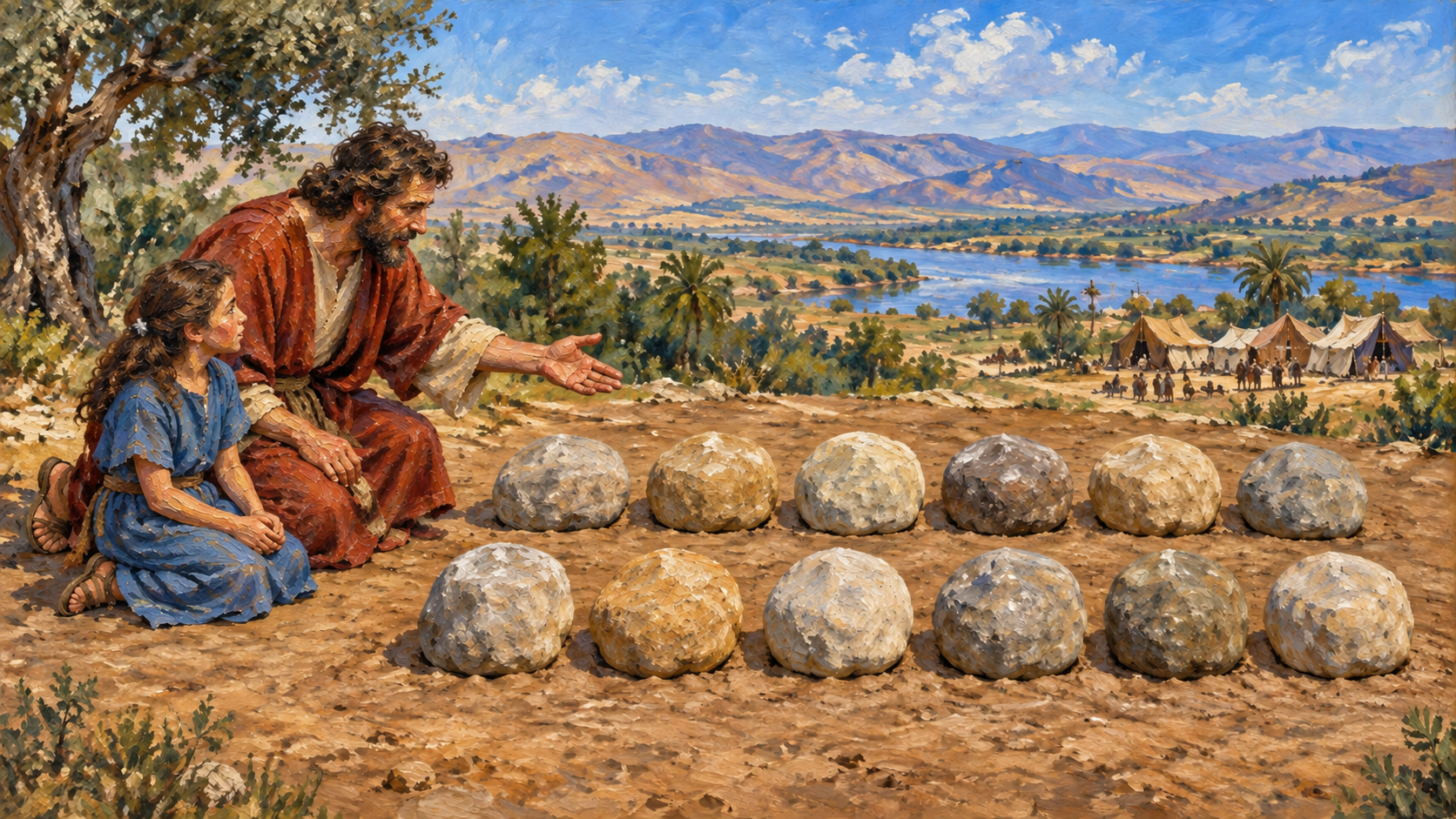
At the Jordan, the LORD used twelve representatives to prepare a memorial for the nation.
And it came to pass, when all the people had completely crossed over the Jordan, that the LORD spoke to Joshua, saying: “Take for yourselves twelve men from the people, one man from every tribe, and command them, saying, ‘Take for yourselves twelve stones from here, out of the midst of the Jordan, from the place where the priests’ feet stood firm. You shall carry them over with you and leave them in the lodging place where you lodge tonight.'” Then Joshua called the twelve men whom he had appointed from the children of Israel, one man from every tribe; and Joshua said to them: “Cross over before the ark of the LORD your God into the midst of the Jordan, and each one of you take up a stone on his shoulder, according to the number of the tribes of the children of Israel, that this may be a sign among you when your children ask in time to come, saying, ‘What do these stones mean to you?’ Then you shall answer them that the waters of the Jordan were cut off before the ark of the covenant of the LORD; when it crossed over the Jordan, the waters of the Jordan were cut off. And these stones shall be for a memorial to the children of Israel forever.” And the children of Israel did so, just as Joshua commanded, and took up twelve stones from the midst of the Jordan, as the LORD had spoken to Joshua, according to the number of the tribes of the children of Israel, and carried them over with them to the place where they lodged, and laid them down there. Then Joshua set up twelve stones in the midst of the Jordan, in the place where the feet of the priests who bore the ark of the covenant stood; and they are there to this day.
One man from each tribe carried a stone out of the riverbed to the place where Israel lodged. The twelve stones represented the whole people God had brought across the Jordan. When children later asked about them, they were to hear how the LORD had cut off the water before the ark of His covenant and brought Israel over on dry ground.
Joshua also set up twelve stones in the Jordan where the priests had stood. Scripture distinguishes those stones from the ones carried out to the lodging place. Neither set had power of its own. Through the memorial God commanded, parents were to teach their children about His deliverance so that another generation would know His mighty hand and fear Him.
Centuries later, Elijah used twelve stones during the confrontation with Baal worship at Mount Carmel.
Then Elijah said to all the people, “Come near to me.” So all the people came near to him. And he repaired the altar of the LORD that was broken down. And Elijah took twelve stones, according to the number of the tribes of the sons of Jacob, to whom the word of the LORD had come, saying, “Israel shall be your name.” Then with the stones he built an altar in the name of the LORD; and he made a trench around the altar large enough to hold two seahs of seed.
Israel was politically divided into northern and southern kingdoms when Elijah repaired the LORD’s altar with twelve stones. He used the number of the tribes descended from Jacob, and the passage recalls God’s naming him Israel. The division of the kingdom had not made the LORD the God of only one region. As Elijah called the people away from Baal, he reminded them of the identity of the whole covenant nation.
The LORD answered with fire that consumed Elijah’s sacrifice, whereas Baal’s prophets had received no answer. The people could see whom they should worship. The stones represented Israel, but they gave Elijah no power to produce that answer. The LORD who had formed the nation answered its prophet.
During Solomon’s earlier reign, twelve governors had supplied his household, each responsible for one month of the year. Their districts do not simply repeat the tribal allotments, and Judah is not explicitly named as a district in the NKJV list in 1 Kings 4:7–19. The count fits the yearly schedule of provision. It does not make righteous government the universal meaning of twelve, or make an organization godly because it divides its work into twelve parts. Its conduct still has to be judged by God’s Word.
Jesus Chose Twelve Apostles
Jesus appointed twelve apostles and later linked their future service to Israel’s twelve tribes.
And when He had called His twelve disciples to Him, He gave them power over unclean spirits, to cast them out, and to heal all kinds of sickness and all kinds of disease. Now the names of the twelve apostles are these: first, Simon, who is called Peter, and Andrew his brother; James the son of Zebedee, and John his brother; Philip and Bartholomew; Thomas and Matthew the tax collector; James the son of Alphaeus, and Lebbaeus, whose surname was Thaddaeus; Simon the Cananite, and Judas Iscariot, who also betrayed Him.
An apostle is a commissioned messenger, someone sent with authority. Jesus gave these men their authority and sent them to Israel in the mission that follows this list. The Messiah was calling His people and announcing that the kingdom had drawn near, while preparing witnesses to carry His teaching after His death and resurrection. Later He explicitly linked His followers with Israel’s tribes: when the Son of Man sits on His glorious throne, they will sit on twelve thrones judging the twelve tribes (Matthew 19:28).
As Jesus trained these men, their different backgrounds and failures became evident. They sometimes misunderstood Him, argued about their standing or acted fearfully. His appointment gave them responsibility under His command without making them flawless. We cannot separate their authority from the Lord who sent them.
Matthew names Judas Iscariot among the twelve and identifies him as the betrayer. Judas’s place in that group did not regenerate him, or give him genuine new birth. He remained unsaved despite his closeness to Jesus and participation in ministry. I cannot base assurance on an office, religious work or association with faithful people when Judas had all those outward advantages.
Jesus knew who would betray Him, yet Judas remained responsible for his greed and deceit. He chose to hand the sinless Son over to His enemies and died in his sin. His betrayal fulfilled Scripture without defeating Christ’s purpose, for Jesus willingly completed His saving work and rose bodily from the grave.
Scripture can use “the twelve” as the apostolic group’s established name even when its immediate headcount differs. Paul does this in describing an appearance of the risen Christ. We use group names even when someone is absent; the expression does not require twelve men to be present at every event in which the group is named.
After the ascension, Peter addressed the vacancy Judas had left. They needed someone who had accompanied Jesus from John’s baptism through His ascension and could testify to His resurrection. The lot fell to Matthias, whom Acts says was numbered with the eleven apostles. Paul’s later call by the risen Christ was distinct. We can affirm his genuine apostleship without rejecting what Acts tells us about Matthias.
Revelation 21 places the names of the Lamb’s twelve apostles on the city’s foundations but does not give those names individually. We therefore cannot use the vision to settle which man’s name appears on a particular foundation. Scripture does establish their unique role in the church’s founding witness. Christ gave them their authority through His call and revelation. An institution cannot reproduce that calling by continually appointing successors with the same authority to reveal doctrine.
Ephesians 2 describes God’s household as built on the foundation of the apostles and prophets, with Jesus Christ as the chief cornerstone. The cornerstone governs the building’s alignment. The apostles bore witness to Christ and taught what He revealed, serving under His authority rather than becoming an independent source alongside Him.
We receive that inspired apostolic witness in Scripture and test every teacher’s claims against it. Christ continues building His church through His Word and Spirit, and the Spirit’s gifts still serve His people. That continuing work does not require a new governing circle of twelve men claiming revelation equal to the founding apostles. Even the honor given to their names in the New Jerusalem belongs within a city whose life and glory come from God and the Lamb.
Twelve in the Miracles and the Life of Jesus
The feeding of the five thousand gives us another twelve, but this time the number counts baskets of food left after a crowd had eaten.
When Jesus heard it, He departed from there by boat to a deserted place by Himself. But when the multitudes heard it, they followed Him on foot from the cities. And when Jesus went out He saw a great multitude; and He was moved with compassion for them, and healed their sick. When it was evening, His disciples came to Him, saying, “This is a deserted place, and the hour is already late. Send the multitudes away, that they may go into the villages and buy themselves food.” But Jesus said to them, “They do not need to go away. You give them something to eat.” And they said to Him, “We have here only five loaves and two fish.” He said, “Bring them here to Me.” Then He commanded the multitudes to sit down on the grass. And He took the five loaves and the two fish, and looking up to heaven, He blessed and broke and gave the loaves to the disciples; and the disciples gave to the multitudes. So they all ate and were filled, and they took up twelve baskets full of the fragments that remained. Now those who had eaten were about five thousand men, besides women and children.
Jesus fed about five thousand men, besides women and children, from five loaves and two fish. Everyone ate until satisfied, yet twelve baskets of fragments remained. Those leftovers showed how abundantly He had provided. Moved by compassion for hungry people, He supplied real food, leaving more than the disciples had brought to Him.
Some interpreters connect the twelve baskets with Israel or suggest one basket for each apostle. A miracle among Israel through the service of the twelve could carry that echo, but Matthew does not explain the baskets that way. At the later feeding of four thousand, seven large baskets remained. The counts and the different Greek words for the baskets belong to distinct events. We should attend to those differences without inventing a chart of meanings the writers never give.
In both feedings, the disciples had to depend on Jesus to provide what they could not supply themselves. Any proposed symbolism should remain secondary to His compassion and authority in feeding the crowds.
Mark 5 brings together two people whose situations are linked by twelve years.
Now when Jesus had crossed over again by boat to the other side, a great multitude gathered to Him; and He was by the sea. And behold, one of the rulers of the synagogue came, Jairus by name. And when he saw Him, he fell at His feet and begged Him earnestly, saying, “My little daughter lies at the point of death. Come and lay Your hands on her, that she may be healed, and she will live.” So Jesus went with him, and a great multitude followed Him and thronged Him. Now a certain woman had a flow of blood for twelve years, and had suffered many things from many physicians. She had spent all that she had and was no better, but rather grew worse. When she heard about Jesus, she came behind Him in the crowd and touched His garment. For she said, “If only I may touch His clothes, I shall be made well.” Immediately the fountain of her blood was dried up, and she felt in her body that she was healed of the affliction. And Jesus, immediately knowing in Himself that power had gone out of Him, turned around in the crowd and said, “Who touched My clothes?” But His disciples said to Him, “You see the multitude thronging You, and You say, ‘Who touched Me?'” And He looked around to see her who had done this thing. But the woman, fearing and trembling, knowing what had happened to her, came and fell down before Him and told Him the whole truth. And He said to her, “Daughter, your faith has made you well. Go in peace, and be healed of your affliction.” While He was still speaking, some came from the ruler of the synagogue’s house who said, “Your daughter is dead. Why trouble the Teacher any further?” As soon as Jesus heard the word that was spoken, He said to the ruler of the synagogue, “Do not be afraid; only believe.” And He permitted no one to follow Him except Peter, James, and John the brother of James. Then He came to the house of the ruler of the synagogue, and saw a tumult and those who wept and wailed loudly. When He came in, He said to them, “Why make this commotion and weep? The child is not dead, but sleeping.” And they ridiculed Him. But when He had put them all outside, He took the father and the mother of the child, and those who were with Him, and entered where the child was lying. Then He took the child by the hand, and said to her, “Talitha, cumi,” which is translated, “Little girl, I say to you, arise.” Immediately the girl arose and walked, for she was twelve years of age. And they were overcome with great amazement. But He commanded them strictly that no one should know it, and said that something should be given her to eat.
Jairus asked Jesus to come to his dying daughter. As Jesus went with him, a woman who had suffered from a flow of blood for twelve years touched His clothing and was healed. During that interruption, news arrived that the girl had died. Jesus continued to the house and raised her, and only then does Mark tell us she was twelve years old. The woman’s affliction had lasted the child’s entire lifetime.
The woman had spent everything on treatment, only to grow worse. Under Leviticus 15, her continuing discharge also made her ceremonially unclean. This affected contact with people and household objects and restricted her participation in worship. Social isolation was a likely consequence, although Mark does not describe the details of her daily life. Her ceremonial condition did not establish that she had committed sexual sin or lived immorally.
Contact with her did not overcome Jesus’ holiness. His power healed her body, and He addressed her openly as “Daughter” and sent her away in peace. At Jairus’s house, He took the dead child by the hand and restored her to life. Her parents received a living daughter, and Jesus told them to give her food.
The matching years help us notice two needs met by the same Lord. Christ healed the woman and restored the child to life by His power, without making twelve years a condition for either miracle. Mark never defines twelve as the number of healing, so we cannot turn these events into a promise that God must heal someone after a twelve-year wait.
Luke takes us back to Jesus’ childhood. He records His age as twelve in the only extended Gospel account between His infancy and adult ministry:
His parents went to Jerusalem every year at the Feast of the Passover. And when He was twelve years old, they went up to Jerusalem according to the custom of the feast. When they had finished the days, as they returned, the Boy Jesus lingered behind in Jerusalem. And Joseph and His mother did not know it; but supposing Him to have been in the company, they went a day’s journey, and sought Him among their relatives and acquaintances. So when they did not find Him, they returned to Jerusalem, seeking Him. Now so it was that after three days they found Him in the temple, sitting in the midst of the teachers, both listening to them and asking them questions. And all who heard Him were astonished at His understanding and answers. So when they saw Him, they were amazed; and His mother said to Him, “Son, why have You done this to us? Look, Your father and I have sought You anxiously.” And He said to them, “Why did you seek Me? Did you not know that I must be about My Father’s business?” But they did not understand the statement which He spoke to them. Then He went down with them and came to Nazareth, and was subject to them, but His mother kept all these things in her heart. And Jesus increased in wisdom and stature, and in favor with God and men.
Mary and Joseph found Jesus among the temple teachers, listening and asking questions. Those who heard Him were astonished at His understanding and answers. His reference to His Father’s business expressed His unique relationship with God, yet He returned to Nazareth and remained subject to Mary and Joseph.
His age places this event within His actual human life. In the incarnation, the eternal Son took a true human nature without ceasing to be fully God. He grew in wisdom and stature without sinning. That real growth and sinless obedience deserve our attention without assigning twelve a hidden meaning.
Twelve in Revelation’s Tribes and Holy City
Revelation returns to the representation of God’s people with twelve thousand sealed servants from each of twelve named tribes.
And I heard the number of those who were sealed. One hundred and forty-four thousand of all the tribes of the children of Israel were sealed: of the tribe of Judah twelve thousand were sealed; of the tribe of Reuben twelve thousand were sealed; of the tribe of Gad twelve thousand were sealed; of the tribe of Asher twelve thousand were sealed; of the tribe of Naphtali twelve thousand were sealed; of the tribe of Manasseh twelve thousand were sealed; of the tribe of Simeon twelve thousand were sealed; of the tribe of Levi twelve thousand were sealed; of the tribe of Issachar twelve thousand were sealed; of the tribe of Zebulun twelve thousand were sealed; of the tribe of Joseph twelve thousand were sealed; of the tribe of Benjamin twelve thousand were sealed.
John gives a total of 144,000 and identifies them as coming from the tribes of the children of Israel. I understand them to be actual Israelite servants sealed during the future Tribulation. He then describes a multitude no one can number from every nation, tribe, people and language. We should preserve the distinction between that numbered company from Israel and the innumerable multinational multitude, rather than dissolve both into one vague symbol.
Unlike a land allotment, this list names servants being sealed. It includes Levi and names Joseph and Manasseh, while neither Dan nor Ephraim appears by name. Some readers attribute the omissions to idolatry, but Revelation does not state that reason. We know which names John gives and that God knows the tribes from which He seals His servants. The passage leaves other details of His selection unexplained.
Revelation 21 then describes the New Jerusalem, where tribal and apostolic names both appear.
Then one of the seven angels who had the seven bowls filled with the seven last plagues came to me and talked with me, saying, “Come, I will show you the bride, the Lamb’s wife.” And he carried me away in the Spirit to a great and high mountain, and showed me the great city, the holy Jerusalem, descending out of heaven from God, having the glory of God. Her light was like a most precious stone, like a jasper stone, clear as crystal. Also she had a great and high wall with twelve gates, and twelve angels at the gates, and names written on them, which are the names of the twelve tribes of the children of Israel: three gates on the east, three gates on the north, three gates on the south, and three gates on the west. Now the wall of the city had twelve foundations, and on them were the names of the twelve apostles of the Lamb. And he who talked with me had a gold reed to measure the city, its gates, and its wall. The city is laid out as a square; its length is as great as its breadth. And he measured the city with the reed: twelve thousand furlongs. Its length, breadth, and height are equal. Then he measured its wall: one hundred and forty-four cubits, according to the measure of a man, that is, of an angel. The construction of its wall was of jasper; and the city was pure gold, like clear glass. The foundations of the wall of the city were adorned with all kinds of precious stones: the first foundation was jasper, the second sapphire, the third chalcedony, the fourth emerald, the fifth sardonyx, the sixth sardius, the seventh chrysolite, the eighth beryl, the ninth topaz, the tenth chrysoprase, the eleventh jacinth, and the twelfth amethyst. The twelve gates were twelve pearls: each individual gate was of one pearl. And the street of the city was pure gold, like transparent glass.
The twelve gates bear the names of Israel’s tribes, and the twelve foundations bear the names of the Lamb’s apostles. Each gate is a pearl, and twelve kinds of precious stones adorn the foundations. The city measures twelve thousand furlongs in length, breadth and height, while its wall is measured at 144 cubits. Twelve and its multiples recur in the description of this immense city descending from God.
Both sets of names remain identifiable: the apostles do not erase Israel’s tribes, nor do the tribes displace the apostolic witness to the Lamb. God honors both within the city whose glory comes from Him. As the following verses explain, its temple is the Lord God Almighty and the Lamb. Those named representatives tell us much more than a calculation that assigns meaning to twelve apart from the people.
I understand John to be describing a real city with real measurements, whose order and beauty also express God’s faithfulness to His people. We can recognize that meaning without making the city imaginary. Its names proclaim that God has not forgotten Israel or the Lamb’s apostles. Its dimensions do not give us a hidden date for His return or a scheme for identifying current events.
The next chapter takes us from the city’s gates and foundations to the provision of life within it.
And he showed me a pure river of water of life, clear as crystal, proceeding from the throne of God and of the Lamb. In the middle of its street, and on either side of the river, was the tree of life, which bore twelve fruits, each tree yielding its fruit every month. The leaves of the tree were for the healing of the nations. And there shall be no more curse, but the throne of God and of the Lamb shall be in it, and His servants shall serve Him. They shall see His face, and His name shall be on their foreheads. There shall be no night there: They need no lamp nor light of the sun, for the Lord God gives them light. And they shall reign forever and ever.
The river flows from the throne of God and of the Lamb, and the tree of life produces fruit each month. Twelve belongs here to that continual fruitfulness. The leaves are for the healing of the nations; the verse does not define twelve itself as the number of healing. John describes abundant life with the curse gone, where God’s servants see His face, bear His name and reign forever in His light.
Our hope includes restored bodies in a restored creation, where we will live before the risen Christ in the city He provides. His promise to make all things new reaches the creation He made and the people He has redeemed.
Follow the Pattern Without Turning It Into a Code
Across these passages, twelve repeatedly arranges named representatives of God’s people. Jacob’s sons became the ancestors of the tribes whose names the high priest carried before God. At the Jordan, men from those tribes carried stones as a memorial of His deliverance. Christ later appointed twelve apostles, whose names appear with the tribal names in the New Jerusalem. These settings support the themes of covenant representation and an ordered community. They do not prevent twelve from being an ordinary count when a passage gives an age, duration or quantity.
We need the same care with seven and forty. Seven often occurs in patterns of fullness or completion, while forty can describe a period of testing, judgment, preparation or transition. Sometimes they simply tell us how many or how long. The studies on the number seven and the number forty examine those passages. Repetition gives us a reason to investigate the setting, rather than permission to impose one meaning everywhere.
Modern “angel number” teaching abandons that setting altogether. A person notices 12:12 on a clock, twelve dollars on a receipt, or twelve in an address and treats it as guidance from God. None of those occurrences carries the biblical identification of tribes or apostles. Repeatedly noticing the number cannot supply an instruction God has not given. His prohibition of divination should make us refuse attempts to obtain hidden guidance through such signs.
I should seek wisdom through Scripture, prayer and wise counsel while trusting God’s providence, His care and direction of our lives. Trusting Him does not require decoding coincidences. Decisions about work, marriage or ministry call for sound judgment governed by His Word; repeated digits cannot authorize something His Word forbids.
Gematria assigns numerical values to letters and calculates totals from words or names. Such calculations cannot establish doctrine on their own, since the results depend on the spelling, language, text and method selected. Clear biblical teaching must govern how we interpret obscure details. A number game cannot overturn the gospel or produce a prediction God has not spoken.
Paul brings us back to the message the apostles proclaimed. In his account of the gospel, the twelve appear as witnesses:
Moreover, brethren, I declare to you the gospel which I preached to you, which also you received and in which you stand, by which also you are saved, if you hold fast that word which I preached to you–unless you believed in vain. For I delivered to you first of all that which I also received: that Christ died for our sins according to the Scriptures, and that He was buried, and that He rose again the third day according to the Scriptures, and that He was seen by Cephas, then by the twelve. After that He was seen by over five hundred brethren at once, of whom the greater part remain to the present, but some have fallen asleep. After that He was seen by James, then by all the apostles. Then last of all He was seen by me also, as by one born out of due time.
Paul proclaimed what Christ did: He died for our sins according to Scripture, was buried, rose bodily on the third day and appeared to witnesses. “The twelve” names the recognized apostolic group within that testimony. Their number saved no one; salvation comes through the crucified and risen Lord to whom they bore witness.
Paul’s warning about believing in vain does not mean that a genuinely born-again believer can become unborn. Some Corinthians denied bodily resurrection, undermining the message they professed to believe. He confronts that denial by returning to Christ’s resurrection and the testimony they had received. Claiming the gospel’s name while rejecting its teaching cannot substitute for believing it.
Jesus is the eternal, uncreated Son, fully God and fully man, born of a virgin and completely sinless. His atonement rests on His perfection and His willing offering of Himself to be slain as the perfect sacrifice for our sins. Wicked men inflicted His bodily torture and death, while He willingly shed His blood and died for us. His saving sacrifice through that blood and death was complete before He was buried and rose bodily from the grave. The Father did not punish, curse, abandon, strike, bruise or pour wrath on Jesus. Father, Son and Holy Spirit are three distinct, coequal, coeternal Persons, one God acting in perfect unity.
Christ died for the whole world, and God’s offer of salvation is genuine for every person. People can resist His grace and finally reject Him, but everyone who repents and believes is forgiven and justified, meaning declared righteous before God.
Everyone genuinely born again becomes a new creation, indwelt and sealed by the Holy Spirit and eternally secure in Christ. Obedience gives evidence of that new life; our works neither earn nor keep salvation. New birth does not make us sinless, but it changes our conduct. Calling ourselves Christians cannot substitute for being born again, and assurance never excuses lawlessness.
No number can forgive my sin or supply a private path to God. Christ alone saves, and the inspired apostolic message directs us to Him. We are responsible to receive that gospel, obey the Lord it proclaims and faithfully bring the same message to others.
My Final Thoughts
Twelve draws my attention to named people: the sons of Jacob, the men Christ commissioned, and the tribes and apostles remembered in the New Jerusalem. Those connections give me reason to trust God’s faithfulness and study His Word carefully. They give no authority to a number on a clock or receipt. The apostles did not direct people to a numerical key to blessing; they testified to the crucified and risen Jesus Christ. If studying their number leads me away from their message, I have missed what Scripture is showing me.