
The number seven appears in some of Scripture’s most familiar passages, including creation week and the fall of Jericho. I believe the repeated pattern often draws our attention to something God brings to completion. But the meaning comes from what He says and does in each passage, and we need to follow that explanation rather than treat the number itself as a source of spiritual power.
Creation and the Seventh Day
Genesis begins with God’s creative work across six ordinary days. By the seventh day, the heavens and the earth were finished, and He set that day apart.
Thus the heavens and the earth, and all the host of them, were finished. And on the seventh day God ended His work which He had done, and He rested on the seventh day from all His work which He had done. Then God blessed the seventh day and sanctified it.
God sanctified the seventh day, setting it apart as holy, and blessed it because His creative work was complete. Nothing in the passage suggests that seven is lucky or that using the number gives us a spiritual advantage.
Genesis 1 closes each of the six workdays with evening and morning, while Genesis 2 does not repeat that wording for the seventh. The text does not explain the omission, so I would not build a doctrine on the missing phrase. The chapter repeatedly emphasizes what God had accomplished: He finished His creative work, rested from it, and blessed the day on which He rested.
His rest did not mean He needed to recover from exhaustion. Isaiah describes the Creator as One who never grows weary:
Have you not known? Have you not heard? The everlasting God, the LORD, The Creator of the ends of the earth, Neither faints nor is weary.
The Hebrew verb shavat means to cease or stop. God ceased from the creative work described in Genesis because it was complete. We should not imagine that making the world had used up His strength or that He stopped caring for what He made.
God later used that creation week as the basis for Israel’s Sabbath command. The people were to acknowledge His work in the way they ordered their own labor.
Remember the Sabbath day, to keep it holy. Six days you shall labor and do all your work, but the seventh day is the Sabbath of the LORD your God.
For in six days the LORD made the heavens and the earth, the sea, and all that is in them, and rested the seventh day. Therefore the LORD blessed the Sabbath day and hallowed it.
God grounded that command in His actual work of creation. Israel was to labor for six days and set apart the seventh because the Lord had made the world and rested. Their weekly pattern acknowledged what He had done and placed their own work under His authority. Even the day they might have wanted for more production belonged to Him.
Christians are not under the Mosaic Sabbath law that governed Israel. In Colossians 2:16-17, Paul tells believers not to let anyone judge them regarding sabbaths. He calls those observances shadows, meaning that they pointed ahead to the reality found in Christ. Observing a day cannot make us righteous before God or earn our salvation.
We can still learn from the creation pattern. If I treat every unfinished task as a disaster only I can prevent, I have begun assigning myself a responsibility God never gave me. I need to do my work faithfully, but I am still a creature who needs rest. Taking responsibility does not require me to behave as though God has left the world in my hands.
Seven also appeared in the worship God appointed for Israel. Moses received instructions for an actual tabernacle and its furnishings, including the lampstand:
You shall make seven lamps for it, and they shall arrange its lamps so that they give light in front of it.
The seven lamps provided light for the priests serving in the holy place. God had prescribed the furnishing, so Moses was not free to redesign it according to his preferences. I believe the complete set of lamps also fits Scripture’s broader use of seven to convey fullness, although Exodus does not separately explain the number here.
Psalm 119:105 describes God’s Word as a lamp to our feet and a light to our path. I see a fitting comparison with the priests’ need for light in the tabernacle: God’s people depend on what He reveals as they learn how to serve Him. That comparison must remain accountable to His Word. I cannot replace His instructions with my preferences merely because I am sincere, or assign a spiritual meaning to every fixture in a church building because light can represent guidance.
God also prescribed how the high priest was to approach Him on the Day of Atonement. The mercy seat was the cover of the ark, within the innermost part of the tabernacle. The priest’s duties there included sprinkling blood seven times before it:
He shall take some of the blood of the bull and sprinkle it with his finger on the mercy seat on the east side; and before the mercy seat he shall sprinkle some of the blood with his finger seven times.
The high priest used blood from the bull offered for himself and his household, sprinkling it seven times before the mercy seat as God had commanded. I understand the complete act as emphasizing the fullness of His provision for cleansing under the Law. The ceremony required a sinful people to acknowledge their guilt and approach God through the shed blood He had appointed for atonement. By atonement, I mean His provision for dealing with their sin and allowing them to approach Him. The priest could not turn seven repetitions into a technique for compelling God to forgive.
Yet the high priest had to return to this service year after year because animal sacrifices were not the final answer to sin. They pointed beyond themselves to Christ, who would offer Himself once for all. His own blood would accomplish what repeated animal offerings could not.
Seven also marked the length of the Feast of Unleavened Bread, connected with Passover and Israel’s deliverance from Egypt.
Seven days you shall eat unleavened bread. On the first day you shall remove leaven from your houses.
For the whole seven-day period, Israel was to remove leaven and eat unleavened bread in remembrance of the Lord’s deliverance from Egypt. I understand that complete observance as teaching the people to live set apart for Him and ready to follow His instructions. Leaven can illustrate an influence spreading through a larger whole, but its meaning still depends on the passage. We should not assume that every mention of leaven represents the same thing.
Christians do not repeat these sacrifices or keep the feast to become righteous before God. Still, I cannot claim to appreciate the cleansing Christ provides while making excuses for a sin I intend to keep practicing. The New Testament calls us to confess honestly rather than conceal an unrepentant heart behind religious observances.
If we confess our sins, He is faithful and just to forgive us our sins and to cleanse us from all unrighteousness.
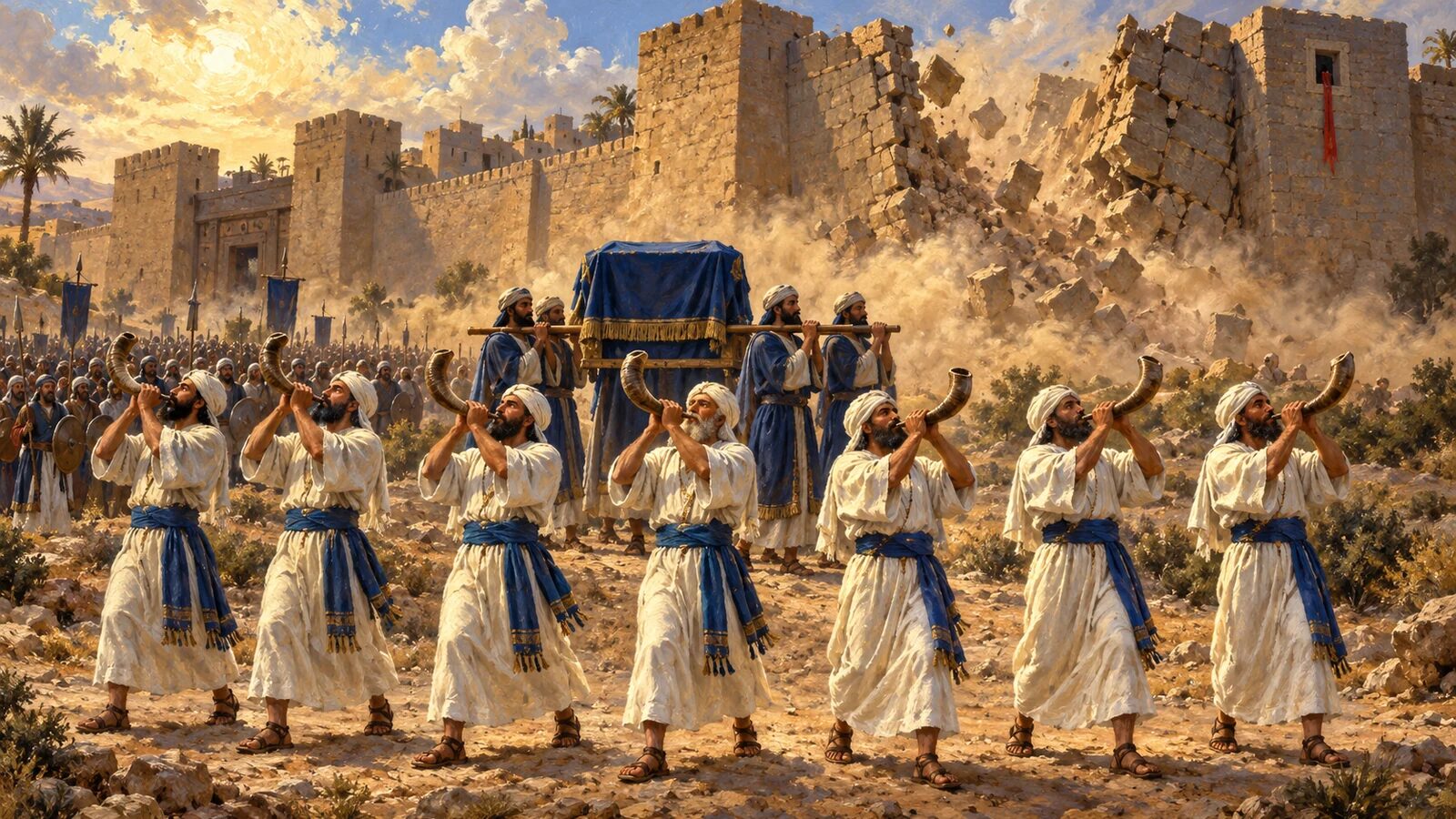
When Israel entered Canaan, seven appeared in the Lord’s instructions for taking Jericho. He promised Joshua the city and told him how the people were to proceed. Their victory would require them to trust that promise and follow His instructions, which included a repeated use of seven:
And seven priests shall bear seven trumpets of rams’ horns before the ark. But the seventh day you shall march around the city seven times, and the priests shall blow the trumpets.
Seven priests carried seven trumpets, and the people marched seven times around the city on the seventh day. The walls fell after the trumpet blast and the people’s shout, just as God had said. Their marching and shouting could not have brought down those walls by their own force. Israel obeyed because the Lord had promised the victory; that obedience expressed their faith without making Him indebted to them.
Jericho’s destruction also involved judgment. God had explained the moral reason for judgment on the land centuries earlier, when He spoke to Abraham about his descendants’ return.
But in the fourth generation they shall return here, for the iniquity of the Amorites is not yet complete.
By the time Israel reached Jericho, centuries had passed since God spoke those words to Abraham. The judgment followed His earlier declaration about the inhabitants’ guilt, and He determined when it would come. Israel’s military strength did not establish the moral right to take the city. Its conquest rested on the Lord’s specific command and the judgment He had announced.
Within that judgment, Rahab and her household received mercy. She had hidden Israel’s spies and confessed the Lord as God in heaven above and on earth beneath. She marked her house as instructed, and Joshua sent the spies to bring her and her family out before the city was burned. Hebrews later commends her faith. I need to recognize the Canaanite woman received among God’s people as well as the city that fell: the Lord judged the wickedness of Jericho and spared a woman who trusted Him.
God had also warned Israel that His own covenant people would face increasingly severe discipline if they refused His correction. In Leviticus 26, He said:
And after all this, if you do not obey Me, then I will punish you seven times more for your sins.
The chapter repeats this sevenfold warning as it describes the people’s continued resistance. God had made His commands known and warned them of the discipline that would follow if they refused to return to Him. Here seven expresses the severity of correction for persistent rebellion. We would badly misread the passage if we treated the number as an assurance that everything would be comfortable.
Daniel’s Sevens
Centuries later, during Israel’s exile, Daniel was praying about his people’s sin and Jerusalem’s desolation. He had been studying the seventy years Jeremiah foretold. As Daniel prayed, Gabriel brought an answer reaching beyond the return from exile to another period measured in sevens:
Seventy weeks are determined For your people and for your holy city, To finish the transgression, To make an end of sins, To make reconciliation for iniquity, To bring in everlasting righteousness.
The term translated weeks refers to units of seven. Gabriel announces seventy such units for Daniel’s people and holy city, Israel and Jerusalem. The purposes include dealing with transgression, making reconciliation for iniquity, bringing in everlasting righteousness, and fulfilling vision and prophecy. Daniel had prayed about the desolation he knew; God’s answer also addressed the lasting need to deal with sin and establish righteousness.
The following verses divide the seventy sevens into seven, sixty-two, and one. The first two divisions total sixty-nine and lead to Messiah the Prince. After those sixty-nine, Messiah is cut off in death, and the city and sanctuary are subsequently destroyed. We need to keep those events and the remaining seven in view rather than turn the prophecy into a general statement about completion.
I understand these sevens as years, with the final seven still future and distinct from the preceding sixty-nine. During that last period, a ruler confirms a covenant and then ends sacrifice and offering at its midpoint. I believe this is the literal seven-year Tribulation. Its midpoint corresponds to the abomination that defiles the holy place and the intensified desolation described in the prophetic passages.
The prophecy gives us an ordered timetable for God’s dealings with Israel and Jerusalem, with divisions that help us follow what He has promised to accomplish. We have reason to expect fulfillment, but the message does not supply a date for Christ’s return or authorize us to manufacture one through calculations.
Seven in Revelation
Revelation opens with a message addressed to seven churches. Before asking what their number may signify, we need to remember the actual congregations receiving Christ’s words:
John, to the seven churches which are in Asia: Grace to you and peace from Him who is and who was and who is to come.
They were Ephesus, Smyrna, Pergamos, Thyatira, Sardis, Philadelphia, and Laodicea. Some endured suffering faithfully, while others tolerated corruption or had become spiritually dead or lukewarm. Christ addressed what He found in each church. We should take His encouragement and rebukes seriously in our own congregations, while remembering that He originally spoke to people living in those cities.
In the rest of John’s greeting, grace and peace come from the Father, from “the seven Spirits who are before His throne”, and from Jesus Christ. I understand the seven Spirits as a description of the fullness of the one Holy Spirit. Isaiah’s description of the Spirit resting on Messiah supports that reading:
The Spirit of the LORD shall rest upon Him, The Spirit of wisdom and understanding, The Spirit of counsel and might, The Spirit of knowledge and of the fear of the LORD.
Isaiah first names the Spirit of the Lord, then describes six qualities in three pairs: wisdom and understanding, counsel and might, knowledge and the fear of the Lord. I read that description alongside Revelation’s language of fullness. The Holy Spirit is fully God, coequal and coeternal with the Father and the Son. Describing His fullness through sevenfold imagery does not divide Him into seven separate divine beings.
Revelation’s seven seals, seven trumpets, and seven bowls describe God’s coming judgment of evil. I understand these as real future judgments during a literal seven-year Tribulation. The church will be gathered to Christ before that period. After the Tribulation, He will return bodily and establish His literal thousand-year reign. Following that reign and the final rebellion come the final judgment and the new heaven and new earth. John’s symbolic visions describe events God will actually bring about.
Revelation 20 also identifies the outcome of final judgment. Verse 10 explicitly says that the devil, the beast, and the false prophet will be tormented forever. The chapter then describes the dead being raised and judged, with those not found in the Book of Life cast into the lake of fire. Verses 14-15 call this the second death. I understand it as the final, irreversible destruction of body and soul. The specific statement about the devil, the beast, and the false prophet does not make the second death an endless life in conscious misery for every lost person.
Our salvation from that judgment rests on Christ’s completed sacrifice. The eternal Son became fully man without ceasing to be God and obeyed His Father without sin. Wicked men tortured and crucified Him, yet He voluntarily gave Himself to be slain as the perfect sacrifice for our sins. The Father did not punish or abandon the Son; they were united in providing our salvation. John records Christ’s words as He gave His life:
So when Jesus had received the sour wine, He said, “It is finished!” And bowing His head, He gave up His spirit.
The Greek word tetelestai, translated “It is finished”, is a perfect-tense form expressing completed action with a continuing result. Jesus announced that the work His Father had given Him stood accomplished. Through His shed blood and death, He completed the saving sacrifice before His burial and bodily resurrection.
Since Christ’s saving work is complete, no priest or ritual can supplement His atonement. I cannot make myself worthy of salvation by adding religious performance to what He has done, and neither the merits attributed to saints nor supposed suffering in purgatory can complete His saving work.
Salvation is by grace through faith in Christ. He died for the whole world and receives everyone who repents and believes. When I speak of someone being born again, I mean more than a person calling himself a Christian. The Holy Spirit lives in that person and seals him as God’s child, so his security rests in Christ’s work. We ought to see evidence of that new life in his conduct. Obedience does not purchase salvation or keep it in force, but a claim to know Christ should never be used to excuse deliberate lawlessness.
Paul brings us back to creation’s seventh day when he discusses God’s rest in Hebrews 4. He warns his readers against hardening their hearts as the unbelieving generation in the wilderness did. God’s promise of rest still calls for a response of faith:
There remains therefore a rest for the people of God. For he who has entered His rest has himself also ceased from his works as God did from His.
In the whole passage, Paul urges his readers to respond in faith and persevere instead of repeating Israel’s unbelief. God’s completed creative work provides the pattern for rest, and Christ’s completed sacrifice gives us the basis for ceasing our attempts to earn acceptance with God. I can trust Him and obey without trying to add to His saving work. That rest does not excuse idleness or place Christians under Israel’s Mosaic Sabbath law.
The connection between creation’s seventh day and God’s promised rest comes from Scripture itself. Numerology takes a different approach, using numbers and calculations to claim secret knowledge, often forcing grammar and context to accommodate the proposed code. Once a calculation becomes more authoritative than the passage, we can be very impressed with our interpretation while missing what God actually said.
Even the count needs to be checked. Exodus records ten plagues in Egypt, not seven. The seven lamps, seven days of Unleavened Bread, and seven circuits on Jericho’s seventh day also belong to different commands. Their shared number cannot erase those differences or allow one passage to be substituted for another.
That does not mean repeated details should be ignored. I want to notice the patterns God included and follow the connections Scripture supports. The difficulty begins when an interesting connection is made to carry a claim the passage never gives, such as a date for Christ’s return.
We should also distinguish Scripture’s own numbered groups from lists prepared to organize a study. The familiar seven signs in John’s Gospel are one way of grouping passages; John does not introduce a numbered list of seven signs. The traditional seven sayings of Jesus from the cross are gathered from the Gospel accounts. Both arrangements can help us read those passages, provided we keep our confidence in the inspired text rather than giving the outline an authority of its own.
My Final Thoughts
Seven often accompanies the completion of work God has appointed, from creation to His future judgments. I want to notice that pattern because it helps me follow what Scripture is teaching, but the number is never a substitute for believing God. If I become engrossed in calculations while neglecting His plain instructions, I have missed the purpose of studying these passages.