
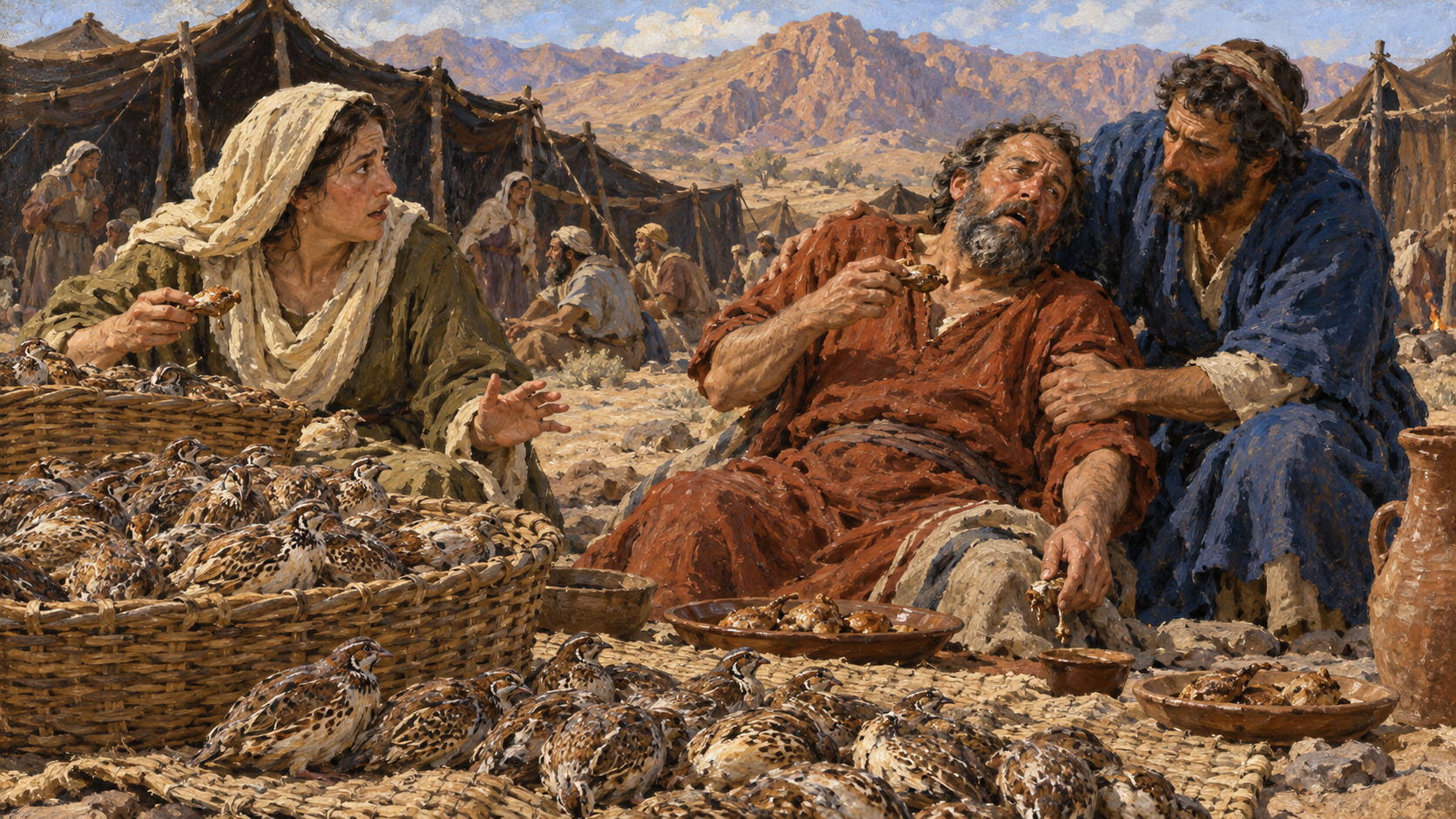
God gave Israel quail on two occasions in the wilderness, but only one account ends beside graves. The difference was not that meat had become sinful. In Numbers 11, the people treated their rescue from Egypt as a mistake and despised the Lord who was feeding them. I want to understand that rebellion without turning the passage against people who are hungry, exhausted, or honestly asking God for help.
God First Gave Quail as Gracious Provision
Exodus 16 dates the first quail to the second month after Israel left Egypt. The people had crossed the Red Sea but had not yet reached Sinai or entered the covenant established there. They needed food for the congregation, and the difficulty of feeding so many people was real. Their words to Moses and Aaron, however, went beyond asking for help: they accused the men who had led them out of intending to kill them through hunger.
And they journeyed from Elim, and all the congregation of the children of Israel came to the Wilderness of Sin, which is between Elim and Sinai, on the fifteenth day of the second month after they departed from the land of Egypt. Then the whole congregation of the children of Israel complained against Moses and Aaron in the wilderness. And the children of Israel said to them, “Oh, that we had died by the hand of the LORD in the land of Egypt, when we sat by the pots of meat and when we ate bread to the full! For you have brought us out into this wilderness to kill this whole assembly with hunger.” Then the LORD said to Moses, “Behold, I will rain bread from heaven for you. And the people shall go out and gather a certain quota every day, that I may test them, whether they will walk in My law or not. And it shall be on the sixth day that they shall prepare what they bring in, and it shall be twice as much as they gather daily.” Then Moses and Aaron said to all the children of Israel, “At evening you shall know that the LORD has brought you out of the land of Egypt. And in the morning you shall see the glory of the LORD; for He hears your complaints against the LORD. But what are we, that you complain against us?” Also Moses said, “This shall be seen when the LORD gives you meat to eat in the evening, and in the morning bread to the full; for the LORD hears your complaints which you make against Him. And what are we? Your complaints are not against us but against the LORD.” Then Moses spoke to Aaron, “Say to all the congregation of the children of Israel, ‘Come near before the LORD, for He has heard your complaints.'” Now it came to pass, as Aaron spoke to the whole congregation of the children of Israel, that they looked toward the wilderness, and behold, the glory of the LORD appeared in the cloud. And the LORD spoke to Moses, saying, “I have heard the complaints of the children of Israel. Speak to them, saying, ‘At twilight you shall eat meat, and in the morning you shall be filled with bread. And you shall know that I am the LORD your God.'” So it was that quail came up at evening and covered the camp, and in the morning the dew lay all around the camp. And when the layer of dew lifted, there, on the surface of the wilderness, was a small round substance, as fine as frost on the ground. So when the children of Israel saw it, they said to one another, “What is it?” For they did not know what it was. And Moses said to them, “This is the bread which the LORD has given you to eat.
The people recalled Egypt’s meat pots and plentiful bread while leaving slavery out of the comparison. Pharaoh had subjected them to forced labor and ordered Hebrew sons killed, and Israel had cried out for deliverance. Now they spoke as though remaining in bondage would have been better than following the Lord into the wilderness. Moses made the accusation’s real object clear. They were complaining against the God who had brought them out, not merely against the two men leading them.
The Lord heard the complaint and supplied food. Quail covered the camp that evening, and manna appeared after the dew the next morning. The quail supplied the promised meat, while manna became the daily provision that sustained Israel through the wilderness years. Exodus records no plague or burial ground following this first meal of quail.
Receiving the food did not mean Israel had earned it through grumbling or that God approved their accusation. His kindness was teaching the people He had rescued to know and trust Him. Nor does this meal give us grounds to condemn meat or the enjoyment of food. We can receive God’s gifts with thanksgiving while examining whether getting a particular gift has become a condition of our trust. The study on the Exodus follows that relationship between deliverance and dependence more fully.
The manna instructions made dependence part of each day’s work. God told the people how much to gather, what they could keep, and when they should rest. Receiving His provision required attention to His word as well as effort in collecting food.
This is the thing which the LORD has commanded: ‘Let every man gather it according to each one’s need, one omer for each person, according to the number of persons; let every man take for those who are in his tent.'” Then the children of Israel did so and gathered, some more, some less. So when they measured it by omers, he who gathered much had nothing left over, and he who gathered little had no lack. Every man had gathered according to each one’s need. And Moses said, “Let no one leave any of it till morning.” Notwithstanding they did not heed Moses. But some of them left part of it until morning, and it bred worms and stank. And Moses was angry with them. So they gathered it every morning, every man according to his need. And when the sun became hot, it melted. And so it was, on the sixth day, that they gathered twice as much bread, two omers for each one. And all the rulers of the congregation came and told Moses. Then he said to them, “This is what the LORD has said: ‘Tomorrow is a Sabbath rest, a holy Sabbath to the LORD. Bake what you will bake today, and boil what you will boil; and lay up for yourselves all that remains, to be kept until morning.'” So they laid it up till morning, as Moses commanded; and it did not stink, nor were there any worms in it. Then Moses said, “Eat that today, for today is a Sabbath to the LORD; today you will not find it in the field. Six days you shall gather it, but on the seventh day, the Sabbath, there will be none.” Now it happened that some of the people went out on the seventh day to gather, but they found none. And the LORD said to Moses, “How long do you refuse to keep My commandments and My laws? See! For the LORD has given you the Sabbath; therefore He gives you on the sixth day bread for two days. Let every man remain in his place; let no man go out of his place on the seventh day.” So the people rested on the seventh day. And the house of Israel called its name Manna. And it was like white coriander seed, and the taste of it was like wafers made with honey. Then Moses said, “This is the thing which the LORD has commanded: ‘Fill an omer with it, to be kept for your generations, that they may see the bread with which I fed you in the wilderness, when I brought you out of the land of Egypt.'” And Moses said to Aaron, “Take a pot and put an omer of manna in it, and lay it up before the LORD, to be kept for your generations.” As the LORD commanded Moses, so Aaron laid it up before the Testimony, to be kept. And the children of Israel ate manna forty years, until they came to an inhabited land; they ate manna until they came to the border of the land of Canaan. Now an omer is one-tenth of an ephah.
An omer was allotted for each person, so the amount needed by a large household differed from that needed by a small one. Verse 18 describes enough for each household’s needs, not an identical amount in every tent. Manna kept until morning against God’s instruction bred worms and stank. The portion kept overnight at His command for the Sabbath remained good. They needed to receive the food on the terms He gave, rather than assume that collecting or storing more would always serve them better.
Some kept food overnight when they had been told not to, while others went out on the Sabbath after being told there would be nothing to gather. In both cases, they acted against the instruction of the One feeding them. Christians are not required to reproduce those collection rules, and planning for a future need is not itself unbelief. The warning reaches us when we prefer our own means of control to obedience to a command God has actually given.
The preserved jar would show later generations how God had sustained Israel. Their survival could not be credited to their own ingenuity. Looking back over the forty years, Moses explained why the Lord had allowed hunger and then given manna.
“Every commandment which I command you today you must be careful to observe, that you may live and multiply, and go in and possess the land of which the LORD swore to your fathers. And you shall remember that the LORD your God led you all the way these forty years in the wilderness, to humble you and test you, to know what was in your heart, whether you would keep His commandments or not. So He humbled you, allowed you to hunger, and fed you with manna which you did not know nor did your fathers know, that He might make you know that man shall not live by bread alone; but man lives by every word that proceeds from the mouth of the LORD. Your garments did not wear out on you, nor did your foot swell these forty years. You should know in your heart that as a man chastens his son, so the LORD your God chastens you. “Therefore you shall keep the commandments of the LORD your God, to walk in His ways and to fear Him. For the LORD your God is bringing you into a good land, a land of brooks of water, of fountains and springs, that flow out of valleys and hills; a land of wheat and barley, of vines and fig trees and pomegranates, a land of olive oil and honey; a land in which you will eat bread without scarcity, in which you will lack nothing; a land whose stones are iron and out of whose hills you can dig copper. When you have eaten and are full, then you shall bless the LORD your God for the good land which He has given you.
God had used hunger and manna to humble His people and expose what was in their hearts. They needed bread, but they remained dependent on the God whose word supplied it. Entering a fertile land would not end that dependence. After eating their fill, they would need to bless Him for the food rather than forget Him in the abundance He had promised.
In Numbers, Craving Turned Israel Back Toward Egypt
Numbers 11 returns us to Israel’s wilderness journey after Sinai, about a year after the first quail. By then the covenant had been given, the tabernacle built, and Passover observed. Soon after they left Sinai, complaints at Taberah brought fire upon the camp’s outskirts. The people appealed to Moses, he prayed, and the fire stopped. That recent judgment and mercy should be kept in view as we read the demand that followed.
Now when the people complained, it displeased the LORD; for the LORD heard it, and His anger was aroused. So the fire of the LORD burned among them, and consumed some in the outskirts of the camp. Then the people cried out to Moses, and when Moses prayed to the LORD, the fire was quenched. So he called the name of the place Taberah, because the fire of the LORD had burned among them. Now the mixed multitude who were among them yielded to intense craving; so the children of Israel also wept again and said: “Who will give us meat to eat? We remember the fish which we ate freely in Egypt, the cucumbers, the melons, the leeks, the onions, and the garlic; but now our whole being is dried up; there is nothing at all except this manna before our eyes!” Now the manna was like coriander seed, and its color like the color of bdellium. The people went about and gathered it, ground it on millstones or beat it in the mortar, cooked it in pans, and made cakes of it; and its taste was like the taste of pastry prepared with oil. And when the dew fell on the camp in the night, the manna fell on it.
Numbers calls the group that first yielded to craving asafsuf, a rare Hebrew term for a gathered crowd or rabble. Some readers connect them with the mixed multitude who left Egypt in Exodus 12:38, though this word alone does not identify their ancestry. The passage then expressly says that the children of Israel joined the weeping. Whoever began the complaint, Israel’s participation was its own choice, and the influence of others could not excuse it.
They recalled fish, cucumbers, melons, leeks, onions, and garlic as though the food in Egypt had come without cost. Their recollection left out forced labor and the violence inflicted on their families. Desire had drawn their attention to what they missed while obscuring what they had needed to escape. I need to examine that same distortion if an old pleasure starts to look attractive and I stop remembering the bondage that accompanied it.
Their dismissal of the manna showed how far the complaint had gone beyond wanting variety. The Lord would identify their conduct as despising Him while He was among them. They asked why they had ever left Egypt, treating deliverance as a loss and the One who had rescued them as unable to provide. Their hunger was not the charge against them; their contempt for the Lord was.
The earlier complaint in Exodus was wrong too, even though no plague is recorded there. In Numbers, after further instruction and provision, God expressly named their rejection of Him and announced judgment. We should let those explanations govern our reading of the different outcomes. God was not condemning the eating of meat. He was judging the people’s rejection of Him.
God Helped Moses and Proved His Arm Was Not Shortened
Moses heard the families weeping at their tent doors and told God he could not carry the burden alone. His prayer became so desperate that he asked to die rather than continue in his wretchedness. Those are the words of an overwhelmed servant seeking help from the Lord. They do not place every part of his response beyond correction, but they do show where he took a burden he could no longer bear.
Then Moses heard the people weeping throughout their families, everyone at the door of his tent; and the anger of the LORD was greatly aroused; Moses also was displeased. So Moses said to the LORD, “Why have You afflicted Your servant? And why have I not found favor in Your sight, that You have laid the burden of all these people on me? Did I conceive all these people? Did I beget them, that You should say to me, ‘Carry them in your bosom, as a guardian carries a nursing child,’ to the land which You swore to their fathers? Where am I to get meat to give to all these people? For they weep all over me, saying, ‘Give us meat, that we may eat.’ I am not able to bear all these people alone, because the burden is too heavy for me. If You treat me like this, please kill me here and now–if I have found favor in Your sight–and do not let me see my wretchedness!” So the LORD said to Moses: “Gather to Me seventy men of the elders of Israel, whom you know to be the elders of the people and officers over them; bring them to the tabernacle of meeting, that they may stand there with you. Then I will come down and talk with you there. I will take of the Spirit that is upon you and will put the same upon them; and they shall bear the burden of the people with you, that you may not bear it yourself alone. Then you shall say to the people, ‘Consecrate yourselves for tomorrow, and you shall eat meat; for you have wept in the hearing of the LORD, saying, “Who will give us meat to eat? For it was well with us in Egypt.” Therefore the LORD will give you meat, and you shall eat. You shall eat, not one day, nor two days, nor five days, nor ten days, nor twenty days, but for a whole month, until it comes out of your nostrils and becomes loathsome to you, because you have despised the LORD who is among you, and have wept before Him, saying, “Why did we ever come up out of Egypt?”‘” And Moses said, “The people whom I am among are six hundred thousand men on foot; yet You have said, ‘I will give them meat, that they may eat for a whole month.’ Shall flocks and herds be slaughtered for them, to provide enough for them? Or shall all the fish of the sea be gathered together for them, to provide enough for them?” And the LORD said to Moses, “Has the LORD’s arm been shortened? Now you shall see whether what I say will happen to you or not.”
God answered by providing others to carry responsibility with Moses. He was to gather seventy men he already knew as elders and officers, and the Lord would equip them by His Spirit for the work. Moses did not have to become sufficient for every need the people brought to him. The Lord gave him fellow servants rather than treating his need for help as proof that he should be discarded.
The promise of meat then challenged the limits Moses saw in the available resources. He counted six hundred thousand men on foot, besides their families, and asked whether slaughtering the flocks and herds or gathering the sea’s fish could supply enough. God had promised a month of meat, until the food became loathsome to them. Giving them so much of what they demanded would expose the contempt behind their request, rather than merely offer a change of diet.
God answered Moses with the question “Has the LORD’s arm been shortened?” His arm is an image of His power to accomplish what He says. Moses was counting resources he could see, but the wilderness had not diminished the Lord’s ability to provide. Trusting this particular promise meant receiving God’s word even when Moses could not calculate how it would be fulfilled.
I cannot invent a promise and then call it faith to insist that God fulfill it. Here, however, God had spoken. Neither the number of people nor the scarcity of food could defeat His word. Moses went out, reported that word, and gathered the appointed elders.
So Moses went out and told the people the words of the LORD, and he gathered the seventy men of the elders of the people and placed them around the tabernacle. Then the LORD came down in the cloud, and spoke to him, and took of the Spirit that was upon him, and placed the same upon the seventy elders; and it happened, when the Spirit rested upon them, that they prophesied, although they never did so again. But two men had remained in the camp: the name of one was Eldad, and the name of the other Medad. And the Spirit rested upon them. Now they were among those listed, but who had not gone out to the tabernacle; yet they prophesied in the camp. And a young man ran and told Moses, and said, “Eldad and Medad are prophesying in the camp.” So Joshua the son of Nun, Moses’ assistant, one of his choice men, answered and said, “Moses my lord, forbid them!” Then Moses said to him, “Are you zealous for my sake? Oh, that all the LORD’s people were prophets and that the LORD would put His Spirit upon them!” And Moses returned to the camp, he and the elders of Israel. Now a wind went out from the LORD, and it brought quail from the sea and left them fluttering near the camp, about a day’s journey on this side and about a day’s journey on the other side, all around the camp, and about two cubits above the surface of the ground. And the people stayed up all that day, all night, and all the next day, and gathered the quail (he who gathered least gathered ten homers); and they spread them out for themselves all around the camp. But while the meat was still between their teeth, before it was chewed, the wrath of the LORD was aroused against the people, and the LORD struck the people with a very great plague. So he called the name of that place Kibroth Hattaavah, because there they buried the people who had yielded to craving. From Kibroth Hattaavah the people moved to Hazeroth, and camped at Hazeroth.
When the Spirit rested on the appointed elders, they prophesied, publicly confirming that God had equipped them. Eldad and Medad were among those listed, though they had remained in the camp instead of coming to the tabernacle. The Spirit rested on them there too. Joshua wanted Moses to stop them, but Moses asked whether Joshua’s concern was jealousy for Moses’ sake. He wished that all the Lord’s people were prophets and that God would put His Spirit upon them.
The Abundance Exposed What Desire Had Become
The Lord sent a wind that carried quail from the sea to the camp. Common quail migrate through the region, as research on migrating birds at Eilat documents. That observation supplies useful background for the kind of birds involved. It does not turn the event into a coincidence or explain away the announced timing, the enormous supply, and the judgment attached to it.
God’s use of wind does not make His action less personal. He had already driven back the Red Sea with an east wind, employing a means He directed. Here too, the account identifies Him as the One sending the wind and bringing the birds. The study on God’s providence and provision considers how His care includes ordinary means as well as extraordinary acts.
The people gathered through that day and night and continued throughout the following day. Even the least successful gatherer collected ten homers. A homer was a large dry measure, much larger than the omer allotted for one person’s daily manna. Their similar English names can obscure the size of the collection if we confuse the two measures. The minimum amount gathered was enormous, though we cannot convert an ancient measure into a modern quantity with decimal precision.
The description of birds about two cubits above the ground has been understood in two ways. It may refer to quail flying or fluttering within reach, perhaps exhausted after their journey, or to birds lying around the camp to that depth. I would allow that discussion rather than insist on a perfectly uniform layer three feet deep. The birds also extended about a day’s journey on each side. Without the camp’s dimensions and the distribution of the quail, we cannot calculate their exact number.
Moses’ question about whether there could be enough had been answered with an immense supply. The people gathered it, but judgment came while the meat was still between their teeth, before it was chewed. The Lord struck them with a very great plague. We should not use the promise of a month’s meat to move the plague to the end of a full month of eating. Verse 33 places it at this moment, connecting the judgment directly with their craving.
The text identifies the Lord as the One who struck the people and gives no medical diagnosis for the plague. It does not describe an accidental outbreak later mistaken for divine judgment. The place was named Kibroth Hattaavah, Graves of Craving, because the people who yielded to craving were buried there. We need to hear that name in the setting of their rebellion. It does not condemn every strong desire or make enjoying a satisfying meal dangerous in itself.
Before the quail arrived, Moses had also received help through the Spirit’s equipping of other men. He welcomed their service instead of treating it as a threat to his position. I need that correction if protecting my influence becomes more attractive than recognizing a genuine work of God. Moses’ desire for the Spirit to rest on all the Lord’s people also anticipates Joel’s wider promise and the New Testament outpouring. That Old Testament equipping of particular servants differs from the Spirit’s indwelling of every genuinely born-again believer. The Holy Spirit still gives gifts for service, without giving every believer the same ministry.
Psalm 78 names the unbelief behind the demand. After seeing water come from the rock, the people questioned whether God could prepare a table in the wilderness.
But they sinned even more against Him By rebelling against the Most High in the wilderness. And they tested God in their heart By asking for the food of their fancy. Yes, they spoke against God: They said, “Can God prepare a table in the wilderness? Behold, He struck the rock, So that the waters gushed out, And the streams overflowed. Can He give bread also? Can He provide meat for His people?” Therefore the LORD heard this and was furious; So a fire was kindled against Jacob, And anger also came up against Israel, Because they did not believe in God, And did not trust in His salvation. Yet He had commanded the clouds above, And opened the doors of heaven, Had rained down manna on them to eat, And given them of the bread of heaven. Men ate angels’ food; He sent them food to the full. He caused an east wind to blow in the heavens; And by His power He brought in the south wind. He also rained meat on them like the dust, Feathered fowl like the sand of the seas; And He let them fall in the midst of their camp, All around their dwellings. So they ate and were well filled, For He gave them their own desire. They were not deprived of their craving; But while their food was still in their mouths, The wrath of God came against them, And slew the stoutest of them, And struck down the choice men of Israel.
They received the food they insisted on, but receiving it did not establish God’s approval. Psalm 106 describes the inward cost of forgetting His works and refusing to wait for His counsel.
They soon forgot His works; They did not wait for His counsel, But lusted exceedingly in the wilderness, And tested God in the desert. And He gave them their request, But sent leanness into their soul.
Receiving what I want does not establish that I have received it rightly or that it is doing me good. Israel received the food it demanded, but God also sent the leanness Psalm 106 describes. Psalm 105, meanwhile, praises God for quail and manna as acts of covenant faithfulness: He remembered His promise to Abraham and supplied His people. The praise does not cancel the warnings, nor do the warnings deny His faithfulness. The Lord sustained the people even as their responses exposed their distrust of Him.
Faithful Lament and Learned Contentment Still Trust God
A suffering person’s honest prayer is different from the rebellion described here. The Psalms give words to grief, fear, and confusion, bringing them to the Lord and asking for help. Faithful lament can acknowledge that we do not understand. It does not have to pretend that a burden is light before asking God to lift it.
Moses needed correction for questioning whether God could provide the meat He had promised. He also needed help with the people, and God gave it. Israel’s demand went further, treating Egypt as preferable and their deliverance as a mistake. That difference should teach us to listen carefully to a person in distress. Tears, exhaustion, and difficult questions do not by themselves tell us whether he is rejecting God or seeking His help.
Nor does contentment mean ignoring hunger. Jesus taught His disciples to ask for daily bread, and God fed Israel when the people could not feed themselves. We can seek practical help and act responsibly to meet a need. Contentment refuses to make comfort or possessions the condition of trusting God; it does not require us to deny that we lack something.
Paul’s description of learning contentment makes that clear. He had known hunger as well as plenty, and he still welcomed the Philippians’ gift.
But I rejoiced in the Lord greatly that now at last your care for me has flourished again; though you surely did care, but you lacked opportunity. Not that I speak in regard to need, for I have learned in whatever state I am, to be content: I know how to be abased, and I know how to abound. Everywhere and in all things I have learned both to be full and to be hungry, both to abound and to suffer need. I can do all things through Christ who strengthens me. Nevertheless you have done well that you shared in my distress. Now you Philippians know also that in the beginning of the gospel, when I departed from Macedonia, no church shared with me concerning giving and receiving but you only. For even in Thessalonica you sent aid once and again for my necessities. Not that I seek the gift, but I seek the fruit that abounds to your account. Indeed I have all and abound. I am full, having received from Epaphroditus the things sent from you, a sweet-smelling aroma, an acceptable sacrifice, well pleasing to God. And my God shall supply all your need according to His riches in glory by Christ Jesus. Now to our God and Father be glory forever and ever. Amen.
Christ strengthened Paul to live through hunger as well as abundance, but Paul still welcomed the help the church sent. He thanked the Philippians for sharing his distress and called their gift a sacrifice pleasing to God. Their generosity was one way God cared for him. I cannot tell a hungry believer to be content and then use that instruction as an excuse to withhold help I could give.
The promise that God would supply the Philippians’ need belongs in the setting of that generous partnership. It does not guarantee that every desire will be satisfied whenever we ask. I need to consider what a desire is leading me to do. If gratitude disappears, obedience becomes negotiable, or I am prepared to harm someone to get what I want, the desire is governing me in a way it should not. Even a legitimate need does not authorize every method of meeting it.
The Wilderness Warning Leads Us to the True Bread
Paul also directs Christians back to Israel’s wilderness failures. The people had received extraordinary privileges, but those privileges did not make rebellion safe.
Moreover, brethren, I do not want you to be unaware that all our fathers were under the cloud, all passed through the sea, all were baptized into Moses in the cloud and in the sea, all ate the same spiritual food, and all drank the same spiritual drink. For they drank of that spiritual Rock that followed them, and that Rock was Christ. But with most of them God was not well pleased, for their bodies were scattered in the wilderness. Now these things became our examples, to the intent that we should not lust after evil things as they also lusted. And do not become idolaters as were some of them. As it is written, “The people sat down to eat and drink, and rose up to play.” Nor let us commit sexual immorality, as some of them did, and in one day twenty-three thousand fell; nor let us tempt Christ, as some of them also tempted, and were destroyed by serpents; nor complain, as some of them also complained, and were destroyed by the destroyer. Now all these things happened to them as examples, and they were written for our admonition, upon whom the ends of the ages have come. Therefore let him who thinks he stands take heed lest he fall. No temptation has overtaken you except such as is common to man; but God is faithful, who will not allow you to be tempted beyond what you are able, but with the temptation will also make the way of escape, that you may be able to bear it.
Paul names craving evil, idolatry, sexual immorality, tempting Christ, and complaining among the failures that warn us. He is exposing false confidence and calling believers to vigilance. I do not read this as teaching that genuine new birth can be undone. The Holy Spirit indwells and seals the person who is truly born again, but that security never gives us permission to repeat Israel’s rebellion or disregard God’s correction.
An empty profession cannot establish that someone belongs to Christ, and a genuine believer must remain alert to temptation. Paul warns the person who thinks he stands to take heed, while also assuring him of God’s faithfulness and a way to endure temptation. Those truths give us reason to seek God’s help and take the escape He provides. We cannot excuse a chosen sin by claiming that resisting it was impossible.
John 6 takes us back from Paul’s warning to Jesus’ ministry, where He used the manna account to explain everlasting life. After feeding the five thousand and crossing the lake, He addressed the crowd that followed Him to Capernaum. They sought Him because they had eaten and been filled. Jesus directed them toward the enduring life that receiving another meal could not give.
Jesus answered them and said, “Most assuredly, I say to you, you seek Me, not because you saw the signs, but because you ate of the loaves and were filled. Do not labor for the food which perishes, but for the food which endures to everlasting life, which the Son of Man will give you, because God the Father has set His seal on Him.” Then they said to Him, “What shall we do, that we may work the works of God?” Jesus answered and said to them, “This is the work of God, that you believe in Him whom He sent.” Therefore they said to Him, “What sign will You perform then, that we may see it and believe You? What work will You do? Our fathers ate the manna in the desert; as it is written, ‘He gave them bread from heaven to eat.'” Then Jesus said to them, “Most assuredly, I say to you, Moses did not give you the bread from heaven, but My Father gives you the true bread from heaven. For the bread of God is He who comes down from heaven and gives life to the world.” Then they said to Him, “Lord, give us this bread always.” And Jesus said to them, “I am the bread of life. He who comes to Me shall never hunger, and he who believes in Me shall never thirst. But I said to you that you have seen Me and yet do not believe. All that the Father gives Me will come to Me, and the one who comes to Me I will by no means cast out. For I have come down from heaven, not to do My own will, but the will of Him who sent Me. This is the will of the Father who sent Me, that of all He has given Me I should lose nothing, but should raise it up at the last day. And this is the will of Him who sent Me, that everyone who sees the Son and believes in Him may have everlasting life; and I will raise him up at the last day.”
Moses had not been the source of manna; the Father gave it. Jesus now identified Himself as the true Bread from heaven who gives life to the world, calling people to come to Him and believe. He promised to receive the one who comes and raise the believer at the last day. He gives life to everyone who believes, even as He confronts the unbelief of people hearing Him. I understand His later words about eating His flesh and drinking His blood as the call to receive Him by faith. Communion remembers and proclaims His body and blood; it neither physically produces eternal life nor repeats His sacrifice.
The Israelites who ate manna still died, while Christ promises everlasting life and bodily resurrection to those who believe in Him. Stronger self-control cannot give us that life. We need the eternal Son, who became fully man without ceasing to be fully God and lived entirely without sin. He alone can save us and bring us to the Father.
His sinless perfection made Him the perfect sacrifice for our sins, and He voluntarily gave Himself to be slain. Wicked men inflicted the bodily torture and death He endured. His shed blood and death completed His saving sacrifice before His burial, and He then rose bodily. The Father did not punish, curse, abandon, strike, bruise, or pour wrath on Jesus. Father and Son acted in unity to redeem us. Christ died for the whole world, so God’s offer is genuine for every person, although people can resist and reject Him. We receive salvation through repentance and faith in the crucified and risen Savior.
Israel’s favorable recollection of Egypt makes me examine how I remember sin. A pleasure can begin to look inviting if I stop acknowledging the bondage that accompanied it. When I have a real need, I can bring it to God honestly and accept help from His people without making satisfaction a condition of obedience. The Lord who rescued Israel also taught the people to receive His provision on His terms.
Above all, we need the new life Christ gives. Those who repent and believe are justified, declared righteous before God, and genuinely born again. The Holy Spirit indwells and seals them, and they are eternally secure in Christ. Obedience grows from that life; it neither earns nor keeps salvation, and genuine faith does not make a person sinless. Jesus promises to receive the one who comes to Him and raise that believer on the last day. His welcome gives us reason to trust and obey Him, rather than seek from another gift the life only the Giver can supply.
My Final Thoughts
The quail accounts do not make enjoying God’s gifts a sin. They make me examine whether desire has begun governing what I believe about Him. Israel’s demand in Numbers rejected the Lord who was among them, while Moses brought his distress to Him and received help. We need to hear the warning without using it to silence a person who is suffering.
God fed His people and showed that His power had not diminished. Yet even abundant food could not give them everlasting life. Jesus Christ, the true Bread from heaven, offers that life to everyone who believes. I want to receive His gifts gratefully while continuing to trust the Savior Himself.