
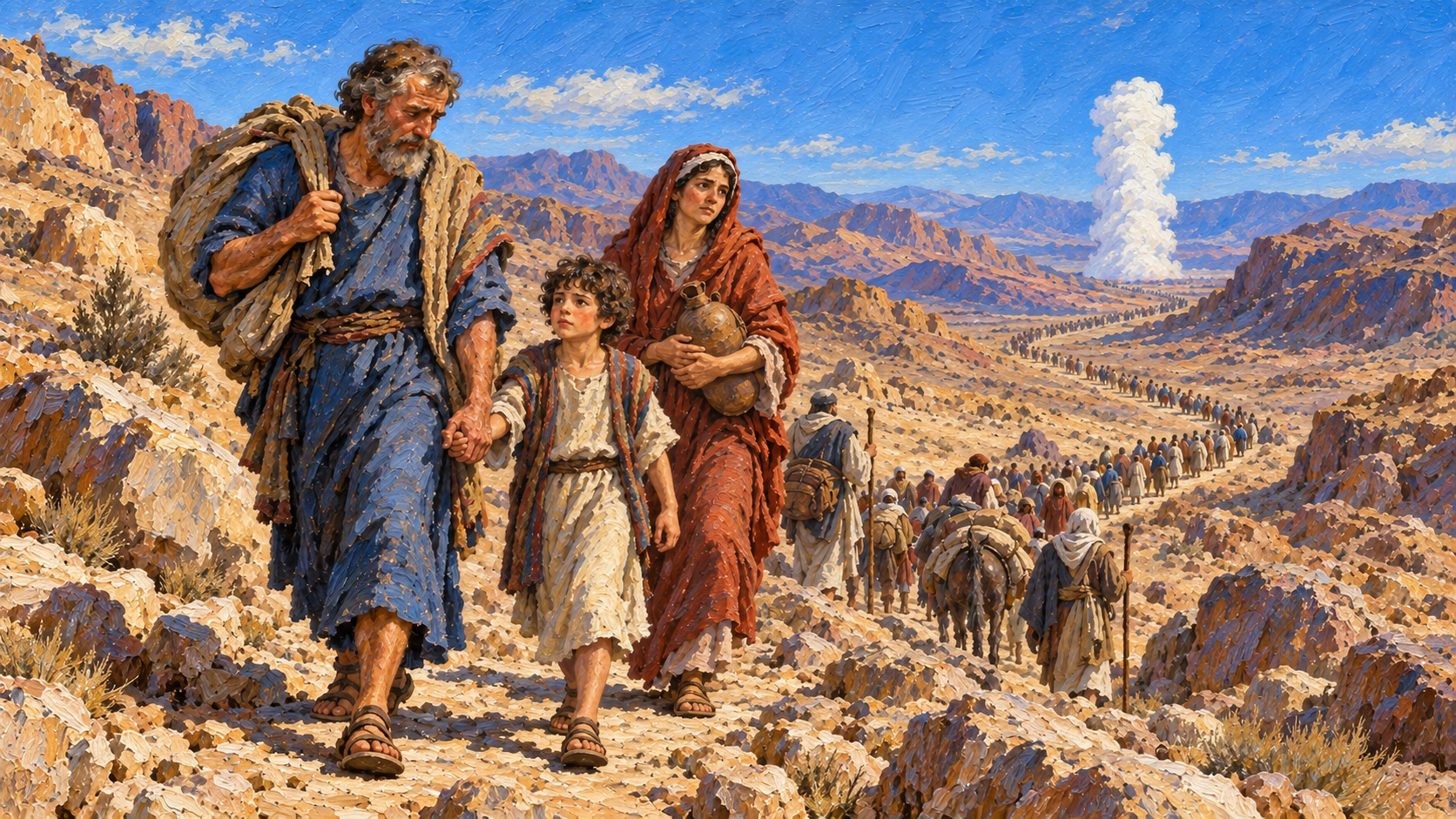
Israel’s forty years in the wilderness were not simply a long journey through difficult country. At Kadesh Barnea, a generation that had seen God deliver them from Egypt refused His command to enter Canaan and proposed returning to slavery. God judged that rebellion while continuing to sustain the nation and bring their children toward the promised land. I need to understand those events before using the wilderness as a picture of difficulties in my own life.
From Egypt to Kadesh Barnea
The journey began with God’s deliverance from Egypt. He chose the route and went before His people, so the longer road they initially took was not evidence that Moses had lost his way.
Then it came to pass, when Pharaoh had let the people go, that God did not lead them by way of the land of the Philistines, although that was near; for God said, “Lest perhaps the people change their minds when they see war, and return to Egypt.” So God led the people around by way of the wilderness of the Red Sea. And the children of Israel went up in orderly ranks out of the land of Egypt. And Moses took the bones of Joseph with him, for he had placed the children of Israel under solemn oath, saying, “God will surely visit you, and you shall carry up my bones from here with you.” So they took their journey from Succoth and camped in Etham at the edge of the wilderness. And the LORD went before them by day in a pillar of cloud to lead the way, and by night in a pillar of fire to give them light, so as to go by day and night. He did not take away the pillar of cloud by day or the pillar of fire by night from before the people.
The nearer road ran through Philistine territory, where seeing war might make the newly freed people turn back to Egypt. God instead led them toward the Red Sea by the wilderness route. The pillar of cloud guided them by day, and the pillar of fire gave light at night. Moses also carried Joseph’s bones, honoring the oath Joseph had required because he believed God would bring Israel out. The studies on the Exodus and the pillar of fire and cloud follow those events more fully.
God had more for Israel to do than cover the distance to Canaan. They crossed the sea, received food and water, fought Amalek, and reached Sinai. There they received His law, entered the covenant, and built the tabernacle. A census organized the nation before they departed toward the land. The whole wilderness period includes these early stages, rather than beginning only when the spies returned.
On the way to Sinai, the people who had sung beside the sea soon complained about bitter water. Their deliverance had not made them consistently willing to trust God. God provided manna, but they later quarreled over water at Rephidim and asked whether the LORD was among them. He told Moses to strike the rock at Horeb, and water came out. The place was named Massah and Meribah because of their testing and contention.
After Sinai, fire brought judgment at Taberah, craving dominated the people at Kibroth Hattaavah, and even Miriam and Aaron opposed Moses. These events exposed repeated resistance to the God whose deliverance and provision they had witnessed. That is different from a distressed person bringing an honest question or lament to Him. Scripture records faithful prayers spoken in anguish.
When Israel longed for Egypt’s food, they remembered it selectively. Forced labor, slavery, and the murder of their sons disappeared from the appealing picture, along with the rescue God had accomplished. I need to remember former bondage honestly when what was familiar starts to look attractive again. Forgetting its cost makes disobedience easier to rationalize.
The Rebellion That Brought the Forty-Year Sentence
At Kadesh, twelve leaders returned after spending forty days exploring Canaan. Their report confirmed the land’s abundance, but they disagreed about whether Israel could possess it.
And they returned from spying out the land after forty days. Now they departed and came back to Moses and Aaron and all the congregation of the children of Israel in the Wilderness of Paran, at Kadesh; they brought back word to them and to all the congregation, and showed them the fruit of the land. Then they told him, and said: “We went to the land where you sent us. It truly flows with milk and honey, and this is its fruit. Nevertheless the people who dwell in the land are strong; the cities are fortified and very large; moreover we saw the descendants of Anak there. The Amalekites dwell in the land of the South; the Hittites, the Jebusites, and the Amorites dwell in the mountains; and the Canaanites dwell by the sea and along the banks of the Jordan.” Then Caleb quieted the people before Moses, and said, “Let us go up at once and take possession, for we are well able to overcome it.” But the men who had gone up with him said, “We are not able to go up against the people, for they are stronger than we.” And they gave the children of Israel a bad report of the land which they had spied out, saying, “The land through which we have gone as spies is a land that devours its inhabitants, and all the people whom we saw in it are men of great stature. There we saw the giants (the descendants of Anak came from the giants); and we were like grasshoppers in our own sight, and so we were in their sight.”
They brought fruit and described a land flowing with milk and honey. They also reported fortified cities and formidable inhabitants, including Anak’s descendants. Caleb urged the people to go up at once. The ten who opposed him turned their observations into a verdict that Israel could not obey God’s command and succeed.
The walls and warriors were real. Joshua and Caleb did not need to pretend otherwise; they believed that the LORD who had brought Israel out could give them the land He promised. The other spies spoke as though the comparison between their own strength and their enemies’ strength settled the outcome. Their description of themselves as grasshoppers spread fear through the camp.
So all the congregation lifted up their voices and cried, and the people wept that night. And all the children of Israel complained against Moses and Aaron, and the whole congregation said to them, “If only we had died in the land of Egypt! Or if only we had died in this wilderness! Why has the LORD brought us to this land to fall by the sword, that our wives and children should become victims? Would it not be better for us to return to Egypt?” So they said to one another, “Let us select a leader and return to Egypt.” Then Moses and Aaron fell on their faces before all the assembly of the congregation of the children of Israel. But Joshua the son of Nun and Caleb the son of Jephunneh, who were among those who had spied out the land, tore their clothes; and they spoke to all the congregation of the children of Israel, saying: “The land we passed through to spy out is an exceedingly good land. If the LORD delights in us, then He will bring us into this land and give it to us, ‘a land which flows with milk and honey.’ Only do not rebel against the LORD, nor fear the people of the land, for they are our bread; their protection has departed from them, and the LORD is with us. Do not fear them.” And all the congregation said to stone them with stones. Now the glory of the LORD appeared in the tabernacle of meeting before all the children of Israel.
The congregation wept that night and accused God of bringing their families to be killed. They proposed choosing a leader to return to Egypt. Moses and Aaron fell on their faces, while Joshua and Caleb tore their clothes and appealed to the LORD’s presence with them. They warned the people not to rebel or fear the inhabitants.
The congregation’s answer was a call to stone them. This had become organized revolt against God’s direction, not a passing feeling of apprehension. They rejected His promise and threatened those urging obedience. Then the LORD’s glory appeared at the tabernacle.
God spoke of striking the people and making a nation from Moses. Moses interceded for the very people who had rejected his leadership.
And Moses said to the LORD: “Then the Egyptians will hear it, for by Your might You brought these people up from among them, and they will tell it to the inhabitants of this land. They have heard that You, LORD, are among these people; that You, LORD, are seen face to face and Your cloud stands above them, and You go before them in a pillar of cloud by day and in a pillar of fire by night. Now if You kill these people as one man, then the nations which have heard of Your fame will speak, saying, ‘Because the LORD was not able to bring this people to the land which He swore to give them, therefore He killed them in the wilderness.’ And now, I pray, let the power of my Lord be great, just as You have spoken, saying, ‘The LORD is longsuffering and abundant in mercy, forgiving iniquity and transgression; but He by no means clears the guilty, visiting the iniquity of the fathers on the children to the third and fourth generation.’ Pardon the iniquity of this people, I pray, according to the greatness of Your mercy, just as You have forgiven this people, from Egypt even until now.” Then the LORD said: “I have pardoned, according to your word; but truly, as I live, all the earth shall be filled with the glory of the LORD– because all these men who have seen My glory and the signs which I did in Egypt and in the wilderness, and have put Me to the test now these ten times, and have not heeded My voice, they certainly shall not see the land of which I swore to their fathers, nor shall any of those who rejected Me see it. But My servant Caleb, because he has a different spirit in him and has followed Me fully, I will bring into the land where he went, and his descendants shall inherit it.
Moses did not argue that Israel deserved pardon. He appealed to what Egypt and the other nations had heard about the LORD’s power and visible presence with His people. Destroying the nation could give them occasion to claim that God had been unable to fulfill His promise. Moses also relied on God’s own declaration of patience and abundant mercy, without denying that He judges guilt.
The LORD pardoned according to Moses’ request, sparing the nation instead of destroying it and beginning again with him. That pardon did not remove the consequence for the generation that had rejected Him. The people would continue as a nation, but the rebels would not possess the land. Caleb, who followed the LORD fully, would enter it; Joshua stood with him in that same faith.
And the LORD spoke to Moses and Aaron, saying, “How long shall I bear with this evil congregation who complain against Me? I have heard the complaints which the children of Israel make against Me. Say to them, ‘As I live,’ says the LORD, ‘just as you have spoken in My hearing, so I will do to you: The carcasses of you who have complained against Me shall fall in this wilderness, all of you who were numbered, according to your entire number, from twenty years old and above. Except for Caleb the son of Jephunneh and Joshua the son of Nun, you shall by no means enter the land which I swore I would make you dwell in. But your little ones, whom you said would be victims, I will bring in, and they shall know the land which you have despised. But as for you, your carcasses shall fall in this wilderness. And your sons shall be shepherds in the wilderness forty years, and bear the brunt of your infidelity, until your carcasses are consumed in the wilderness. According to the number of the days in which you spied out the land, forty days, for each day you shall bear your guilt one year, namely forty years, and you shall know My rejection. I the LORD have spoken this. I will surely do so to all this evil congregation who are gathered together against Me. In this wilderness they shall be consumed, and there they shall die.'”
The sentence concerned the complaining men numbered from twenty years old and upward, with Caleb and Joshua expressly excepted. This was the military census generation. The Levites were counted separately, as Numbers 26:62 makes clear. We should not turn the sentence into a claim that every adult Israelite, regardless of that census, had to die before the crossing.
Nor does twenty establish a universal age of accountability, an age before which no child can answer morally to God. The passage identifies a particular group and its corporate rebellion. Younger people would share the years of wandering and their hardships, but God promised to bring into Canaan the very children their parents had said would become victims.
God assigned a year for each of the spies’ forty days. The judgment governed the wilderness era, including the journey already underway. Deuteronomy 2:14 records thirty-eight years from Kadesh Barnea to the crossing of the Zered Valley, until the military generation had died. That interval helps explain why the Bible describes the whole wilderness period as forty years without adding another forty years after Kadesh.
The ten spies who brought the evil report died by plague. The congregation mourned when Moses announced the sentence, but the action they chose next showed that regret had not made them willing to obey.
Then Moses told these words to all the children of Israel, and the people mourned greatly. And they rose early in the morning and went up to the top of the mountain, saying, “Here we are, and we will go up to the place which the LORD has promised, for we have sinned!” And Moses said, “Now why do you transgress the command of the LORD? For this will not succeed. Do not go up, lest you be defeated by your enemies, for the LORD is not among you. For the Amalekites and the Canaanites are there before you, and you shall fall by the sword; because you have turned away from the LORD, the LORD will not be with you.” But they presumed to go up to the mountaintop. Nevertheless, neither the ark of the covenant of the LORD nor Moses departed from the camp. Then the Amalekites and the Canaanites who dwelt in that mountain came down and attacked them, and drove them back as far as Hormah.
They now declared themselves ready to enter the land and admitted that they had sinned. Moses warned them not to go, because the LORD would not be with this expedition. They went anyway. Neither Moses nor the ark left the camp, and the Amalekites and Canaanites attacked and drove them back toward Hormah.
First they had refused to go when God commanded it; then they insisted on going after He forbade it. Their willingness to fight did not make the second refusal faith. Repentance would have accepted God’s verdict and submitted to His present instruction. I cannot call an action obedience merely because I can point to an earlier command while disregarding what God has now said.
God Disciplined and Sustained His People
The LORD did not abandon the nation during the years of judgment. He continued to guide them, provide food and water, and maintain His sanctuary among them. Their clothing did not wear out. Near the end of the journey, Moses told the people what they were to learn from that provision and discipline.
“Every commandment which I command you today you must be careful to observe, that you may live and multiply, and go in and possess the land of which the LORD swore to your fathers. And you shall remember that the LORD your God led you all the way these forty years in the wilderness, to humble you and test you, to know what was in your heart, whether you would keep His commandments or not. So He humbled you, allowed you to hunger, and fed you with manna which you did not know nor did your fathers know, that He might make you know that man shall not live by bread alone; but man lives by every word that proceeds from the mouth of the LORD. Your garments did not wear out on you, nor did your foot swell these forty years. You should know in your heart that as a man chastens his son, so the LORD your God chastens you. “Therefore you shall keep the commandments of the LORD your God, to walk in His ways and to fear Him.
God humbled Israel and tested whether they would obey His commands. He did not need to discover information hidden from Him. The tests exposed their response and taught them dependence on His word. He allowed hunger, then supplied manna, showing that life did not rest merely on the food they could obtain for themselves.
They had to gather it according to His instructions. They could not keep ordinary leftovers overnight contrary to His command, while the double portion gathered before the Sabbath was preserved for that day. Receiving food in the way God appointed required trusting His word. Jesus later cited this passage when refusing Satan’s temptation to turn stones into bread.
Moses described this discipline as a father’s correction of his son. Yet belonging to the covenant nation did not mean every person was believing or pleasing to God. Many ate the manna and drank the water while continuing in unbelief. Outward participation in a community and its blessings cannot replace personal faith.
The particular provision Israel received also does not guarantee Christians uninterrupted health, food, or comfort. Faithful believers have suffered hunger, sickness, loss, and martyrdom. I would be misusing these passages if I blamed their suffering on weak faith or promised that obedience would spare them every deprivation. We depend on God in the circumstances we face without claiming every feature of Israel’s journey as a promise about our own.
Earlier in those wilderness years, rebellion had also reached the nation’s recognized leaders. Korah, Dathan, and Abiram opposed Moses and Aaron, with On named in the initial group and 250 prominent men joining the challenge. They appealed to the holiness of the congregation while rejecting the particular offices God had appointed. Moses rebuked Korah for seeking the priesthood; Dathan and Abiram accused Moses of making himself a ruler and failing to bring them into the promised land.
The earth opened beneath Dathan and Abiram, swallowing their households and possessions, while fire from the LORD consumed the 250 men offering incense. Numbers later associates Korah with the earth’s judgment and expressly says his sons did not die. We are not told what became of On after he is first named.
The censers became a hammered covering for the altar, warning others against unauthorized priestly approach. Aaron’s budding rod then confirmed God’s choice. Korah’s appeal to the congregation’s holiness had not entitled him to seize the priesthood. God held influential men accountable as surely as the people they influenced.
Moses and Aaron also faced a severe consequence when the congregation needed water near the end of the wilderness years. This was a later event at Meribah, distinct from the earlier occasion when God had commanded Moses to strike the rock.
Then the LORD spoke to Moses, saying, “Take the rod; you and your brother Aaron gather the congregation together. Speak to the rock before their eyes, and it will yield its water; thus you shall bring water for them out of the rock, and give drink to the congregation and their animals.” So Moses took the rod from before the LORD as He commanded him. And Moses and Aaron gathered the assembly together before the rock; and he said to them, “Hear now, you rebels! Must we bring water for you out of this rock?” Then Moses lifted his hand and struck the rock twice with his rod; and water came out abundantly, and the congregation and their animals drank. Then the LORD spoke to Moses and Aaron, “Because you did not believe Me, to hallow Me in the eyes of the children of Israel, therefore you shall not bring this assembly into the land which I have given them.” This was the water of Meribah, because the children of Israel contended with the LORD, and He was hallowed among them.
This time God told Moses to speak to the rock before the people. Moses called them rebels, asked whether he and Aaron must bring water out for them, and struck it twice. Abundant water came for the people and their animals, but that provision did not excuse the leaders’ disobedience.
God identified their failure as unbelief and a failure to honor Him as holy before Israel. The wrong action cannot be separated from that public misrepresentation of God. Moses and Aaron would not bring the assembly into the land. Aaron later died on Mount Hor, and Moses would die in Moab. Long service and high office did not put either man beyond correction.
As the people traveled around Edom, discouragement again gave way to speaking against God and Moses. They despised the food God had provided.
Then they journeyed from Mount Hor by the Way of the Red Sea, to go around the land of Edom; and the soul of the people became very discouraged on the way. And the people spoke against God and against Moses: “Why have you brought us up out of Egypt to die in the wilderness? For there is no food and no water, and our soul loathes this worthless bread.” So the LORD sent fiery serpents among the people, and they bit the people; and many of the people of Israel died. Therefore the people came to Moses, and said, “We have sinned, for we have spoken against the LORD and against you; pray to the LORD that He take away the serpents from us.” So Moses prayed for the people. Then the LORD said to Moses, “Make a fiery serpent, and set it on a pole; and it shall be that everyone who is bitten, when he looks at it, shall live.” So Moses made a bronze serpent, and put it on a pole; and so it was, if a serpent had bitten anyone, when he looked at the bronze serpent, he lived.
The fiery serpents bit the people, and many died. This time the people confessed that they had sinned against the LORD and Moses and asked him to pray. God instructed Moses to put a bronze serpent on a pole. The bitten person who looked at it lived because God had attached His promise to that response, not because bronze possessed healing power.
Centuries later, Israelites burned incense to the object, and Hezekiah destroyed it as a piece of bronze. A sign God once used could not rightly become an object of worship. Jesus Himself connected the serpent’s lifting up with His own in John 3:14-15. The person facing death must trust the saving provision God gives. That comparison does not make the sinless Christ morally equivalent to a serpent. The study on the bronze serpent examines the connection more fully.
Near the end of the wilderness years, Israelites joined idolatry and sexual immorality at Baal of Peor, and a plague killed twenty-four thousand. The children who had grown up during the wandering were not naturally righteous merely because their parents’ sentence was ending.
After that plague, Numbers 26 records a new census. Among the military men now numbered, none from the earlier census by Moses and Aaron at Sinai remained except Caleb and Joshua. God’s sentence had been carried out, and the land would be assigned to the new households. He had judged the rebels without allowing the nation or His covenant purpose to perish. Their entry rested on His faithfulness, rather than any claim that the younger generation was righteous in itself.
Moses, Joshua, and Entry Into the Land
Before Israel crossed, Moses went up to see the land he would not enter. The closing account records both God’s faithfulness to the fathers and the consequence Moses bore.
Then Moses went up from the plains of Moab to Mount Nebo, to the top of Pisgah, which is across from Jericho. And the LORD showed him all the land of Gilead as far as Dan, all Naphtali and the land of Ephraim and Manasseh, all the land of Judah as far as the Western Sea, the South, and the plain of the Valley of Jericho, the city of palm trees, as far as Zoar. Then the LORD said to him, “This is the land of which I swore to give Abraham, Isaac, and Jacob, saying, ‘I will give it to your descendants.’ I have caused you to see it with your eyes, but you shall not cross over there.” So Moses the servant of the LORD died there in the land of Moab, according to the word of the LORD. And He buried him in a valley in the land of Moab, opposite Beth Peor; but no one knows his grave to this day. Moses was one hundred and twenty years old when he died. His eyes were not dim nor his natural vigor diminished. And the children of Israel wept for Moses in the plains of Moab thirty days. So the days of weeping and mourning for Moses ended.
Moses was 120, with clear sight and undiminished strength. He did not remain outside Canaan because he had become too frail to lead. God had said he would not bring the people in because of his failure at Meribah. From Pisgah he saw the land promised to Abraham, Isaac, and Jacob, then died in Moab, where the LORD buried him.
Israel mourned thirty days. Joshua, filled with the spirit of wisdom, took up leadership, while Scripture continued to honor Moses’ unique prophetic ministry. His failure did not erase his faithful service, and his faithful service did not make the failure insignificant. Both belong in an honest account of his life.
God charged Joshua to be strong, meditate on the Book of the Law, and obey what was written. The ark went before the people at the Jordan, and God stopped the waters so they could cross. Memorial stones would teach later children what He had done, recalling His deliverance at the sea while marking entry into the inheritance.
Israel renewed circumcision and kept the Passover. The manna ceased the day after the people ate the produce of Canaan. God’s provision continued through the land He gave them, rather than through the same daily miracle.
Entry did not end every conflict or make the people incapable of sin. Jericho fell through God’s power, but Achan soon disobeyed the command concerning the devoted things, the goods God had set apart from ordinary use. Further obedience was required as the conquest continued. Canaan was Israel’s actual inheritance, not a promise of a trouble-free Christian life.
Why the Wilderness Still Warns Us
Scripture itself tells us how to learn from these events. Psalm 95 calls worshipers to hear God’s voice “today” instead of hardening their hearts as at Meribah. A generation that had seen His works still went astray, and God swore they would not enter His rest.
If I praise the great King while refusing His word, my worship contradicts my conduct. The hardening described here grows from continued resistance, rather than the arrival of a fearful thought. “Today” calls me to respond now, without assuming that an old failure has placed mercy permanently beyond reach or using God’s patience to excuse continued rebellion.
Paul also applied Israel’s experience directly to the church in Corinth, which included many Gentiles.
Moreover, brethren, I do not want you to be unaware that all our fathers were under the cloud, all passed through the sea, all were baptized into Moses in the cloud and in the sea, all ate the same spiritual food, and all drank the same spiritual drink. For they drank of that spiritual Rock that followed them, and that Rock was Christ. But with most of them God was not well pleased, for their bodies were scattered in the wilderness. Now these things became our examples, to the intent that we should not lust after evil things as they also lusted. And do not become idolaters as were some of them. As it is written, “The people sat down to eat and drink, and rose up to play.” Nor let us commit sexual immorality, as some of them did, and in one day twenty-three thousand fell; nor let us tempt Christ, as some of them also tempted, and were destroyed by serpents; nor complain, as some of them also complained, and were destroyed by the destroyer. Now all these things happened to them as examples, and they were written for our admonition, upon whom the ends of the ages have come. Therefore let him who thinks he stands take heed lest he fall. No temptation has overtaken you except such as is common to man; but God is faithful, who will not allow you to be tempted beyond what you are able, but with the temptation will also make the way of escape, that you may be able to bear it.
The Israelites had all shared the cloud, the sea, the food, and the water, yet most fell under God’s judgment. Paul identifies the spiritual Rock as Christ, the divine source of their provision. The eternal Son was sustaining Israel. We do not need to imagine a geological boulder traveling behind the camp to understand that spiritual provision came through Him.
Paul’s description of being baptized into Moses identifies their shared association with him through the sea and cloud. Those privileges did not automatically give each participant saving faith. The church must not use its own outward participation or spiritual privileges to shield cherished sin from correction.
His warnings are specific: do not crave evil, practice idolatry, commit sexual immorality, test Christ, or complain as Israel did. Numbers 25 gives twenty-four thousand deaths in the plague at Peor, whereas Paul says twenty-three thousand fell “in one day.” I understand the difference as a day’s count within the whole plague total. That reads each statement with its stated scope, without inventing details about when the other deaths occurred.
These applications do not turn the church into Israel or transfer Canaan’s boundaries to Christians. They warn us against the sins for which Israel was judged. A person confident that he could never fall needs Paul’s warning especially, because pride can make him careless about the very danger he dismisses.
Paul also assures believers that temptation is common to humanity and that God faithfully provides a way to endure it. We should flee idolatry and use the way He supplies, rather than surrender to despair or assume we must yield. His help does not make vigilance unnecessary.
In Hebrews, Paul returns to Psalm 95 and calls professing believers to encourage one another against the hardening that sin produces.
Therefore, as the Holy Spirit says: “Today, if you will hear His voice, Do not harden your hearts as in the rebellion, In the day of trial in the wilderness, Where your fathers tested Me, tried Me, And saw My works forty years. Therefore I was angry with that generation, And said, ‘They always go astray in their heart, And they have not known My ways.’ So I swore in My wrath, ‘They shall not enter My rest.'” Beware, brethren, lest there be in any of you an evil heart of unbelief in departing from the living God; but exhort one another daily, while it is called “Today,” lest any of you be hardened through the deceitfulness of sin. For we have become partakers of Christ if we hold the beginning of our confidence steadfast to the end, while it is said: “Today, if you will hear His voice, Do not harden your hearts as in the rebellion.” For who, having heard, rebelled? Indeed, was it not all who came out of Egypt, led by Moses? Now with whom was He angry forty years? Was it not with those who sinned, whose corpses fell in the wilderness? And to whom did He swear that they would not enter His rest, but to those who did not obey? So we see that they could not enter in because of unbelief.
Unbelief kept the wilderness generation from entering the land. The warning reaches people who hear God’s word now: encourage one another daily rather than allow deceitful sin to become settled resistance. Sin deceives us partly by making disobedience appear reasonable and its consequences remote.
Hebrews 4 goes on to say that Joshua’s bringing Israel into Canaan did not exhaust God’s promise of rest. A rest still remains, and the gospel must be received in faith. Israel’s rest in the land and eternal salvation are therefore related in Paul’s teaching without being identical. Moses’ exclusion from Canaan does not mean he was eternally lost.
I do not understand Hebrews to teach that someone truly born again can become unborn. Settled unbelief can expose a false profession, while genuine believers must continue in the faith they possess. The Holy Spirit dwells within and seals everyone born of God. Their security is no permission to harden themselves, and obedience is evidence of new life, not a payment that earns salvation or keeps them saved.
The Son who sustained Israel is the Savior to whom the lifted serpent directs our faith. Jesus is eternal, fully God and fully man, born of a virgin and completely sinless. He is our only Savior and Mediator, the One through whom we come to God.
Wicked men physically tortured, punished, and killed Him. He willingly bore that real bodily punishment for our sins, shed His innocent blood, and died. His saving work through His blood and death was complete before His burial and bodily resurrection. The Father did not punish, curse, abandon, strike, bruise, or pour wrath on Jesus.
Christ died for the whole world, so God’s offer of salvation is genuine for every person, though His grace can be resisted. Everyone who repents and believes receives forgiveness and justification, God’s declaration that the believer is righteous before Him. That person is genuinely born again, indwelt and sealed by the Holy Spirit, and eternally secure in Christ. A superficial profession does not establish that new birth, and eternal security never permits lawlessness.
We should not diagnose every hardship as punishment for a particular sin or promise our own “Canaan” after a fixed period of difficulty. Scripture offers no guarantee of health, wealth, or worldly success. It does call us to refuse idolatry and sexual sin, speak honestly about former bondage, and encourage one another to trust Christ while we hear His voice today.
My Final Thoughts
God judged a numbered generation for rejecting His promise while sustaining Israel and keeping His covenant purpose for their children. I need to remember that provision does not excuse unbelief, and that my determination to do something cannot make it faith when it contradicts God’s word. Their wilderness years call me to hear Him, receive correction, and resist the temptation to make former bondage look appealing. The God who supplied their needs has given us His Son, and everyone who repents and believes can trust Him for salvation.