
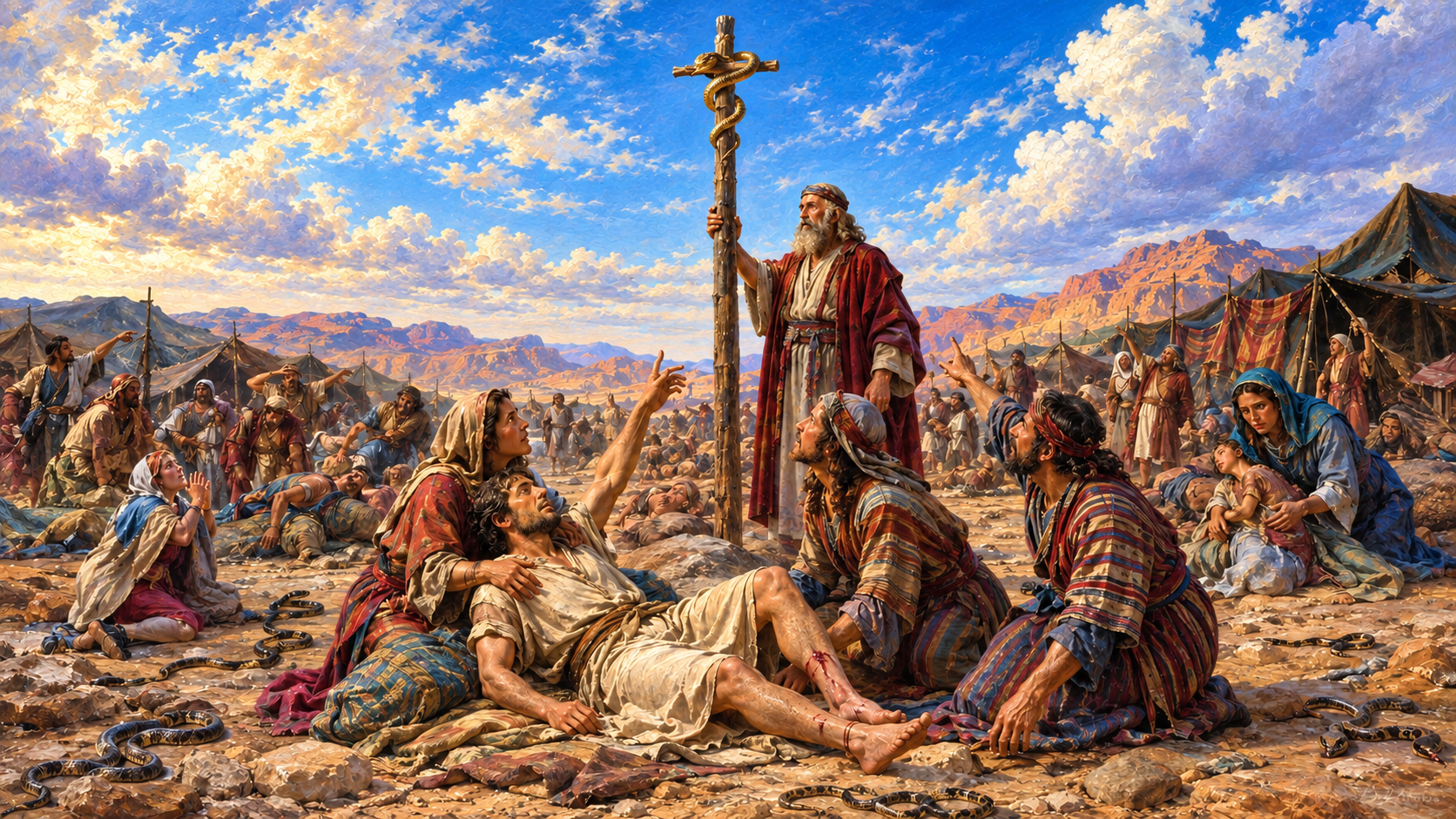
God told Moses to raise a bronze serpent among people who were dying from snakebites, with the promise that anyone bitten would live when he looked at it. Jesus later referred to that event when explaining His own death and the eternal life He gives. The sign that once directed dying Israelites to God’s provision also helps us understand why sinners must look to Christ.
Discouragement Turned Into Accusation
Numbers 21 takes place late in Israel’s wilderness journey. Edom had refused passage through its land, Aaron had died, and the people were taking the long route around Edom. Scripture describes their discouragement as they traveled:
Then they journeyed from Mount Hor by the Way of the Red Sea, to go around the land of Edom; and the soul of the people became very discouraged on the way.
The Hebrew nephesh, translated “soul,” can refer to a person’s life or inner being, as well as appetite and desire. The whole expression here describes how discouraged and impatient the people had become. Their hardship was real, but being tired or asking God for help was not the offense. Faithful people in the Psalms speak honestly to Him about fear and exhaustion, even when they do not understand their circumstances.
The Israelites accused God and Moses of bringing them out of Egypt to die. They said they had no food or water, then expressed disgust for the manna God had supplied. They spoke as though the God who freed them from slavery had brought them into the wilderness merely to kill them. The LORD had continued to guide and provide for them, and a difficult journey did not make that accusation true.
The LORD answered their rebellion with judgment:
So the LORD sent fiery serpents among the people, and they bit the people; and many of the people of Israel died.
“Fiery” may refer to the burning effect of the venom or to the serpents’ appearance. The passage explicitly identifies this as God’s response to Israel’s rebellion. We have no right to assume the same explanation for every sick person we meet. Job’s suffering should keep us from making such a reckless accusation.
The people then came to Moses and admitted what they had done:
We have sinned, for we have spoken against the LORD and against you; pray to the LORD that He take away the serpents from us.
They named their words against the LORD and Moses as sin. Stress might have explained their frustration, but it could not excuse the accusations. Moses prayed for the very people who had spoken against him, seeking God’s help for them even though they had wronged him.
God’s Remedy: Look and Live
The people asked for the serpents to be taken away. God’s answer gave those who had been bitten a way to live. He told Moses what to make and what promise to give them:
Make a fiery serpent, and set it on a pole; and it shall be that everyone who is bitten, when he looks at it, shall live.
Moses made the serpent of bronze and raised it on a pole. Numbers 21:9 records that when someone who had been bitten looked at it, he lived. The act of looking did not supply a cure or earn God’s help. People lived because God kept His promise, and looking where He directed was their response to that promise.
The bronze serpent was lifeless and carried no venom, although it resembled the creatures bringing death into the camp. Moses did not tell anyone to worship it or pray to it. God had appointed this public sign for that occasion and attached His promise to it. Trusting what He said was faith, rather than superstition about the metal.
God did not reserve His promise for the strongest people in the camp. A person weakened by a bite could look without buying treatment or learning a difficult ritual. The simplicity of the response gave him no reason to demand another remedy. Refusing to look would have meant rejecting the help God had supplied.
The Israelites could have told God they were weary without accusing Him of intending their death. I can likewise bring Him my confusion and pain, but hardship does not entitle me to dismiss His past care or charge Him with wrongdoing. If I have done that, I need to confess it instead of defending it as an understandable part of being upset.
Israel’s confession did not purchase the mercy that followed. It meant agreeing that their conduct was wrong and giving up their defense of it. I also appreciate Moses’ willingness to intercede for people who had accused him. Seeking mercy for someone who has wronged me does not require calling his conduct innocent.
Jesus Explains the Sign
Jesus referred to this event while speaking with Nicodemus, a ruler and teacher in Israel. Nicodemus knew Scripture and held an honored position, yet Jesus told him that he needed to be born again. He then explained where that life would come from:
And as Moses lifted up the serpent in the wilderness, even so must the Son of Man be lifted up, that whoever believes in Him should not perish but have eternal life.
Jesus compared the serpent Moses lifted up with the Son of Man who must be lifted up. The Israelites looked where God directed and lived; sinners believe in Christ and receive eternal life. This connection comes from Jesus Himself. It gives us a reason to read Numbers 21 in light of His death, without assigning a separate doctrine to every feature of the bronze object.
Later in John’s Gospel, Jesus again spoke of being lifted up. John 12:32–33 explains that He was indicating the kind of death He would die. His body would be raised publicly on the cross. When Jesus said He “must” be lifted up, He was speaking of the work He had come to accomplish. The cross was no accidental end to a failed mission. He gave Himself willingly, while the men who crucified Him remained responsible for their violence.
An Israelite dying from a snakebite needed rescue, regardless of how capable he had been before it happened. Our guilt likewise puts us in need of a Savior; becoming more religious or improving a few habits cannot reconcile us to God. Nicodemus’s knowledge and respected position could not give him the life Jesus was describing. I cannot rely on my background or reputation to do what only Christ can do.
Christ also gives far more than the earlier sign promised. Healing from a snakebite did not make those Israelites immortal. Jesus gives eternal life, and He possesses the power to save. We trust the living Son of God, rather than an object through which healing happened on a particular occasion.
The Sinless Substitute
A type is a pattern God gives that points toward a later fulfillment. Jesus connects the raised serpent with His own coming death, but the comparison does not mean that He became sinful because the sign resembled the creatures killing Israel.
He is the eternal Son, fully God and fully man, who remained holy while taking the sinner’s place. Paul describes His saving work this way:
For He made Him who knew no sin to be sin for us, that we might become the righteousness of God in Him.
Paul identifies the One made sin for us as the One who “knew no sin.” Jesus offered Himself as the sinless sacrifice and bore our sins in His own body. He did not acquire a corrupt nature or cease to be God.
Galatians 3:13 says Christ redeemed us from the law’s curse by becoming a curse for us. Paul cites the declaration that everyone hanging on a tree is cursed. Jesus accepted that publicly shameful, cursed death for guilty people; this does not mean the Father cursed His beloved Son. First Peter 2:24 likewise locates His sin-bearing in His own body on the tree.
Wicked men physically tortured and punished His innocent body. Jesus willingly endured that real punishment for our sins, shedding His blood and dying. His saving work was completed through His blood and death before His bodily resurrection. The Father did not punish, curse, abandon, strike, bruise, or pour wrath on Jesus. The Trinity was not torn apart, and the Son remained the spotless Lamb as He offered Himself.
He was buried and rose bodily from the dead, demonstrating that death could not hold Him. A sinful Jesus would have needed a Savior Himself. His true humanity enabled Him to stand in our place, while His deity gives His sacrifice infinite worth. Moses had prayed for guilty people, but Christ offered Himself for them and now lives as our only Mediator, the sinless God-man.
Faith Receives the Life God Gives
In that same conversation with Nicodemus, Jesus followed the comparison with a promise that makes the scope of God’s provision clear:
For God so loved the world that He gave His only begotten Son, that whoever believes in Him should not perish but have everlasting life.
I understand “whoever” as a genuine invitation. God loved the world, and Christ died for the whole world. His provision is not restricted to a hidden elect group while everyone else is excluded from a sincere offer. People can resist His appeal and reject Him, but He truly promises life to whoever believes.
John 3:17 says the Son was sent so that the world through Him might be saved, and verse 18 identifies the unbeliever as condemned already. Rejecting Christ does not leave someone in a safe, neutral position. A bitten Israelite who refused to look would still have been facing death. Likewise, unbelief leaves a sinner in the condition from which he needs deliverance. The warning is urgent because he needs salvation, not because the Savior is reluctant to give it.
Faith receives what God provides; it is not a payment we bring. Neither religious effort nor church membership can purchase life, and family heritage cannot produce the new birth. Good works follow salvation rather than cause it. We obey because Christ has saved us, not to persuade Him to save us.
Water baptism follows faith as commanded obedience identifying the believer with Christ; it does not cause regeneration. Communion remembers and proclaims His body and blood without repeating His sacrifice. These ordinances direct us to the Savior, and neither can accomplish what He alone provides.
Everyone who truly believes is born again and made a new creation. The Spirit indwells and seals that believer, who is eternally secure in Christ. Everlasting life is not a temporary arrangement revoked whenever a Christian stumbles. The Lord corrects His people and calls them to confess their sins and grow in holiness. His grace gives us reason for gratitude and obedience, never permission to make peace with sin.
Do Not Worship the Bronze
Long before Jesus spoke with Nicodemus, the bronze serpent had already become an object of idolatry. In Hezekiah’s day, centuries after Moses raised it, the people of Judah were burning incense to it. Its origin at God’s command had not kept them from misusing it. During his reforms, Hezekiah destroyed it along with other objects used in false worship:
He removed the high places and broke the sacred pillars, cut down the wooden image and broke in pieces the bronze serpent that Moses had made; for until those days the children of Israel burned incense to it, and called it Nehushtan.
Nehushtan means a piece of bronze, however highly the people had come to regard it. God had told earlier Israelites to look at it, but He had not commanded future generations to worship it. Its history could not legitimize their idolatry, and Hezekiah was right to destroy it.
I need to examine what I am trusting too. A cross necklace cannot save anyone, nor can a church building or a remembered baptism. A person might boast of using the right Bible translation while overlooking his own need for faith in the Lord it teaches him to know. Family tradition and a respected teacher’s reputation cannot make him right with God either.
This does not require despising every physical reminder. Scripture records God giving His people memorials, and baptism and communion teach spiritual truth through visible actions. The problem arises when a sign receives the trust that belongs to Christ. We can also become dependent on a ministry method or a remembered experience merely because God used it in the past. Something that once helped us should not displace the Savior it was meant to direct us toward.
Peter identified Jesus as the only Savior when speaking before Israel’s rulers after a man lame from birth had been healed in His name:
Nor is there salvation in any other, for there is no other name under heaven given among men by which we must be saved.
The miracle testified to the risen Christ’s authority. Peter did not present himself or a technique as the source of salvation. Nor is admiring the cross a substitute for believing in the One who died on it. Salvation is found in Jesus Himself.
Turning to Him requires honesty about why we need Him. If I speak cruelly to someone, calling myself blunt does not make it right. Pressure may explain why I was tempted to lose my temper, but it cannot make sinful conduct innocent. Self-examination can expose my guilt; it cannot remove it. I need the forgiveness only Christ can give.
Remembering that mercy should make us patient with people who struggle and earnest with those who remain lost. We did not receive life because we were stronger or wiser than they are. Christ supplied what we could not provide, and our witness should direct people to Him instead of encouraging confidence in our methods or cherished objects.
My Final Thoughts
I cannot remove my guilt by becoming more religious or promising to improve. The Israelites needed the remedy God supplied, and Jesus used their deliverance to explain why He would be lifted up for sinners. My confidence belongs in the sinless Son who bore our sins in His innocent body, shed His blood, died, and rose bodily. His promise of eternal life gives us reason to come to Him in faith, without trying to earn the mercy He freely offers.