
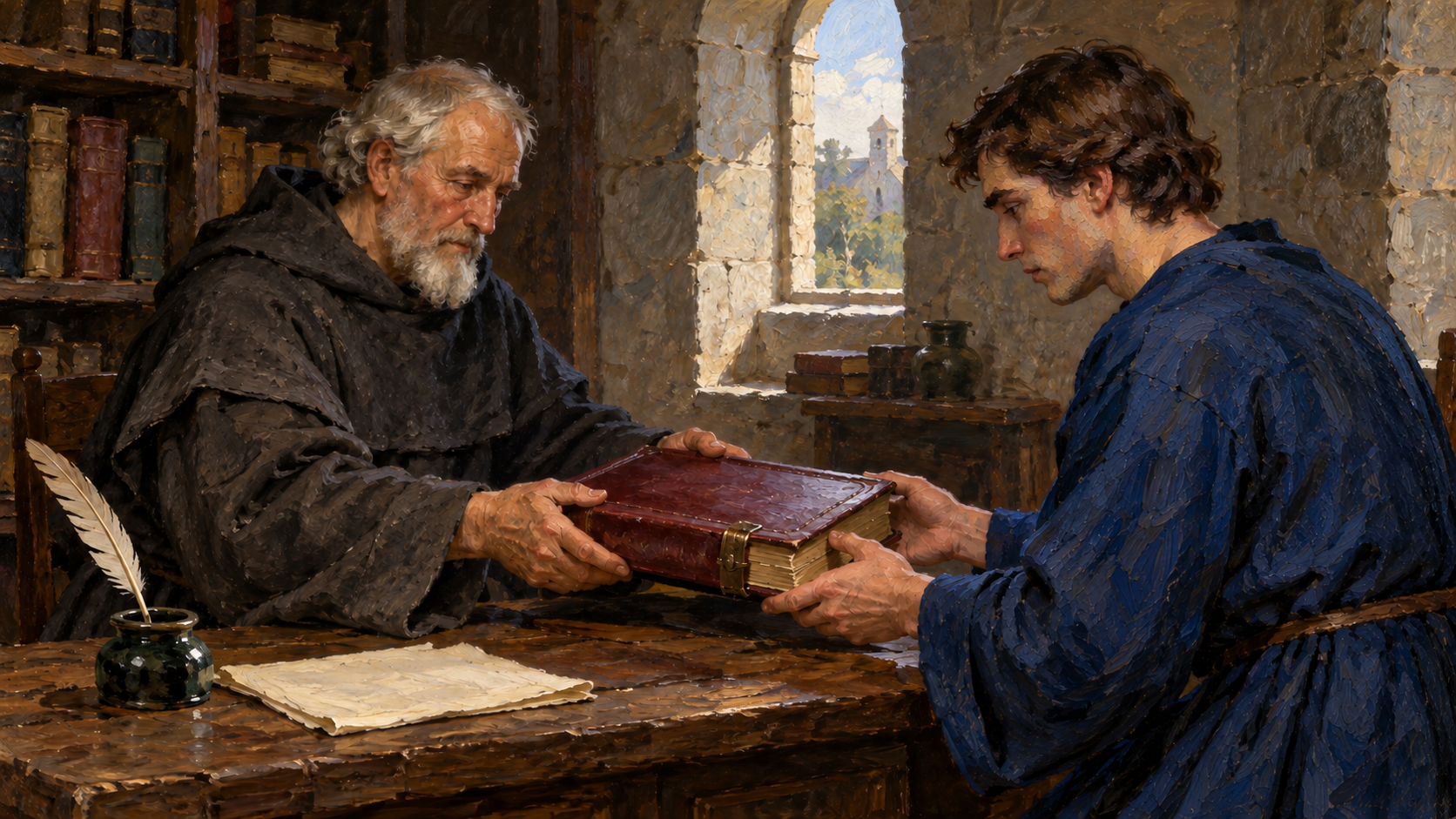
The phrase “Dark Ages” can settle our opinion of a thousand years before we have examined any of them. There was terrible corruption in medieval Christianity, including teaching that obscured the gospel and authorities who persecuted people they should have heard. There were also Christians copying Scripture, teaching their neighbors, and calling their own leaders to account. I want to tell the truth about both. Defending the Bible does not give me permission to repeat a false accusation against the people who preserved its manuscripts.
What We Mean by the Dark Ages
“Dark Ages” often refers to the early medieval centuries after Roman power weakened in Western Europe. Popular usage stretches the term across the whole Middle Ages, roughly AD 500 to 1500. Within that period, historians distinguish the early, high, and late Middle Ages, although the boundaries vary. A village living through invasions after Rome’s western collapse belonged to a different world from a university town in Wycliffe’s day. Nor did Western Europe, the Byzantine East, and Christian communities beyond them share the same circumstances.
To understand how church leaders gained political influence, we need to begin before the Western Empire fell. In 313, Constantine and Licinius agreed to religious toleration and the restoration of property confiscated from Christians. The agreement commonly called the Edict of Milan did not immediately make Christianity the empire’s official religion. Constantine subsequently favored Christianity, funded church buildings, granted privileges, and involved imperial power in church disputes. Christians could worship openly after persecution, but their leaders now faced opportunities to seek status and use a ruler’s power against opponents.
The entanglement of church and state developed over generations. One decree did not instantly create Roman Catholicism or turn every Christian practice into paganism. Imperial approval could make a church wealthy and influential without making its teaching true. A shepherd who depended on a ruler’s favor could gradually become more concerned about protecting church property and privileges than feeding the people entrusted to him.
The deposition of Romulus Augustulus in 476 conventionally marks the end of the Western Roman Empire. Roman society did not disappear with him. Law, roads, languages, estates, churches, and habits of government continued in altered forms. Invasions and political fragmentation disrupted trade and reduced urban life in some regions, but the extent and duration of the disruption varied. Meanwhile, the Eastern Roman Empire remained centered in Constantinople for almost another thousand years. Its people regarded themselves as Romans, even as Greek became their dominant language.
War, disease, poor literacy, and religious coercion caused immense harm during the medieval centuries. Yet missionaries preached, Christians founded hospitals, and schools continued teaching. Charlemagne encouraged educational and church reforms. Monastic scribes copied Scripture and biblical commentary alongside grammar, history, and classical literature; universities emerged in the high Middle Ages. Acknowledging that work does not require me to approve everything taught in those institutions. It does require me to stop describing every priest, monk, place, and century as though they were identical.
I will call a doctrine spiritually dark when it conceals the gospel or replaces God’s command. The New Testament had already warned about such departures while the Roman Empire was standing. Wolves could arise within the flock, leaders could pursue selfish ambition, and a discerning congregation could leave its first love. Political upheaval aggravated some problems, but it did not create the human heart’s willingness to misuse religion. Persecuted churches and privileged churches both needed correction, as ours do today.
Christ Preserved His Church Without Guaranteeing Every Institution
In Western Europe, the Latin church became a major landholder and an influential participant in education, law, and government. “Latin” describes its customary language of worship, scholarship, and administration. Western churches increasingly looked to the bishop of Rome, while bishops and abbots sometimes exercised civil authority themselves. Popes crowned rulers, negotiated during wars, and confronted monarchs.
That influence was extensive, but it was never the simple arrangement of one pope controlling every king for a thousand years. Rulers interfered with church appointments, armies humiliated popes, rival claimants divided loyalties, and local customs limited Roman authority. We can describe those limits honestly while rejecting the claim that the bishop of Rome inherited Christ’s headship over every believer.
Peter had a real apostolic calling. In Matthew 16, his confession identifies the One on whom the church depends:
He said to them, “But who do you say that I am?” Simon Peter answered and said, “You are the Christ, the Son of the living God.” Jesus answered and said to him, “Blessed are you, Simon Bar-Jonah, for flesh and blood has not revealed this to you, but My Father who is in heaven. And I also say to you that you are Peter, and on this rock I will build My church, and the gates of Hades shall not prevail against it.”
Jesus is the Christ, the Son of the living God, and He builds the church that belongs to Him. Peter received that truth from the Father; his importance as an apostolic witness does not make later Roman bishops infallible monarchs. The church rests on Christ and the apostles’ testimony to Him. Qualified elders are entrusted with local congregations under His authority.
Christ’s promise means His church will endure and share His resurrection victory. It does not guarantee that every congregation, diocese, or denomination will remain faithful. An institution can retain its buildings, offices, and legal recognition after abandoning the truth those things were supposed to serve. Later in Revelation, Jesus warns that He can remove a congregation’s lampstand if it refuses to repent. Wealth and antiquity cannot exempt a church from His judgment.
The universal church consists of everyone truly born again through faith in Christ, in every time and place. Believers ordinarily gather in visible local assemblies, where others may profess faith without possessing new life. An institution’s corruption therefore does not prove that Christ lost His people. Nor must we invent a secret denomination with an uninterrupted organizational chain through the centuries to rescue His promise. Christ knows His own, and the historical record contains Scripture, gospel testimony, reform, and dissent in many settings.
Each of those witnesses still needs to be examined. Opposing Rome did not make a medieval group doctrinally pure, any more than belonging to a powerful institution made its leaders faithful. I discuss the church’s identity and calling further in A Complete Bible Study on the Ecclesia.
Scripture Survived Even When Access Was Limited
The surviving manuscripts disprove the claim that the Bible vanished for a thousand years. Western churches and monasteries copied the Latin Scriptures, read them in worship, and produced commentaries. Byzantine Christians copied Greek manuscripts. Schools and universities later increased Western demand for Bibles. The reformers received a text that medieval copyists had helped transmit.
Copying a complete Bible required trained labor and expensive materials. Most people could not purchase one, many could not read, and those who read their own language did not necessarily understand Latin. Ordinary worshipers depended heavily on public readings, sermons, biblical art, and liturgy for their knowledge of Scripture. The Metropolitan Museum’s account of medieval book production explains the labor behind these manuscripts. Their survival demonstrates preservation; it does not demonstrate that everyone had ready access to them.
Some barriers were imposed by authorities. Particular councils and rulers restricted unauthorized translations or texts associated with condemned movements. In England, Archbishop Arundel’s constitutions, brought into force in 1409, required approval for new vernacular translations and for using translations made in or after Wycliffe’s time. “Vernacular” means the language people ordinarily spoke. Enforcement varied, but these restrictions were real obstacles to access.
They do not establish that every layperson everywhere was forbidden to read any Scripture. Psalms, Gospel passages, selected readings, biblical paraphrases, and devotional books circulated in French and other languages before the Reformation. Laypeople as well as clergy owned such material. We have to ask where a restriction applied, what it prohibited, and how it was enforced, rather than turning a regional rule into a universal ban.
Even a chain attached to a Bible requires some explanation. Churches and libraries chained expensive volumes to protect them from theft while allowing consultation in a fixed place. A chained book could be available to readers; the chain itself does not prove suppression. We still need to know who could enter, when they could read, whether they understood the language, and whether the instruction they received explained the text faithfully.
Preserving a manuscript and teaching its meaning are separate responsibilities. A church could keep Scripture on an altar while using tradition to prevent its message from correcting the institution. God entrusted His Word to His people as stewards and witnesses. They did not create its authority and cannot place themselves above it. When leaders withhold the text to protect their own claims, they misuse that trust.
I therefore want people to have Scripture in a language they understand, hear it explained carefully, and be able to examine what their teachers say. Those responsibilities belong together. Simply putting a Bible into someone’s hands does not excuse shoddy interpretation, and a teacher’s learning does not authorize him to silence questions. How to Study the Bible Properly develops the practical work of reading a passage in context.
Tradition and Every Teacher Must Remain Under the Gospel
Jesus confronted religious leaders who used inherited teaching to evade God’s command:
He answered and said to them, “Well did Isaiah prophesy of you hypocrites, as it is written: ‘This people honors Me with their lips, But their heart is far from Me. And in vain they worship Me, Teaching as doctrines the commandments of men.’ For laying aside the commandment of God, you hold the tradition of men—the washing of pitchers and cups, and many other such things you do.”
The apostles themselves handed down teaching, and churches need ways to explain what they believe. Tradition is not automatically false. Jesus condemned the brazen substitution of human requirements for God’s command while retaining the appearance of worship. A practice may be ancient, familiar, and sincerely defended, yet still need to be abandoned because Scripture contradicts it.
Medieval teaching about papal supremacy, prayers to Mary and departed saints, and the veneration of images and relics developed through different debates and circumstances. Relics are objects associated with a revered person, sometimes including bodily remains. Teachings about purgatory, a proposed purification after death, developed alongside a penitential system in which religious acts were prescribed to people confessing their sins. These teachings did not all appear together by a single decree.
Catholic teaching distinguishes the veneration of images from the adoration owed to God alone; its catechism explains that distinction in paragraph 2132. That is different from claiming a statue is God. My objection concerns the religious devotion directed through images and the invocation of departed people without biblical authorization. Scripture teaches one God in three Persons and identifies the Man Christ Jesus as the one Mediator between God and men. Believers can pray to God through Him. An image cannot contain God’s presence, and an object associated with a saint cannot convey saving merit.
In Catholic doctrine, an indulgence remits temporal punishment for sins whose guilt has already been forgiven; it is not officially defined as purchasing initial forgiveness. The church claims to apply a treasury of the merits of Christ and the saints for that purpose, including on behalf of the dead. The Catholic catechism’s explanation of indulgences states these claims. My disagreement reaches beyond the abuses associated with their sale: Scripture gives no authority for an institution to distribute the merits of Mary and other saints to relieve such penalties. I believe this adds an unauthorized system of spiritual penalties and remedies to the sufficient saving work of Christ. The church is commissioned to proclaim His finished work, and the good works of believers cannot become a treasury it dispenses to other sinners.
The gospel provides the test for every claim to spiritual authority. Paul applied it even to himself:
I marvel that you are turning away so soon from Him who called you in the grace of Christ, to a different gospel, which is not another; but there are some who trouble you and want to pervert the gospel of Christ. But even if we, or an angel from heaven, preach any other gospel to you than what we have preached to you, let him be accursed. As we have said before, so now I say again, if anyone preaches any other gospel to you than what you have received, let him be accursed.
If an apostle or an angel must be rejected for preaching a different gospel, a pope, council, theologian, or ruler cannot demand an exemption. Neither an impressive vision nor centuries of acceptance can change how a sinner is reconciled to God. We receive salvation as God’s gift through faith in Jesus Christ, apart from works. Sacraments, pilgrimages, almsgiving, acts of penance, indulgences, and institutional membership cannot justify us before God. He declares believers righteous through faith in Christ, and good works follow from the new life He gives.
The Reformation proclaimed justification by faith apart from works with needed force. It did not create the gospel in 1517. That gospel was already in the apostolic Scriptures and had been confessed with varying clarity before Luther. It also judged Luther and every other reformer. Rejecting one false authority does not authorize a replacement to alter the same message.
Paul warned church elders that the threat could arise among the leaders themselves:
Therefore take heed to yourselves and to all the flock, among which the Holy Spirit has made you overseers, to shepherd the church of God which He purchased with His own blood. For I know this, that after my departure savage wolves will come in among you, not sparing the flock. Also from among yourselves men will rise up, speaking perverse things, to draw away the disciples after themselves.
Paul first told the elders to watch themselves. Their office could not sanctify greed or excuse their conduct, because the flock belonged to the One who purchased it with His blood. Reform therefore had to address both teaching and behavior. An orderly institution could still preach a false gospel, while a leader who recited correct doctrine could still prey on the people he was supposed to shepherd. A Complete Bible Study on False Teachers examines those warnings more fully.
Medieval records reveal the kinds of abuses Paul warned about. They document simony, the buying or selling of church office or spiritual privilege. They also document sexual immorality, luxurious living, political appointments of unfit men, and neglect of the people entrusted to their care. Councils and writers within the institution denounced such abuses, so the evidence does not support condemning every priest or monastery indiscriminately. It does expose what happens when spiritual office becomes a means of gaining money and power.
Church and civil authorities also imprisoned people accused of heresy, confiscated property, tortured some, and executed others. Force can compel outward compliance; it cannot produce faith in Christ. No one should be punished simply for translating, possessing, or teaching Scripture. Some dissenters protested genuine errors, while others advanced political causes, mystical claims, or mistaken sacramental teaching of their own. Their errors did not justify persecution, and their courage did not make every belief correct.
Reform, Printing, and the Duty to Tell the Truth
Among the movements that challenged established authority were the Waldensians, who arose around Peter Waldo in the late twelfth century. They emphasized poverty, preaching in ordinary people’s language, and the right of lay believers to proclaim the message. Their communities endured severe persecution in parts of Europe. Lollardy arose later in England under Wycliffe’s influence, criticizing clerical wealth and certain doctrines while circulating English biblical texts despite legal repression. Neither movement was uniform, and neither supplies a simple organizational chain back to the apostles. They do show that appeals to Scripture continued despite attempts to silence them.
John Wycliffe was an Oxford theologian and Catholic priest who challenged papal claims and clerical wealth. Near the end of the fourteenth century, his followers produced the first complete English Bible, translated from the Latin Vulgate used in the Western church. Its Middle English differs considerably from modern English. Calling it “Wycliffe’s Bible” does not mean he personally translated every book from Hebrew and Greek. Translators and revisers worked on earlier and later versions, and over 250 manuscript witnesses survive.
The British Library’s Wycliffite Bible record describes a surviving portion made for Thomas of Woodstock, Duke of Gloucester. Oxford’s manuscript catalogue documents another substantial collection; the faculty also provides an updated catalogue description. These witnesses show how extensively the translation circulated despite opposition and restrictions. Later English translators would work from Hebrew and Greek rather than translating through Latin, but the Wycliffite Bible had already placed a complete biblical text in English before readers and challenged clerical claims with it.
Wycliffe’s influence also reached Bohemia, where Jan Hus preached against clerical corruption. Hus received much from Wycliffe while disagreeing with him on other teachings. The Council of Constance condemned Hus, and civil authorities burned him in 1415 after he refused to recant positions he believed could not be refuted from Scripture. His appeal and his death deserve to be understood within their medieval setting. He did not already hold every formulation of a later Protestant confession.
The familiar claim that Hus predicted a swan would arise a century after the killing of a goose is not securely documented as his dying statement. It should not be preached as fulfilled prophecy. His recorded convictions and execution already provide ample grounds for examining institutional violence; embellishment only weakens an otherwise serious account.
Within decades of Hus’s death, Johannes Gutenberg, Johann Fust, and their associates produced the Gutenberg Bible at Mainz around 1454–55. The Library of Congress Gutenberg guide describes a probable print run of about 180 copies. It was the first large-format typographic Bible produced in Europe. Printing and movable type already had a history in Asia, so Gutenberg should not be credited with inventing all printing everywhere. His metal-type system nevertheless transformed Western book production.
Printers arranged reusable letters into pages, inked the type, and pressed multiple copies before rearranging it. A single setting could therefore produce many copies of the same text. The Gutenberg Bible itself was a Latin Vulgate, rather than a Protestant translation into everyday language, and early printed books remained expensive. Printing did not suddenly make everyone literate. Over time, however, presses and distribution networks allowed Bibles, sermons, and controversial pamphlets to circulate far more quickly than hand copying permitted.
That expanding trade helped spread Martin Luther’s ninety-five theses. On October 31, 1517, he sent Archbishop Albrecht a letter criticizing indulgence preaching and enclosed his propositions for debate. The letter and theses are well established. The familiar scene of hammering them onto the Castle Church door is disputed: posting a university notice would have been plausible, but the later account came from Philip Melanchthon, who was not in Wittenberg in 1517, and Luther did not record that act himself.
The theses were not a finished Protestant confession. Luther’s understanding developed as arguments over authority and justification widened into disputes about worship, the sacraments, civil power, and the biblical text. I am grateful for the recovery of Scripture’s final authority and justification by faith apart from works. Gratitude does not require me to endorse every conclusion or action of the reformers. They stood under the same Word they placed over Rome.
History Places Every Church Under the Word
Paul described the church’s responsibility to uphold the truth:
These things I write to you, though I hope to come to you shortly; but if I am delayed, I write so that you may know how you ought to conduct yourself in the house of God, which is the church of the living God, the pillar and ground of the truth.
A pillar supports what rests on it. The church is to uphold and display God’s truth, not invent it or prevent Scripture from correcting its leaders. Medieval authorities sometimes treated biblical correction as a threat because accepting it might cost them wealth, influence, or inherited claims. A modern pastor or denomination can react the same way when protecting its reputation becomes more urgent than admitting error.
A favorite teacher can become a practical magisterium, a teaching authority whose conclusions we treat as beyond question. Political loyalties, an academic consensus, an algorithm, or a claim of private revelation can also begin ruling our conscience. I should learn from scholars and experienced Christians while examining the grounds for their conclusions. I need the instruction and accountability of a local church where even the most respected voice remains answerable to the written Word.
Being able to identify another teacher’s error does not settle the condition of our own church. Jesus told the discerning congregation at Ephesus:
Nevertheless I have this against you, that you have left your first love. Remember therefore from where you have fallen; repent and do the first works, or else I will come to you quickly and remove your lampstand from its place–unless you repent.
They needed to remember, repent, and return to the works they had abandoned. Their earlier faithfulness could not excuse their present neglect of love. Neither can ours. A church can become skilled at exposing medieval corruption while refusing Christ’s correction of the conduct taking place in its own congregation.
A church returning to Christ must also resist teachers who turn grace into an excuse for sin. Jude calls believers to defend the faith they have received:
Beloved, while I was very diligent to write to you concerning our common salvation, I found it necessary to write to you exhorting you to contend earnestly for the faith which was once for all delivered to the saints. For certain men have crept in unnoticed, who long ago were marked out for this condemnation, ungodly men, who turn the grace of our God into lewdness and deny the only Lord God and our Lord Jesus Christ.
The faith was delivered to the saints; it is not ours to reinvent. Defending it requires the courage to name error and the honesty to abandon accusations that are false. When a familiar claim about the Middle Ages proves inaccurate, I need to correct it even if it has served my side of an argument for years. Scripture gives us enough grounds to expose false teaching without manufacturing evidence against its teachers. Paul reminded Timothy of the authority and purpose of those Scriptures:
and that from childhood you have known the Holy Scriptures, which are able to make you wise for salvation through faith which is in Christ Jesus.
All Scripture is given by inspiration of God, and is profitable for doctrine, for reproof, for correction, for instruction in righteousness,
that the man of God may be complete, thoroughly equipped for every good work.
These Scriptures lead us to salvation through faith in Christ and equip God’s people for every good work. Keeping the text available and teaching it faithfully therefore serves far more than historical curiosity. People need to hear how they can be reconciled to God and how He calls them to live.
For by grace you have been saved through faith, and that not of yourselves; it is the gift of God,
not of works, lest anyone should boast. For we are His workmanship, created in Christ Jesus for good works,
which God prepared beforehand that we should walk in them.
Our salvation rests on Jesus Christ, fully God and fully man, who lived without sin and willingly gave Himself for us. Wicked men physically tortured and punished Him, then killed Him. He bore that real bodily suffering for our sins and completed His saving work through His shed blood and death before His bodily resurrection. He was buried and rose again. The Father did not punish, curse, abandon, strike, bruise, or pour wrath on Jesus.
Christ died for the whole world, and God’s offer of salvation is genuine for every person, although people can resist and reject it. Everyone who repents and believes is forgiven, justified by faith, and given everlasting life. Those truly born again become new creations, indwelt and sealed by the Holy Spirit. They are eternally secure in Christ, whose grace produces a changed life rather than permission for lawlessness. A Christian label or a superficial profession cannot substitute for genuine new birth.
Jesus calls those who believe Him to continue in His teaching:
Then Jesus said to those Jews who believed Him, “If you abide in My word, you are My disciples indeed. And you shall know the truth, and the truth shall make you free.”
Having access to a Bible carries the responsibility to heed it. I cannot claim the freedom Christ describes while allowing another human authority to overrule His Word, or while refusing it when it corrects me. The same Scripture that exposes another church’s error must govern my own beliefs and conduct.
My Final Thoughts
Christ did not lose His church or His Word during the medieval centuries. Scripture survived through the labor of imperfect people and institutions, and witnesses continued to challenge corruption. We can be grateful for that preservation while condemning false doctrine and persecution plainly. The apostolic gospel judged Rome, the dissenters, and the reformers; it continues to judge our churches. I want to receive what God preserved, teach it accurately, and accept its correction even when obedience costs me a cherished tradition.