
Israel entered Egypt as a family welcomed because of Joseph, but later generations lived in slavery under rulers who treated their growth as a threat. Exodus follows their rescue and explains why the LORD intervened. He kept His promises to Abraham, Isaac, and Jacob, made His name known through judgment on Egypt, and brought His people out to worship Him. By the end of the book, He was dwelling among the people Pharaoh had tried to destroy.
From Joseph to Pharaoh’s Oppression
Joseph’s brothers had sold him into Egypt, but God raised him to authority and used him to preserve many lives during famine. Jacob’s household settled in Goshen under Pharaoh’s protection. After Joseph and his brothers died, their descendants continued to multiply. The family that had arrived needing food became a large people living within Egypt.
Their position changed under a king who did not know Joseph. Exodus does not blame Joseph for what followed or identify a particular sin by Israel as the reason for this oppression. It describes a ruler who regarded their increasing numbers as a problem to be controlled.
Now there arose a new king over Egypt, who did not know Joseph.
Exodus 1:8, NKJV
The Hebrew verb yada, translated “know,” can include recognizing or acknowledging. I think the king’s disregard for Joseph’s service is part of the point. Whatever he had heard about Joseph, his policy showed no gratitude for the man through whom Egypt had survived famine. He portrayed Joseph’s descendants as a potential enemy.
come, let us deal shrewdly with them, lest they multiply, and it happen, in the event of war, that they also join our enemies and fight against us, and so go up out of the land.”
Exodus 1:10, NKJV
Pharaoh made oppression sound like a sensible precaution against war. His proposed solution was forced labor, intended to suppress Israel’s growth and keep its people under Egyptian control. Their affliction did not produce the result he wanted.
But the more they afflicted them, the more they multiplied and grew. And they were in dread of the children of Israel.
Exodus 1:12, NKJV
As Israel continued to grow, Egypt’s dread of them increased. The Egyptians imposed exhausting work making bricks and mortar and laboring in the fields. Exodus describes the bitterness of that life plainly.
So the Egyptians made the children of Israel serve with rigor. And they made their lives bitter with hard bondage–in mortar, in brick, and in all manner of service in the field. All their service in which they made them serve was with rigor.
Exodus 1:13-14, NKJV
God had already told Abram in Genesis 15:13-16 that his descendants would live as strangers and suffer affliction before He brought them out. Pharaoh’s policy had not caught Him unprepared, but foreknowledge did not make the cruelty righteous or the suffering insignificant. The rulers were responsible for what they did. I need to keep that responsibility in view while recognizing that no king could cancel the covenant God had made.
Pharaoh then ordered the Hebrew midwives, Shiphrah and Puah, to kill the boys they delivered. Exodus names these women even though it does not give us the king’s name. They had no army with which to oppose him, but they knew that his office did not give him the right to demand murder.
But the midwives feared God, and did not do as the king of Egypt commanded them, but saved the male children alive.
Exodus 1:17, NKJV
Their fear of God directed what they did in their daily work. They refused to treat an evil command as a duty merely because it came from the king, even though refusing him could cost them dearly. We should respect those over us, but we cannot give them the obedience that belongs to God alone.
The king did not abandon his campaign against the children. He widened it, ordering his people to throw the Hebrew boys into the river. Moses was born under that decree.
Moses Preserved and Prepared
Moses’ mother hid him for three months. When she could no longer conceal him, she placed him in a small vessel among the reeds by the riverbank. The Hebrew word tevah is also used for Noah’s ark. The vessels were very different in size, but both sheltered life in the water. Before Moses could do anything for Israel, his own life had to be preserved.
Pharaoh’s daughter found the child and had compassion on him, knowing he was a Hebrew. Through his sister’s intervention, Moses’ own mother was hired to nurse him before he became the princess’s son. The royal household that had threatened Hebrew children would now raise one of them. Stephen later described the education Moses received there.
And Moses was learned in all the wisdom of the Egyptians, and was mighty in words and deeds.
Acts 7:22, NKJV
That education gave Moses knowledge of Egypt, but a palace upbringing could not authorize him to speak for God. Nor did he allow the advantages of that upbringing to settle where he belonged. Paul describes his decision in Hebrews.
By faith Moses, when he became of age, refused to be called the son of Pharaoh’s daughter,
Hebrews 11:24, NKJV
esteeming the reproach of Christ greater riches than the treasures in Egypt; for he looked to the reward.
Hebrews 11:26, NKJV
Moses lived before the cross and resurrection, yet faith in God’s promises led him to identify with God’s people and value the reproach of Christ above Egypt’s treasures. He was willing to be counted among an afflicted people rather than let royal privilege determine his allegiance.
His concern for his people did not make every action he took right. When he saw an Egyptian beating a Hebrew, he killed the Egyptian and concealed the body.
So he looked this way and that way, and when he saw no one, he killed the Egyptian and hid him in the sand.
Exodus 2:12, NKJV
When Pharaoh learned what Moses had done, he sought to kill him, and Moses fled to Midian. The man raised in Egypt’s royal household became a shepherd and spent long years away from the court. Midian would be the setting of God’s preparation and call; Moses would return to Egypt with a commission from the LORD rather than an authority his education or position could supply.
Moses had witnessed a real injustice, but killing the man and hiding him was not how God would free Israel. I can recognize that someone is being mistreated and still answer that wrong sinfully. A good cause does not excuse whatever method I choose. The LORD would send Moses to make His demand openly and bring Egypt under judgments the nation could see.
While Moses was in Midian, the Egyptian king died, but Israel remained in bondage. Exodus 2:23-25 says that God heard their groaning and remembered His covenant with Abraham, Isaac, and Jacob. He was about to act on the promises that Egypt’s oppression had not annulled.
The Burning Bush and the Name of the LORD
Moses was tending sheep near Horeb when the Angel of the LORD appeared in a bush that burned without being consumed. He turned aside to look, and God called him by name.
And the Angel of the LORD appeared to him in a flame of fire from the midst of a bush. So he looked, and behold, the bush was burning with fire, but the bush was not consumed. Then Moses said, “I will now turn aside and see this great sight, why the bush does not burn.” So when the LORD saw that he turned aside to look, God called to him from the midst of the bush and said, “Moses, Moses!” And he said, “Here I am.” Then He said, “Do not draw near this place. Take your sandals off your feet, for the place where you stand is holy ground.” Moreover He said, “I am the God of your father–the God of Abraham, the God of Isaac, and the God of Jacob.” And Moses hid his face, for he was afraid to look upon God.
Exodus 3:2-6, NKJV
The passage first identifies the Angel of the LORD, then says that the LORD saw Moses and God spoke from the bush. The speaker identifies Himself as the God of Abraham, Isaac, and Jacob. I understand this as a Christophany, an appearance of the eternal Son before His incarnation, rather than an ordinary created angel speaking only about God.
Moses had to remove his sandals and keep the distance God required. The ground was holy because God was there. The God who had heard Israel’s suffering was drawing near to rescue them, but Moses still had to approach Him with reverence. His commission would come from the One who had made the covenant with Israel’s fathers.
God commissioned Moses to go to Pharaoh and bring Israel out of Egypt. When Moses questioned his fitness for that task, God answered by promising to go with him.
But Moses said to God, “Who am I that I should go to Pharaoh, and that I should bring the children of Israel out of Egypt?” So He said, “I will certainly be with you. And this shall be a sign to you that I have sent you: When you have brought the people out of Egypt, you shall serve God on this mountain.”
Exodus 3:11-12, NKJV
The promise “I will certainly be with you” gave Moses a reason to go that did not depend on confidence in himself. God also named the purpose of the rescue: Israel would serve Him on that mountain. Moses then asked what he should tell the Israelites when they asked the name of the God who had sent him.
And God said to Moses, “I AM WHO I AM.” And He said, “Thus you shall say to the children of Israel, ‘I AM has sent me to you.’”
Exodus 3:14, NKJV
“I AM WHO I AM” reveals the living God who exists in and of Himself, depending on nothing outside Himself for life. Exodus 3:15 gives the name represented by YHWH, printed as LORD in many English Bibles. Moses would face Pharaoh in the name of this God, whose covenant with Israel’s fathers remained in force.
Moses raised further objections, telling God that he was not eloquent. The LORD promised help with his speech, but Moses eventually asked Him to send someone else. That refusal provoked God’s anger.
But he said, “O my Lord, please send by the hand of whomever else You may send.” So the anger of the LORD was kindled against Moses, and He said: “Is not Aaron the Levite your brother? I know that he can speak well. And look, he is also coming out to meet you. When he sees you, he will be glad in his heart.
Exodus 4:13-14, NKJV
Aaron would help Moses speak, but Moses still had to go. God provided assistance without withdrawing the commission. If the Lord has clearly commanded something, I cannot make feeling capable a condition of obeying Him. Admitting my weakness should lead me to depend on Him and receive the help He provides, rather than turn reluctance into a reason to reject His Word.
Judgment on Egypt and Pharaoh’s Hardened Heart
When Moses returned to Egypt and brought God’s demand to Pharaoh, the king refused to recognize the LORD’s authority over him.
And Pharaoh said, “Who is the LORD, that I should obey His voice to let Israel go? I do not know the LORD, nor will I let Israel go.”
Exodus 5:2, NKJV
Pharaoh increased Israel’s burden instead of releasing them. The worsening conditions also discouraged the people, and Moses again questioned whether Pharaoh would listen to him. In Exodus 6:12, he described himself as having “uncircumcised lips.” Circumcision was the covenant sign of being set apart, and Moses used the opposite image for his own speech to describe how unfit he felt as God’s spokesman. God did not let that objection cancel His command to bring Israel out.
The plagues that followed exposed the limits of everything Egypt depended on. The Nile’s waters became blood, followed by frogs, lice, and flies. Disease struck the livestock, and boils afflicted people and animals. Hail and locusts devastated the land, and darkness covered it before the final judgment on the firstborn. The nation could not secure its food, health, or future against the LORD who commanded creation.
Exodus 12:12 also describes judgment against Egypt’s gods. The book does not give us a list assigning each plague to one named deity, so some proposed pairings go beyond what it actually identifies. We can say plainly that Egypt’s religion and royal power could not protect the nation from the Creator. The magicians imitated some early signs, but those imitations gave Pharaoh no relief. By the plague of lice they acknowledged the finger of God, and later the boils left them unable even to stand before Moses.
God also announced particular acts of protection for His people. Before the flies came, He specified that Goshen would be spared and explained what Pharaoh was to learn from it.
And in that day I will set apart the land of Goshen, in which My people dwell, that no swarms of flies shall be there, in order that you may know that I am the LORD in the midst of the land.
Exodus 8:22, NKJV
God was exercising authority within the land Pharaoh claimed to control. He announced Goshen’s protection beforehand, so it could not reasonably be dismissed as fortunate weather or chance. He was deliberately caring for His covenant people.
Exodus describes Pharaoh hardening himself, his heart becoming hard, and the LORD hardening him. God had already foretold His hardening in Exodus 4:21, before Moses returned to confront the king. We therefore cannot treat it as an unexpected development. Yet Pharaoh’s own rebellion is also explicit: before the first plague, he had rejected God’s demand and made Israel’s bondage worse.
During the judgments, Pharaoh repeatedly promised to release Israel when the suffering became unbearable. Once relief came, he took back his word and refused again. His conduct shows why a promise made under pressure is not necessarily repentance. He had received warnings and evidence of God’s power, but he continued trying to retain control of the people God had commanded him to release.
I understand God’s hardening as judicial confirmation of that rebellion, meaning a judgment that confirmed Pharaoh in the course he had chosen. One Hebrew verb used for hardening, chazaq, can mean to strengthen or make firm; in these passages it describes a heart made stubborn. Paul quotes the LORD’s words to Pharaoh when explaining how God used the king to display His power and make His name known.
For the Scripture says to the Pharaoh, “For this very purpose I have raised you up, that I may show My power in you, and that My name may be declared in all the earth.” Therefore He has mercy on whom He wills, and whom He wills He hardens.
Romans 9:17-18, NKJV
I do not read Paul as saying that God created evil in an innocent man or made Pharaoh a blameless puppet. Pharaoh was responsible for defying the LORD, and the LORD had the right to judge him and use his resistance to display His power. Neither the king’s stubbornness nor his position could force God to abandon Israel.
Passover and Christ Our Passover
Before the final plague, God instructed Israel about Passover. A household would be spared the judgment on the firstborn through the blood of an unblemished lamb, placed as He commanded. Israelite ancestry alone was not sufficient protection; the people had to receive the means of rescue God appointed.
The LORD told Israel to reckon that month as the first month of their year, making the coming deliverance central to their calendar and worship. Families selected their lambs and kept them until the appointed day. They were to eat the meal dressed and ready to leave, with unleavened bread reflecting the haste of their departure. God also specified where the lamb’s blood belonged.
And they shall take some of the blood and put it on the two doorposts and on the lintel of the houses where they eat it.
Exodus 12:7, NKJV
The household took shelter under that blood as God commanded. Its occupants could not invent a different sign for the doorway or merely agree that a lamb had died somewhere in Egypt. A substitute had died, and they were to trust God’s Word by remaining within the refuge He provided. The blood was not a charm that worked independently of Him.
Paul identifies Christ with the fulfillment to which Passover pointed.
Therefore purge out the old leaven, that you may be a new lump, since you truly are unleavened. For indeed Christ, our Passover, was sacrificed for us.
1 Corinthians 5:7, NKJV
Jesus is the eternal Son, fully God and fully man. He was born of a virgin and lived without sin, the true Passover Lamb. Wicked men tortured Him and inflicted real physical punishment on Him, while He willingly bore the punishment for our sins in His innocent body. His shed blood and death completed our redemption before He was buried and rose bodily from the grave.
The Father did not punish, curse, abandon, strike, bruise, or pour wrath on Jesus. The Father and Son remained united in redemption. Christ’s blood is the only sufficient basis for forgiveness; we cannot devise another refuge any more than the Passover households could invent their own terms of rescue.
Christ died for the whole world, and God’s offer of salvation is genuine, although people can resist His grace and reject Him. Everyone who repents and believes in Jesus is forgiven and justified, declared righteous before God through faith. God brings that person to new birth and makes him a new creation, and the Holy Spirit comes to dwell within him and seals him. Salvation is received by grace through faith. Observing Passover or being baptized cannot earn it, and neither can church membership, keeping the law, or improving our conduct.
Those who are truly born again are eternally secure because Christ keeps the people He saves. Their failures do not undo His finished work, but that security gives no permission for lawlessness. Obedience follows as evidence of new life, rather than a payment for it. A superficial profession of faith cannot establish that someone has been regenerated, meaning genuinely born again.
Through the Red Sea to Worship
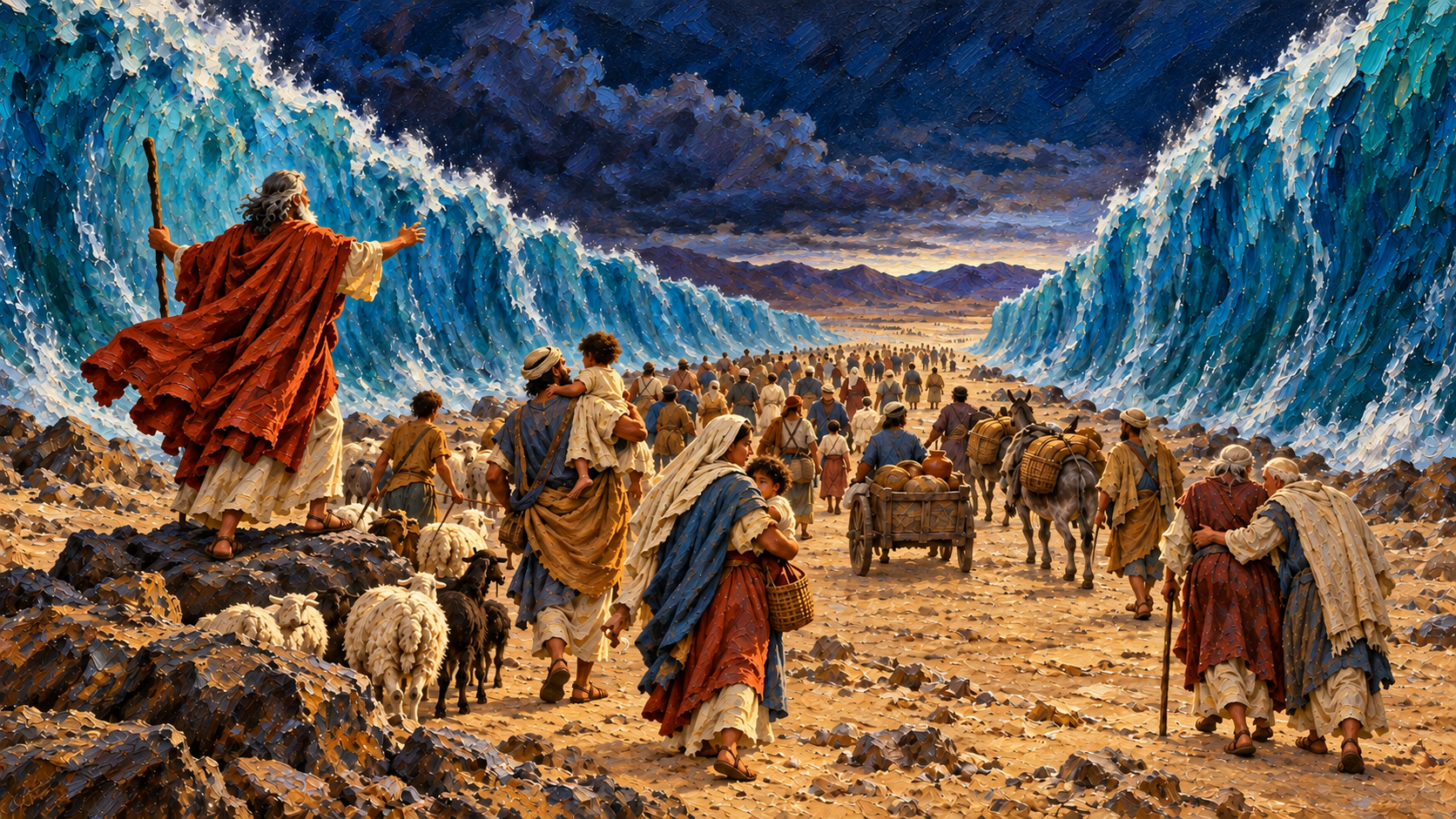
After the judgment on Egypt’s firstborn, Pharaoh told Moses and Aaron to take Israel out of the land. He then changed his mind and pursued the people with his army. With the sea ahead and Egyptian chariots approaching behind them, the Israelites could not fight their way free. Moses told them to “stand still” and see the LORD’s salvation.
The LORD will fight for you, and you shall hold your peace.
Exodus 14:14, NKJV
That command to trust God did not mean they were never to move. The LORD then told them to go forward, and He opened a path through the sea. Israel crossed on dry ground before the waters closed over the army pursuing them. Obedience now meant walking where God had made a way, rather than remaining at the shoreline or trying to defeat Pharaoh by their own strength.
The same passage through the sea rescued Israel and brought judgment on the force seeking to return them to slavery. God had done what neither Moses’ education nor Israel’s strength could accomplish. Pharaoh could pursue them, but he could not prevent the LORD from completing their deliverance.
The book continues as God leads His redeemed people toward Sinai, gives them His covenant law, and directs the construction of the tabernacle so He may dwell among them. They had been rescued to belong to Him. His commands were not a means of earning the escape He had already provided, and their freedom did not authorize them to invent whatever worship they preferred.
Later Scripture treats the Exodus as history, as Stephen’s account and Paul’s words in Hebrews demonstrate. We can learn courage from it, but reducing it to a general account of personal liberation would leave out the covenant, judgment, and blood through which God rescued Israel. He had made promises to a particular people and acted to keep them.
I need to respond to the Deliverer, rather than simply admire the deliverance. Pharaoh repeatedly heard God’s Word and resisted it; the midwives feared God enough to obey when the king demanded evil. Those responses call me to consider whose approval directs my own decisions. The grace God gives us through Christ brings us into a relationship of belonging to Him, where faith grows into worship and obedience.
My Final Thoughts
God’s faithfulness did not make Israel’s years of affliction painless, but those years did not cancel His promises. I want to trust what He has said without making an immediate escape from hardship the condition of my obedience. Exodus also directs me to Christ, our Passover Lamb, whose blood provides the forgiveness I cannot earn. We have been redeemed to belong to the Lord, and that should shape the way we hear His Word and worship Him.