
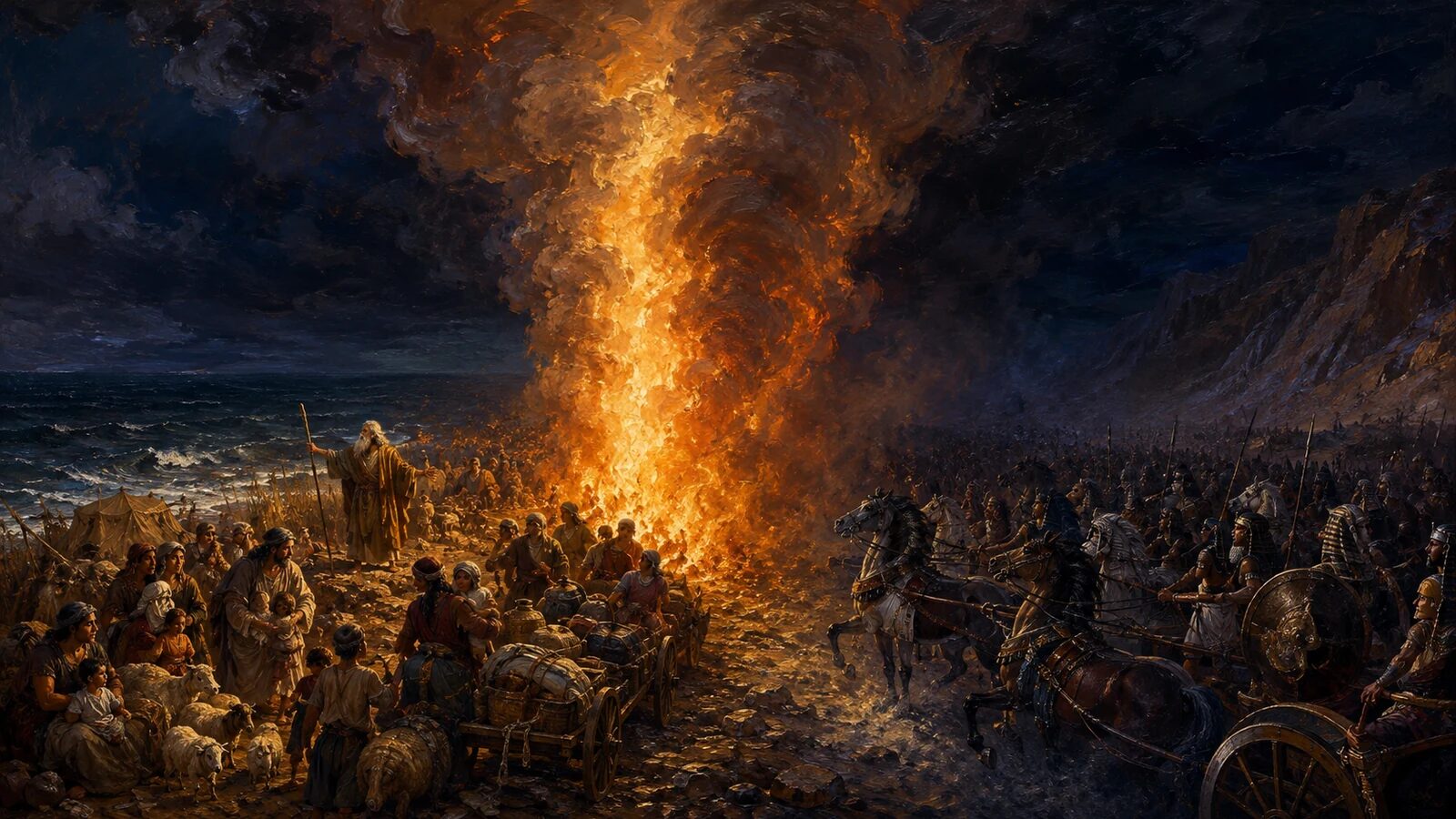
God brought Israel out of Egypt, but freedom did not mean the people knew where to go or could protect themselves along the way. He went before them in the pillar of cloud and fire, making His presence visible as He led them. They had been rescued from Pharaoh to live under the Lord’s care and authority, not to become independent of Him.
At Passover, they had sheltered under the lamb’s blood while judgment fell on Egypt’s firstborn. They left slavery with a journey still ahead of them. Exodus records how God guided these people through unfamiliar country, protected them at the sea, and later governed their movements from the tabernacle.
I may be quite willing to ask God for direction until I realize that obedience will interfere with my plans. Israel could see the Lord’s presence ahead of them, but they still had to follow Him. His nearness did not give them permission to choose their own route or decide for themselves how He should be worshiped.
The Lord’s Route and Public Guidance
Before describing the pillar, Exodus gives a reason for the route God chose:
God did not lead them by way of the land of the Philistines, although that was near.
The rest of the verse explains that seeing war might make the people change their minds and return to Egypt. God took their weakness into account when He chose their route. The shorter road would bring them toward a conflict they might try to escape by going back to slavery.
I need to be careful when I assume the quickest route must be the best. Scripture gives us God’s reason for leading Israel this way, but it does not tell me the reason for every delay in my own life. I can trust Him through a setback without claiming to know something He has not told me.
He also gave the camp guidance they could see:
And the LORD went before them by day in a pillar of cloud to lead the way, and by night in a pillar of fire to give them light.
The cloud led by day, and the fire gave light for travel at night. God was providing for the practical needs of people walking with their households and possessions. Exodus describes His deliberate leadership; Israel had not simply noticed an unusual natural feature and given it a religious meaning.
The Hebrew word ammud means a pillar or standing column. The whole camp could see the Lord’s guidance and was responsible to follow it. They did not have to depend on a private impression reported by a few influential people.
Exodus 13:22 adds that the Lord did not take the pillar away from before them. His care continued throughout the journey. He did not expect them to find their own way through the wilderness while living on memories of what He had done at Passover.
The Presence That Protects
At the sea, Pharaoh’s army approached from behind while the water blocked Israel’s way forward. They could not overcome that danger through their own strength. The pillar then moved to stand between them and their pursuers:
The Angel of God, who went before the camp of Israel, moved and went behind them; and the pillar of cloud went from before them and stood behind them.
Exodus closely connects the movement of the Angel of God with the movement of the cloud. The Lord who had gone before Israel was now protecting them from behind. I understand this Angel to be the eternal Son appearing before He became man, an appearance called a Christophany. Throughout the Old Testament, this divine Messenger speaks and acts with God’s own authority. That identifies Him as more than a created messenger, without making every angel mentioned in Scripture an appearance of Christ.
With the cloud between the camps, the Egyptians faced darkness while Israel had light:
It was a cloud and darkness to the one, and it gave light by night to the other.
The two camps were kept apart through the night. At God’s command, Moses stretched out his hand over the sea, and the Lord drove the waters back with a strong east wind. Israel crossed on dry ground, and the Egyptians followed them into the passage. During the morning watch, the Lord looked upon the Egyptian army through the pillar of fire and cloud and threw them into confusion. He took off their chariot wheels, and the pursuers recognized that He was fighting for Israel. The waters returned over the army, while the people they had pursued were safe on the other side.
The same presence that protected Israel brought judgment upon their oppressors. Pharaoh’s pursuit could not undo the deliverance God had begun.
God’s Holy Presence in the Camp
After the crossing, Israel came to Sinai and received God’s commandments. Yet the people soon rebelled by worshiping the golden calf. In the aftermath, Exodus 33 describes Moses pitching a meeting tent outside the camp, where those seeking the Lord would go. This was before the completed tabernacle was erected in Exodus 40:
The pillar of cloud descended and stood at the door of the tabernacle, and the LORD talked with Moses.
The people watched and worshiped from their own tent doors as the cloud descended. They had recently defied God by worshiping through a golden calf. Now they watched Him meet with Moses, the man through whom He had given His commandments. God was still willing to meet with His people, but they could not take His patience as permission to worship however they pleased.
When the tabernacle was completed according to His instructions, the cloud covered it:
The cloud covered the tabernacle of meeting, and the glory of the LORD filled the tabernacle.
Even Moses could not enter because the cloud rested above the tabernacle and God’s glory filled it. The man who spoke with the Lord could not simply walk in whenever he chose. God had graciously come to dwell among the people He redeemed, and He determined how they were to approach Him.
The Hebrew word kavod, translated glory, can refer to honor and splendor. Its connection with weight is figurative, much as we speak of a person whose words carry weight. Here the cloud and glory revealed the Lord’s holy presence among His people. They could not produce it by working themselves into a religious mood. He had provided the tabernacle, priesthood, sacrifices, and mercy seat as the means by which they could approach Him. Those provisions also help us understand why we need the access Christ gives us through His blood.
The cloud above the tabernacle also governed the nation’s journeys. When it lifted, the people set out. When it remained, they stayed:
If the cloud was not taken up, then they did not journey till the day that it was taken up.
Numbers 9 describes stays ranging from a single night to a much longer period. Whether the wait lasted days, a month, or a year, the people were to remain until the cloud lifted. They had to be ready to travel again when it did. Restlessness was not a sufficient reason to break camp, and reluctance to pack up could not cancel the command to move.
Both impatience and reluctance can interfere with obedience. I may rush into a decision before I have understood what God requires, or I may put off a clear responsibility because I dislike what it will cost. My preference for moving or staying cannot settle what is right. Israel had to follow the Lord’s timing, even when it did not suit them.
Later generations remembered the pillar as evidence of the Lord’s patience. In Nehemiah 9, the Levites led Israel in confessing the nation’s rebellion and acknowledging that God had not forsaken them in the wilderness. Psalm 78 also recalls the cloud by day and fire by night while recounting Israel’s repeated disobedience. The Lord had continued to care for people who often resisted Him.
Guidance Must Remain Under God’s Word
The God who led through the pillar also gave the commandments and the instructions for the tabernacle. Seeing His presence did not excuse Israel from obeying what He had said. The golden calf showed how far they could go wrong even while the Lord was caring for them.
We need to be honest when we claim God’s guidance today. If I have to conceal the truth from someone to make my plan work, saying the Lord led me there does not excuse the deceit. I need to abandon the dishonest part of the plan, even if it costs me an opportunity I wanted. The same applies to a relationship Scripture condemns. Feeling certain that God brought two people together does not authorize them to disregard what He says about sexual immorality. Nor can I rename greed or pride as faith merely because I am eager for money or admiration. The Spirit of truth will not contradict the Word He inspired.
Our search for direction should begin with Scripture and prayer. Mature counsel can help us recognize what we have overlooked, and circumstances can clarify opportunities as we obey. Those things do not replace the truth God has already given. I do not need to wait for a visible pillar before doing what Scripture plainly requires.
The Holy Spirit lives within believers, and we should expect Him to guide us. We also belong to Christ’s body, where another believer may see an error I have overlooked. If I call a conviction spiritual, I must still be willing to examine it in the light of God’s Word. Trusting the Spirit includes listening when someone uses Scripture to show me that I am mistaken.
The Pillar Points to Christ
Jesus identifies Himself as the Light we are to follow:
I am the light of the world. He who follows Me shall not walk in darkness, but have the light of life.
Jesus promises the light of life, far more than the illumination Israel needed for walking at night. John also says the Word became flesh and dwelt among us, and that the apostles beheld His glory. The eternal Son, whose presence had protected Israel in the wilderness, came among us as a man. He is fully God and fully man, the Lord to whom the pillar directs us.
At the transfiguration, the disciples saw Jesus with Moses and Elijah, and a bright cloud overshadowed them. The Father’s voice directed them to His Son: “This is My beloved Son… Hear Him” (Matthew 17:5). I should not become so fascinated with the visible cloud that I overlook the command to listen to Christ.
Christ brings us near to God by dealing with the sin that separates us from Him. He lived without sin and willingly gave Himself to be slain as the perfect sacrifice for sinners. Wicked men tortured Him, shed His blood, and killed Him; His bodily suffering and death were real. His atonement rests on His perfection and the offering of His innocent life. The Father did not punish or abandon Him. Father and Son remained united in this saving work, and Christ’s sacrifice through His shed blood and death was complete before His burial and bodily resurrection.
Christ died for the sins of the whole world, and God’s saving offer is genuine for every person, though people can resist and reject it. The sinner who repents and trusts in Him is forgiven and born again. Regeneration, or new birth, is the new life the Holy Spirit gives a person who trusts in Christ. Taking the name Christian without that faith does not make someone born again. The Spirit lives within that believer and seals him as God’s own, secure in Christ forever. Obedience gives evidence of the new life; it neither earns nor keeps salvation. I cannot use that security to excuse deliberate lawlessness, as though being saved meant I no longer needed to listen to the Lord.
Before going to the cross, Jesus had promised His apostles that the Spirit would guide them after His departure:
When He, the Spirit of truth, has come, He will guide you into all truth.
Jesus was addressing the apostles who would bear witness to Him and teach with His authority. The Spirit would guide them in that testimony, which we receive in the New Testament. When I seek His guidance, I need to listen to what He gave them to teach. I cannot use this promise to give my own impressions the authority of Scripture.
The Spirit is a divine Person, not a feeling or an impersonal force. He glorifies Christ, teaches us through the written Word, and convicts us of sin. He sanctifies us, making us holy in the way we live, and equips believers with gifts to serve one another. His guidance reaches beyond helping me choose my next step. When He exposes sin I would rather leave alone, I need to repent instead of looking for an experience that makes me feel better about continuing in it.
My Final Thoughts
The Lord who brought Israel out of Egypt continued to care for them and direct their journey. He has given us His written Word and the indwelling Spirit. When Scripture already tells me what He requires, waiting for another sign can become a convenient way of postponing obedience. I want His reassurance, but I also need to accept His correction and follow Him when obedience is inconvenient. Christ is the Light who brings us near to God, and I can trust Him with the consequences of doing what He says.