
Doves appear in some of the Bible’s most familiar passages, from Noah’s ark to the baptism of Jesus. I do not want to assume that the bird means the same thing in each one. A dove can be an actual bird carrying evidence of receding water, an offering appointed under the Law, or a comparison in poetry. We need to understand what the writer is describing before deciding what the bird represents.
Let Scripture Explain the Image
Artwork often associates doves with peace, purity, or the Holy Spirit. Those associations are understandable, but they can also make us stop reading too soon. If I come to every passage with a fixed definition, I may overlook the explanation God has already given in the surrounding verses.
The secret things belong to the LORD our God, but those things which are revealed belong to us and to our children forever, that we may do all the words of this law.
Moses was speaking to Israel about receiving and obeying what God had revealed in His covenant. The verse is not a dictionary of symbols, but its instruction should govern the way I handle them. I am responsible to receive what God has said, and I have no authority to present an imaginative connection as something He has revealed.
That leaves plenty to study. Genesis describes Noah sending a dove from the ark; Leviticus tells worshipers which birds they could bring as offerings. Song of Solomon compares lovers’ eyes to doves, while Jesus uses their harmlessness to instruct His disciples. Hosea even compares Ephraim to a foolish dove. Each passage has something specific to teach, and the differences are part of what we need to hear.
The Dove After Judgment
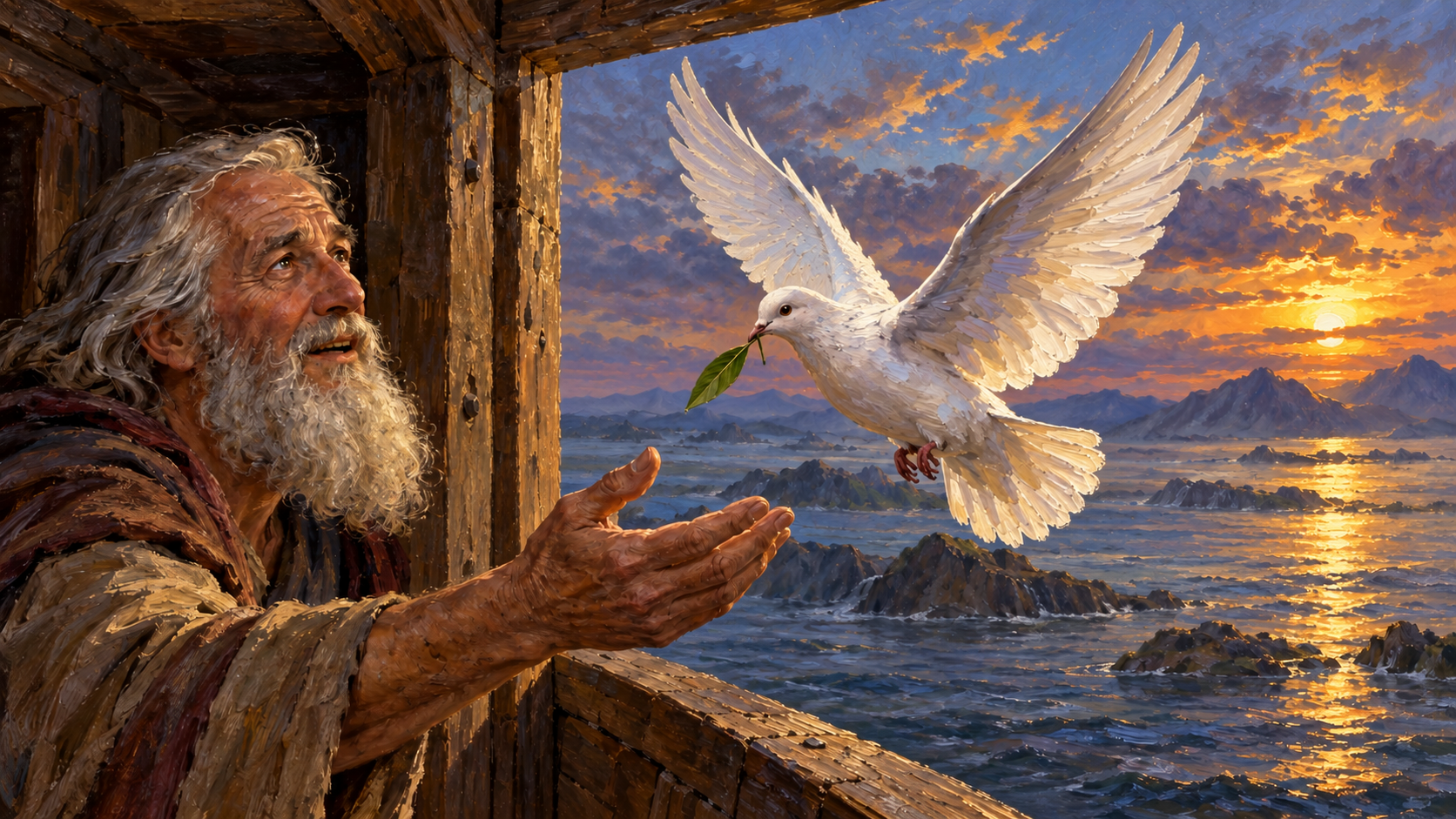
After the flood, Noah and his family remained in the ark while the waters receded. The ark had come to rest on the mountains of Ararat, but that did not mean the surrounding ground was ready for them to inhabit. Noah sent out a raven and then a dove to learn about conditions outside.
He also sent out from himself a dove, to see if the waters had receded from the face of the ground.
But the dove found no resting place for the sole of her foot, and she returned into the ark to him, for the waters were on the face of the whole earth. So he put out his hand and took her, and drew her into the ark to himself.
On the dove’s first journey, she found nowhere to rest and returned. Noah reached out and brought her back into the ark. After another seven days he sent her out again, and this time her return supplied evidence that the waters had gone down:
Then the dove came to him in the evening, and behold, a freshly plucked olive leaf was in her mouth; and Noah knew that the waters had receded from the earth.
The freshly plucked leaf showed that the dove could reach vegetation. Genesis tells us what Noah learned from it: the waters had receded. He waited another seven days before sending her a third time, and she did not return. Her absence suggested that she could now remain outside, where she had previously found no resting place.
Noah did not immediately take his family out when the leaf arrived or when the dove failed to return. The chapter goes on to describe the drying ground and God’s command to leave the ark. In Genesis 8:13–19, their departure follows that command. The bird gave Noah information about the earth; God told him when to go out into it.
I understand why a dove carrying an olive leaf became associated with peace. Noah’s household had survived God’s judgment, and the diminishing waters meant that life outside the ark would be possible again. But Genesis does not call the bird the Holy Spirit or give it a separate message to deliver. The mercy is in God’s preservation of the family and His provision of a world they could inhabit after judgment. The study on Noah and the ark considers that larger account.
Doves, Sacrifice, and the Poor
Under the Law, turtledoves and young pigeons had a place in Israel’s worship because God appointed them as offerings. Their acceptability did not depend on a worshiper’s opinion about the bird’s beauty or temperament. God specified what could be brought:
And if the burnt sacrifice of his offering to the LORD is of birds, then he shall bring his offering of turtledoves or young pigeons.
He also made provision for someone who could not afford a lamb:
If he is not able to bring a lamb, then he shall bring to the LORD, for his trespass which he has committed, two turtledoves or two young pigeons: one as a sin offering and the other as a burnt offering.
I do not want to hurry past the words “if he is not able to bring a lamb.” An Israelite with little money was still responsible to obey God, but he was not required to produce an animal he could not afford. The Lord supplied an acceptable offering within his means. A wealthier person’s lamb did not make the poorer worshiper unwelcome.
The provision did not make sin less serious, and the bird’s blood could not finally accomplish what Christ’s sacrifice would accomplish. Atonement concerns dealing with sin so that people may approach the holy God. These offerings belonged to the covenant God had given Israel and pointed ahead to the perfect sacrifice of Jesus Christ. Bringing them was a genuine act of obedience, even though no animal could provide the final removal of sin.
Mary and Joseph’s offering after Jesus’ birth came from another such provision. Leviticus 12 required a lamb and a bird after childbirth, but allowed two turtledoves or two young pigeons when the mother could not afford a lamb. Luke records their obedience:
Now when the days of her purification according to the law of Moses were completed, they brought Him to Jerusalem to present Him to the Lord.
And to offer a sacrifice according to what is said in the law of the Lord, “A pair of turtledoves or two young pigeons.”
The sacrifice concerned Mary’s purification under the Law. It was not an offering for sin in Jesus, who is the sinless Son of God. Mary and Joseph presented Him to the Lord and brought the birds the Law permitted. Their offering indicates modest means; the Son of God entered this world in a household that did not possess the wealth people commonly associate with royal power.
The child they brought to the temple would do what the animals offered there could not. He would give His own body and shed His blood for sinners. Whether a worshiper brought a bird, a goat, a bull, or a lamb, the final answer to sin would come through Christ Himself, rather than through the cost of an offering.
During His public ministry, Jesus confronted merchants who were selling sacrificial animals in the temple. The birds were acceptable offerings under the Law, but their sale had become part of a marketplace in His Father’s house:
And He found in the temple those who sold oxen and sheep and doves, and the money changers doing business.
When He had made a whip of cords, He drove them all out of the temple, with the sheep and the oxen, and poured out the changers’ money and overturned the tables.
In John 2:16, Jesus told the sellers of doves to remove them and condemned turning His Father’s house into a place of merchandise. He was not announcing that God had been wrong to accept bird offerings. He was confronting what people had made of the place appointed for worship.
I can defend a practice God has given while still needing correction about how I am using it. Teaching Scripture, gathering for worship, and receiving offerings can all be made to serve someone’s reputation or profit. The presence of something God appointed does not excuse the corruption around it. Jesus’ treatment of the merchants calls us to honor His Father’s house rather than use worship for our own advantage.
Beauty, Harmlessness, and Warning
In Song of Solomon, doves belong to the language of love poetry. The lovers describe one another through images drawn from animals, gardens, fragrance, and fruit. The comparisons express their delight in one another:
Behold, you are fair, my love! Behold, you are fair! You have dove’s eyes.
You have dove’s eyes behind your veil. Your hair is like a flock of goats, Going down from Mount Gilead.
The bride also uses the image when describing the bridegroom:
His eyes are like doves By the rivers of waters, Washed with milk, And fitly set.
These comparisons are part of Scripture’s treatment of marital love within God’s good design. Tenderness, desire, and pleasure in a spouse’s beauty are not unspiritual subjects that we must explain away. I do not need to turn the eyes, the milk, and the rivers into a hidden doctrinal code before receiving the poetry as God’s Word. Here the dove helps express beauty and affection between the lovers.
Jesus drew attention to another quality when He sent His disciples into danger. They would meet people who intended them harm, and their conduct had to remain innocent without becoming naive:
Behold, I send you out as sheep in the midst of wolves. Therefore be wise as serpents and harmless as doves.
If I call myself discerning while lying, manipulating, or taking advantage of people, I have used the claim of wisdom to excuse sin. Jesus did not authorize His disciples to become predatory because they were surrounded by wolves. At the same time, harmlessness does not require ignoring a threat or believing every flattering claim. We need to recognize evil clearly enough to respond wisely while refusing to participate in it.
Hosea’s comparison warns about the other failure: acting without discernment. Ephraim, representing the northern kingdom of Israel, sought security from foreign powers instead of trusting the Lord:
Ephraim also is like a silly dove, without sense, They call to Egypt, They go to Assyria.
Seeking help from Egypt and Assyria could not remedy Israel’s unfaithfulness to God. Hosea describes their lack of sense through the dove, rather than praising their innocence. The issue is their wayward reliance on political powers while disregarding God. If I insist that a dove must always mean purity or peace, I will turn this rebuke into something the prophet never said.
The Holy Spirit Descended Like a Dove
The dove’s most prominent connection with the Holy Spirit comes at Jesus’ baptism. Matthew describes what happened as Jesus came up from the water:
When He had been baptized, Jesus came up immediately from the water; and behold, the heavens were opened to Him, and He saw the Spirit of God descending like a dove and alighting upon Him.
Luke also records a visible descent and the Father’s voice:
And the Holy Spirit descended in bodily form like a dove upon Him, and a voice came from heaven which said, “You are My beloved Son; in You I am well pleased.”
The Holy Spirit is a divine Person, fully God, distinct from the Father and the Son. He is not a bird, nor did He become one of God’s creatures. Luke describes a bodily form like a dove through which His descent could be seen. The Son was in the water, the Spirit descended upon Him, and the Father spoke from heaven. All three Persons are revealed together, without being confused with one another.
Jesus did not become the Son of God at His baptism. He is the eternal Son who had taken true humanity, and the Father’s words acknowledged the Son He already was. The Spirit’s descent confirmed Him publicly for His ministry. The study on the dove at Jesus’ baptism examines this event more closely.
John the Baptist explains why he had been given this sign. God had told him that the Spirit would descend and remain upon the One who baptizes with the Holy Spirit:
And John bore witness, saying, “I saw the Spirit descending from heaven like a dove, and He remained upon Him.
I did not know Him, but He who sent me to baptize with water said to me, ‘Upon whom you see the Spirit descending, and remaining on Him, this is He who baptizes with the Holy Spirit.'”
The visible descent identified Jesus to John according to God’s prior promise. John did not devise the sign or decide that a bird he happened to see must have a spiritual meaning. He received God’s instruction and witnessed its fulfillment. All four Gospels testify to the Spirit’s descent, and the event marks the beginning of Christ’s public ministry.
We must also receive what the rest of Scripture says about the Spirit. He speaks, teaches, convicts, and guides; He gives gifts according to His will. He lives in believers and seals them as God’s own. Those are the acts of a personal, divine Spirit, rather than an impersonal influence or an animal. A visible form at one event does not exhaust what God has revealed about Him. The study on the Person of the Holy Spirit develops that teaching.
For me, the passages about doves reach their highest point here because the sign identifies the Savior. The sinless Son would willingly endure the bodily suffering wicked people inflicted on Him, shed His blood, and die for our sins. His saving work through His blood and death was complete before He rose bodily from the grave. Through Him we receive forgiveness and the indwelling Holy Spirit.
Reading the Whole Biblical Picture
The dove at the Jordan does not turn every earlier dove into an appearance of the Holy Spirit. Noah sent out an actual bird to learn about the floodwaters, and Israel’s worshipers brought actual birds as sacrifices. Song of Solomon uses comparisons to express affection; Jesus and Hosea use the bird in instructions about conduct. We can recognize connections among these passages without erasing what each one says.
The same care applies to other biblical images. Jesus compares the Spirit’s activity with the wind, but He does not teach that every mention of wind refers to the Spirit. The study on the Holy Spirit being like the wind considers that comparison. A familiar image helps explain a particular truth; it does not relieve us of reading the passage carefully.
When I encounter a dove in Scripture, I first need to ask who is speaking, what is happening, and what the passage actually says about the bird. That will tell me whether I am reading an account of an event, a sacrificial instruction, a poetic comparison, or a warning. Only then am I ready to draw an application without making the image carry ideas the text never gave it.
My Final Thoughts
I want to receive the Bible’s uses of the dove with the variety God gave them. The bird can help Noah learn that the waters are receding, be an offering someone of modest means can bring, or express a lover’s affection. It can illustrate the harmlessness Jesus requires or the foolishness Hosea rebukes. We lose those explanations when we impose one meaning on them all.
At Jesus’ baptism, the Spirit descended like a dove and remained upon the Son while the Father spoke from heaven. God supplied the sign and explained its purpose to John. I want that revealed truth to shape my understanding of Christ and the Holy Spirit, rather than look for secret messages in every dove I encounter.