
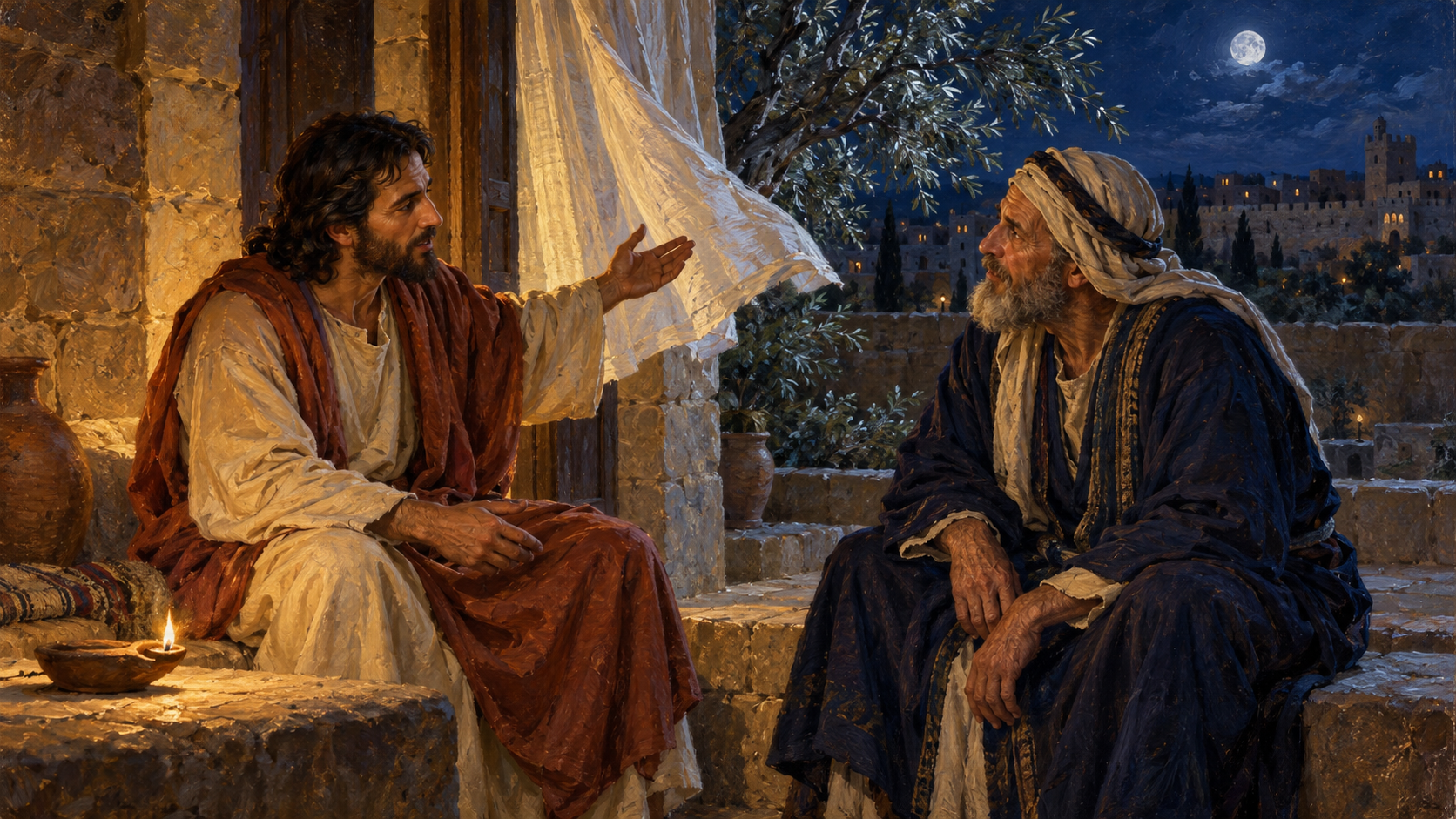
Why did Jesus compare the work of the Holy Spirit to the wind? We cannot see the wind itself, but we hear it and see what it does. Jesus uses that familiar reality to help Nicodemus understand the Spirit’s unseen, sovereign work in giving new life.
The Wind and the New Birth
Scripture often uses visible images to help us understand what we cannot see. Fire may picture God’s holy presence and purifying work, while oil may point to consecration and anointing. Water can picture cleansing and life. Wind and breath draw our attention to life and movement beyond human control. I need to learn from these images without confusing the Holy Spirit with the things used to describe Him. He is God, a distinct divine Person, not an object or an atmosphere, and not energy we can use.
Let’s begin with the conversation between Jesus and Nicodemus. As a ruler of the Jews and a teacher of Israel, Nicodemus knew the Old Testament. Yet neither his religious status nor his physical descent could give him the life he needed. Knowing biblical words was not enough, and ritual or moral improvement could not supply what was missing. He had to be born again by the Spirit.
Jesus answered, “Most assuredly, I say to you, unless one is born of water and the Spirit, he cannot enter the kingdom of God. That which is born of the flesh is flesh, and that which is born of the Spirit is spirit.”
“The wind blows where it wishes, and you hear the sound of it, but cannot tell where it comes from and where it goes. So is everyone who is born of the Spirit.”
Jesus used the wind to illustrate work we cannot see or control but can recognize by its effects. We cannot command the wind to start or stop, and we cannot explain every movement it makes. Yet we hear it and see what it moves. That helps me understand the comparison without treating the Spirit as impersonal. No one watches the new birth happen as a mechanical process, but His sovereign work becomes evident in a person’s life. The sinner comes under conviction and trusts Christ. As that new life begins, he grows to love the truth and turns toward God.
The Spirit’s freedom does not mean His work is chaotic or meaningless. He acts according to God’s will and never contradicts the Father or the Son. When He brings sinners to Christ and opens blind eyes, the fruit of His work agrees with the Scripture He inspired. I can trust His freedom without expecting Him to act against God’s revealed truth.
What the wind moves does not cause the wind to blow. In the same way, a changed life does not purchase regeneration, which is the new birth. The Spirit convicts the sinner and gives new life through faith in Christ, and a growing love for truth follows from that life. I need to keep both His work and its results in view. The new birth cannot be reduced to a human decision, but the Spirit’s sovereignty does not give us a reason to dismiss the visible change Scripture says He produces.
Nicodemus also had the Old Testament to help him understand what Jesus was saying. In Ezekiel 36:26-27, God promised to give His people a new heart and put His Spirit within them. As Israel’s teacher, Nicodemus should have recognized that this life had to come from God. His privileges as a descendant of Israel could not produce it.
The Hebrew word ruach may refer to wind, breath, spirit, or the Spirit, depending on the passage. The Greek word pneuma has a similar range, which helps explain why the wind comparison comes naturally in the original languages. In John 3, Jesus speaks of the Spirit and uses natural wind to illustrate His sovereign work of giving life. Understanding those words helps us read accurately, but we still need the context to tell us which meaning is intended. A word does not carry every possible meaning at once, so we should not read every wind in the Bible as a hidden reference to the Spirit.
We can go wrong in either direction here. Reducing the Spirit to a symbol for inspiration or emotion leaves out who He is, as does treating Him merely as power. But reading every breeze as a secret code also goes beyond Scripture. God chose wind as an image because it fits aspects of the work of a divine Person. The image must not replace Him.
The Spirit Gives Life
The Spirit was present and active long before Pentecost and the birth of the church. The opening pages of Scripture place His work before Israel existed or humanity was formed. Genesis introduces Him as One who belongs to the eternal Godhead and takes part in creation, not as an impersonal influence.
The earth was without form, and void; and darkness was on the face of the deep. And the Spirit of God was hovering over the face of the waters.
By the word of the LORD the heavens were made, And all the host of them by the breath of His mouth.
The Spirit of God has made me, And the breath of the Almighty gives me life.
These passages show the one God working in unity without making the Father, Son, and Spirit one Person. God creates by His word, and the breath of His mouth is connected with the host of heaven. Elihu says the Spirit made him and the Almighty’s breath gives him life. Human life does not begin in itself, but comes from God.
The Almighty gives life, and His Spirit is active in that work. That is why I understand the image of breath as pointing to God rather than to a force that has life in itself. Scripture can speak of breath without suggesting that the Holy Spirit is merely air moving through the world.
Genesis 2 brings the breath image into Adam’s creation. God formed a body from dust, but Adam became a living being only when God gave the breath of life.
And the LORD God formed man of the dust of the ground, and breathed into his nostrils the breath of life; and man became a living being.
Genesis 2:7 records Adam’s creation, so I would not ask it to provide a technical explanation of every later doctrine about the Spirit. It does help us understand how Scripture connects breath with life. Adam’s body, formed from dust, lived because God gave him breath. Later, Ezekiel describes dead bones receiving life when God commands the breath. Jesus then speaks in John 3 of the Spirit giving new birth to dead sinners. In each passage, the life comes from God.
In Ezekiel 37, the prophet stood before a valley of dry, dead bones. These were not people who were merely weak or asleep. When God asked whether they could live, Ezekiel answered humbly, “O Lord GOD, You know.” The vision brings wind and breath together as God shows him where life comes from.
Also He said to me, “Prophesy to the breath, prophesy, son of man, and say to the breath, ‘Thus says the Lord GOD: “Come from the four winds, O breath, and breathe on these slain, that they may live.”‘”
So I prophesied as He commanded me, and breath came into them, and they lived, and stood upon their feet, an exceedingly great army.
God identifies the bones as the whole house of Israel, whose hope seemed lost, and promises to put His Spirit in them so they will live. The vision therefore belongs first to Israel’s restoration, and I should not take it out of that covenant setting. Within that setting, we also see God giving life where human ability has ended. The breath does not act independently of Him, and the bones cannot raise themselves. They live because God commands and gives life.
I notice that the bones came together and received sinews and flesh before the breath came. They had an outward form, yet they still had no life. That helps me understand the difference between religious form and spiritual birth: we can have the outward form without the life only God supplies. The vision first concerns Israel’s restoration, but that distinction also helps us understand the need for new birth.
The Spirit gives the life of God, which is what Nicodemus needed. He does not simply improve the flesh until it becomes spiritual or add something attractive to dead religion. Fallen people cannot produce their own new birth any more than dry bones can raise themselves.
Pentecost, Power, and Witness
In Acts 2, wind imagery appears at the public beginning of the church’s witness through the Spirit’s power. Jesus had promised His disciples power when the Holy Spirit came upon them. He told them to wait for the Father’s promise because the strength for their mission had to come from God. Technique alone could never supply it.
But you shall receive power when the Holy Spirit has come upon you; and you shall be witnesses to Me in Jerusalem, and in all Judea and Samaria, and to the end of the earth.
And suddenly there came a sound from heaven, as of a rushing mighty wind, and it filled the whole house where they were sitting.
Then there appeared to them divided tongues, as of fire, and one sat upon each of them. And they were all filled with the Holy Spirit and began to speak with other tongues, as the Spirit gave them utterance.
Luke says the sound was “as of” a rushing wind and the tongues appeared “as of” fire. Those comparisons help me distinguish the supernatural signs people heard and saw from the Spirit Himself. He did not become air or flame. The signs marked the arrival of the promised Spirit and the beginning of the apostles’ public witness.
The disciples received power to bear witness to Christ, not to draw attention to themselves. Acts 2 moves from the wind and tongues to Peter’s proclamation of Jesus crucified and risen, grounded in Scripture. Through the preached gospel, the Spirit exalts Christ and brings conviction to sinners as He gathers people to Him.
When I follow Pentecost through to the disciples’ witness, I don’t see a reason to make it a search for sensations. They did not create the sound or decide when the promise would arrive, and they did not choose the languages they spoke. The Spirit gave them utterance, and the hearers were directed to the mighty works of God and the risen Christ Peter preached.
I do not believe Scripture forces us into either a hyper-charismatic view or cessationism. We should recognize the Spirit’s present power while testing claims about His work. Pentecost came from heaven in fulfillment of Christ’s promise. It agreed with Scripture and led to gospel witness, so claims today must be tested by that same truth. We cannot manufacture the Spirit’s work through emotional pressure or control Him through ritual. His true work honors Christ and produces holiness as it serves the gospel.
The Spirit Is a Divine Person
Some people take the wind’s invisibility and power to mean that the Spirit is divine energy. But Scripture describes Him speaking and teaching His people. He leads them and calls them to His work, and He intercedes for them. They can lie to Him and grieve Him. These are personal actions and responses, which give us no basis for treating Him as an atmosphere Christians can learn to use.
But the Helper, the Holy Spirit, whom the Father will send in My name, He will teach you all things, and bring to your remembrance all things that I said to you.
As they ministered to the Lord and fasted, the Holy Spirit said, “Now separate to Me Barnabas and Saul for the work to which I have called them.”
And do not grieve the Holy Spirit of God, by whom you were sealed for the day of redemption.
Jesus calls the Spirit the Helper and says He will teach. At Antioch, He spoke with personal authority when He called Barnabas and Saul to the work He had appointed. Paul also warns believers not to grieve Him. I cannot read those passages and treat the Spirit as a tool for my own use. He indwells and seals us, teaching us through the Word He inspired. His leading never excuses lawlessness, and He helps us in our weakness and intercedes according to God’s will.
Teaching involves knowledge and intention, while calling Barnabas and Saul shows the Spirit choosing and directing their work. We can also grieve Him, which would make no sense if He were an impersonal current. Scripture describes Him relating personally to others throughout the church’s life, so this is far more than personal-sounding poetry in an isolated verse.
His personal work belongs within the doctrine of the Trinity. Scripture does not give us three gods, nor does it present one Person wearing three masks. There is one God in three co-equal and co-eternal Persons. The Holy Spirit is distinct from the Father and the Son while remaining fully divine.
There are diversities of gifts, but the same Spirit. There are differences of ministries, but the same Lord. And there are diversities of activities, but it is the same God who works all in all.
The Spirit of the Lord GOD is upon Me, Because the LORD has anointed Me To preach good tidings to the poor; He has sent Me to heal the brokenhearted, To proclaim liberty to the captives, And the opening of the prison to those who are bound.
Paul describes diverse gifts and ministries while speaking of the same Spirit, the same Lord, and the same God. In Isaiah, the Messiah says the Spirit is upon Him because the LORD anointed and sent Him. Jesus applies that passage to Himself in Luke 4. Both passages let us see distinct Persons working in divine unity.
I cannot treat those distinctions as temporary roles that disappear when the work changes. The Son receives the anointing, with the Spirit resting upon Him and the LORD sending Him. They carry out one divine work in perfect agreement, which does not mean Christians worship three separate gods. The Spirit shares the divine identity rather than standing outside it as a created messenger.
The Spirit moves where He wills without competing with the Son or working apart from the Father. As He applies the gospel, He glorifies Christ and forms Christlike character in believers. He also gives gifts to build the church. We are describing the work of a divine Person who shares the Father’s and Son’s essence and purpose, not independent spiritual energy.
Walk by the Spirit Without Chasing Spectacle
Comparing the Spirit’s work to wind does not mean it must always feel dramatic or unpredictable. Scripture describes Him convicting the world and giving new birth. He indwells and seals believers, then opens Scripture to them and produces holy fruit in their lives. His gifts strengthen the church, and He strengthens our witness while pointing people to Christ. Some of that work may be dramatic, but much of it is deep and faithful over time.
I should not value the Spirit’s quieter work less because it lacks the sound of Pentecost. When He exposes a hidden sin and leads a believer to repent, He is acting with power. The same is true when He uses Scripture to steady faith or gives someone courage to speak about Christ. Scripture teaches me to value those changes instead of measuring His presence by how excited I feel.
Walking by the Spirit means living under His rule as we trust Christ and obey God’s Word, rather than following wherever our emotions lead. His fruit includes love, joy, peace, patience, kindness, goodness, faithfulness, gentleness, and self-control. That holy character shows the life of God taking shape in people who once walked according to the flesh. We should not mistake it for a weak result simply because it is character rather than spectacle.
I say then: Walk in the Spirit, and you shall not fulfill the lust of the flesh.
If we live in the Spirit, let us also walk in the Spirit.
Spiritual language does not guarantee that someone is yielding to the Spirit. We must refuse a claim that denies Christ’s deity or rejects Scripture. Nor should we accept one that excuses sin or raises private revelation above the Bible. Seeking attention and manipulating people are also contrary to His work. The Holy Spirit never contradicts the Word He inspired.
Testing a claim by Scripture is an act of obedience to the Spirit who inspired it. I do not distrust Him by exercising the discernment His Word requires. His true work directs attention to Christ rather than the person making the claim, and it leads toward truth and holiness instead of confusion or self-exaltation.
I believe our response should begin with reverence and trust that lead to obedience. We must not grieve or quench the Spirit, or treat Him as a feeling we can stir up and then ignore. His work reaches the ordinary places where my faithfulness is tested. He changes how I speak and leads me away from sin. Even the patience I show toward other people belongs within His work. He also works in our prayers and witness, giving us courage to forgive and deepening our love for Christ.
Related studies explore the Person of the Holy Spirit, indwelling versus coming upon, the Spirit’s indwelling, tongues of fire at Pentecost, and the Trinity.
My Final Thoughts
Jesus’ wind comparison helps me see the Spirit’s work without reducing Him to the image. We do not see the new birth happen, but we see the life He gives as Christ is honored, Scripture is loved, and holiness begins to grow. The Holy Spirit is fully God and personally distinct from the Father and Son, not a force we can control. We should test every spiritual claim by the Word while trusting Him to give power for faithful witness. Instead of chasing spectacle, I want to walk in the life He gives and follow where He leads in obedience to Christ.