
Scripture describes the Holy Spirit coming upon someone for a task, but it also speaks of Him indwelling believers. I want to understand the difference without treating every passage as though it describes the same work. He is the same divine Person throughout Scripture, and the context helps us see how He was working in each period.
Genesis shows the Spirit personally active in creation, and Israel’s history shows Him empowering people for particular tasks. Then Christ’s promise and Pentecost bring us to His permanent indwelling of everyone who is truly born again. John, Acts, Romans, and Ephesians explain that New Covenant promise of indwelling and sealing. Following these passages will help us understand both His sovereign empowerment and His abiding presence in believers.
Before comparing His work in those periods, we need to understand who the Spirit is. Genesis begins with God creating the heavens and the earth, rather than with preexisting matter or random chance. It does not place a created spiritual force beside Him. God stands over the universe as its Creator, so creation is not divine and He is not part of it. His Spirit was personally present and active from the beginning.
In the beginning God created the heavens and the earth. The earth was without form, and void; and darkness was on the face of the deep. And the Spirit of God was hovering over the face of the waters.
Genesis 1 describes the earth as unformed and unfilled, then shows God forming and filling it. I notice that the Spirit was already active before human beings existed or sin entered the world. His work cannot be understood only as repairing our failures, because He was involved in God’s good creation from the beginning.
The Hebrew word ruach, translated spirit here, can also mean wind or breath. Understanding that range helps us read accurately, but context tells us which meaning fits. Genesis 1:2 names the Spirit of God, whom the rest of Scripture reveals as personal and divine. We should not reduce Him to an impersonal wind.
Not a Force
The Holy Spirit is not an impersonal power or a passing religious mood. He is not spiritual energy in the atmosphere that people can use like electricity. Scripture presents Him speaking with understanding and teaching the truth. He directs God’s servants according to His will, at times sending them and at other times forbidding a particular course. He testifies about Christ and prays on behalf of believers. Because He is a Person, people can grieve Him and even lie to Him.
The Spirit is fully God, as Acts 5 makes clear when it says Ananias lied to the Holy Spirit and then says he lied to God. He is no created messenger beneath the Father and the Son. Scripture names Him with them in the baptismal confession and apostolic blessing.
When I speak of the Spirit indwelling a believer, I am speaking of God Himself graciously taking residence in His people. We have received more than power to use. His holy presence brings us into a personal relationship with Him that reaches every part of life.
The Spirit has always been God. What develops through Scripture is how His ministry is applied as Christ fulfills redemption, not who He is.
Throughout Israel’s history, the Spirit graciously provided what God’s servants needed for their assignments. He empowered leaders and spoke through prophets, but His work also included giving a craftsman unusual skill or strengthening someone for a difficult task. Those genuine works of the Spirit do not mean that the Old Testament presents the settled indwelling of every believer in the same way the New Testament does after Christ’s finished work and Pentecost.
Consider Bezalel, whose assignment was neither public preaching nor military deliverance. God filled him with the Spirit to understand the tabernacle work and carry it out wisely, giving him the remarkable skill he needed as a craftsman.
And I have filled him with the Spirit of God, in wisdom, in understanding, in knowledge, and in all manner of workmanship.
Bezalel’s work keeps me from limiting the Spirit’s activity to dramatic moments. The careful craftsmanship needed for the tabernacle served God’s purposes too. When God gives His servants an assignment, the Spirit can provide what they need to carry it out.
Bezalel’s filling was tied to that particular assignment in Israel’s tabernacle construction. We need to let the context explain the work being described, rather than assume that every Old Testament reference to the Spirit means the same thing as New Covenant indwelling.
Coming Upon for a Task
In Judges and Samuel, the Spirit often came upon someone to provide what a particular task or role required. Sometimes that help met the need of one decisive moment. Gideon was not introduced as a naturally bold leader, yet the Spirit came upon him and gave him courage for the deliverance God had appointed.
But the Spirit of the LORD came upon Gideon; then he blew the trumpet, and the Abiezrites gathered behind him.
Samson performed feats beyond ordinary human strength when the Spirit came mightily upon him. Yet his life also shows why we cannot equate that empowerment with maturity. God can equip a man for a task while serious sin in that man’s life still needs to be judged and corrected.
And the Spirit of the LORD came mightily upon him, and he tore the lion apart as one would have torn apart a young goat.
I need to keep that distinction in mind when looking at someone’s ministry today. God may use a person without approving everything in that person’s life. The strength Samson received at a particular moment in Judges 14 is different from the fruit of the Spirit in a person’s character described in Galatians 5. A visible ministry or spiritual gift does not prove maturity, and neither unusual ability nor a dramatic experience can take the place of obedience.
The Spirit of the Lord came upon Saul in connection with his kingship, but 1 Samuel says He later departed. That raises a troubling question: could the Spirit leave a believer today in the same way? We need to understand what happened to Saul before answering it.
But the Spirit of the LORD departed from Saul, and a distressing spirit from the LORD troubled him.
God had equipped Saul for his assigned role as king, but his reign became marked by repeated disobedience and growing pride. He feared people more than God and refused to submit to God’s word. The Spirit’s departure concerned the removal of God’s empowering presence from him as king. We cannot take that Old Covenant event out of its royal setting and use it to teach that a born-again believer can lose the indwelling Spirit.
I would not ask this one statement to settle every question about Saul’s eternal condition. It tells us that he lost the Spirit’s empowering presence in his royal office. It does not describe a New Covenant Christian being unsealed or needing to be born again a second time. The royal setting helps us understand the loss the passage actually describes.
David’s prayer in Psalm 51 came from that same Old Covenant setting. After his grievous sin, he pleaded for mercy and cleansing. He wanted the joy of salvation restored and longed to remain useful in God’s service. Within that plea he said, “Do not take Your Holy Spirit from me.”
Do not cast me away from Your presence, And do not take Your Holy Spirit from me.
David had seen what happened to Saul and knew that being king did not shield him from judgment. His prayer should make me take sin seriously too. But we should not use it to cancel the New Testament promise that believers are sealed with the Spirit until the day of redemption.
Saul’s life gives no leader an excuse for rebellion, and David’s prayer teaches us to confess quickly when we have sinned. I should respond to those lessons without concluding that the Spirit abandons every believer who stumbles. Sin is never safe, even when someone holds a position of leadership.
The Promised Indwelling
The prophets looked ahead to God changing His people inwardly. Israel already had the clear teaching of the Law, so more information alone could not solve the problem in their hearts. God promised to remove the hard heart and give His people a new one, placing His own Spirit within them.
I will give you a new heart and put a new spirit within you; I will take the heart of stone out of your flesh and give you a heart of flesh. I will put My Spirit within you and cause you to walk in My statutes.
God promised more than clearer commands. He would renew His people inwardly by putting His Spirit within them and causing them to walk in His ways. I need to understand New Covenant life in terms of that inward work, rather than simply having better instructions to follow.
Joel described how broadly God would pour out His Spirit. His work would no longer be highlighted only among a narrow group of leaders or prophets. Sons and daughters would receive what He poured out, with neither age nor a servant’s low social position excluding them. God’s promise reached across His people.
And it shall come to pass afterward That I will pour out My Spirit on all flesh; Your sons and your daughters shall prophesy.
That breadth does not mean every human being is automatically saved or indwelt, since Scripture still calls people to repent and believe. God was promising a new breadth and depth to the Spirit’s ministry among His people.
On the night before the cross, Jesus prepared His disciples for His departure and the Spirit’s coming by speaking about the Helper. The Greek word parakletos describes someone called alongside to help, and context may lead us to render it Comforter, Advocate, or Counselor. Those meanings help us understand the personal help Jesus promised in John 14-16. He was describing the Holy Spirit’s ministry to His people, not an impersonal power.
And I will pray the Father, and He will give you another Helper, that He may abide with you forever, the Spirit of truth.
Jesus promised that the Spirit would abide with the disciples forever. He also told them, “He dwells with you and will be in you.” I notice that He did not speak as though they had never known the Spirit’s presence or work. The Spirit was already with them, but the promised indwelling was still ahead. Jesus would die and rise from the grave, then send the Spirit after His ascension to fulfill that promise.
Jesus even told the disciples that His departure would be to their advantage because He would send the Helper. That does not diminish Christ. Through the Spirit, the risen and ascended Lord would continue ministering to His people.
Nevertheless I tell you the truth. It is to your advantage that I go away; for if I do not go away, the Helper will not come to you.
Pentecost and the New Covenant
After His resurrection, Jesus told the disciples to wait for the Father’s promise of being baptized with the Holy Spirit. What lay ahead was a historical turning point in God’s plan, far more than the disciples becoming braver.
for John truly baptized with water, but you shall be baptized with the Holy Spirit not many days from now.
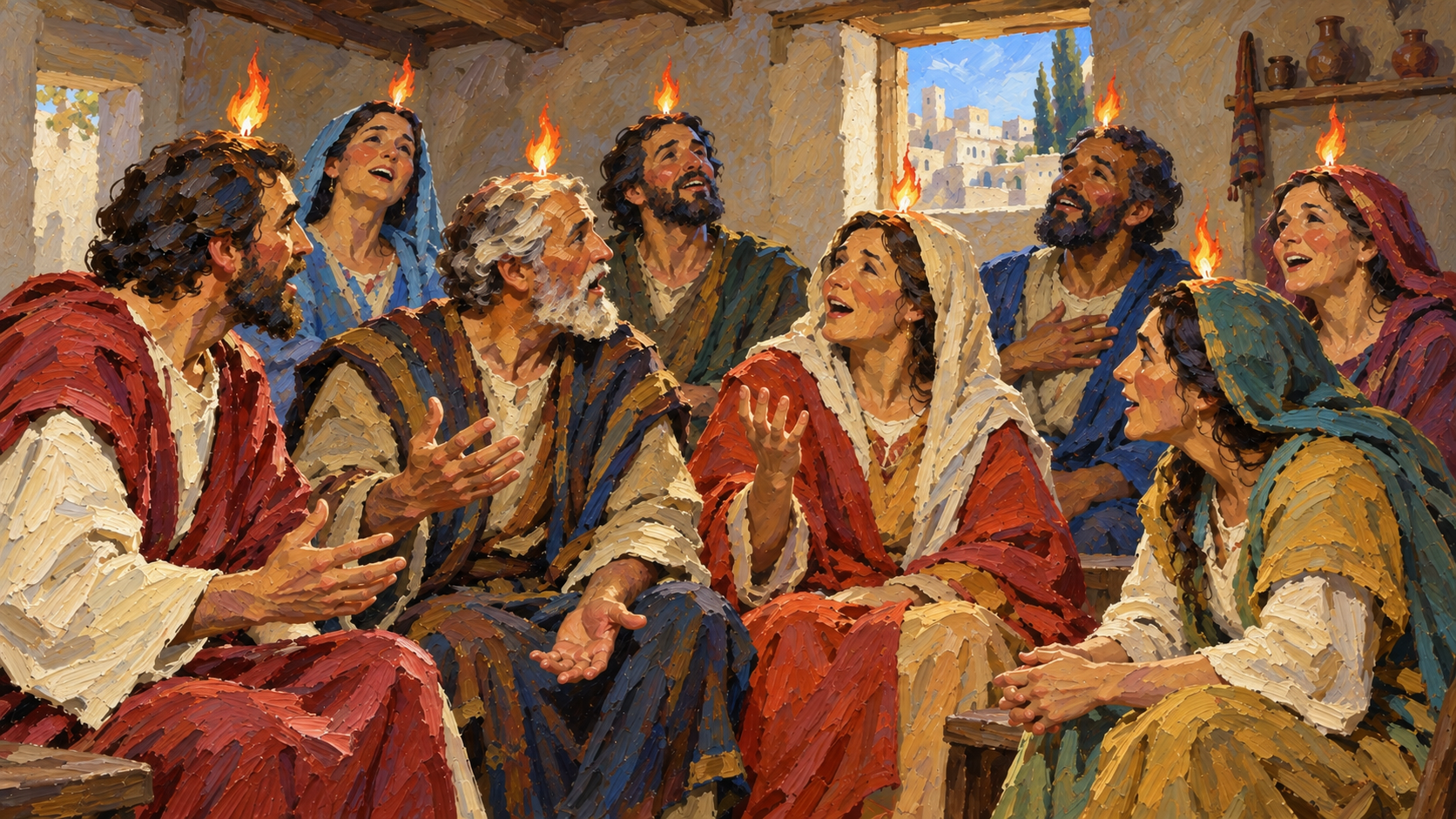
At Pentecost, the Spirit was poured out as Acts 2 records. Peter pointed to Joel to explain that the promised outpouring had arrived. The church would now bear witness to the risen Christ by the Spirit’s power.
The phrase “baptized with the Holy Spirit” should not be confused with water baptism or with repeated filling. Pentecost was the public arrival of the promised Spirit ministry, and 1 Corinthians 12:13 later says that believers were baptized by one Spirit into one body. This is not a second level of salvation reserved for Christians who reproduce Pentecost’s signs. Water baptism follows salvation and pictures the believer’s identification with Christ; it does not cause the Spirit to indwell someone.
Acts records unique turning points in God’s work alongside ongoing patterns for the church. I would not turn Pentecost into a private emotional experience that every believer must reproduce in every detail. It publicly marked the arrival of the New Covenant Spirit ministry promised by the prophets and Jesus. The New Testament letters then describe indwelling as the normal reality for every true believer, rather than sending Christians in pursuit of the same signs.
Paul gives us a definite answer in Romans 8: anyone who does not have the Spirit of Christ does not belong to Him. Writing after Pentecost, he leaves no category for a true Christian without the Holy Spirit.
Now if anyone does not have the Spirit of Christ, he is not His.
Having the Spirit belongs to what it means to belong to Christ. He gives life and brings believers into the privileges of adoption, bearing witness within them that they are God’s children. That witness provides assurance, and His power enables them to put the sinful deeds of the body to death. His presence is more than a mark placed on someone from the outside.
Paul also uses temple language for both the church and the believer’s body. A temple is where God makes His presence known, so this language teaches that He now dwells in His people by the Spirit.
Do you not know that you are the temple of God and that the Spirit of God dwells in you?
Being indwelt by God does not make me divine. It means He has graciously taken residence in His people, giving us assurance and calling us to holiness. A temple is not common space, and I need to live as someone who belongs to God.
Paul connects the Spirit’s seal with hearing and believing the gospel in Ephesians 1. People hear the word of truth and believe in Christ, then God seals them with His Spirit as the guarantee of their promised inheritance. This is one of Scripture’s clearest grounds for assurance.
That gospel centers on Jesus, the eternal Son who is fully God and fully man, virgin-born and completely sinless. Wicked men physically tortured and killed Jesus. In His innocent body, He willingly bore the punishment for our sins. He shed His blood, died, was buried, and rose bodily from the dead.
Christ died for the whole world, and God’s genuine offer can be resisted or rejected. Whoever repents and believes is forgiven and made new. The Holy Spirit indwells and seals that believer, who is eternally secure. Eternal security never gives permission for lawlessness, and a superficial claim to believe is not proof that someone was genuinely born again.
In Him you also trusted, after you heard the word of truth, the gospel of your salvation; in whom also, having believed, you were sealed with the Holy Spirit of promise, who is the guarantee of our inheritance.
The Greek word sphragizo means to seal. In Ephesians, the seal identifies believers as God’s own, with the Holy Spirit Himself as His pledge that they will receive the promised inheritance. I find assurance in how long that promise lasts. Ephesians 4:30 says believers are sealed until the day of redemption, not merely until their next failure.
And do not grieve the Holy Spirit of God, by whom you were sealed for the day of redemption.
The same verse that assures me of the Spirit’s seal commands me not to grieve Him. Being secure in Him gives me no reason to disregard that command. Sin is more grievous, not harmless, when we recognize that we are sinning against the Spirit who dwells in us.
The Spirit’s settled presence in every true believer is indwelling. Filling describes our yielding to His control and depending on His power, which shapes our worship and gives us boldness for obedient service. A believer who is indwelt can still resist His work, so the New Testament commands believers to be filled. Sin may grieve Him, and unbelief may quench what He is doing.
And do not be drunk with wine, in which is dissipation; but be filled with the Spirit.
Spiritual gifts also need to be understood in light of the Spirit’s work in believers. He distributes them according to His own will, so no single gift proves that someone is saved. We must test claims of tongues or prophecy by Scripture and hold public teaching to that same standard. Those who give or lead remain accountable to the Word too, as do those who show mercy or help others. The Spirit who gives these gifts also produces fruit in the believer’s character.
Walk in the Spirit, and you shall not fulfill the lust of the flesh.
I do not believe Scripture supports a hyper-charismatic approach that accepts every spiritual claim without testing it. Nor do I believe cessationism is correct when it says that the Spirit’s miraculous gifts no longer operate. The Spirit of truth never contradicts the Word He inspired. His work glorifies Christ and produces holiness in God’s people as He builds the church and keeps believers anchored to the truth.
My Final Thoughts
The Holy Spirit is the divine Person who gives life, convicts of sin, and glorifies Christ, not an impersonal power. His work in the Old Testament included empowering people for particular tasks. Under the New Covenant, He indwells and seals every true believer. Knowing that God Himself dwells in His people gives me assurance, but it also calls me to humble obedience. I want that confidence to lead me to walk with Him, rather than chase experiences detached from Scripture.