
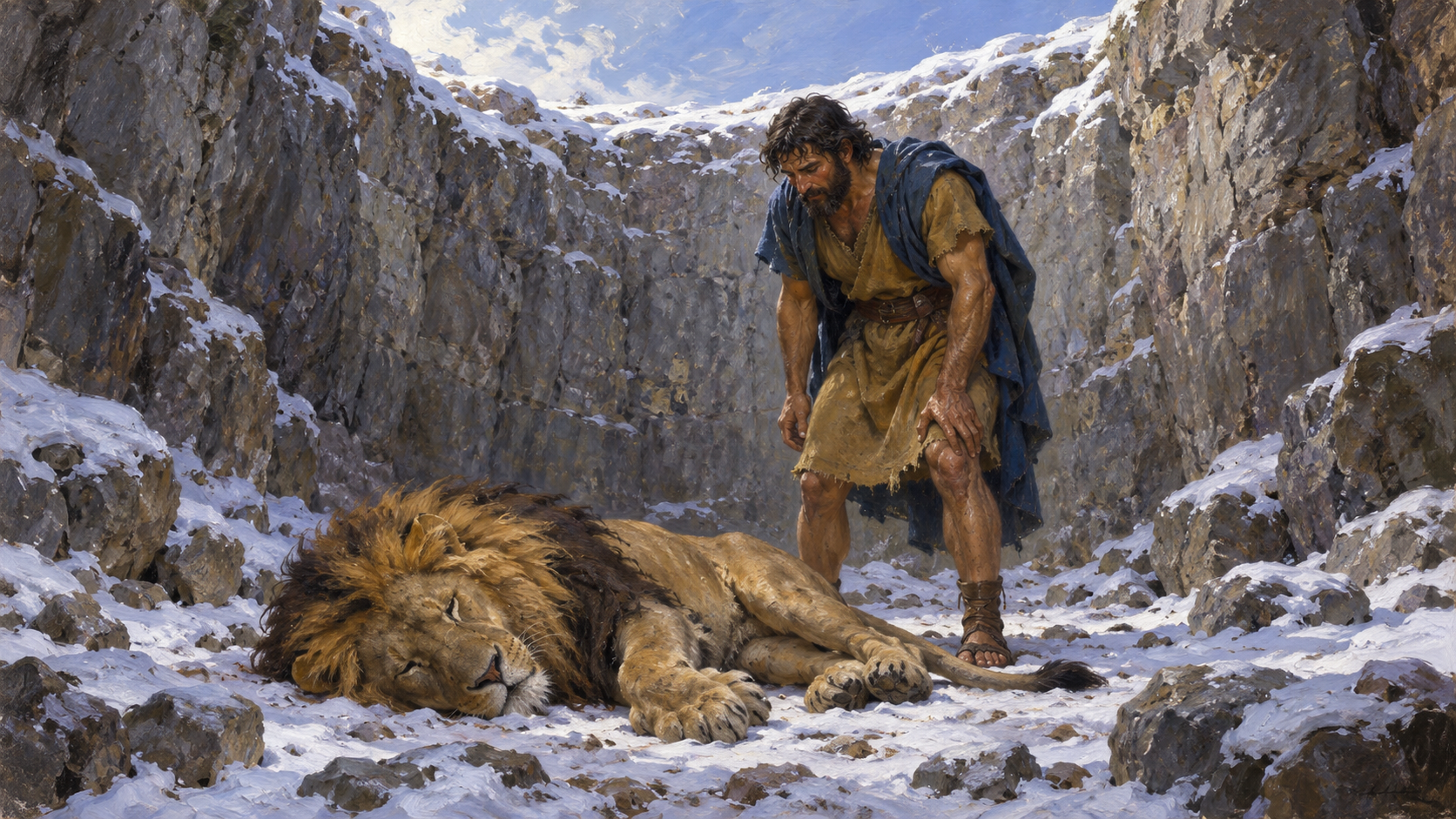
Benaiah is usually remembered for killing a lion in a pit on a snowy day. Scripture also follows him through years of service to David and Solomon, when courage had to be accompanied by loyalty, restraint, and dependable work. His later responsibilities help me understand the man more fully than that one remarkable victory can.
Benaiah’s Recorded Courage
Several men in the Old Testament bear the name Benaiah. This study concerns Jehoiada’s son from Kabzeel, a town in southern Judah, who served among David’s mighty men and eventually commanded Solomon’s army. His father’s name and his recorded offices help us follow him without confusing him with other men who shared his name.
Benaiah means “the LORD has built” or “YHWH has built,” as reflected in Brown–Driver–Briggs. Scripture does not use his name to predict his advancement. We are told little about his early life or training, and no childhood experiences or private reflections are recorded. We meet him as a man whose deeds have already distinguished him.
Benaiah was the son of Jehoiada, the son of a valiant man from Kabzeel, who had done many deeds. He had killed two lion-like heroes of Moab. He also had gone down and killed a lion in the midst of a pit on a snowy day. And he killed an Egyptian, a spectacular man. The Egyptian had a spear in his hand; so he went down to him with a staff, wrested the spear out of the Egyptian’s hand, and killed him with his own spear. These things Benaiah the son of Jehoiada did, and won a name among three mighty men. He was more honored than the thirty, but he did not attain to the first three. And David appointed him over his guard.
The account in 2 Samuel names three achievements: defeating two formidable Moabites, killing the lion, and overcoming an imposing Egyptian with the Egyptian’s own spear. Chronicles recounts the same deeds and adds the Egyptian’s height and the size of his weapon, helping us appreciate the danger Benaiah faced.
Benaiah was the son of Jehoiada, the son of a valiant man from Kabzeel, who had done many deeds. He had killed two lion-like heroes of Moab. He also had gone down and killed a lion in the midst of a pit on a snowy day. And he killed an Egyptian, a man of great height, five cubits tall. In the Egyptian’s hand there was a spear like a weaver’s beam; and he went down to him with a staff, wrested the spear out of the Egyptian’s hand, and killed him with his own spear. These things Benaiah the son of Jehoiada did, and won a name among three mighty men. Indeed he was more honored than the thirty, but he did not attain to the first three. And David appointed him over his guard.
The Egyptian stood five cubits tall and carried a spear like a weaver’s beam. Benaiah approached him with a staff, seized the spear, and killed him with it. He had faced a formidable opponent who was better armed, and his victory demonstrated both courage and skill.
The NKJV describes the Moabites as “two lion-like heroes of Moab.” The Hebrew wording is compressed, referring to two Ariel of Moab, and its precise meaning is disputed. The term has been associated with lion and God, but interpreters differ over whether it describes warriors or serves as a name. Some translations read sons of Ariel, supplying “sons” through a proposed reconstruction of the text. The NET textual note explains that choice. The following clause separately describes a literal lion, so I would not turn the first deed into two more animal fights.
In the encounter with that lion, Scripture expressly mentions the pit and the snowy day. We can recognize the danger without claiming to know the pit’s dimensions, the condition of Benaiah’s footing, or why he went down. The brief account records no speech or private prayer. His victory deserves our admiration, but the weather and the pit do not become an allegory of personal difficulties, and we are not told that he entered to improve his career prospects.
I would be misusing Benaiah’s example if I urged someone to manufacture danger in the hope of gaining influence. Scripture promises no such reward for a spectacular risk. David appointed Benaiah over his guard after his courage had been proved, but we are not told every qualification or step in the appointment. The account also describes his rank carefully: he was more honored than the Thirty but did not attain to the first Three.
Years of Service Under David
The lists of David’s officials show what Benaiah’s appointment involved. He commanded the Cherethites and Pelethites, a force closely associated with the king’s protection. Their service through later crises, including Solomon’s installation, helps us recognize their role as a royal guard.
So David reigned over all Israel; and David administered judgment and justice to all his people. Joab the son of Zeruiah was over the army; Jehoshaphat the son of Ahilud was recorder; Zadok the son of Ahitub and Ahimelech the son of Abiathar were the priests; Seraiah was the scribe; Benaiah the son of Jehoiada was over both the Cherethites and the Pelethites; and David’s sons were chief ministers.
The troops’ ancestry and the origins of their names are debated. I would not insist that the names mean executioners and couriers or that every member came from one foreign people. We have firmer grounds for describing the work they did under Benaiah’s command. A later list still places him over them after the upheaval of rebellion in David’s reign.
And Joab was over all the army of Israel; Benaiah the son of Jehoiada was over the Cherethites and the Pelethites; Adoram was in charge of revenue; Jehoshaphat the son of Ahilud was recorder; Sheva was scribe; Zadok and Abiathar were the priests; and Ira the Jairite was a chief minister under David.
That repeated entry is easy to pass over when we have just read about a victory over a lion. Yet it shows Benaiah continuing to lead people through changing circumstances. His service did not end with the encounter that made him renowned; he remained responsible for the men under his command.
Chronicles describes another part of his work in the arrangement for monthly military service. Each division contained twenty-four thousand men, and Benaiah commanded the division assigned to the third month. His son Ammizabad also appears in that record.
And the children of Israel, according to their number, the heads of fathers’ houses, the captains of thousands and hundreds and their officers, served the king in every matter of the military divisions. These divisions came in and went out month by month throughout all the months of the year, each division having twenty-four thousand. Over the first division for the first month was Jashobeam the son of Zabdiel, and in his division were twenty-four thousand; he was of the children of Perez, and the chief of all the captains of the army for the first month. Over the division of the second month was Dodai an Ahohite, and of his division Mikloth also was the leader; in his division were twenty-four thousand. The third captain of the army for the third month was Benaiah, the son of Jehoiada the priest, who was chief; in his division were twenty-four thousand. This was the Benaiah who was mighty among the thirty, and was over the thirty; in his division was Ammizabad his son.
The passage calls Jehoiada a priest, giving us a fact about Benaiah’s family without describing his upbringing or explaining every later achievement through his ancestry. It also identifies Benaiah with the Thirty and places him over them. That leadership did not erase the distinction already made between his standing and that of the first Three.
Commanding a division required more than personal bravery in combat. The men had to be ready for their appointed month, and their officers remained responsible for them. Scripture does not describe Benaiah’s daily routine, but it does record this organized command alongside his leadership of the guard. When I consider what he did for David, I need to give those years of work attention as well as his victories.
Loyalty During the Struggle for the Throne
Benaiah’s loyalty was tested when David grew old and physically weak. Adonijah, who had been born after Absalom and was older than Solomon, announced that he would be king. His age did not authorize him to seize the throne. He displayed chariots, horsemen, and runners, enlisted Joab and Abiathar, and held a feast that excluded Solomon and several of David’s trusted servants.
Then Adonijah the son of Haggith exalted himself, saying, “I will be king”; and he prepared for himself chariots and horsemen, and fifty men to run before him. (And his father had not rebuked him at any time by saying, “Why have you done so?” He was also very good-looking. His mother had borne him after Absalom.) Then he conferred with Joab the son of Zeruiah and with Abiathar the priest, and they followed and helped Adonijah. But Zadok the priest, Benaiah the son of Jehoiada, Nathan the prophet, Shimei, Rei, and the mighty men who belonged to David were not with Adonijah. And Adonijah sacrificed sheep and oxen and fattened cattle by the stone of Zoheleth, which is by En Rogel; he also invited all his brothers, the king’s sons, and all the men of Judah, the king’s servants. But he did not invite Nathan the prophet, Benaiah, the mighty men, or Solomon his brother. So Nathan spoke to Bathsheba the mother of Solomon, saying, “Have you not heard that Adonijah the son of Haggith has become king, and David our lord does not know it? Come, please, let me now give you advice, that you may save your own life and the life of your son Solomon. Go immediately to King David and say to him, ‘Did you not, my lord, O king, swear to your maidservant, saying, “Assuredly your son Solomon shall reign after me, and he shall sit on my throne”? Why then has Adonijah become king?’ Then, while you are still talking there with the king, I also will come in after you and confirm your words.” So Bathsheba went into the chamber to the king. (Now the king was very old, and Abishag the Shunammite was serving the king.) And Bathsheba bowed and did homage to the king. Then the king said, “What is your wish?” Then she said to him, “My lord, you swore by the LORD your God to your maidservant, saying, ‘Assuredly Solomon your son shall reign after me, and he shall sit on my throne.’ So now, look! Adonijah has become king; and now, my lord the king, you do not know about it. He has sacrificed oxen and fattened cattle and sheep in abundance, and has invited all the sons of the king, Abiathar the priest, and Joab the commander of the army; but Solomon your servant he has not invited. And as for you, my lord, O king, the eyes of all Israel are on you, that you should tell them who will sit on the throne of my lord the king after him. Otherwise it will happen, when my lord the king rests with his fathers, that I and my son Solomon will be counted as offenders.” And just then, while she was still talking with the king, Nathan the prophet also came in. So they told the king, saying, “Here is Nathan the prophet.” And when he came in before the king, he bowed down before the king with his face to the ground. And Nathan said, “My lord, O king, have you said, ‘Adonijah shall reign after me, and he shall sit on my throne’? For he has gone down today, and has sacrificed oxen and fattened cattle and sheep in abundance, and has invited all the king’s sons, and the commanders of the army, and Abiathar the priest; and look! They are eating and drinking before him; and they say, ‘Long live King Adonijah!’ But he has not invited me–me your servant–nor Zadok the priest, nor Benaiah the son of Jehoiada, nor your servant Solomon. Has this thing been done by my lord the king, and you have not told your servant who should sit on the throne of my lord the king after him?” Then King David answered and said, “Call Bathsheba to me.” So she came into the king’s presence and stood before the king. And the king took an oath and said, “As the LORD lives, who has redeemed my life from every distress, just as I swore to you by the LORD God of Israel, saying, ‘Assuredly Solomon your son shall be king after me, and he shall sit on my throne in my place,’ so I certainly will do this day.” Then Bathsheba bowed with her face to the earth, and paid homage to the king, and said, “Let my lord King David live forever!” And King David said, “Call to me Zadok the priest, Nathan the prophet, and Benaiah the son of Jehoiada.” So they came before the king. The king also said to them, “Take with you the servants of your lord, and have Solomon my son ride on my own mule, and take him down to Gihon. There let Zadok the priest and Nathan the prophet anoint him king over Israel; and blow the horn, and say, ‘Long live King Solomon!’ Then you shall come up after him, and he shall come and sit on my throne, and he shall be king in my place. For I have appointed him to be ruler over Israel and Judah.” Benaiah the son of Jehoiada answered the king and said, “Amen! May the LORD God of my lord the king say so too. As the LORD has been with my lord the king, even so may He be with Solomon, and make his throne greater than the throne of my lord King David.” So Zadok the priest, Nathan the prophet, Benaiah the son of Jehoiada, the Cherethites, and the Pelethites went down and had Solomon ride on King David’s mule, and took him to Gihon. Then Zadok the priest took a horn of oil from the tabernacle and anointed Solomon. And they blew the horn, and all the people said, “Long live King Solomon!” And all the people went up after him; and the people played the flutes and rejoiced with great joy, so that the earth seemed to split with their sound.
Nathan and Bathsheba brought the danger to David’s attention. Bathsheba warned that she and her son would be treated as offenders if Adonijah secured the throne. Solomon’s claim and their lives were at stake. David renewed his oath that Solomon would reign and ordered the installation to take place that day.
Benaiah answered David’s command with “Amen” and asked the LORD to confirm it. He prayed that God would be with Solomon as He had been with David and make Solomon’s throne greater. His answer acknowledged God’s authority over the succession, and he followed it by helping carry out the king’s instructions.
Solomon rode David’s own mule to Gihon, visibly displaying the reigning king’s authorization. Zadok anointed him, Nathan participated as the Lord’s prophet, and Benaiah accompanied them with the Cherethites and Pelethites. The trumpet announced Solomon as king, and the people rejoiced so loudly that Adonijah’s guests heard the city in an uproar. They would soon learn that David had appointed Solomon and their own attempt had failed.
Difficult Judgments Under Solomon
Under the new king, Benaiah was also required to carry out death sentences. These deaths deserve careful attention to the grounds and circumstances Scripture records. After Solomon’s installation, Adonijah had taken refuge at the altar. Solomon spared him on the condition that he prove worthy, warned that further wickedness would bring death, and sent him home.
After David’s death, Adonijah asked Bathsheba to obtain Abishag the Shunammite as his wife. She had cared for the aged David and belonged to his royal household. Although 1 Kings 1:4 says David had not had sexual relations with her, a request involving a woman of the former king’s household could still imply a claim to royal standing. Solomon understood the petition in light of Adonijah’s earlier attempt to take the throne.
Now Adonijah the son of Haggith came to Bathsheba the mother of Solomon. So she said, “Do you come peaceably?” And he said, “Peaceably.” Moreover he said, “I have something to say to you.” And she said, “Say it.” Then he said, “You know that the kingdom was mine, and all Israel had set their expectations on me, that I should reign. However, the kingdom has been turned over, and has become my brother’s; for it was his from the LORD. Now I ask one petition of you; do not deny me.” And she said to him, “Say it.” Then he said, “Please speak to King Solomon, for he will not refuse you, that he may give me Abishag the Shunammite as wife.” So Bathsheba said, “Very well, I will speak for you to the king.” Bathsheba therefore went to King Solomon, to speak to him for Adonijah. And the king rose up to meet her and bowed down to her, and sat down on his throne and had a throne set for the king’s mother; so she sat at his right hand. Then she said, “I desire one small petition of you; do not refuse me.” And the king said to her, “Ask it, my mother, for I will not refuse you.” So she said, “Let Abishag the Shunammite be given to Adonijah your brother as wife.” And King Solomon answered and said to his mother, “Now why do you ask Abishag the Shunammite for Adonijah? Ask for him the kingdom also–for he is my older brother–for him, and for Abiathar the priest, and for Joab the son of Zeruiah.” Then King Solomon swore by the LORD, saying, “May God do so to me, and more also, if Adonijah has not spoken this word against his own life! Now therefore, as the LORD lives, who has confirmed me and set me on the throne of David my father, and who has established a house for me, as He promised, Adonijah shall be put to death today!” So King Solomon sent by the hand of Benaiah the son of Jehoiada; and he struck him down, and he died. And to Abiathar the priest the king said, “Go to Anathoth, to your own fields, for you are deserving of death; but I will not put you to death at this time, because you carried the ark of the Lord GOD before my father David, and because you were afflicted every time my father was afflicted.” So Solomon removed Abiathar from being priest to the LORD, that he might fulfill the word of the LORD which He spoke concerning the house of Eli at Shiloh. Then news came to Joab, for Joab had defected to Adonijah, though he had not defected to Absalom. So Joab fled to the tabernacle of the LORD, and took hold of the horns of the altar. And King Solomon was told, “Joab has fled to the tabernacle of the LORD; there he is, by the altar.” Then Solomon sent Benaiah the son of Jehoiada, saying, “Go, strike him down.” So Benaiah went to the tabernacle of the LORD, and said to him, “Thus says the king, ‘Come out!'” And he said, “No, but I will die here.” And Benaiah brought back word to the king, saying, “Thus said Joab, and thus he answered me.” Then the king said to him, “Do as he has said, and strike him down and bury him, that you may take away from me and from the house of my father the innocent blood which Joab shed. So the LORD will return his blood on his head, because he struck down two men more righteous and better than he, and killed them with the sword–Abner the son of Ner, the commander of the army of Israel, and Amasa the son of Jether, the commander of the army of Judah–though my father David did not know it. Their blood shall therefore return upon the head of Joab and upon the head of his descendants forever. But upon David and his descendants, upon his house and his throne, there shall be peace forever from the LORD.” So Benaiah the son of Jehoiada went up and struck and killed him; and he was buried in his own house in the wilderness. The king put Benaiah the son of Jehoiada in his place over the army, and the king put Zadok the priest in the place of Abiathar.
Solomon responded by asking why Bathsheba did not request the kingdom for Adonijah too. Adonijah had just spoken of the kingdom as once his, even while admitting that Solomon had received it from the LORD. Given his earlier conduct, Solomon regarded the request as a renewed danger to the throne and ordered Benaiah to put him to death. We are given the king’s explanation, but no confession of a second conspiracy. I would not claim to know every private motive behind the petition.
Solomon removed Abiathar from the priesthood but spared his life because he had served and suffered with David. When Joab heard what had happened, he fled to the tabernacle and took hold of the altar’s horns. Joab had supported Adonijah, but Solomon also named two earlier murders as grounds for his death.
Joab had killed Abner after David received him in peace at Hebron. Without David’s knowledge, Joab had him brought back and took him aside before stabbing him. Later, he greeted Amasa as a brother and grasped his beard as though to kiss him, then struck him down. Both men were killed through treachery rather than in battle against Joab. David had charged Solomon concerning their blood, and Solomon named both commanders when explaining why Joab must die.
Benaiah first told Joab to come out of the tabernacle. When Joab refused and said he would die there, Benaiah returned to Solomon with his answer. He sought further direction instead of deciding for himself how to carry out the sentence at the altar. Solomon confirmed the order and required Joab’s burial, and Benaiah then obeyed.
Holding the altar’s horns did not give a murderer unconditional protection. Exodus 21:14 requires a man who kills his neighbor through premeditated treachery to be taken from God’s altar to die. Solomon said Joab’s blood would return upon his own head and the innocent blood he had shed would be removed from David’s house. The severity of the sentence should not make us overlook the named crimes or the king’s clarified order. Nor should we assign Benaiah personal hatred or a scheme to obtain Joab’s office when the passage gives neither as his motive.
Shimei, who had cursed David during Absalom’s rebellion, had been allowed to live under a different condition. Solomon ordered him to remain in Jerusalem, with death as the penalty for leaving. The warning specifically named crossing the Brook Kidron, but the command forbade travel anywhere outside the city. Shimei accepted it and swore to obey.
Then the king sent and called for Shimei, and said to him, “Build yourself a house in Jerusalem and dwell there, and do not go out from there anywhere. For it shall be, on the day you go out and cross the Brook Kidron, know for certain you shall surely die; your blood shall be on your own head.” And Shimei said to the king, “The saying is good. As my lord the king has said, so your servant will do.” So Shimei dwelt in Jerusalem many days. Now it happened at the end of three years, that two slaves of Shimei ran away to Achish the son of Maachah, king of Gath. And they told Shimei, saying, “Look, your slaves are in Gath!” So Shimei arose, saddled his donkey, and went to Achish at Gath to seek his slaves. And Shimei went and brought his slaves from Gath. And Solomon was told that Shimei had gone from Jerusalem to Gath and had come back. Then the king sent and called for Shimei, and said to him, “Did I not make you swear by the LORD, and warn you, saying, ‘Know for certain that on the day you go out and travel anywhere, you shall surely die’? And you said to me, ‘The word I have heard is good.’ Why then have you not kept the oath of the LORD and the commandment that I gave you?” The king said moreover to Shimei, “You know, as your heart acknowledges, all the wickedness that you did to my father David; therefore the LORD will return your wickedness on your own head. But King Solomon shall be blessed, and the throne of David shall be established before the LORD forever.” So the king commanded Benaiah the son of Jehoiada; and he went out and struck him down, and he died. Thus the kingdom was established in the hand of Solomon.
Three years later, Shimei left Jerusalem for Gath to retrieve two runaway servants. He brought them back, but returning did not undo his breach of the command and oath. Solomon confronted him with the terms he had accepted and recalled his earlier wickedness against David. Shimei had known the penalty for leaving Jerusalem, and the king now ordered Benaiah to carry it out.
Benaiah carried out these royal judgments as an authorized officer in Israel. His office did not give him permission to kill personal rivals, and these accounts give Christians no such permission either. The church corrects and disciplines under Christ’s word, while civil government has a distinct responsibility under God. No human office makes every order righteous or removes our responsibility to obey the Lord. Benaiah’s return to Solomon also shows that faithful service can include asking for clarification before acting.
Benaiah had been appointed commander of the army after Joab’s death, before Shimei’s later execution. The list of Solomon’s officials in 1 Kings 4 records him holding that office.
So King Solomon was king over all Israel. And these were his officials: Azariah the son of Zadok, the priest; Elihoreph and Ahijah, the sons of Shisha, scribes; Jehoshaphat the son of Ahilud, the recorder; Benaiah the son of Jehoiada, over the army; Zadok and Abiathar, the priests; Azariah the son of Nathan, over the officers; Zabud the son of Nathan, a priest and the king’s friend; Ahishar, over the household; and Adoniram the son of Abda, over the labor force.
By then, Scripture has traced years of Benaiah’s service among David’s mighty men, over the royal guard, and in command of a monthly division. He remained loyal during the succession crisis and carried out difficult orders under Solomon. Those responsibilities help us understand his advancement without turning his experience into a formula for someone else’s career.
I would give people a false expectation if I promised promotion in return for faithfulness. Scripture also honors prophets who were rejected, apostles who were imprisoned, and believers who were killed. Some servants receive public responsibility; others continue faithfully where few people notice. We need to obey the Lord in the work He entrusts to us without making recognition a condition of our service.
The Throne Beyond Solomon
Benaiah had prayed that Solomon’s throne would be greater than David’s, but that prayer did not make every later decision of Solomon righteous. God gave him wisdom, he built the temple, and the kingdom enjoyed peace. He later followed the gods of the foreign women he loved, and his disobedience brought judgment that would divide the kingdom. Israel’s lasting hope rested on the promise God made in His covenant with David, a promise that reached beyond Solomon’s reign.
Now therefore, thus shall you say to My servant David, ‘Thus says the LORD of hosts: “I took you from the sheepfold, from following the sheep, to be ruler over My people, over Israel. And I have been with you wherever you have gone, and have cut off all your enemies from before you, and have made you a great name, like the name of the great men who are on the earth. Moreover I will appoint a place for My people Israel, and will plant them, that they may dwell in a place of their own and move no more; nor shall the sons of wickedness oppress them anymore, as previously, since the time that I commanded judges to be over My people Israel, and have caused you to rest from all your enemies. Also the LORD tells you that He will make you a house. “When your days are fulfilled and you rest with your fathers, I will set up your seed after you, who will come from your body, and I will establish his kingdom. He shall build a house for My name, and I will establish the throne of his kingdom forever. I will be his Father, and he shall be My son. If he commits iniquity, I will chasten him with the rod of men and with the blows of the sons of men. But My mercy shall not depart from him, as I took it from Saul, whom I removed from before you. And your house and your kingdom shall be established forever before you. Your throne shall be established forever.”‘” According to all these words and according to all this vision, so Nathan spoke to David.
Solomon fulfilled the promise of a son who would build the temple and could receive discipline for his own sin. His mortal reign, however, did not fulfill the whole promise of an everlasting house and throne. Its final fulfillment belongs to Jesus Christ, the sinless Son of David. Gabriel connected His coming reign specifically with David’s throne and the house of Jacob.
Now in the sixth month the angel Gabriel was sent by God to a city of Galilee named Nazareth, to a virgin betrothed to a man whose name was Joseph, of the house of David. The virgin’s name was Mary. And having come in, the angel said to her, “Rejoice, highly favored one, the Lord is with you; blessed are you among women!” But when she saw him, she was troubled at his saying, and considered what manner of greeting this was. Then the angel said to her, “Do not be afraid, Mary, for you have found favor with God. And behold, you will conceive in your womb and bring forth a Son, and shall call His name JESUS. He will be great, and will be called the Son of the Highest; and the Lord God will give Him the throne of His father David. And He will reign over the house of Jacob forever, and of His kingdom there will be no end.”
Benaiah helped carry out the authorized succession in the royal house to which God had made that promise. This gives him a real connection to the history leading to Christ without making each battle an allegory of Christ’s saving work. Scripture does not identify Benaiah as a type of Christ, a person specifically presented as foreshadowing Him.
The promised King does not commission His church to reenact Benaiah’s executions. Jesus builds it through His word and His people’s witness as the Holy Spirit works among them. He will return bodily and reign on earth, fulfilling God’s promise, and His judgments will be perfectly righteous. No sin, deceit, or political ambition can corrupt Him.
At His first coming, Jesus voluntarily gave Himself to be slain as the perfect sacrifice for our sins. He is the eternal Son, fully God and fully man, born of a virgin and without sin. Wicked men inflicted real bodily torture and crucified Him, while He willingly shed His innocent blood and died for us. His saving sacrifice was complete before His burial and bodily resurrection. The Father did not punish, curse, abandon, strike, bruise, or pour wrath on Jesus. Father, Son, and Holy Spirit remained united, with no broken fellowship in the Godhead.
Christ died for the whole world, and God’s offer of salvation is genuine even though people can resist and reject His grace. Everyone who repents and believes is forgiven and justified by faith rather than works. To be justified is to be declared righteous before God. Through the new birth, the believer becomes a new creation, indwelt and sealed by the Holy Spirit. That new life is eternally secure in Christ, but it gives no permission to live lawlessly. A Christian label alone does not establish that someone has been born again. Obedience should show the Spirit’s work in us; it neither earns nor keeps salvation, and new birth does not mean sinless perfection.
Our first loyalty belongs to the King who has saved us. We may respect a leader, appreciate an employer, or serve someone for many years, but those relationships cannot oblige us to disobey Christ. When an order is unclear, we should ask what is required and understand the limits of our responsibility. When it plainly requires sin, the pressure to obey does not make it right.
Much of our own service will attract little attention, but we still need to prepare for work, care for people entrusted to us, and keep our word. Benaiah’s recorded offices keep me from overlooking those duties while admiring his courage. We need the resolve to obey along with the care to act truthfully and within the authority God has given us.
My Final Thoughts
Benaiah’s life gives me more to consider than a dangerous encounter with a lion. His service continued through changing responsibilities, and his return to Solomon concerning Joab shows that courage could leave room for clarification. We can honor his deeds without inventing motives, promising ourselves advancement, or treating Israel’s royal sentences as permission for private violence. Above David and Solomon stands the perfectly righteous Son of David. Our final loyalty belongs to Jesus Christ and His word.