
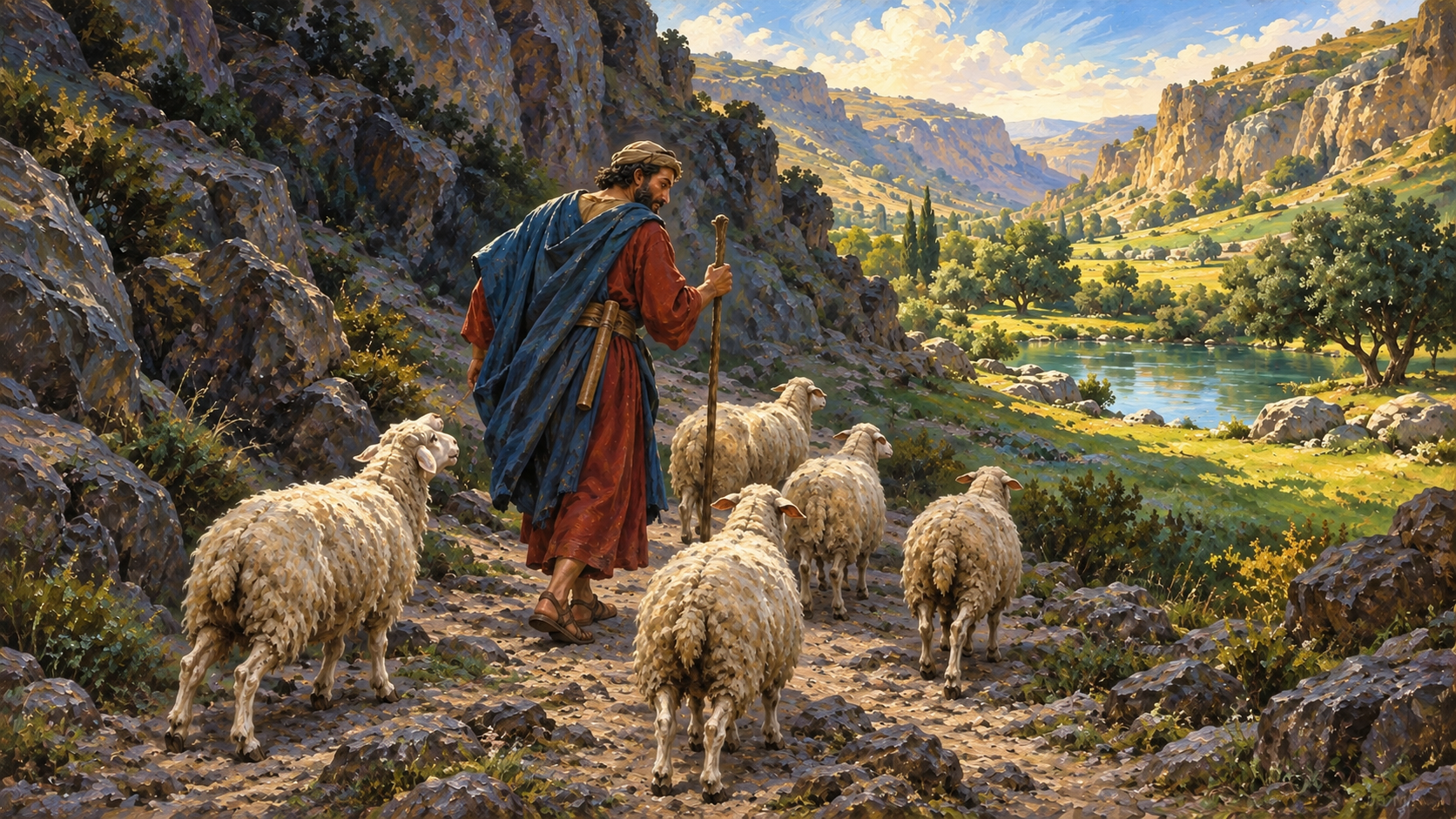
Psalm 23 is often read when someone is grieving or facing death, and it belongs there. David’s words also speak to the needs, decisions, and dangers of an ordinary life with God. I want to read the whole psalm together, because his confidence in the valley began with his confession: “The LORD is my shepherd.”
Psalm 23 Is One Shepherded Journey
We may remember the words, “Yea, though I walk through the valley of the shadow of death, I will fear no evil.” Yet David did not describe the valley apart from the Lord who provided pasture, led him in righteousness, and welcomed him at His table. Here is the whole psalm:
“The LORD is my shepherd; I shall not want. He makes me to lie down in green pastures; He leads me beside the still waters. He restores my soul; He leads me in the paths of righteousness For His name’s sake. Yea, though I walk through the valley of the shadow of death, I will fear no evil; For You are with me; Your rod and Your staff, they comfort me. You prepare a table before me in the presence of my enemies; You anoint my head with oil; My cup runs over. Surely goodness and mercy shall follow me All the days of my life; And I will dwell in the house of the LORD Forever.”
Before David ruled Israel, he cared for his father’s sheep. He told Saul that he had defended the flock against a lion and a bear, crediting the LORD with delivering him from both (1 Samuel 17:34–37). He understood the work behind the picture he used here. Sheep needed someone to find pasture, guide them, and defend them when a predator attacked.
Psalm 78:70–72 says that God took David from tending sheep to shepherd Israel. The man entrusted with caring for a nation still needed the LORD to care for him. His courage and experience did not make him self-sufficient, and being a king did not put him beyond the need for guidance or correction.
As the psalm unfolds, the places and circumstances change. There is rest beside water, danger in a dark valley, and a generous welcome while enemies remain nearby. David never says that trusting the LORD removes every threat. He explains why he can trust Him while those threats are real.
The LORD Provides, Restores, and Leads
The all-capital word LORD represents God’s covenant name in the Old Testament. David was speaking of the God of Israel, who had revealed Himself and committed Himself to His promises. He was not expressing a vague hope that some higher power might look after him.
David also said “my shepherd.” The God who rules heaven and earth cared for him personally. David could depend on the LORD’s greatness without thinking that greatness made Him too distant to attend to one person’s need. I find comfort in that combination: God knows the person He is caring for, and His ability to help is not limited as ours is.
“I shall not want.” Here, want means lack. David trusted the Shepherd to provide what he needed, but his own life keeps us from confusing that trust with a guarantee of prosperity. He experienced hunger, pursuit, betrayal, family sorrow, and God’s discipline. Neither this line nor the overflowing cup later in the psalm promises that believers will always be comfortable or receive everything they desire.
David’s life was in the care of One who knew his needs and could provide for him. He did not have to make himself secure apart from God. We go wrong when we either assume that God is indifferent to our need or insist that He meet it according to our preferences and schedule. The study on the providence and provision of God considers that dependence more fully.
The green pastures supply nourishment, and the still waters offer rest and refreshment. A shepherd has to know where to lead his flock for both. These images remind me that the LORD understands our limits. He made us with bodies that need food and rest; He does not despise those needs or expect us to prove our faith by pretending we have none.
David then said, “He restores my soul.” Restoration includes the renewal of life and strength, reaching the person rather than merely improving outward circumstances. Exhaustion, grief, guilt, and fear can leave someone in need of that care. David’s other psalms contain cries for help and confessions of sin, so we should not imagine that he always approached God feeling composed and strong.
“The LORD is near to those who have a broken heart, And saves such as have a contrite spirit.”
A brokenhearted believer does not need to be reprimanded for failing to look cheerful. When sin is involved, His restoration also calls for repentance; when a person is grieving, we should not invent some hidden wrongdoing to explain the sorrow. In either case, the person needs the LORD’s care rather than our assumption that weakness proves a lack of faith.
The Shepherd also leads in paths of righteousness “for His name’s sake.” His guidance agrees with His character and His revealed will. He does not restore His sheep so that they can resume rebellion. If an opportunity requires disobedience to Scripture, we cannot reasonably call it God’s leading simply because it is attractive or seems likely to succeed.
“For His name’s sake” also gives us confidence in the One doing the leading. God’s faithfulness rests in His own character, not in our ability to anticipate every difficulty. A righteous path may involve rejection, waiting, or a costly refusal to sin. The LORD has not failed to guide us because obedience proves difficult.
The Shepherd Is Present in the Valley
The path brings David into “the valley of the shadow of death.” The Hebrew word often written tsalmaveth describes deep darkness and is used of distress and extreme danger. The Brown–Driver–Briggs lexicon entry includes Psalm 23:4 among those uses. We can rightly draw comfort from this verse as death approaches, while also recognizing that its language reaches severe dangers and griefs earlier in life.
David’s reason for courage was personal: “I will fear no evil; For You are with me.” The valley had not become harmless. He could face it because the Shepherd had not left him. I would not use those words to shame someone who is frightened. Scripture records faithful people enduring terrible suffering, and bringing our fear to God is part of trusting Him through it.
Notice the change in the way David spoke. He began with “He makes,” “He leads,” and “He restores.” In the valley, he said, “You are with me.” He moved from speaking about the LORD to addressing Him. What he knew about God became the substance of his prayer when he needed help.
That nearness included the Shepherd’s ability to guard and guide:
“Your rod and Your staff, they comfort me.”
A shepherd’s rod could be used to defend the flock, while his staff assisted him in tending and directing it. David’s comfort rested in the LORD’s active care. A frightened sheep could not make a dangerous route safe through determination, but it could be led by a shepherd who knew the ground and was able to deal with threats.
The LORD’s authority belongs to that care. We should not want His protection while resenting every warning that turns us away from sin. Correction may be uncomfortable, especially when we have been determined to go our own way, but leaving us to wander would not be kindness. The study on the fear of the Lord explains why reverence for Him belongs with confidence in His goodness.
Darkness can make it hard to see what to do next, but it does not prevent God from knowing where we are. The related studies on God being our light and not being forsaken develop that assurance. His presence gives us someone to trust when we cannot yet see how a difficulty will end.
The Table, the Pursuing Mercy, and the Journey Home
In verse 5, David changed the picture from a shepherd tending sheep to a host welcoming a guest: “You prepare a table before me in the presence of my enemies.” The enemies were still there, yet they could not prevent the LORD from providing for His servant and honoring him at His table.
“You anoint my head with oil” describes a welcome that refreshes and honors the guest. “My cup runs over” adds the generosity of the provision. David was not being grudgingly tolerated. He pictured himself received with care by a Host whose resources were not exhausted by his need.
David had known God’s provision while Saul pursued him and while he lived in wilderness places. Opposition had not stopped the LORD from preserving him and keeping His promise. Psalm 27:5 similarly describes the LORD sheltering His servant during trouble. We should not conclude that God has abandoned us simply because someone remains hostile or a conflict has not been resolved.
The psalm then looks beyond the immediate danger: “Surely goodness and mercy shall follow me All the days of my life.” David’s “surely” expresses confidence in God’s continuing faithfulness. “Follow” has the force of pursuing, as the NET Bible’s note on this verse explains. God’s goodness and covenant kindness would continue to attend him; he was not left to hope for occasional help from an otherwise indifferent God.
That confidence does not require us to call every event good. Betrayal is still evil, death is still an enemy, and discipline can hurt. God’s mercy continues through those experiences without making the wrong done to His people right. Sometimes we later recognize help we could not see at the time. Where we cannot explain what has happened, we can still depend on His character.
David ended, “And I will dwell in the house of the LORD Forever.” His hope reached beyond escaping an enemy to remaining in fellowship with the LORD Himself. The generous Host’s presence was where he wanted to be. As Christians, we read that lasting hope in light of what Jesus has revealed about eternal life: the Shepherd’s care will bring His people into God’s presence beyond death.
Jesus Is the Good Shepherd
Psalm 23 first speaks as David’s confession of the LORD’s care for him. Elsewhere, Scripture develops the promise of God caring for His people as their Shepherd. Ezekiel 34 rebukes Israel’s unfaithful shepherds and promises that God Himself will seek His scattered sheep, feed them, and bind up the injured. He also promises to set over them one shepherd, His servant David. That promise points to the Messiah from David’s line, revealed in the New Testament as Jesus Christ.
“I am the good shepherd. The good shepherd gives His life for the sheep.”
Jesus identified Himself as the Good Shepherd and explained the cost of His care. He is fully God and fully man, sinless, and He willingly gave Himself for sinners. Wicked men inflicted His bodily suffering and death; He voluntarily shed His blood and bore the punishment for our sins in His innocent body. His saving work in that death was complete before He rose bodily from the grave. The living Shepherd who keeps His sheep is the One who gave His life for them.
Paul brings Christ’s resurrection, His shepherding care, and His people’s obedience together in Hebrews:
“Now may the God of peace who brought up our Lord Jesus from the dead, that great Shepherd of the sheep, through the blood of the everlasting covenant, make you complete in every good work to do His will…”
Paul prayed that the God who raised our great Shepherd would equip His people to do His will. Redemption brings us into a life of obedience, not merely relief from immediate distress. The same Lord who saves us leads us in righteousness, so following Him cannot mean accepting His comfort while refusing His authority. The study on Jesus as the Good Shepherd examines His words and work more closely.
Revelation 7 brings the Lamb and the Shepherd together in a description of His people’s future comfort:
“For the Lamb who is in the midst of the throne will shepherd them and lead them to living fountains of waters. And God will wipe away every tear from their eyes.”
The Lamb who was slain will shepherd His people. Death therefore cannot take them beyond His care, and their tears will not continue forever. That is why Psalm 23 offers more than a hope that our circumstances will improve before we die. The risen Christ gives His sheep eternal life and brings them into the presence of God.
Following the Shepherd on the Path We Face
I need to do more than admire David’s confidence. If I call the LORD my Shepherd while insisting that He approve a decision I have already made, I am refusing the very guidance the psalm describes. Trust means bringing my choices under His Word, including the choices I would rather keep to myself.
An opportunity requiring dishonesty or sexual sin does not become God’s direction because it offers money, affection, or advancement. If I have to falsify records to secure a promotion, the next obedient step is to refuse the dishonesty. I do not need a private sign to excuse what Scripture has already forbidden. The same principle applies when bitterness or neglect of a clear duty is involved: uncertainty about the future does not prevent obedience in what God has made plain.
David’s change from “He” to “You” also gives us a practical way to pray. We can speak directly to the LORD about the danger we face and ask for the help we need. Saying “You are with me” need not mean that we feel calm already. We are confessing what we know about Him while bringing Him the fear that still troubles us.
When enemies remain, the prepared table reminds us that their hostility cannot decide whether God is good or whether obedience is worthwhile. He can sustain His servant while opposition continues. We can seek His provision, accept His correction, and take the next faithful step without pretending we understand the entire course of our lives.
My Final Thoughts
David trusted the LORD for nourishment and rest, for restoration when he was worn down, and for guidance when the path became dangerous. I want that dependence to shape how I respond both to ordinary decisions and to severe grief. The Good Shepherd gave His life for His sheep and now lives to care for them. We have reason to follow Him even when we cannot see the way ahead, because neither an enemy nor death itself can cancel His promise to bring His people into God’s presence.