
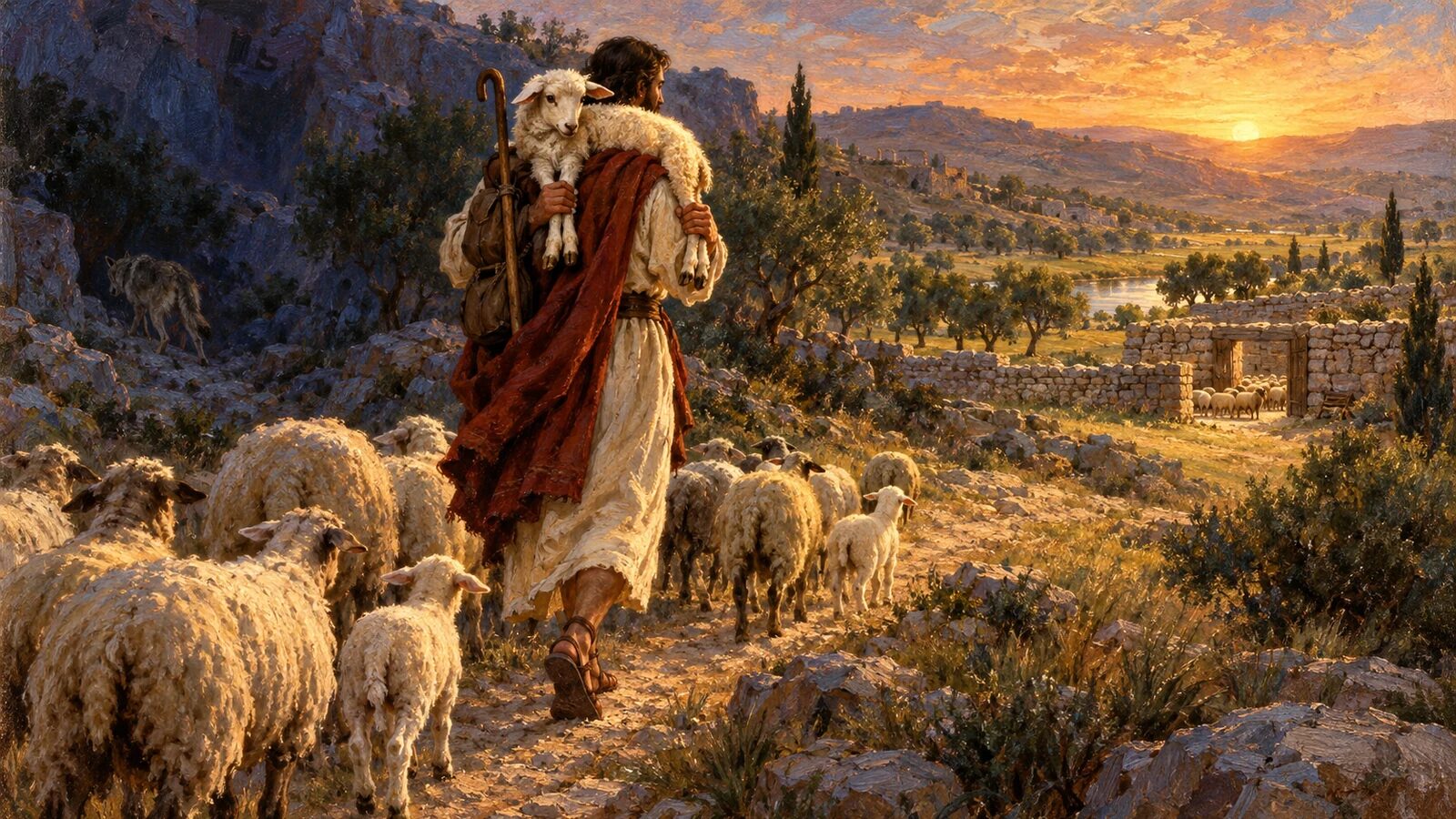
Jesus says “I am the good shepherd” in John 10, explaining that He will give His life for His sheep. He had just received a man whom religious leaders had cast out, and His words exposed the difference between their treatment of people and His own. As we follow the shepherd passages through Scripture, we can understand both the comfort of His promise and the responsibility of anyone who claims to lead His sheep.
Abel, David, and the Work of a Shepherd
The first shepherd named in Scripture is Abel, one of Adam and Eve’s sons. His brother Cain worked the ground, and both men brought an offering to the LORD from their work.
Then she bore again, this time his brother Abel. Now Abel was a keeper of sheep, but Cain was a tiller of the ground. And in the process of time it came to pass that Cain brought an offering of the fruit of the ground to the LORD. Abel also brought of the firstborn of his flock and of their fat. And the LORD respected Abel and his offering,
Genesis 4:2-4, NKJV
Abel brought the firstborn of his flock and their fat portions. He gave God priority and brought what was valuable, while Cain’s offering receives a plainer description. Genesis also says that God respected Abel and his offering, naming the worshiper before the gift. God’s response concerned the man who approached Him as well as what he brought.
Hebrews tells us why Abel’s offering was accepted.
By faith Abel offered to God a more excellent sacrifice than Cain, through which he obtained witness that he was righteous, God testifying of his gifts; and through it he being dead still speaks.
Hebrews 11:4, NKJV
Abel offered by faith. He trusted God rather than assuming a religious act would oblige God to accept him. Cain became angry when his offering was rejected, and his refusal to receive correction eventually led to his brother’s murder. Bringing a gift had not made his heart right before God.
Some readers understand the absence of blood as the reason Cain’s offering was rejected. The wider biblical teaching on atonement certainly requires us to take blood and sacrifice seriously, but Genesis 4 does not state that this was the sole reason. The Hebrew word minchah, used for both offerings, can describe a gift, tribute, or offering of grain or animals. The word itself does not settle the question. Hebrews identifies Abel’s faith, and Genesis shows Cain resisting God’s correction. We should keep those explanations before us when drawing conclusions about their gifts.
Abel’s work introduces shepherding, but later passages develop it as a picture of leadership. Sheep need someone to find pasture and water, notice when they are injured, and search for them when they stray. A shepherd cannot assume that yesterday’s care will keep the flock safe today. David explained how demanding that responsibility could become when Saul doubted his ability to face Goliath.
But David said to Saul, “Your servant used to keep his father’s sheep, and when a lion or a bear came and took a lamb out of the flock, I went out after it and struck it, and delivered the lamb from its mouth; and when it arose against me, I caught it by its beard, and struck and killed it.”
1 Samuel 17:34-35, NKJV
David had gone after a predator with a lamb in its mouth and faced the animal when it turned on him. He had accepted danger himself to recover one of the sheep entrusted to him. His work involved much more than watching a flock graze, and God would use that experience as He prepared David for responsibility over Israel.
Psalm 78:70–72 describes God taking David from the sheepfolds to shepherd His people with integrity of heart and skill. Both were needed. A man may have considerable ability and still use people to advance himself, while good intentions alone will not equip him to care for them wisely. Shepherding requires honest concern for the people as well as the ability to guide and protect them.
The LORD and the Shepherds of His People
David also knew what it meant to need a shepherd himself. In Psalm 23, the man who had defended his father’s flock confessed his own dependence on the LORD.
The LORD is my shepherd; I shall not want. He makes me to lie down in green pastures; He leads me beside the still waters.
Psalm 23:1-2, NKJV
“I shall not want” expresses confidence that the LORD will meet his needs. It does not promise that God will satisfy every desire David might have. The Shepherd provides rest and nourishment, restores His sheep, and leads them in paths of righteousness for His name’s sake. His care includes directing them toward what is right, even when they might prefer another path.
The psalm does not end beside still water. David also describes walking through a valley where death threatens, with his confidence resting on the Shepherd’s presence.
Yea, though I walk through the valley of the shadow of death, I will fear no evil; For You are with me; Your rod and Your staff, they comfort me.
Psalm 23:4, NKJV
The rod and staff belong to the One who guards and guides the flock. A shepherd could defend a sheep against a predator, turn it away from danger, or help recover it when it strayed. David found comfort in knowing that the LORD was with him and able to care for him. He was not promised a life in which there would never be a threatening valley to cross.
I should not mistake the Shepherd’s correction for rejection. If I am insisting on a path that leads into sin, letting me continue without warning would be neglect. God’s care may require Him to confront what I would rather excuse. His tenderness does not mean He has surrendered the right to direct my life.
Isaiah 40:11 describes that tenderness toward the weak: the LORD feeds His flock, gathers the lambs in His arm, carries them close, and gently leads those with young. He knows when a sheep needs to be carried. The God whose greatness Isaiah declares is also attentive to those who cannot keep up by their own strength.
Ezekiel 34 exposes leaders whose treatment of people was the opposite of that care. They ate the fat and clothed themselves with the wool, but failed to feed the flock. They did not strengthen the weak or bind up the injured, and their harsh rule left sheep scattered and exposed to predators. They were enjoying the benefits of leadership while refusing its responsibilities.
“For thus says the Lord GOD: ‘Indeed I Myself will search for My sheep and seek them out.’”
Ezekiel 34:11, NKJV
The LORD promised to search for His sheep Himself. He would bring them back from the places where they had been scattered and give them good pasture. He would seek the lost, bring back those that strayed, bind up the broken, and strengthen the weak. Each part of His promise answered a failure of the leaders He had condemned.
Ezekiel also says God would establish “one shepherd” over them, “My servant David.” David had been dead for centuries when Ezekiel spoke, and I understand this as a promise of the coming King from his line. Jesus fulfills the promise as the Davidic King and as the divine Son through whom God Himself cares for His flock. Jeremiah 23 likewise moves from condemning shepherds who scatter the sheep to promising the righteous Branch from David’s line. Israel needed the King God had appointed.
Jesus Is the Good Shepherd
John 10 follows the healing of a man born blind. In John 9, the man’s neighbors and the religious leaders repeatedly questioned what had happened, but they could not erase the fact that Jesus had opened his eyes. Some leaders insisted Jesus was a sinner, and they cast the man out when he would not accept their judgment. Jesus found him afterward, revealed who He was, and received his worship.
The chapter break does not separate the shepherd teaching from that confrontation. The leaders had driven the man away, and Jesus had sought him and received him.
Jesus began with a sheepfold, an enclosure into which a shepherd entered through the door. A thief climbed in another way because he had no right to the sheep. The doorkeeper opened to the shepherd, who called his own sheep and led them out.
To him the doorkeeper opens, and the sheep hear his voice; and he calls his own sheep by name and leads them out. And when he brings out his own sheep, he goes before them; and the sheep follow him, for they know his voice.
John 10:3-4, NKJV
The shepherd knew which sheep were his and called them by name. They recognized him and followed as he went ahead, rather than trusting a stranger. Jesus’ care is personal in that way. He knows those who belong to Him, and His sheep know the One they trust. Their relationship reflects the knowledge between the Father and the Son described in John 10:14–15.
Jesus also called Himself the door. Those who enter through Him are saved and find pasture under His care. He is both the way into salvation and the Shepherd who leads the people He saves. The abundant life He promises in John 10:10 cannot be measured by income or comfortable circumstances. The sheep have life in Him even when following Him involves hardship, just as Psalm 23 places the LORD with His sheep in the valley.
“I am the good shepherd. The good shepherd gives His life for the sheep.”
John 10:11, NKJV
The Greek word translated “good,” kalos, can describe what is excellent, noble, or beautiful. Here Jesus is the Shepherd who is everything a shepherd ought to be. He cares faithfully for the sheep and does His Father’s will without defect. His character and teaching set the standard for human shepherds, so they cannot redefine care according to what benefits themselves.
The LORD had said He would seek His sheep Himself, and now Jesus identifies Himself as their Shepherd. He is the eternal Son, fully God and fully man, who reveals the Father and fulfills His promise.
Jesus also spoke of bringing other sheep into His flock, extending His care beyond the Jewish people hearing Him.
And other sheep I have which are not of this fold; them also I must bring, and they will hear My voice; and there will be one flock and one shepherd.
John 10:16, NKJV
Through the gospel, believing Gentiles would join believing Jews under one Shepherd, fulfilling God’s promise to bless the nations through Abraham’s seed. Their unity depends on belonging to Christ and hearing His word. It does not require reducing the faith to whatever different religions can agree on, or overlooking teaching that contradicts Him.
That one flock also leaves no place for ethnic pride or a leader’s private empire. A pastor may serve a particular congregation, but those people do not become his possession. They belong with other believers under the same Lord. Asking them to disregard Scripture in order to preserve loyalty to a man would divide them from the truth that should unite them.
Jesus contrasted His care with that of a hireling, a worker hired to tend the flock who runs when a wolf comes. The hired man does not care for the sheep, but Jesus would not abandon them to save Himself. He explained that the death He was about to face would be voluntary.
“Therefore My Father loves Me, because I lay down My life that I may take it again. No one takes it from Me, but I lay it down of Myself. I have power to lay it down, and I have power to take it again. This command I have received from My Father.”
John 10:17-18, NKJV
The word translated “life,” psyche, can refer to life, the self, or the soul, depending on its use. Here Jesus speaks of giving Himself in physical death and taking His life again. His enemies would not force Him into a death He was unwilling to endure. He had authority to lay down His life and to take it again, in obedience to His Father.
Wicked people physically tortured and punished Jesus before crucifying Him. He willingly bore that real punishment for our sins in His innocent body, shedding His blood and dying to redeem us. His saving work through His blood and death was completed before He was buried and rose bodily from the grave. The Father and Son were united in that saving work. The Father did not punish, curse, abandon, strike, bruise, or pour wrath on Jesus. The Son offered Himself in obedience, and the Father was pleased with His offering.
Giving His life “for the sheep” does not mean His death was provided for no one else. I do not accept Calvinistic limited atonement, because 1 John 2:2 teaches that His sacrifice is for the whole world, and God genuinely offers salvation to every person. People can resist His grace and reject Him. John 10 assures those who believe that their Shepherd gave His life to save them; it does not cancel the invitation to everyone else. We receive the benefit of His death through faith in Him.
The studies on the gospel and the blood of Christ for salvation explain that saving work more fully. The Shepherd’s promise rests on what He has done for sinners, rather than on our ability to make ourselves worthy of His care.
The Shepherd Seeks, Gathers, and Keeps
Luke 15 describes another occasion when Jesus explained His care for the lost. Tax collectors and sinners were coming to hear Him, while Pharisees and scribes complained that He received them and ate with them. Jesus answered with three parables about what was lost and found, beginning with a shepherd searching for one missing sheep.
“What man of you, having a hundred sheep, if he loses one of them, does not leave the ninety-nine in the wilderness, and go after the one which is lost until he finds it? And when he has found it, he lays it on his shoulders, rejoicing.”
Luke 15:4-5, NKJV
The shepherd finds the sheep and carries it home rejoicing. Jesus used that picture to explain heaven’s joy over a sinner who repents. Those complaining about His welcome were objecting to the very rescue that heaven celebrated. The Shepherd’s concern for the lost should make us willing to receive a repentant sinner rather than resent the mercy shown to him.
We cannot rescue ourselves through works or religious rituals. God saves us by grace through faith in Jesus Christ. When a sinner repents and believes, God forgives him and justifies him, declaring him righteous by faith. He is born again, and the Holy Spirit comes to dwell within him and seals him as God’s own. Obedience follows as evidence of that new life; it never becomes part of the price he pays to obtain it.
Repentance is therefore part of the response Jesus describes. His welcome does not encourage people to remain content in the sin that is destroying them. He seeks the lost so that they may turn to Him and receive life, with their rescue depending on His grace rather than their merit.
John records a promise about the sheep’s security in a separate exchange during the Feast of Dedication in Jerusalem, in John 10:22–30. Jesus’ opponents surrounded Him and demanded to know plainly whether He was the Christ. He pointed to the works He had done in His Father’s name and their refusal to believe. Then He described those who belonged to Him.
My sheep hear My voice, and I know them, and they follow Me. And I give them eternal life, and they shall never perish; neither shall anyone snatch them out of My hand.
John 10:27-28, NKJV
Jesus promises eternal life and says His sheep will never perish. He adds in the following verse that no one can snatch them from His Father’s hand either. The Father and Son are united in keeping those who belong to Christ. This eternal security rests on Their power and faithfulness, rather than on the believer’s ability to make himself safe.
That assurance is not permission for lawlessness. Jesus describes sheep who hear His voice and follow Him. Merely calling oneself a Christian while refusing His word is not evidence of regeneration, or genuine new birth. At the same time, a believer’s struggle with sin does not prove that God has discarded him. The Shepherd corrects His own and restores them when they wander. His discipline does not undo the new birth.
I can confess sin and receive correction without assuming that Christ is waiting for an excuse to reject me. His promise gives me confidence to come to Him honestly and obey Him. The One who gave His life for His sheep will not fail to keep them.
Hearing His voice must also be understood in light of what He has said. The Holy Spirit applies God’s written Word to believers, bringing correction, comfort, and protection from error. If an impression contradicts Scripture, I cannot claim it is the Shepherd leading me. Following Christ requires us to receive His teaching, rather than use His name to give authority to whatever we feel.
Wolves and the Shepherds of the Church
Because the sheep belong to Christ, anyone who teaches them must be judged by faithfulness to Him. Jesus warned that false prophets could appear trustworthy while harming the flock.
“Beware of false prophets, who come to you in sheep’s clothing, but inwardly they are ravenous wolves.”
Matthew 7:15, NKJV
A confident speaker may seem compassionate and knowledgeable, yet teach something that draws people away from Christ. Paul warned the Ephesian elders that danger would arise both outside the church and among the leaders themselves.
For I know this, that after my departure savage wolves will come in among you, not sparing the flock. Also from among yourselves men will rise up, speaking perverse things, to draw away the disciples after themselves.
Acts 20:29-30, NKJV
I cannot settle whether a teacher is trustworthy by counting his followers or admiring how confidently he speaks. I need to compare what he says with Scripture. A man who excuses sin, diminishes Christ’s deity, or denies His saving blood and bodily resurrection is not leading people in the Shepherd’s truth. Nor is a teacher faithful if he uses that truth to gather a following devoted to himself. The study on false teachers examines those dangers more fully.
Christ does appoint shepherds to care for local churches, but their responsibility does not transfer ownership of His people to them. After Peter had denied Him, Jesus restored him and charged him to care for His flock.
He said to him, “Feed My lambs.” He said to him again a second time, “Simon, son of Jonah, do you love Me?” He said to Him, “Yes, Lord; You know that I love You.” He said to him, “Tend My sheep.”
John 21:15-16, NKJV
The repeated “My” identifies whose sheep Peter was to feed. He was entrusted with people Christ loved and had bought, and he would have to serve them under Christ’s authority. Later, Peter gave instructions to other elders about that same responsibility.
Shepherd the flock of God which is among you, serving as overseers, not by compulsion but willingly, not for dishonest gain but eagerly; nor as being lords over those entrusted to you, but being examples to the flock;
1 Peter 5:2-3, NKJV
I understand the local church’s offices and authoritative teaching leadership to belong to biblically qualified men. Elders must have godly character as well as the ability to teach, and their office gives no exemption from accountability. A pastor cannot use his position to make himself untouchable or insist that questions about his conduct are disloyalty to Christ. Peter tells elders to lead willingly and by example, without using the flock for dishonest gain or domination.
Hebrews 13:20 calls Jesus the great Shepherd of the sheep, and 1 Peter 2:25 calls Him the Shepherd and Overseer of believers’ souls. Human shepherds never take over His place as the source of their people’s life. They feed the church with His word, provide care for those who are weak, and bring correction from Scripture when it is needed. Their authority serves that work.
Peter also promises the appearing of the Chief Shepherd and a crown of glory in 1 Peter 5:4. Every leader will answer to Christ for the people entrusted to him. A large congregation or flattering praise cannot excuse neglect or cruelty. Christ knows both what a man taught and how he treated the sheep, including the people whose needs brought him no public recognition.
The congregation needs discernment too. We should read the passages a teacher uses and consider whether his explanation agrees with them. We can ask honest questions without assuming that every mistake reveals a wolf. Neither suspicion toward everyone nor unquestioning loyalty to a favorite preacher will help us follow Christ. A faithful church keeps returning to His word and expects its leaders to live under it as well.
My Final Thoughts
I am grateful that the Good Shepherd knows His sheep personally and keeps those He has saved. His care cost Him His blood and life, and His resurrection gives us confidence in the One we follow. That should make me willing to receive His correction as well as His comfort. It should also govern how we treat one another in the church. People Christ gave His life to save must never become the means of building a leader’s reputation or securing his comfort at their expense.