
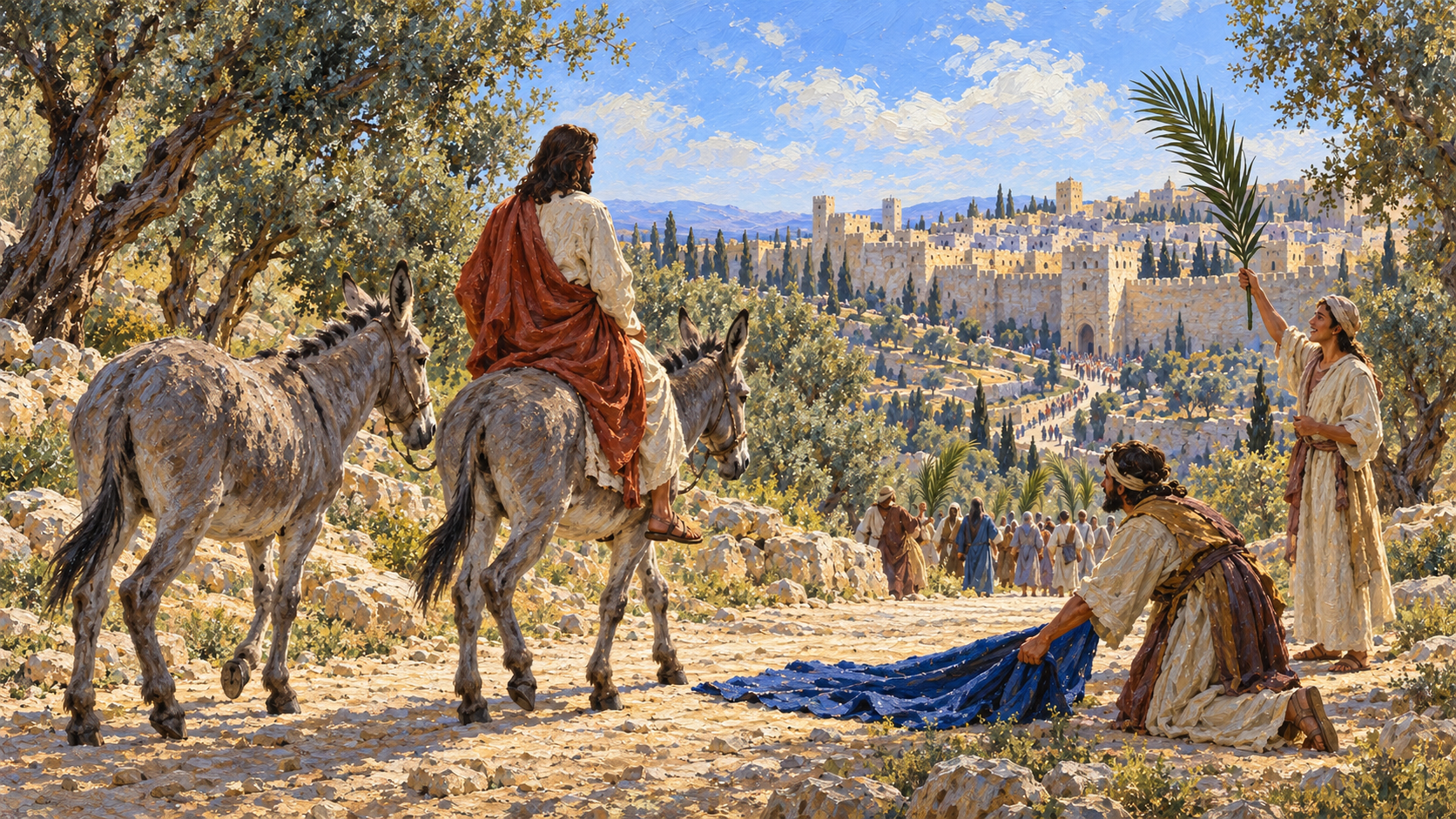
Why did Jesus choose a donkey’s colt for His public entry into Jerusalem? He was declaring something about Himself through that animal, and I want to understand more than the crowd’s excitement. Zechariah’s full prophecy gives us the setting for the sign. From there, we can follow what Jesus did through all four Gospels.
Zechariah’s King and His Royal Mount
Jesus deliberately fulfilled prophecy as He entered Jerusalem, publicly revealing Himself as King. Yet the people praising Him did not all understand what He was doing. The Gospel accounts take us beyond the procession into the temple, where His judgment comes into view as His death approaches.
Zechariah had announced that Zion’s King would ride a donkey’s colt. Jesus directed His disciples to the animals and deliberately carried out that sign. I see no accidental coincidence here, nor an attempt to make an unrelated prediction fit. The King who inspired the prophetic Word was fulfilling it truthfully.
His lowliness did not mean He had surrendered His authority. Jesus accepted royal praise, then wept over Jerusalem and confronted corruption in the temple. I cannot reduce that to a gentle scene that asks nothing of me. At His first coming, He willingly went toward suffering; when He returns, He will openly judge and rule.
The burden of the word of the LORD Against the land of Hadrach, And Damascus its resting place (For the eyes of men And all the tribes of Israel Are on the LORD); Also against Hamath, which borders on it, And against Tyre and Sidon, though they are very wise. For Tyre built herself a tower, Heaped up silver like the dust, And gold like the mire of the streets. Behold, the LORD will cast her out; He will destroy her power in the sea, And she will be devoured by fire. Ashkelon shall see it and fear; Gaza also shall be very sorrowful; And Ekron, for He dried up her expectation. The king shall perish from Gaza, And Ashkelon shall not be inhabited. "A mixed race shall settle in Ashdod, And I will cut off the pride of the Philistines. I will take away the blood from his mouth, And the abominations from between his teeth. But he who remains, even he shall be for our God, And shall be like a leader in Judah, And Ekron like a Jebusite. I will camp around My house Because of the army, Because of him who passes by and him who returns. No more shall an oppressor pass through them, For now I have seen with My eyes. "Rejoice greatly, O daughter of Zion! Shout, O daughter of Jerusalem! Behold, your King is coming to you; He is just and having salvation, Lowly and riding on a donkey, A colt, the foal of a donkey. I will cut off the chariot from Ephraim And the horse from Jerusalem; The battle bow shall be cut off. He shall speak peace to the nations; His dominion shall be 'from sea to sea, And from the River to the ends of the earth.' "As for you also, Because of the blood of your covenant, I will set your prisoners free from the waterless pit. Return to the stronghold, You prisoners of hope. Even today I declare That I will restore double to you. For I have bent Judah, My bow, Fitted the bow with Ephraim, And raised up your sons, O Zion, Against your sons, O Greece, And made you like the sword of a mighty man." Then the LORD will be seen over them, And His arrow will go forth like lightning. The Lord GOD will blow the trumpet, And go with whirlwinds from the south. The LORD of hosts will defend them; They shall devour and subdue with slingstones. They shall drink and roar as if with wine; They shall be filled with blood like basins, Like the corners of the altar. The LORD their God will save them in that day, As the flock of His people. For they shall be like the jewels of a crown, Lifted like a banner over His land– For how great is its goodness And how great its beauty! Grain shall make the young men thrive, And new wine the young women.
Zechariah ministered after Jewish exiles returned from Babylon. They were rebuilding Jerusalem’s temple and community, but still lived under foreign imperial power. The independent Davidic kingdom Scripture promised had not yet come. Imagine hearing “your King is coming” in those modest, pressured circumstances. God was directing their hope beyond the weakness they could see to the royal future He had guaranteed.
The chapter begins with the LORD speaking against surrounding cities, then turns to His defense of His house. Zion is told to rejoice because her own King is coming to her. That is where I want to begin in understanding the colt: with the identity of the One riding it.
“Daughter of Zion” is a poetic address to Jerusalem and the people identified with her. She is being called to see and welcome the King God sends. Matthew keeps that personal appeal when he describes Jesus approaching the city.
We need to keep reading beyond verse 9. God removes the chariots and warhorses along with the battle bow, while the King brings peace to the nations. His rule reaches from sea to sea. The prophecy also tells us why prisoners will be released: because of the blood of the covenant. The LORD Himself saves His people.
The colt belongs within that promise of the Messiah’s peace and salvation. His worldwide reign includes Israel’s restoration. If I separate the animal from the kingdom Zechariah announces, I lose the reason it serves as a royal sign.
Zion is being told to welcome the King who already belongs to her. He does not become king because a crowd approves of His teaching; He comes according to God’s promise.
Zechariah describes Him as just, or righteous, and Jesus’ sinless character sets Him apart from every corrupt ruler. The phrase “having salvation” can describe a victorious King who has received deliverance or who brings it. As we follow the fulfillment in the Gospels, the larger question becomes clear: Jesus Himself is the Savior who delivers His people.
The salvation Jesus brings reaches beyond freedom from Roman occupation. Sin and death are greater enemies, and Satan also opposes God’s people. But I would not use that deeper deliverance to erase the political and national promises made to Israel. The Messiah will restore Israel and finally rule the nations.
Let this mind be in you which was also in Christ Jesus, who, being in the form of God, did not consider it robbery to be equal with God, but made Himself of no reputation, taking the form of a bondservant, and coming in the likeness of men. And being found in appearance as a man, He humbled Himself and became obedient to the point of death, even the death of the cross. Therefore God also has highly exalted Him and given Him the name which is above every name, that at the name of Jesus every knee should bow, of those in heaven, and of those on earth, and of those under the earth, and that every tongue should confess that Jesus Christ is Lord, to the glory of God the Father.
The Hebrew term describing Zechariah’s lowly King can refer to humility and affliction, or to someone’s low estate. Jesus approached without the military display people would expect from an earthly conqueror. His manner of coming fits that description.
Philippians helps us understand how this humility belongs to the eternal Son. He took a servant’s form and obeyed to the point of death before God highly exalted Him. His deity did not cease when He humbled Himself.
That humility did not leave Jesus uncertain about His mission or under the crowd’s control. He directed the entry and accepted messianic praise, then pronounced judgment and acted with authority in His Father’s house. Being lowly did not keep Him from confronting sin.
Hebrew poetry often explains a thought through two related lines. Here the first names a donkey, and the second tells us more precisely which animal is meant: a colt born to a donkey.
This kind of mount could suit a king approaching in peace, especially beside the war equipment removed in the next verse. Riding it would not have been inherently ridiculous or unroyal in the biblical world.
Mark and Luke tell us no one had sat on the colt before. That fits an animal set apart for this particular royal use. I would not make it a rule that every unridden animal symbolizes meekness, since Scripture does not give us that rule.
Verse 10 gives me a firmer basis for understanding the contrast than a sweeping claim about what every ancient king rode. God cuts off Ephraim’s chariot and Jerusalem’s warhorse, along with the battle bow. I do not need to claim that every conqueror rode a horse or every peaceful king rode a donkey to see what the prophecy contrasts.
The King speaks peace to the nations under His rule, which reaches from sea to sea and to the ends of the earth. It is His righteous rule that brings peace, not a willingness to tolerate rebellion.
Jesus did not come the first time to lead an uprising against Rome. When He returns, He will defeat His enemies and establish the promised kingdom, bringing the earth under His peace.
Zechariah identifies the blood of Zion’s covenant as the reason prisoners will be released from the waterless pit. That blood speaks of God’s binding commitment. Their deliverance rests on a covenant He has established.
The Gospel later reveals the new covenant in Jesus’ blood. His saving death was not an accidental defeat that interrupted His kingship. The rejected King gave His life willingly and rose bodily.
I do not think every part of Zechariah 9 has to happen on the same day. The prophecy places the humility of His first coming beside covenant deliverance and also looks ahead to His worldwide reign. Later revelation helps us see the sequence in which those promises unfold.
Then King David answered and said, "Call Bathsheba to me." So she came into the king's presence and stood before the king. And the king took an oath and said, "As the LORD lives, who has redeemed my life from every distress, just as I swore to you by the LORD God of Israel, saying, 'Assuredly Solomon your son shall be king after me, and he shall sit on my throne in my place,' so I certainly will do this day." Then Bathsheba bowed with her face to the earth, and paid homage to the king, and said, "Let my lord King David live forever!" And King David said, "Call to me Zadok the priest, Nathan the prophet, and Benaiah the son of Jehoiada." So they came before the king. The king also said to them, "Take with you the servants of your lord, and have Solomon my son ride on my own mule, and take him down to Gihon. There let Zadok the priest and Nathan the prophet anoint him king over Israel; and blow the horn, and say, 'Long live King Solomon!' Then you shall come up after him, and he shall come and sit on my throne, and he shall be king in my place. For I have appointed him to be ruler over Israel and Judah." Benaiah the son of Jehoiada answered the king and said, "Amen! May the LORD God of my lord the king say so too. As the LORD has been with my lord the king, even so may He be with Solomon, and make his throne greater than the throne of my lord King David." So Zadok the priest, Nathan the prophet, Benaiah the son of Jehoiada, the Cherethites, and the Pelethites went down and had Solomon ride on King David's mule, and took him to Gihon. Then Zadok the priest took a horn of oil from the tabernacle and anointed Solomon. And they blew the horn, and all the people said, "Long live King Solomon!" And all the people went up after him; and the people played the flutes and rejoiced with great joy, so that the earth seemed to split with their sound.
David ordered that Solomon ride the king’s own mule to Gihon to be anointed. The public procession identified the chosen son, and the people responded with great rejoicing.
Solomon’s mule was not the same as a donkey’s colt. Even so, his procession helps me see why we should not treat Jesus’ mount as a sign of nothing but poverty or humiliation. Israel already knew a royal procession in which David’s son rode something other than a warhorse.
Jesus came as the greater Son of David, and His choice of a colt expressed lowliness without obscuring His claim to be King.
Together, these passages give the colt a meaning more definite than a sentimental picture of gentleness. Zion’s own King in Zechariah brings covenant deliverance and worldwide peace, with the weapons of war removed. Solomon’s procession shows that a royal son did not need a warhorse to make his identity known. Jesus came humbly without the military display of an earthly conqueror, but His authority was no less real. The rest of Zechariah’s prophecy still points ahead to His open rule over the nations.
Jesus Deliberately Fulfilled the Sign
Bethphage and Bethany lay east of Jerusalem near the Mount of Olives. Jesus approached from that direction, crossing the mount from the nearby villages and descending toward the city in public view. His actions in the temple followed that procession. I want to follow the Gospel writers through the whole approach because the entry and the temple scenes belong together.
Jesus told two disciples where to go and described the animals they would find. He told them what to say if anyone challenged them and explained how that person would respond. Everything happened as He had instructed them.
A prior arrangement is possible, and supernatural knowledge also fits what the Gospels tell us about Jesus. The writers do not stop to identify which explains His knowledge of the colt. Their emphasis is on His knowing what will happen and directing it with authority.
Deliberately fulfilling prophecy does not make the act dishonest. A false claimant manipulates evidence to pretend he is someone else. Jesus was the promised King, openly carrying out the Scripture that testified about Him.
Now when they drew near Jerusalem, and came to Bethphage, at the Mount of Olives, then Jesus sent two disciples, saying to them, "Go into the village opposite you, and immediately you will find a donkey tied, and a colt with her. Loose them and bring them to Me. And if anyone says anything to you, you shall say, 'The Lord has need of them,' and immediately he will send them." All this was done that it might be fulfilled which was spoken by the prophet, saying: "Tell the daughter of Zion, 'Behold, your King is coming to you, Lowly, and sitting on a donkey, A colt, the foal of a donkey.'" So the disciples went and did as Jesus commanded them. They brought the donkey and the colt, laid their clothes on them, and set Him on them. And a very great multitude spread their clothes on the road; others cut down branches from the trees and spread them on the road. Then the multitudes who went before and those who followed cried out, saying: "Hosanna to the Son of David! 'Blessed is He who comes in the name of the LORD!' Hosanna in the highest!" And when He had come into Jerusalem, all the city was moved, saying, "Who is this?" So the multitudes said, "This is Jesus, the prophet from Nazareth of Galilee." Then Jesus went into the temple of God and drove out all those who bought and sold in the temple, and overturned the tables of the money changers and the seats of those who sold doves. And He said to them, "It is written, 'My house shall be called a house of prayer,' but you have made it a 'den of thieves.'" Then the blind and the lame came to Him in the temple, and He healed them. But when the chief priests and scribes saw the wonderful things that He did, and the children crying out in the temple and saying, "Hosanna to the Son of David!" they were indignant and said to Him, "Do You hear what these are saying?" And Jesus said to them, "Yes. Have you never read, 'Out of the mouth of babes and nursing infants You have perfected praise'?" Then He left them and went out of the city to Bethany, and He lodged there.
Matthew records a donkey tied with her colt and says the event fulfilled what was spoken by the prophet. His quotation combines “Tell the daughter of Zion” language resembling Isaiah 62:11 with Zechariah 9:9.
The disciples placed their garments on the animals and prepared the colt for Jesus. As He rode, a very great multitude spread clothing and branches along the road. The city responded by asking, “Who is this?”
Matthew takes us with the King into the temple. Jesus drove out merchants who had corrupted its worship, then healed suffering people and received the children’s praise. When the religious leaders became indignant, He confronted their refusal to recognize what God was doing.
Matthew mentions the mother donkey as well as her colt. The other three Gospel writers concentrate on the colt Jesus rode, but that does not contradict Matthew. Telling us about one animal does not deny that a second was there.
Matthew’s phrase “on them” can naturally refer to the garments spread on the animals or to the arrangement prepared for Him. We do not have to picture Jesus awkwardly riding both animals at once.
Perhaps the mother’s presence helped lead the unridden colt through the crowd. Scripture does not say that was the reason, so I would leave it as a possibility. The accounts agree on the essential fact that Jesus rode the colt.
Now when they drew near Jerusalem, to Bethphage and Bethany, at the Mount of Olives, He sent two of His disciples; and He said to them, "Go into the village opposite you; and as soon as you have entered it you will find a colt tied, on which no one has sat. Loose it and bring it. And if anyone says to you, 'Why are you doing this?' say, 'The Lord has need of it,' and immediately he will send it here." So they went their way, and found the colt tied by the door outside on the street, and they loosed it. But some of those who stood there said to them, "What are you doing, loosing the colt?" And they spoke to them just as Jesus had commanded. So they let them go. Then they brought the colt to Jesus and threw their clothes on it, and He sat on it. And many spread their clothes on the road, and others cut down leafy branches from the trees and spread them on the road. Then those who went before and those who followed cried out, saying: "Hosanna! 'Blessed is He who comes in the name of the LORD!' Blessed is the kingdom of our father David That comes in the name of the Lord! Hosanna in the highest!" And Jesus went into Jerusalem and into the temple. So when He had looked around at all things, as the hour was already late, He went out to Bethany with the twelve. Now the next day, when they had come out from Bethany, He was hungry. And seeing from afar a fig tree having leaves, He went to see if perhaps He would find something on it. When He came to it, He found nothing but leaves, for it was not the season for figs. In response Jesus said to it, "Let no one eat fruit from you ever again." And His disciples heard it. So they came to Jerusalem. Then Jesus went into the temple and began to drive out those who bought and sold in the temple, and overturned the tables of the money changers and the seats of those who sold doves. And He would not allow anyone to carry wares through the temple. Then He taught, saying to them, "Is it not written, 'My house shall be called a house of prayer for all nations'? But you have made it a 'den of thieves.'" And the scribes and chief priests heard it and sought how they might destroy Him; for they feared Him, because all the people were astonished at His teaching. When evening had come, He went out of the city.
Mark describes the colt tied outside by a door and records the bystanders asking what the disciples were doing. “The Lord has need of it” was the answer that secured its release, just as Jesus had said. The crowd cried Hosanna and blessed David’s coming kingdom in the LORD’s name. Jesus entered the temple and looked around, then left for the night. On the following day He returned to judge the fruitlessness and corruption in worship.
Although no one had ridden the colt, the Lord was not left struggling to control it. An animal He had created quietly carried its Creator and appointed King.
When He had said this, He went on ahead, going up to Jerusalem. And it came to pass, when He drew near to Bethphage and Bethany, at the mountain called Olivet, that He sent two of His disciples, saying, "Go into the village opposite you, where as you enter you will find a colt tied, on which no one has ever sat. Loose it and bring it here. And if anyone asks you, 'Why are you loosing it?' thus you shall say to him, 'Because the Lord has need of it.'" So those who were sent went their way and found it just as He had said to them. But as they were loosing the colt, the owners of it said to them, "Why are you loosing the colt?" And they said, "The Lord has need of him." Then they brought him to Jesus. And they threw their own clothes on the colt, and they set Jesus on him. And as He went, many spread their clothes on the road. Then, as He was now drawing near the descent of the Mount of Olives, the whole multitude of the disciples began to rejoice and praise God with a loud voice for all the mighty works they had seen, saying: "'Blessed is the King who comes in the name of the LORD!' Peace in heaven and glory in the highest!" And some of the Pharisees called to Him from the crowd, "Teacher, rebuke Your disciples." But He answered and said to them, "I tell you that if these should keep silent, the stones would immediately cry out." Now as He drew near, He saw the city and wept over it, saying, "If you had known, even you, especially in this your day, the things that make for your peace! But now they are hidden from your eyes. For days will come upon you when your enemies will build an embankment around you, surround you and close you in on every side, and level you, and your children within you, to the ground; and they will not leave in you one stone upon another, because you did not know the time of your visitation." Then He went into the temple and began to drive out those who bought and sold in it, saying to them, "It is written, 'My house is a house of prayer,' but you have made it a 'den of thieves.'" And He was teaching daily in the temple. But the chief priests, the scribes, and the leaders of the people sought to destroy Him, and were unable to do anything; for all the people were very attentive to hear Him.
Luke says the whole multitude of disciples rejoiced and praised God for the mighty works they had seen Jesus do. They praised the King coming in the LORD’s name and proclaimed peace in heaven. Some Pharisees wanted Jesus to rebuke them, but He said the stones would immediately cry out if His disciples fell silent. I cannot treat their praise as an embarrassing excess after hearing that answer. The promised King had arrived at the appointed time, and even creation would testify to Him.
Yet as Jesus approached Jerusalem and saw the city, He wept. It had not recognized the things that made for peace, and the day of visitation remained hidden from it.
Jesus foretold a siege that would surround Jerusalem and destroy it, with even the children falling in the devastation. His words found historical expression when Roman forces destroyed the city and its temple in AD 70. That event shows the seriousness of rejecting the Messiah, though it does not exhaust every prophecy about Jerusalem’s future.
I need to keep those tears beside the royal welcome. Jesus did not mistake an enthusiastic crowd for national repentance or saving faith.
The next day a great multitude that had come to the feast, when they heard that Jesus was coming to Jerusalem, took branches of palm trees and went out to meet Him, and cried out: "Hosanna! 'Blessed is He who comes in the name of the LORD!' The King of Israel!" Then Jesus, when He had found a young donkey, sat on it; as it is written: "Fear not, daughter of Zion; Behold, your King is coming, Sitting on a donkey's colt." His disciples did not understand these things at first; but when Jesus was glorified, then they remembered that these things were written about Him and that they had done these things to Him. Therefore the people, who were with Him when He called Lazarus out of his tomb and raised him from the dead, bore witness. For this reason the people also met Him, because they heard that He had done this sign. The Pharisees therefore said among themselves, "You see that you are accomplishing nothing. Look, the world has gone after Him!"
John tells us the people took palm branches and went out to meet Jesus after hearing He was coming. Another crowd bore witness to His raising Lazarus. Their testimony helps us understand why so many were excited to see Him.
Jesus found a young donkey and sat on it as Scripture foretold. His disciples took part without yet understanding the depth of what was happening. After He was glorified, His teaching helped them recognize what Scripture had said about Him and how they had participated in its fulfillment.
Hosanna, Rejection, and the Temple
Open to me the gates of righteousness; I will go through them, And I will praise the LORD. This is the gate of the LORD, Through which the righteous shall enter. I will praise You, For You have answered me, And have become my salvation. The stone which the builders rejected Has become the chief cornerstone. This was the LORD's doing; It is marvelous in our eyes. This is the day the LORD has made; We will rejoice and be glad in it. Save now, I pray, O LORD; O LORD, I pray, send now prosperity. Blessed is he who comes in the name of the LORD! We have blessed you from the house of the LORD. God is the LORD, And He has given us light; Bind the sacrifice with cords to the horns of the altar. You are my God, and I will praise You; You are my God, I will exalt You. Oh, give thanks to the LORD, for He is good! For His mercy endures forever.
“Hosanna” carries the plea “Save now” from Psalm 118. The same psalm blesses the One coming in the LORD’s name and describes the rejected stone becoming the chief cornerstone. The crowd’s words belong to that larger passage.
At the entry, “Save now” became a welcome to the King. The crowds were using this pilgrimage psalm to express their hope in David’s promised Son.
I notice that the psalm includes rejection as well as welcome. The builders refuse the very stone God establishes. Jesus would soon apply that warning to the leaders opposing Him.
Then Pilate, when he had called together the chief priests, the rulers, and the people, said to them, "You have brought this Man to me, as one who misleads the people. And indeed, having examined Him in your presence, I have found no fault in this Man concerning those things of which you accuse Him; no, neither did Herod, for I sent you back to him; and indeed nothing deserving of death has been done by Him. I will therefore chastise Him and release Him" (for it was necessary for him to release one to them at the feast). And they all cried out at once, saying, "Away with this Man, and release to us Barabbas"– who had been thrown into prison for a certain rebellion made in the city, and for murder. Pilate, therefore, wishing to release Jesus, again called out to them. But they shouted, saying, "Crucify Him, crucify Him!" Then he said to them the third time, "Why, what evil has He done? I have found no reason for death in Him. I will therefore chastise Him and let Him go." But they were insistent, demanding with loud voices that He be crucified. And the voices of these men and of the chief priests prevailed. So Pilate gave sentence that it should be as they requested. And he released to them the one they requested, who for rebellion and murder had been thrown into prison; but he delivered Jesus to their will.
Preachers often say the same people shouted “Hosanna” and later “Crucify Him.” It makes a powerful contrast, but I do not think the Gospel writers give us enough evidence to identify the crowds that way.
Jerusalem’s residents were joined by pilgrims arriving for the feast, and different groups gathered at different times for different reasons. Luke calls those praising Jesus at the entry a multitude of disciples. Later, the rulers stood with a crowd before Pilate. Neither description tells us these were exactly the same people.
Some may have attended both events, and the entry’s enthusiasm certainly did not become national repentance. We can take the warning about fickleness seriously while admitting that the Gospel writers do not identify the crowds as the same group.
After the procession, Jesus went to the temple rather than seizing the Roman fortress. There He confronted the commerce that had turned a house of prayer into a den of thieves.
Matthew shows us the healing and children’s praise in the temple, while Mark places the cleansing between the events involving the fig tree. Luke describes Jesus teaching there daily as the leaders sought to destroy Him.
Following Jesus into the temple helps me understand what His kingship means. Having received rightful praise, He judged the corruption of Israel’s worship. He also taught the truth and healed suffering people who came to Him. His exposure of spiritual fruitlessness belongs with that compassion. The peace He brings does not leave Him indifferent to desecration.
The Lowly King Will Return in Glory
Now I saw heaven opened, and behold, a white horse. And He who sat on him was called Faithful and True, and in righteousness He judges and makes war. His eyes were like a flame of fire, and on His head were many crowns. He had a name written that no one knew except Himself. He was clothed with a robe dipped in blood, and His name is called The Word of God. And the armies in heaven, clothed in fine linen, white and clean, followed Him on white horses. Now out of His mouth goes a sharp sword, that with it He should strike the nations. And He Himself will rule them with a rod of iron. He Himself treads the winepress of the fierceness and wrath of Almighty God. And He has on His robe and on His thigh a name written: KING OF KINGS AND LORD OF LORDS. Then I saw an angel standing in the sun; and he cried with a loud voice, saying to all the birds that fly in the midst of heaven, "Come and gather together for the supper of the great God, that you may eat the flesh of kings, the flesh of captains, the flesh of mighty men, the flesh of horses and of those who sit on them, and the flesh of all people, free and slave, both small and great." And I saw the beast, the kings of the earth, and their armies, gathered together to make war against Him who sat on the horse and against His army. Then the beast was captured, and with him the false prophet who worked signs in his presence, by which he deceived those who received the mark of the beast and those who worshiped his image. These two were cast alive into the lake of fire burning with brimstone. And the rest were killed with the sword which proceeded from the mouth of Him who sat on the horse. And all the birds were filled with their flesh.
At His first coming, Jesus rode into Jerusalem on a colt on His way to rejection. Wicked men would shed His blood and kill Him, but He would rise bodily. Revelation takes us to His second coming, when heaven opens and the Faithful and True Rider appears on a white horse to judge and make war in righteousness.
The difference between those scenes is vivid, but I do not see two different characters in Jesus. The lowly King is righteous, and the King who comes to judge remains faithful and true.
Jesus will return bodily to defeat the beast and the false prophet. He will restore Israel before reigning for a literal thousand years, establishing on earth the worldwide rule Zechariah promised.
Go through, Go through the gates! Prepare the way for the people; Build up, Build up the highway! Take out the stones, Lift up a banner for the peoples! Indeed the LORD has proclaimed To the end of the world: "Say to the daughter of Zion, 'Surely your salvation is coming; Behold, His reward is with Him, And His work before Him.'" And they shall call them The Holy People, The Redeemed of the LORD; And you shall be called Sought Out, A City Not Forsaken.
Isaiah calls Zion to prepare the way for coming salvation, and God’s redeemed people receive new names. Matthew’s wording helps us connect Jesus’ royal entry with that promised salvation.
Jesus is fully God, and He became fully man without ceasing to be God. He was born of a virgin and remained completely sinless. On the cross He physically bore the punishment for our sins in His innocent body. He endured real torture, shed His blood and died. The Father did not punish or curse Jesus, nor did He abandon Him. He did not strike or bruise Him or pour wrath on Him. Wicked men killed Jesus, but He willingly gave Himself for the whole world and rose bodily from the dead.
The King chose that road and secured salvation through His blood. He laid down His life voluntarily, rather than being carried helplessly toward an altar by circumstances beyond His control.
I must do more than admire the symbol of a lowly King. Jesus has authority over me, just as He had authority to judge the temple’s worship and define the peace He brings. He commands repentance now and will rule the nations openly.
Nor should we make the colt an allegory about remaining untouched by the world. The Gospels do not interpret it that way. Scripture teaches us holiness through its direct commands and the Spirit’s work, without asking us to imitate the animal.
Our response is to repent and believe. God’s genuine offer can be resisted, but everyone who receives Christ by faith is forgiven and made a new creation. The Holy Spirit indwells and seals the believer, making salvation eternally secure. That security never permits lawlessness, and a shallow profession does not prove the new birth has happened. The King who redeemed our lives has the right to rule them.
So then Pilate took Jesus and scourged Him. And the soldiers twisted a crown of thorns and put it on His head, and they put on Him a purple robe. Then they said, "Hail, King of the Jews!" And they struck Him with their hands. Pilate then went out again, and said to them, "Behold, I am bringing Him out to you, that you may know that I find no fault in Him." Then Jesus came out, wearing the crown of thorns and the purple robe. And Pilate said to them, "Behold the Man!" Therefore, when the chief priests and officers saw Him, they cried out, saying, "Crucify Him, crucify Him!" Pilate said to them, "You take Him and crucify Him, for I find no fault in Him." The Jews answered him, "We have a law, and according to our law He ought to die, because He made Himself the Son of God." Therefore, when Pilate heard that saying, he was the more afraid, and went again into the Praetorium, and said to Jesus, "Where are You from?" But Jesus gave him no answer. Then Pilate said to Him, "Are You not speaking to me? Do You not know that I have power to crucify You, and power to release You?" Jesus answered, "You could have no power at all against Me unless it had been given you from above. Therefore the one who delivered Me to you has the greater sin." From then on Pilate sought to release Him, but the Jews cried out, saying, "If you let this Man go, you are not Caesar's friend. Whoever makes himself a king speaks against Caesar." When Pilate therefore heard that saying, he brought Jesus out and sat down in the judgment seat in a place that is called The Pavement, but in Hebrew, Gabbatha. Now it was the Preparation Day of the Passover, and about the sixth hour. And he said to the Jews, "Behold your King!" But they cried out, "Away with Him, away with Him! Crucify Him!" Pilate said to them, "Shall I crucify your King?" The chief priests answered, "We have no king but Caesar!" Then he delivered Him to them to be crucified. Then they took Jesus and led Him away.
Jesus’ precise instructions about the colt show His knowledge and authority, but I would not rest the whole case for His deity on that detail. A prior arrangement is possible, and one prediction alone would not establish His eternal nature.
The full witness does establish His deity. Jesus fulfilled Scripture and exercised divine authority, receiving the praise that belongs to the Messiah. He knows what is in human hearts and has authority to forgive sins. When He raised the dead, creation answered His command. He also identified Himself with the Father and willingly laid down His life before rising bodily from the grave. Those things must be considered together.
Later, Pilate presented Jesus as King while the leaders demanded crucifixion. Their rejection and mockery did not make the title any less true.
For related studies, see The Word Hosanna, The Messiah in the Bible, and Psalm 22 and the Messiah.
My Final Thoughts
Reading Zechariah beside the Gospel accounts, I understand the colt as an unmistakable royal sign Jesus chose Himself. He came as Zion’s righteous and saving King, whose lowliness never meant weakness. He willingly went to the cross and rose bodily from the dead. That rejected King will return to defeat His enemies. He will restore Israel and rule the nations in righteousness. I cannot welcome a harmless version of Jesus who never judges corrupted worship or claims authority over me. My response needs to go beyond a moment of enthusiasm with the crowd to receiving the King as He has revealed Himself and submitting to His rule.