
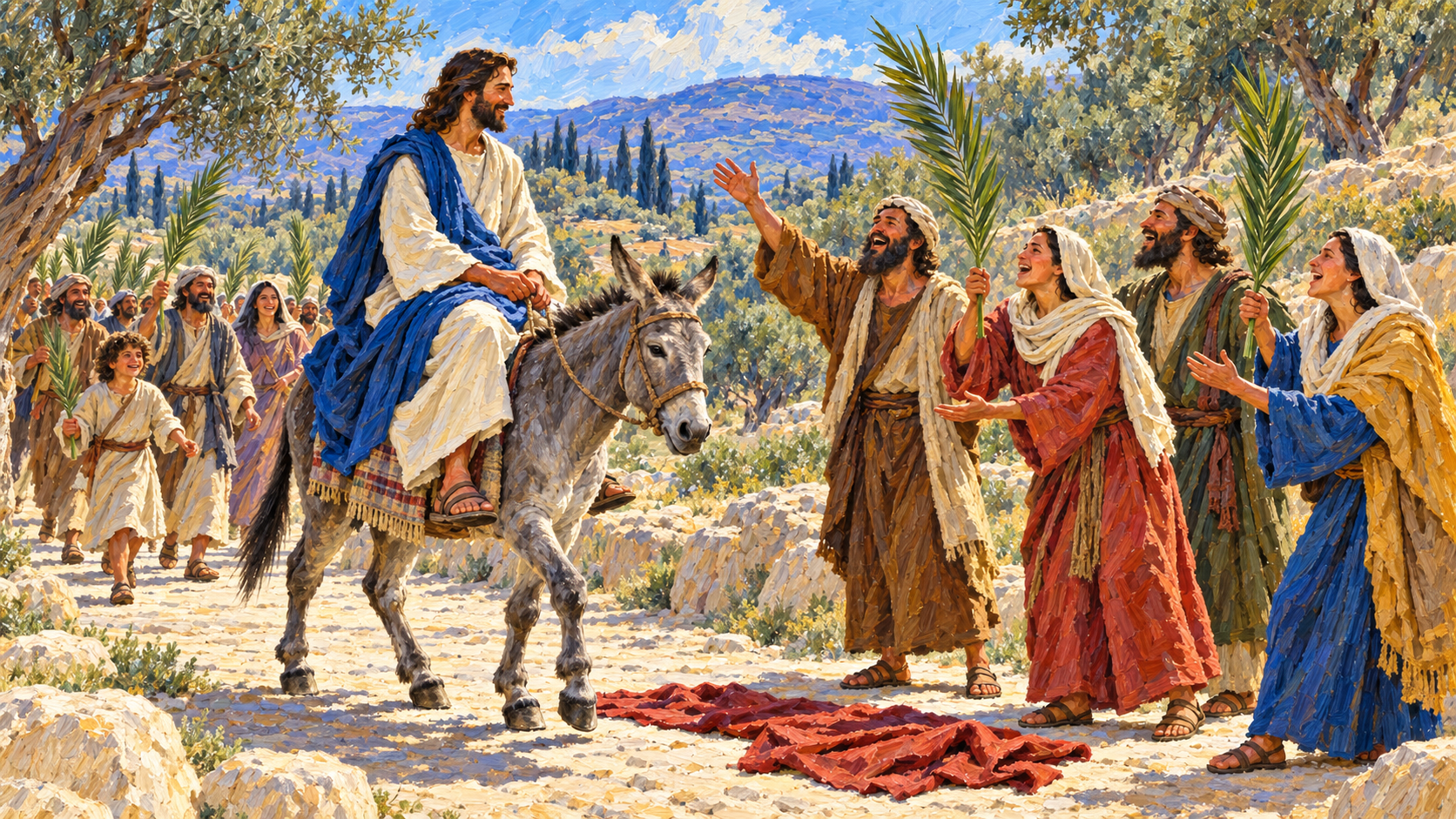
We hear the word “Hosanna” in songs and around Palm Sunday, but what are we actually saying? The word began as an urgent prayer for God to save, and the Gospel crowds spoke it around Jesus as He entered Jerusalem.
The crowds were pleading for salvation as they praised the humble King who came in the LORD’s name. Yet Jesus would first face rejection and go to the cross, and His bodily resurrection would reveal victory where His enemies expected defeat. I want to understand how that plea and praise belong together, beginning with Psalm 118 and then following what each Gospel tells us about the King.
Passover was approaching, and pilgrims were gathering to remember how the LORD delivered Israel from Egypt. Jesus came from Bethany and the Mount of Olives toward the royal city. With that setting in mind, we can hear why a prayer for salvation joined to David’s kingdom carried such public significance. These were more than private devotional words.
People spread branches and garments across the road to welcome Jesus. Some went ahead of Him while others followed, so the cry surrounded the procession. Their public welcome drew on Scripture and unmistakably honored Him as King, even though many had not yet understood how He would save.
Hosanna Means “Save Now, I Pray”
The Textus Receptus uses the Greek form hosanna, written ὡσαννά. The Gospel writers carried the sound of a Semitic expression into Greek letters, a process called transliteration. That differs from translation, which gives a word’s meaning in another language. To understand what the crowds were saying, we need to read the Greek Gospel text alongside the Hebrew psalm from which their cry came.
The Masoretic Hebrew behind the word appears in Psalm 118:25: anna YHWH hoshiah na. The earnest request begins with Anna. It then uses Hoshiah, the command form of the verb for saving or delivering, to call on the LORD for rescue. At the end, na strengthens the appeal. It carries the sense of “now” or “please.” Taken together, the words mean, “Save now, I pray.”
Oh, give thanks to the LORD, for He is good! For His mercy endures forever. Let Israel now say, "His mercy endures forever." Let the house of Aaron now say, "His mercy endures forever." Let those who fear the LORD now say, "His mercy endures forever." I called on the LORD in distress; The LORD answered me and set me in a broad place. The LORD is on my side; I will not fear. What can man do to me? The LORD is for me among those who help me; Therefore I shall see my desire on those who hate me. It is better to trust in the LORD Than to put confidence in man. It is better to trust in the LORD Than to put confidence in princes. All nations surrounded me, But in the name of the LORD I will destroy them. They surrounded me, Yes, they surrounded me; But in the name of the LORD I will destroy them. They surrounded me like bees; They were quenched like a fire of thorns; For in the name of the LORD I will destroy them. You pushed me violently, that I might fall, But the LORD helped me. The LORD is my strength and song, And He has become my salvation. The voice of rejoicing and salvation Is in the tents of the righteous; The right hand of the LORD does valiantly. The right hand of the LORD is exalted; The right hand of the LORD does valiantly. I shall not die, but live, And declare the works of the LORD. The LORD has chastened me severely, But He has not given me over to death. Open to me the gates of righteousness; I will go through them, And I will praise the LORD. This is the gate of the LORD, Through which the righteous shall enter. I will praise You, For You have answered me, And have become my salvation. The stone which the builders rejected Has become the chief cornerstone. This was the LORD's doing; It is marvelous in our eyes. This is the day the LORD has made; We will rejoice and be glad in it. Save now, I pray, O LORD; O LORD, I pray, send now prosperity. Blessed is he who comes in the name of the LORD! We have blessed you from the house of the LORD. God is the LORD, And He has given us light; Bind the sacrifice with cords to the horns of the altar. You are my God, and I will praise You; You are my God, I will exalt You. Oh, give thanks to the LORD, for He is good! For His mercy endures forever.
Psalm 118 begins and ends with thanksgiving because the LORD is good and His mercy endures forever. Between those declarations, the singer remembers calling on God from deep distress. Hostile nations surrounded him, and he endured the LORD’s severe discipline, but God helped him. The rescued worshiper then approaches the gates of righteousness with praise.
Near the center of the psalm, the rejected stone becomes the chief cornerstone, and the people acknowledge that the LORD has brought about this reversal. They rejoice in the day He has made and ask Him to save. As the procession moves toward sacrifice at the altar, they bless the One coming in His name. I want us to hear that whole movement when the Gospel writers describe Jesus entering Jerusalem. Hosanna is a prayer born out of distress and directed to the LORD for rescue, yet it welcomes the arriving King with thankful expectation.
Notice where the rescued worshiper goes. He enters the gates to thank the LORD and approaches the altar with the procession, rather than celebrating his escape and returning to self-rule. The plea for rescue belongs within worship. When the crowds used these words around Jesus, the psalm prepares us to understand a salvation that would come through the rejected stone and the willing sacrifice of the King Himself.
Psalm 118:25 asks the LORD to act because rescue comes from Him. However much political skill or material wealth a person has, neither can provide His salvation. Even if I hold a respected religious position, I remain just as dependent on Him.
The request for prosperity in the next line asks the LORD to make the undertaking succeed. In this context, that is what the Hebrew verb means; it does not promise wealth to every worshiper. Prosperity preaching takes the request away from this procession of righteous worshipers and makes personal abundance the point of the prayer. The psalm itself does not do that.
What I do not want us to lose is the plea inside the joy. Hosanna did not simply change from “save” into “praise.” Matthew places it beside “Son of David” and “Blessed is He who comes.” The crowd asks for salvation while associating that salvation with the arriving King.
A word can keep its basic meaning while becoming a familiar part of worship. Here the joyful setting makes Hosanna an expression of public praise, but the crowd is still asking for salvation. If I hear only “praise,” I lose the prayer Israel carried from the psalm. If I hear only desperation, I miss the joy with which the people welcomed Jesus as King.
We can also praise Jesus for saving us while depending on Him for help now. A sinner may ask for forgiveness and deliverance from sin’s rule. A believer facing danger or oppression may plead for His intervention, and the whole church longs for Christ’s return. God hears those prayers, though His wisdom governs the answer and its timing.
I don’t have to pretend that I no longer need help in order to praise Christ. Nor does asking for help deny what He has already accomplished. We praise the very Savior on whom we still depend, so our worship need not become proud celebration or hopeless panic.
The Son of David Is Zion’s Humble King
Now therefore, thus shall you say to My servant David, 'Thus says the LORD of hosts: "I took you from the sheepfold, from following the sheep, to be ruler over My people, over Israel. And I have been with you wherever you have gone, and have cut off all your enemies from before you, and have made you a great name, like the name of the great men who are on the earth. Moreover I will appoint a place for My people Israel, and will plant them, that they may dwell in a place of their own and move no more; nor shall the sons of wickedness oppress them anymore, as previously, since the time that I commanded judges to be over My people Israel, and have caused you to rest from all your enemies. Also the LORD tells you that He will make you a house. "When your days are fulfilled and you rest with your fathers, I will set up your seed after you, who will come from your body, and I will establish his kingdom. He shall build a house for My name, and I will establish the throne of his kingdom forever. I will be his Father, and he shall be My son. If he commits iniquity, I will chasten him with the rod of men and with the blows of the sons of men. But My mercy shall not depart from him, as I took it from Saul, whom I removed from before you. And your house and your kingdom shall be established forever before you. Your throne shall be established forever."'" According to all these words and according to all this vision, so Nathan spoke to David.
When the crowd called Jesus the Son of David, their words reached back to God’s covenant promise. The LORD had taken David from the sheepfold and established his royal house, promising that his throne would endure. Solomon was an immediate fulfillment, but one mortal king could not exhaust that promise. The enduring throne finds its answer in the Messiah.
Jesus is David’s Son according to His true humanity, belonging to David’s royal line. He also possesses the everlasting kingship God promised. We cannot reduce that title to a resemblance to a good leader, or turn the covenant into a private spiritual feeling. The church does not replace Israel in this promise. Jesus will return bodily and exercise His royal authority openly.
The burden of the word of the LORD Against the land of Hadrach, And Damascus its resting place (For the eyes of men And all the tribes of Israel Are on the LORD); Also against Hamath, which borders on it, And against Tyre and Sidon, though they are very wise. For Tyre built herself a tower, Heaped up silver like the dust, And gold like the mire of the streets. Behold, the LORD will cast her out; He will destroy her power in the sea, And she will be devoured by fire. Ashkelon shall see it and fear; Gaza also shall be very sorrowful; And Ekron, for He dried up her expectation. The king shall perish from Gaza, And Ashkelon shall not be inhabited. "A mixed race shall settle in Ashdod, And I will cut off the pride of the Philistines. I will take away the blood from his mouth, And the abominations from between his teeth. But he who remains, even he shall be for our God, And shall be like a leader in Judah, And Ekron like a Jebusite. I will camp around My house Because of the army, Because of him who passes by and him who returns. No more shall an oppressor pass through them, For now I have seen with My eyes. "Rejoice greatly, O daughter of Zion! Shout, O daughter of Jerusalem! Behold, your King is coming to you; He is just and having salvation, Lowly and riding on a donkey, A colt, the foal of a donkey. I will cut off the chariot from Ephraim And the horse from Jerusalem; The battle bow shall be cut off. He shall speak peace to the nations; His dominion shall be 'from sea to sea, And from the River to the ends of the earth.' "As for you also, Because of the blood of your covenant, I will set your prisoners free from the waterless pit. Return to the stronghold, You prisoners of hope. Even today I declare That I will restore double to you. For I have bent Judah, My bow, Fitted the bow with Ephraim, And raised up your sons, O Zion, Against your sons, O Greece, And made you like the sword of a mighty man." Then the LORD will be seen over them, And His arrow will go forth like lightning. The Lord GOD will blow the trumpet, And go with whirlwinds from the south. The LORD of hosts will defend them; They shall devour and subdue with slingstones. They shall drink and roar as if with wine; They shall be filled with blood like basins, Like the corners of the altar. The LORD their God will save them in that day, As the flock of His people. For they shall be like the jewels of a crown, Lifted like a banner over His land– For how great is its goodness And how great its beauty! Grain shall make the young men thrive, And new wine the young women.
Zechariah calls Zion to rejoice because her righteous King comes bringing salvation. His lowly arrival on a donkey does not diminish His royal power. As we keep reading, the prophecy speaks of peace among the nations and His dominion reaching across the earth.
Jesus knew where the animals were and told the disciples what to say. He deliberately arranged the entry, so I cannot treat it as a symbol an excited crowd invented around Him. Yet He had not come to Jerusalem to lead an immediate revolt against Rome. He first passed through rejection and completed His saving work. After rising from the dead, He ascended to heaven, where He now awaits the future, open exercise of His promised rule.
The procession approached Jerusalem’s righteous gates and moved toward the temple, where Jesus exposed corruption and restored the purpose of the LORD’s house. He had not come simply to protect the religious order as it stood. The One blessed in Psalm 118 was also the stone the religious builders rejected, and the LORD would overturn their verdict.
We should not mistake the crowd’s enthusiasm for acceptance by Jerusalem’s leaders. Official hostility accompanied the public welcome, and the leaders’ rejection formed part of the path through which Jesus would save. That did not make their conduct righteous. Psalm 118 had already taught Israel to expect the LORD to vindicate the stone the builders had cast aside.
Neither condemnation by a political court nor rejection by a religious institution can reverse what God has declared about His Son. That also limits the claims we make today. No political movement owns the title “Son of David.” We cannot make Jesus a mascot for nationalism or revolution. He does not exist to preserve the social order we prefer. His authority judges every ruler and nation.
Why do the nations rage, And the people plot a vain thing? The kings of the earth set themselves, And the rulers take counsel together, Against the LORD and against His Anointed, saying, "Let us break Their bonds in pieces And cast away Their cords from us." He who sits in the heavens shall laugh; The LORD shall hold them in derision. Then He shall speak to them in His wrath, And distress them in His deep displeasure: "Yet I have set My King On My holy hill of Zion." "I will declare the decree: The LORD has said to Me, 'You are My Son, Today I have begotten You. Ask of Me, and I will give You The nations for Your inheritance, And the ends of the earth for Your possession. You shall break them with a rod of iron; You shall dash them to pieces like a potter's vessel.'" Now therefore, be wise, O kings; Be instructed, you judges of the earth. Serve the LORD with fear, And rejoice with trembling. Kiss the Son, lest He be angry, And you perish in the way, When His wrath is kindled but a little. Blessed are all those who put their trust in Him.
In Psalm 2, the world’s rulers oppose the LORD’s Anointed, but God establishes His King and calls those rulers to submit. The nations belong to the Son, and everyone who trusts Him receives blessing. That helps me see how far His royal authority extends beyond the city where the crowd cried Hosanna.
The Four Gospels Show the Entry From Different Angles
Now when they drew near Jerusalem, and came to Bethphage, at the Mount of Olives, then Jesus sent two disciples, saying to them, "Go into the village opposite you, and immediately you will find a donkey tied, and a colt with her. Loose them and bring them to Me. And if anyone says anything to you, you shall say, 'The Lord has need of them,' and immediately he will send them." All this was done that it might be fulfilled which was spoken by the prophet, saying: "Tell the daughter of Zion, 'Behold, your King is coming to you, Lowly, and sitting on a donkey, A colt, the foal of a donkey.'" So the disciples went and did as Jesus commanded them. They brought the donkey and the colt, laid their clothes on them, and set Him on them. And a very great multitude spread their clothes on the road; others cut down branches from the trees and spread them on the road. Then the multitudes who went before and those who followed cried out, saying: "Hosanna to the Son of David! 'Blessed is He who comes in the name of the LORD!' Hosanna in the highest!" And when He had come into Jerusalem, all the city was moved, saying, "Who is this?" So the multitudes said, "This is Jesus, the prophet from Nazareth of Galilee." Then Jesus went into the temple of God and drove out all those who bought and sold in the temple, and overturned the tables of the money changers and the seats of those who sold doves. And He said to them, "It is written, 'My house shall be called a house of prayer,' but you have made it a 'den of thieves.'" Then the blind and the lame came to Him in the temple, and He healed them. But when the chief priests and scribes saw the wonderful things that He did, and the children crying out in the temple and saying, "Hosanna to the Son of David!" they were indignant and said to Him, "Do You hear what these are saying?" And Jesus said to them, "Yes. Have you never read, 'Out of the mouth of babes and nursing infants You have perfected praise'?" Then He left them and went out of the city to Bethany, and He lodged there.
Matthew draws attention to prophecy and the Son of David, then follows Jesus into the temple. He mentions both a donkey and a colt because the animals were brought together, which also fits the Hebrew parallelism in Zechariah’s prophecy. The other Gospels concentrate on the colt Jesus rode. Reading them together, I see no need to imagine Jesus riding two animals.
The multitude called Jesus the Son of David and quoted Psalm 118. Their arrival stirred Jerusalem to ask who He was. The answer “Jesus, the prophet from Nazareth” was true, though it did not tell the whole of His identity. Later, the children continued crying “Hosanna to the Son of David” in the temple. The religious leaders recognized the messianic claim and objected, but Jesus answered them from Psalm 8 instead of silencing the praise.
What Jesus did after receiving that welcome helps me understand what honoring Him involves. He drove out those who had corrupted the temple through buying and selling, then welcomed the blind and lame and healed them. His defense of holiness did not make needy people an interruption to His work.
The chief priests and scribes became indignant over the healings and praise, while the children kept speaking the royal words. Jesus knew exactly what they were saying. By answering from Psalm 8, He affirmed their words as fitting praise. He was not trying to correct an embarrassing misunderstanding.
Now when they drew near Jerusalem, to Bethphage and Bethany, at the Mount of Olives, He sent two of His disciples; and He said to them, "Go into the village opposite you; and as soon as you have entered it you will find a colt tied, on which no one has sat. Loose it and bring it. And if anyone says to you, 'Why are you doing this?' say, 'The Lord has need of it,' and immediately he will send it here." So they went their way, and found the colt tied by the door outside on the street, and they loosed it. But some of those who stood there said to them, "What are you doing, loosing the colt?" And they spoke to them just as Jesus had commanded. So they let them go. Then they brought the colt to Jesus and threw their clothes on it, and He sat on it. And many spread their clothes on the road, and others cut down leafy branches from the trees and spread them on the road. Then those who went before and those who followed cried out, saying: "Hosanna! 'Blessed is He who comes in the name of the LORD!' Blessed is the kingdom of our father David That comes in the name of the Lord! Hosanna in the highest!" And Jesus went into Jerusalem and into the temple. So when He had looked around at all things, as the hour was already late, He went out to Bethany with the twelve.
Mark describes cloaks and leafy branches spread across the road as the people blessed the One coming in the LORD’s name. They also named the kingdom of their father David, directly connecting Jesus’ arrival with Israel’s royal hope.
Mark also records “Hosanna in the highest.” The words lift the acclamation toward the highest realm. I would not go further and build a detailed theory about exactly who in heaven was being addressed, because the phrase does not give us that detail. It does clearly magnify the prayer and praise offered around the King.
Jesus went into the temple and looked around at everything before returning to Bethany, since the hour was late. That quiet inspection prepares us for His judgment of the temple’s corruption the next day.
When He had said this, He went on ahead, going up to Jerusalem. And it came to pass, when He drew near to Bethphage and Bethany, at the mountain called Olivet, that He sent two of His disciples, saying, "Go into the village opposite you, where as you enter you will find a colt tied, on which no one has ever sat. Loose it and bring it here. And if anyone asks you, 'Why are you loosing it?' thus you shall say to him, 'Because the Lord has need of it.'" So those who were sent went their way and found it just as He had said to them. But as they were loosing the colt, the owners of it said to them, "Why are you loosing the colt?" And they said, "The Lord has need of him." Then they brought him to Jesus. And they threw their own clothes on the colt, and they set Jesus on him. And as He went, many spread their clothes on the road. Then, as He was now drawing near the descent of the Mount of Olives, the whole multitude of the disciples began to rejoice and praise God with a loud voice for all the mighty works they had seen, saying: "'Blessed is the King who comes in the name of the LORD!' Peace in heaven and glory in the highest!" And some of the Pharisees called to Him from the crowd, "Teacher, rebuke Your disciples." But He answered and said to them, "I tell you that if these should keep silent, the stones would immediately cry out." Now as He drew near, He saw the city and wept over it, saying, "If you had known, even you, especially in this your day, the things that make for your peace! But now they are hidden from your eyes. For days will come upon you when your enemies will build an embankment around you, surround you and close you in on every side, and level you, and your children within you, to the ground; and they will not leave in you one stone upon another, because you did not know the time of your visitation." Then He went into the temple and began to drive out those who bought and sold in it, saying to them, "It is written, 'My house is a house of prayer,' but you have made it a 'den of thieves.'" And He was teaching daily in the temple. But the chief priests, the scribes, and the leaders of the people sought to destroy Him, and were unable to do anything; for all the people were very attentive to hear Him.
Luke does not use the word Hosanna in this scene, though he records the same blessing from Psalm 118. The multitude of disciples praised God for the mighty works they had seen, calling Jesus the King and proclaiming peace in heaven with glory in the highest.
When some Pharisees told Jesus to rebuke His disciples, He answered that the stones would cry out if the disciples fell silent. He accepted the disciples’ acclamation as King at this appointed moment.
As Jesus drew near Jerusalem, He saw the city and wept over it. He spoke of the peace it had missed and the judgment that would come because it had failed to recognize the time of visitation. All that public praise had not hidden the city’s unbelief from Him.
I don’t want the joy of the entry to make me overlook those tears. Jesus accepted the praise that rightly belonged to Him, but He was not flattered into ignoring Jerusalem’s condition. He knew that enemies would surround the city and bring terrible destruction. His grief shows that He neither enjoyed that coming judgment nor overlooked the people who remained blind to peace.
Then, six days before the Passover, Jesus came to Bethany, where Lazarus was who had been dead, whom He had raised from the dead. There they made Him a supper; and Martha served, but Lazarus was one of those who sat at the table with Him. Then Mary took a pound of very costly oil of spikenard, anointed the feet of Jesus, and wiped His feet with her hair. And the house was filled with the fragrance of the oil. But one of His disciples, Judas Iscariot, Simon's son, who would betray Him, said, "Why was this fragrant oil not sold for three hundred denarii and given to the poor?" This he said, not that he cared for the poor, but because he was a thief, and had the money box; and he used to take what was put in it. But Jesus said, "Let her alone; she has kept this for the day of My burial. For the poor you have with you always, but Me you do not have always." Now a great many of the Jews knew that He was there; and they came, not for Jesus' sake only, but that they might also see Lazarus, whom He had raised from the dead. But the chief priests plotted to put Lazarus to death also, because on account of him many of the Jews went away and believed in Jesus. The next day a great multitude that had come to the feast, when they heard that Jesus was coming to Jerusalem, took branches of palm trees and went out to meet Him, and cried out: "Hosanna! 'Blessed is He who comes in the name of the LORD!' The King of Israel!" Then Jesus, when He had found a young donkey, sat on it; as it is written: "Fear not, daughter of Zion; Behold, your King is coming, Sitting on a donkey's colt." His disciples did not understand these things at first; but when Jesus was glorified, then they remembered that these things were written about Him and that they had done these things to Him. Therefore the people, who were with Him when He called Lazarus out of his tomb and raised him from the dead, bore witness. For this reason the people also met Him, because they heard that He had done this sign. The Pharisees therefore said among themselves, "You see that you are accomplishing nothing. Look, the world has gone after Him!"
John identifies the branches as palms and explains why many people came. Those who had witnessed Jesus call Lazarus from the tomb kept speaking about it, and others gathered after hearing of that sign. They cried Hosanna and blessed the One coming in the LORD’s name, calling Him the King of Israel.
The palms fit the occasion’s festive joy and victory, but they do not tell us that everyone there wanted a military uprising. John even tells us that the disciples did not understand these events at first. After Jesus was glorified, they remembered what Scripture had said about Him. That gives me reason to distinguish genuine participation from complete understanding.
We can follow the testimony as it spread through the crowd: those who had seen Lazarus come out of the tomb spoke, and others went to meet Jesus because of what they heard. The Pharisees complained that the world had gone after Him. They were exaggerating, yet they did not understand how far His saving mission would actually reach.
The Crowd Was Mixed, but Jesus Accepted the Praise
Comparing the four accounts, I cannot treat the crowd as though it were one person with one motive. Jesus’ disciples gathered with Passover pilgrims and witnesses to Lazarus’s resurrection. Residents of Jerusalem asked who He was, while children went on praising Him in the temple and hostile leaders objected. The Gospels give us these different responses without suggesting that everyone understood the same things.
Some likely hoped for national deliverance, since the words about David and kingship support that possibility. Others responded to Jesus’ miracles or shared in the joy of the feast. Scripture does not tell us every private expectation, so I would not claim to know what everyone “really meant” by their words.
For the same reason, I would not insist that the individuals who cried Hosanna were the ones who later shouted, “Crucify Him.” People can certainly be fickle, but the Gospel scenes describe different groups and do not identify which individuals, if any, were in both crowds. When we teach the danger of shallow enthusiasm, we need to do so from the evidence rather than a familiar sermon line.
Jesus accepted the praise because it rightly identified Him. Earlier in His ministry He had sometimes restricted premature publicity. Here, however, He arranged the prophetic sign Himself, answered the Pharisees who wanted silence, and defended the children’s continued praise.
If Jesus were merely a creature, accepting divine honor would be blasphemy. But He is the eternal Son, fully God and fully man, so this praise belongs to Him. His acceptance did not endorse every political hope in the crowd or establish that every hearer had saving faith. Their confession was true even where their understanding was incomplete. Jesus continued to make His kingship known through Scripture and His mission.
Someone can identify Jesus accurately without yet understanding all that those words mean. We should let Scripture deepen that understanding instead of weakening the confession. It teaches us who the King is and what salvation He brings, and popular demand cannot change His mission.
Jesus went on to judge corrupt worship, and that should make us examine our own churches. Singing Hosanna cannot make financial manipulation acceptable. Nor can a worship spectacle excuse neglect of the truth or contempt for the weak. A church’s enthusiastic praise becomes empty ceremony if it refuses the authority of the King it names.
After cleansing the temple and calling it a house of prayer, Jesus received people who needed His mercy. Praising Him should bring us under that same rule. We do not have to choose between holiness and compassion when we follow Him.
That means honesty in our financial practices and worship that does not use performance to hide corruption. It also means receiving people in need instead of treating them as obstacles to an important institution’s work. If we sing to Jesus while resisting His commands in our shared life, we need to repent.
The Cross and Resurrection Answer the Plea
Who has believed our report? And to whom has the arm of the LORD been revealed? For He shall grow up before Him as a tender plant, And as a root out of dry ground. He has no form or comeliness; And when we see Him, There is no beauty that we should desire Him. He is despised and rejected by men, A Man of sorrows and acquainted with grief. And we hid, as it were, our faces from Him; He was despised, and we did not esteem Him. Surely He has borne our griefs And carried our sorrows; Yet we esteemed Him stricken, Smitten by God, and afflicted. But He was wounded for our transgressions, He was bruised for our iniquities; The chastisement for our peace was upon Him, And by His stripes we are healed. All we like sheep have gone astray; We have turned, every one, to his own way; And the LORD has laid on Him the iniquity of us all. He was oppressed and He was afflicted, Yet He opened not His mouth; He was led as a lamb to the slaughter, And as a sheep before its shearers is silent, So He opened not His mouth. He was taken from prison and from judgment, And who will declare His generation? For He was cut off from the land of the living; For the transgressions of My people He was stricken. And they made His grave with the wicked– But with the rich at His death, Because He had done no violence, Nor was any deceit in His mouth. Yet it pleased the LORD to bruise Him; He has put Him to grief. When You make His soul an offering for sin, He shall see His seed, He shall prolong His days, And the pleasure of the LORD shall prosper in His hand. He shall see the labor of His soul, and be satisfied. By His knowledge My righteous Servant shall justify many, For He shall bear their iniquities. Therefore I will divide Him a portion with the great, And He shall divide the spoil with the strong, Because He poured out His soul unto death, And He was numbered with the transgressors, And He bore the sin of many, And made intercession for the transgressors.
Isaiah describes the despised and rejected Servant enduring human violence without answering His oppressors. He is cut off from the living and buried with the rich. Yet the prophecy goes on to His vindication and the result of His work, so we should not stop reading as though His death were the end.
Jesus knew what awaited Him in Jerusalem and willingly went to the cross in fulfillment of Scripture. We should not read the entry as a failed campaign that forced Him to come up with another plan.
The physical torture and punishment Jesus endured came from wicked men who killed Him. He willingly bore that punishment for our sins in His innocent body. After shedding His blood and dying, He was buried and then rose bodily. The Father did not punish Jesus or pour wrath on Him. Neither did He curse or abandon His Son, and He did not strike or bruise Him.
"Men of Israel, hear these words: Jesus of Nazareth, a Man attested by God to you by miracles, wonders, and signs which God did through Him in your midst, as you yourselves also know– Him, being delivered by the determined purpose and foreknowledge of God, you have taken by lawless hands, have crucified, and put to death; whom God raised up, having loosed the pains of death, because it was not possible that He should be held by it. For David says concerning Him: 'I foresaw the LORD always before my face, For He is at my right hand, that I may not be shaken. Therefore my heart rejoiced, and my tongue was glad; Moreover my flesh also will rest in hope. For You will not leave my soul in Hades, Nor will You allow Your Holy One to see corruption. You have made known to me the ways of life; You will make me full of joy in Your presence.' "Men and brethren, let me speak freely to you of the patriarch David, that he is both dead and buried, and his tomb is with us to this day. Therefore, being a prophet, and knowing that God had sworn with an oath to him that of the fruit of his body, according to the flesh, He would raise up the Christ to sit on his throne, he, foreseeing this, spoke concerning the resurrection of the Christ, that His soul was not left in Hades, nor did His flesh see corruption. This Jesus God has raised up, of which we are all witnesses. Therefore being exalted to the right hand of God, and having received from the Father the promise of the Holy Spirit, He poured out this which you now see and hear. "For David did not ascend into the heavens, but he says himself: 'The LORD said to my Lord, "Sit at My right hand, Till I make Your enemies Your footstool."' "Therefore let all the house of Israel know assuredly that God has made this Jesus, whom you crucified, both Lord and Christ."
Peter tells us that Jesus was delivered according to God’s determined purpose and foreknowledge, but he also holds the lawless men who crucified Him accountable. I need to keep both statements in view. God’s purpose did not make their lies and mockery righteous, nor did it excuse their torture and murder. They remained guilty of what they chose to do.
God used their actions without approving their sin, then raised Jesus bodily so that death could not be the end. Peter proclaimed that this crucified Jesus is both Lord and Christ. The Savior whom death could not hold is the decisive answer to the plea for salvation in Hosanna.
Peter also connected the resurrection to David’s promised throne. David had died and remained buried, yet he had spoken beforehand of the Christ whose body would not see corruption. We are therefore looking at far more than a suffering victim or a remembered teacher. The Son of David is the risen Messiah, exalted at God’s right hand until His enemies meet their appointed defeat.
Now this is the testimony of John, when the Jews sent priests and Levites from Jerusalem to ask him, "Who are you?" He confessed, and did not deny, but confessed, "I am not the Christ." And they asked him, "What then? Are you Elijah?" He said, "I am not." "Are you the Prophet?" And he answered, "No." Then they said to him, "Who are you, that we may give an answer to those who sent us? What do you say about yourself?" He said: "I am 'The voice of one crying in the wilderness: "Make straight the way of the LORD,"' as the prophet Isaiah said." Now those who were sent were from the Pharisees. And they asked him, saying, "Why then do you baptize if you are not the Christ, nor Elijah, nor the Prophet?" John answered them, saying, "I baptize with water, but there stands One among you whom you do not know. It is He who, coming after me, is preferred before me, whose sandal strap I am not worthy to loose." These things were done in Bethabara beyond the Jordan, where John was baptizing. The next day John saw Jesus coming toward him, and said, "Behold! The Lamb of God who takes away the sin of the world! This is He of whom I said, 'After me comes a Man who is preferred before me, for He was before me.' I did not know Him; but that He should be revealed to Israel, therefore I came baptizing with water." And John bore witness, saying, "I saw the Spirit descending from heaven like a dove, and He remained upon Him. I did not know Him, but He who sent me to baptize with water said to me, 'Upon whom you see the Spirit descending, and remaining on Him, this is He who baptizes with the Holy Spirit.' And I have seen and testified that this is the Son of God."
John the Baptist identified Jesus as both the Son of God and the Lamb of God who takes away the sin of the world. His saving mission reaches beyond temporary relief, and it is not limited to one nation. Calling the risen Lord the Lamb and Savior does not compete with His identity as the Davidic King; these names help us understand who He is and how He saves.
Christ died for the whole world, though that does not mean everyone is automatically saved. People can resist God’s genuine offer. Everyone who repents and believes receives forgiveness and is declared righteous before God. That person is also born again and made new, with the Holy Spirit dwelling within and sealing the believer. The believer is eternally secure, but that security does not excuse lawlessness, and merely professing faith does not prove that someone has been born again.
The cry for salvation reaches deeper than relief from Rome or immediate danger, and deeper than relief from illness and poverty. Jesus showed compassion toward suffering people, so I would not dismiss those needs. Yet sin leaves every one of us needing forgiveness and new life. John points us to the Lamb because the King saves us at the root of our rebellion before bringing every promised part of His kingdom to completion.
Palm-Bearing Worship Looks Toward the Returning King
After these things I looked, and behold, a great multitude which no one could number, of all nations, tribes, peoples, and tongues, standing before the throne and before the Lamb, clothed with white robes, with palm branches in their hands, and crying out with a loud voice, saying, "Salvation belongs to our God who sits on the throne, and to the Lamb!" All the angels stood around the throne and the elders and the four living creatures, and fell on their faces before the throne and worshiped God, saying: "Amen! Blessing and glory and wisdom, Thanksgiving and honor and power and might, Be to our God forever and ever. Amen." Then one of the elders answered, saying to me, "Who are these arrayed in white robes, and where did they come from?" And I said to him, "Sir, you know." So he said to me, "These are the ones who come out of the great tribulation, and washed their robes and made them white in the blood of the Lamb. Therefore they are before the throne of God, and serve Him day and night in His temple. And He who sits on the throne will dwell among them. They shall neither hunger anymore nor thirst anymore; the sun shall not strike them, nor any heat; for the Lamb who is in the midst of the throne will shepherd them and lead them to living fountains of waters. And God will wipe away every tear from their eyes."
In Revelation, a multitude beyond numbering stands before the throne and the Lamb. People from every nation are there, with humanity’s many peoples and languages represented. Holding palm branches, they declare that salvation belongs to God and to the Lamb.
The palms remind us of the entry into Jerusalem, but the circumstances have changed. This multitude has come through great tribulation, and their robes have been washed in the Lamb’s blood. God shelters them in His presence, where they no longer hunger or thirst. The heat no longer strikes them, and He wipes away every tear.
Many questions remained among the people beside the road into Jerusalem. Here, after terrible suffering, the multitude stands before the throne and declares without confusion that salvation belongs to God and to the Lamb. Seeing people from every nation join in that worship helps me follow the plea of Hosanna toward its complete answer.
The church will be gathered before the seven-year Tribulation, and Jesus will return bodily to establish His literal thousand-year reign. The royal promise acclaimed in Jerusalem will then be openly fulfilled.
While we wait, we can ask Jesus to save, but we must not mistake familiar church language for personal trust in Him. We need to repent of sin and believe in the crucified and risen Son. The King revealed in Scripture does not exist to serve our political hopes or financial ambition, and our praise must honor Him as He is.
If I am sincerely asking this King to save, I also need to accept the identity and mission Scripture gives Him. I cannot ask Him to bless greed or make my side powerful at any cost. He may confront the very ambition I hoped He would serve. Before using His name to judge everyone else, I need to let His Word examine my own loyalties.
We can bring our present trouble to Him honestly, because Hosanna can still express a sincere plea for deliverance.
That plea does not require the Lord to follow our chosen method or schedule. Sometimes He provides through ordinary help, and sometimes faithful people endure suffering while they wait. I can ask Him earnestly to save without claiming the right to dictate the outcome.
While we await Christ’s return, His Word calls us to proclaim the gospel and use our strength to protect the weak. We can do that through present opposition because our hope rests in His certain kingdom.
Continue with Jesus Riding on a Colt, The Davidic Covenant, and The Messiah in the Bible.
My Final Thoughts
I want the word Hosanna to express more than familiarity with church language. In saying it, I am asking the Lord to save and acknowledging Jesus as the promised King. His willing death and bodily resurrection answer that plea, and He still receives everyone who repents and believes. We can bring Him our present troubles without expecting Him to serve our private ambitions. The Son of David who came in humility will return and reign, and our obedience while we wait should agree with the praise we offer Him.