
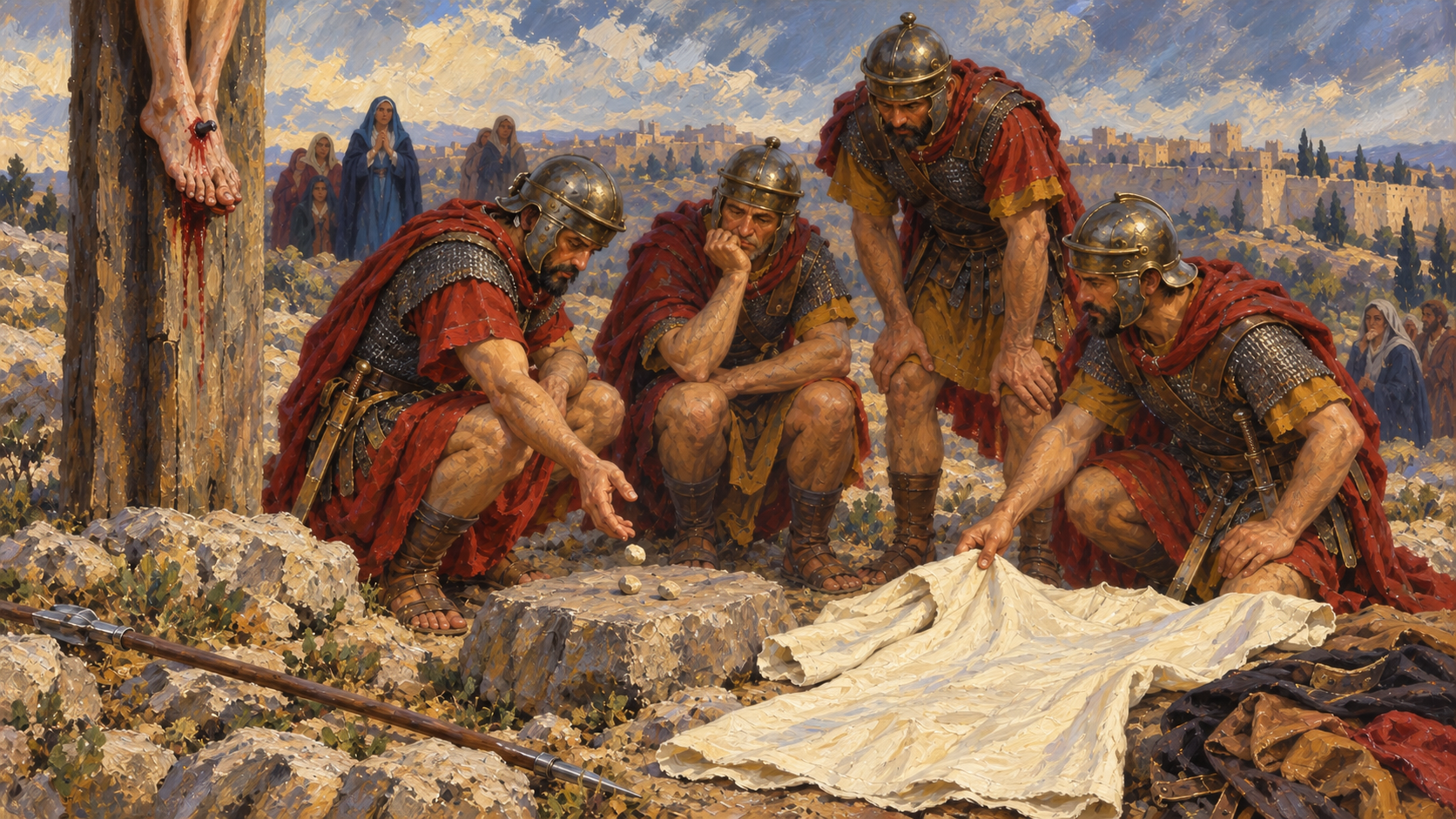
Psalm 22 begins with a question Jesus spoke from the cross. David’s anguish describes the crucifixion so closely that I want to understand how his prayer points to Christ. And does “forsaken” mean the Father actually turned away from Jesus? The psalm gives us more than the opening cry: God answers the sufferer, and the praise that follows reaches the nations.
David’s Lament and the Greater Son of David
David wrote Psalm 22 while he was suffering, but Scripture never identifies the event. His anguish was personal and historical, and the Holy Spirit inspired the words he used to pray. Some details go beyond anything Scripture records about David, though. I don’t want to invent a crisis in his life to explain them when the Gospel writers place Jesus within this psalm at the cross. Hebrews also applies its declaration among the brethren to Christ.
We can recognize David’s real suffering and still see how the prophecy reaches beyond him. Later Scripture makes that greater fulfillment clear. Jesus did not select a vaguely similar poem after the fact; He spoke its opening words while the crowd mocked Him. His body was pierced, and He thirsted as soldiers divided His garments. The psalm had described that pattern long before those events unfolded.
David gave voice to his own anguish in the poetry he wrote. He was not merely recording inspired words unrelated to his own suffering. The Holy Spirit carried those words toward the Son of David, whose cross and resurrection reveal their fullest meaning. I can follow that connection because the New Testament makes it. The argument rests on Scripture interpreting Scripture, not resemblance alone.
I cannot stop at the opening cry when verse 24 says that God did not hide His face and heard the afflicted One. The prayer rises from suffering before the answer comes. After deliverance, the sufferer praises God among his brethren, and the nations turn to the LORD. Future generations then hear what He has done. To read this as a final declaration of divine abandonment would leave out the answer the psalm itself gives.
The predictions in Psalm 22 belong together within a single act of worship. Surrounded by contemptuous enemies, the righteous sufferer entrusts himself to God. God’s answer leads to praise among people the sufferer never met. Jesus fulfills the particular details of the crucifixion and brings the whole lament to its appointed victory through His bodily resurrection.
The heading calls this a psalm of David and includes the phrase often translated “The Deer of the Dawn.” It may name a familiar tune or give another musical direction, but its exact function is uncertain. That uncertainty leaves us without a basis for connecting the phrase to the hour of the crucifixion or resurrection, or to an otherwise unknown ceremony.
David gave the psalm to the Chief Musician, which means his private pain became part of Israel’s public worship. Through his prayer, God’s people learned to pray when circumstances seemed to contradict His faithfulness. That helps me understand why the psalm ends as it does. Deliverance is first announced in the assembly, but the testimony reaches beyond those present to the whole earth and generations not yet born.
The Cry of the Sufferer and the Faithfulness of God
My God, My God, why have You forsaken Me? Why are You so far from helping Me, And from the words of My groaning?
Matthew and Mark record Jesus speaking this verse from the cross. Wicked men had mocked and tortured the sinless Son before nailing Him to the cross and killing Him. His agony was real, so I cannot read His words as a theatrical hint meant only to direct the crowd to a passage. He truly entered the lament He spoke.
Jesus’ quotation also places Psalm 22 before everyone who reads the crucifixion account. We don’t need to establish a fixed Jewish rule that quoting the first line always meant quoting the entire psalm. He spoke Scripture, and the events around Him followed its words. I also notice that He still addresses God in faith. The repeated “My God” is prayer, not a renunciation of the Father or an announcement that God has become divided. Jesus voices terrible suffering and help that appears delayed while still addressing Him as “My God.”
The word forsaken does not mean Jesus endured the final punishment of unbelievers. The second death and the Lake of Fire describe their final judgment, not His suffering on the cross. He did not experience an eternity of punishment compressed into a few hours or continue suffering in hell. Instead, He promised the repentant thief that they would be together in Paradise. Before dying, He declared the sacrifice finished and committed His spirit into the Father’s hands. I see no basis in those events for adding hatred or separation within the Trinity to the Gospel account.
O My God, I cry in the daytime, but You do not hear; And in the night season, and am not silent. But You are holy, Enthroned in the praises of Israel. Our fathers trusted in You; They trusted, and You delivered them. They cried to You, and were delivered; They trusted in You, and were not ashamed.
The sufferer cries out without yet perceiving an answer, and he says so honestly. Faith does not require him to pretend that silence feels like relief. Yet his suffering has not changed God’s holiness or undone His faithfulness to generations of Israelites. Their history gives him reason to trust God’s character even when his present feelings offer no relief.
I notice that the fathers also had to cry out before they were delivered. Their trust was not put to shame, but their deliverance does not promise an immediate answer to every prayer. It gives the sufferer a reason to keep praying through the delay. Help that has not yet come is not proof that God has ceased to be holy or faithful to His covenant.
At the crucifixion, the beloved Son obeyed perfectly while His enemies appeared to win. That did not mean the Father had become unholy or failed to keep His promises. Jesus continued trusting Him throughout the suffering, and the resurrection would openly vindicate what the hours on the cross seemed to conceal.
But I am a worm, and no man; A reproach of men, and despised by the people. All those who see Me ridicule Me; They shoot out the lip, they shake the head, saying, “He trusted in the LORD, let Him rescue Him; Let Him deliver Him, since He delights in Him!”
“A worm, and no man” describes how deeply the sufferer was humiliated. Others treated him as though he had no human worth. I don’t need to look for dye-making symbolism in the worm to understand that contempt, and the context does not support taking the image that far.
Matthew 27 records people wagging their heads while the religious leaders said, “He trusted in God; let Him deliver Him now, if He will have Him.” Those charged with knowing Scripture spoke words that directly fulfilled a prophecy they rejected. Their taunt assumed that God’s delight in His Son had to mean rescuing Him from present suffering. But the Father truly delighted in Jesus, and His victory would come through resurrection rather than escape from the cross.
Verses 9-11 remember God’s care from the womb before asking Him not to be far away. David’s dependence upon God had begun long before that crisis. In the psalm’s fullest fulfillment, the incarnate Son spoke in true humanity: Jesus was conceived by the Holy Spirit and born of Mary. He always pleased the Father, and His prayers were never playacting. Asking for God’s help to be near does not establish that God has abandoned the sufferer. Jesus Himself told the disciples they would scatter and leave Him alone, then immediately explained that He was not truly alone because the Father was with Him.
Enemies Surround Him and His Body Fails
The sufferer describes his enemies through the animals surrounding him. The strong bulls of Bashan portray intimidating strength, since Bashan was known for well-fed cattle. A roaring lion opens its mouth while dogs close in and wild oxen threaten him. Together these images help us see how powerful and hungry for violence his enemies are.
At the crucifixion, the religious rulers worked through Roman authority. Soldiers carried out the sentence while a crowd mocked Jesus. I can see those enemies collectively fulfilling the psalm without assigning each animal to a particular office or an unseen rank of demons. They surrounded a sufferer exposed to their violence. Yet Jesus could have summoned heavenly armies and chose to remain, so His restraint was not weakness. He laid down His life by His own authority, allowing human wickedness to reach the limit God foreknew and would use for salvation.
I am poured out like water, And all My bones are out of joint; My heart is like wax; It has melted within Me. My strength is dried up like a potsherd, And My tongue clings to My jaws; You have brought Me to the dust of death.
The sufferer’s failing strength and desperately dry mouth describe what was happening to his body as death approached. At the cross, Jesus endured extreme pain and public exposure as exhaustion and blood loss weakened Him. John records Him saying, “I thirst.” He then received sour wine.
Taking that suffering seriously does not require us to treat the poetry as a modern medical report. The verse does not require us to understand every bone as literally dislocated, and the heart like wax is an image of physical collapse rather than a clinical diagnosis. I need the same care when I read “You have brought Me to the dust of death” here. They acknowledge God’s sovereign purpose without making the Father the violent executioner. Acts affirms God’s foreknowledge while identifying wicked men as the responsible agents.
Jesus submitted to the saving path the Father willed, while the men who tortured and killed Him acted by their own wicked choice. God’s purpose did not make the scourging imaginary or excuse those who condemned an innocent Man. We can recognize His purpose in the psalm while still holding the human hands that shed Christ’s blood responsible, as the Gospels and Acts do.
For dogs have surrounded Me; The congregation of the wicked has enclosed Me. They pierced My hands and My feet; I can count all My bones. They look and stare at Me.
The NKJV reads, “They pierced My hands and My feet.” That description fits Roman crucifixion and the risen Jesus’ invitation for the disciples to examine His hands and feet. David did not die that way. This is one of the details that leads me beyond David’s own experience to the Messiah.
One alternative in the textual dispute is “like a lion.” I retain the NKJV’s wording about piercing, which agrees with the Gospel accounts of Christ’s wounded body.
Knowing a word’s meaning cannot settle every textual question. We also need to consider the sentence and the larger biblical witness. “Like a lion my hands and my feet” does not supply a complete action, whereas “They pierced My hands and My feet” does. The wording about piercing fits the scene of enemies surrounding and staring at the exposed sufferer. It also agrees with the risen Jesus showing the wounds crucifixion left in His hands and feet.
“I can count all My bones” describes a stretched and exposed body under the gaze of enemies. We can understand the force of that description without imagining bones visible through the skin or assuming they were broken. John specifically tells us that none of Jesus’ bones were broken.
Divided Garments and the Answer That Changes Everything
They divide My garments among them, And for My clothing they cast lots.
All four Gospels record the division of Jesus’ garments. John explains that His tunic had no seam, so the soldiers cast lots rather than tear it. They were carrying out an ordinary part of an execution, not trying to honor Scripture. Yet their actions fulfilled a detail written centuries earlier.
Jesus hung exposed while His executioners treated His clothing as spoil, adding to His shame. Named rulers had authorized the execution, and Roman soldiers carried it out publicly. We are reading about events that happened, not an abstract myth. God’s perfect foreknowledge did not excuse those involved, because they chose their part in the rebellion and remained responsible for it.
In verses 19-21, the sufferer again asks the LORD to come near and rescue him from his enemies. He describes their threat through the sword and the animals: the dog, lion, and wild oxen. Then comes the announcement, “You have answered Me.” The man who was pleading for rescue now proclaims God’s name.
For David, those words express confidence or a deliverance he experienced within the inspired lament. In Christ, we see the greater fulfillment as the Father heard the Son and raised Him bodily from the dead. Jesus was not rescued from having to die. He passed through death and rose beyond its power, bringing this psalm of suffering to its victorious end.
That answer keeps me from separating the cross and the empty tomb. Without the cross, we lose the Messiah’s suffering and sacrificial death. Without the resurrection, we lose God’s answer and the praise that spreads because of it. Death failed to hold the Messiah, and testimony to His victory went out from there.
Wicked men physically tortured Jesus and punished Him by putting Him to death. He willingly bore that real punishment for our sins in His innocent body, shedding His blood and dying for us. He was buried and rose bodily. The Father did not punish or curse Jesus, nor did He abandon, strike, or bruise Him. He did not pour wrath on His Son. They remained united in the work of saving us.
The Risen Messiah Leads Praise to the Nations
For He has not despised nor abhorred the affliction of the afflicted; Nor has He hidden His face from Him; But when He cried to Him, He heard.
Verse 24 directly answers the claim that the Father abandoned Jesus. God heard the afflicted One without despising Him or hiding His face from Him. I have to let that explicit answer guide my understanding of the question in verse 1.
Verse 1 lets us hear the sufferer’s agony when help seems delayed. Verse 24 tells the worshiping assembly what God actually did. Those verses belong together, so I cannot use the earlier question to argue that God secretly did the opposite of what the later verse says. The psalm tells us He heard and did not hide His face.
The delivered One promises in verse 22 to declare God’s name to His brethren and praise Him in the assembly. Paul, the author of Hebrews, places those words in Christ’s mouth in Hebrews 2:12. That chapter describes Jesus tasting death for everyone before being crowned with glory and honor. The risen Son identifies with those He sanctifies and leads their praise, fulfilling the psalm’s movement from suffering to victory.
The praise reaches beyond that one assembly. As the afflicted eat and are satisfied, the ends of the world remember and turn to the LORD. Families from every nation worship Him because the kingdom belongs to Him. I see the same worldwide reach in the gospel invitation: Christ died for the whole world, so the offer is genuine for every person. People can still resist and reject it, which means a genuine offer to all does not mean all will be saved.
The psalm ends with a later generation serving God and telling a future people that He has done this. I can recognize completed divine work in those words without claiming they are linguistically identical to “It is finished” in John 19:30. Generations who were not at Calvary will hear God’s righteousness proclaimed, just as the psalm promises.
We participate in that proclamation when we tell people what God has done in Christ. The church is entrusted with more than preserving an ancient poem about grief. We announce Jesus’ real bodily suffering and the blood He shed, explaining His death and burial before declaring His bodily resurrection. We then call the hearer to repent and believe. Leaving out His blood or leaving Him in the grave would separate what Psalm 22 and the Gospels hold together.
The nations’ worship looks beyond the present spread of the gospel. The LORD rules now, and Jesus will return bodily to exercise His royal authority openly. Other passages establish that He will gather the church before the Tribulation. The seven-year Tribulation follows, and Christ will reign for a literal thousand years. Psalm 22 does not give that whole timeline, so I would not try to draw it all from this passage. It does agree with the wider pattern: the Messiah suffers before His glory is revealed, and the rejected One is the King before whom the nations will bow.
David’s prayer gives me room to be honest with God when help seems far away. He spoke of his anguish while remembering who God is and continuing to ask for help. When the answer came, his private cry became public praise. I can tell God about fear or pain without making those feelings the measure of His faithfulness. His revealed character must remain the measure by which I understand what I am experiencing.
Each person must personally repent and believe in Jesus Christ. Those who truly believe are forgiven and justified, made new through the new birth. The Holy Spirit comes to dwell in them and seals them, so every genuine believer is eternally secure. That security gives no permission for lawlessness, and a superficial profession does not establish that someone has been born again.
Three related studies follow important parts of this subject. The Messiah in the Bible traces the promised Seed, Servant, Priest, and King through His suffering and resurrection to His return and reign. The Blood of Christ for Salvation examines Christ’s physical sacrifice, blood, atonement, reconciliation, and resurrection. A Complete Bible Study on Isaiah follows the Holy One, the suffering Servant, the divine Child, and the coming kingdom.
My Final Thoughts
After following Psalm 22 from its opening cry to its final proclamation, I do not believe we can use one line to teach that the Father abandoned the Son. Wicked men brought Jesus to the dust of death, and His suffering was real as He willingly gave Himself for our sins. Yet the same psalm tells us God heard Him. His bodily resurrection turned the lament into praise that still reaches the nations. When help seems delayed, I can speak honestly to God while remembering that my pain has not changed His character. Our hope rests in the crucified and risen Messiah, who will return as King.