
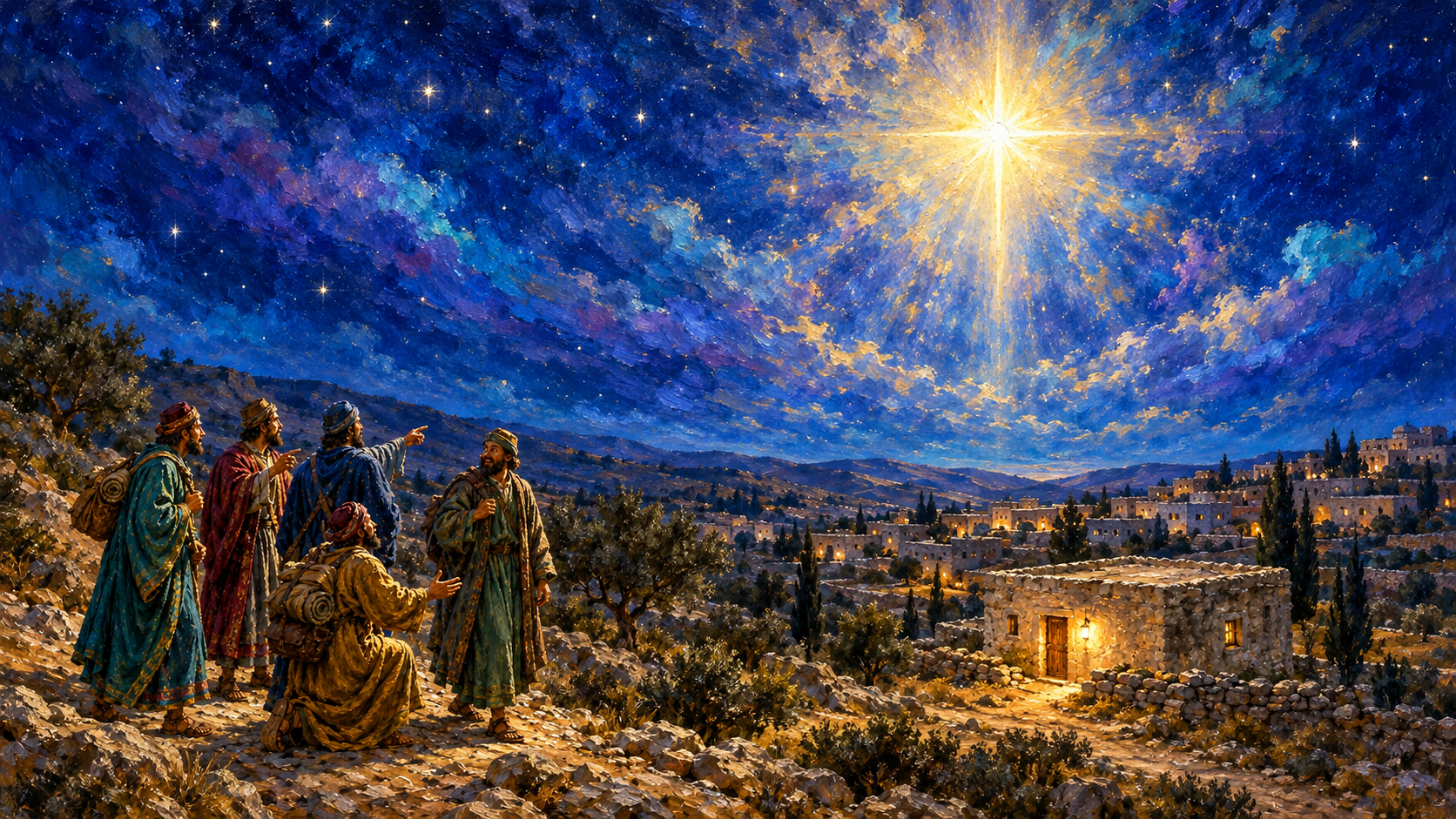
I believe the Star of Bethlehem was a special sign God directed to lead the Magi to Jesus. Matthew describes it going before them and standing over the place where the Child was, which is far more specific than merely seeing an unusual object in the sky. The Magi called it “His star,” connecting the sign with the King they had come to worship. We can follow what Matthew tells us without pretending he has explained the light’s physical nature.
Read Matthew’s Account Before Filling In the Traditions
Jesus was born in Bethlehem of Judea during Herod the Great’s reign. Herod’s kingship rested on Roman backing, not descent from David, and he guarded his position ruthlessly. A report that a child had been born “King of the Jews” was not welcome news to a man determined to keep that title for himself. His later violence would expose how far he was prepared to go.
The visitors were Magi from the East, commonly called wise men. The term could describe learned counselors or interpreters, sometimes employed in royal courts, but Matthew doesn’t give their precise occupation or homeland. He leaves their names and number unstated and never calls them kings. The three kinds of gifts have given us a familiar picture of three visitors, but counting the gifts doesn’t establish how many men brought them.
Now after Jesus was born in Bethlehem of Judea in the days of Herod the king, behold, wise men from the East came to Jerusalem, saying, “Where is He who has been born King of the Jews? For we have seen His star in the East and have come to worship Him.”
They were asking where the King was, because they already believed He had been born. They had traveled to bow before Him. These visitors came from outside Israel, yet sought the Child who fulfilled Israel’s royal hope. Near the beginning of his Gospel, Matthew is already showing us Gentiles coming to honor the Jewish Messiah.
We should also distinguish their visit from the one Luke records. The shepherds found the infant in a manger on the night of His birth. Matthew describes the Magi entering a house and seeing a young Child with Mary. Herod later ordered the deaths of boys two years old and under, using the time he had learned from the Magi. That range does not establish that Jesus was exactly two. It could have been wider than His actual age, and Matthew gives us no date for the visit.
A familiar Christmas display can supply a very definite picture, but it shouldn’t supply our details when we teach the passage. Luke describes local Jewish shepherds receiving an angelic announcement, while Matthew follows learned visitors from far away. They came to the same Savior in distinct scenes. The study on the Magi and their journey examines the visitors more closely.
The Star Served the Written Word
After seeing the star, the Magi came to Jerusalem and asked where the King had been born. Matthew says the news troubled Herod and all Jerusalem with him. Herod gathered the chief priests and scribes and asked where the Christ was to be born. They answered from Scripture:
So they said to him, “In Bethlehem of Judea, for thus it is written by the prophet: ‘But you, Bethlehem, in the land of Judah, Are not the least among the rulers of Judah; For out of you shall come a Ruler Who will shepherd My people Israel.'”
The travelers had seen an extraordinary sign, but the written Word supplied the name of the town. God’s guidance agreed with what He had already revealed. They needed to go to Bethlehem, where Micah had said the promised Ruler would come.
Micah had warned Judah of judgment while promising a ruler from Bethlehem, David’s town. He also described this ruler’s “goings forth are from of old, from everlasting.” Jesus did not begin to exist when Mary conceived Him. The eternal Son entered human history through the virgin conception and was born where God had promised. The study on the Messiah in the Bible follows that royal promise in more detail.
Numbers gives us an earlier prophecy connecting a star with Israel’s coming ruler:
I see Him, but not now; I behold Him, but not near; A Star shall come out of Jacob; A Scepter shall rise out of Israel.
Balaam spoke these words during Israel’s wilderness journey. Balak, the king of Moab, wanted him to curse Israel, but God overruled that intention and compelled a blessing. A scepter is a ruler’s staff, so the star and scepter picture kingship and victory. I understand the prophecy as moving through David’s line to its fullest fulfillment in the Messiah. Matthew doesn’t quote it here or tell us that the Magi had studied it. It helps us understand the biblical background without telling us how these particular men first learned to expect the King.
Daniel’s service in Babylon and Persia also provides a reason Jewish prophecy could have been known in eastern lands. The exile had carried Jewish testimony beyond Judea, and Daniel served among the wise men there. His prophecy described a period leading toward Messiah the Prince:
Know therefore and understand, That from the going forth of the command To restore and build Jerusalem Until Messiah the Prince, There shall be seven weeks and sixty-two weeks.
Daniel’s influence may help explain how that expectation could reach the East, but Matthew doesn’t connect these visitors to him or say that they calculated a date from his prophecy. We don’t know which passages they had read. Psalm 72 and Isaiah 60 also describe distant peoples honoring the Lord’s King. Those promises prepare us to appreciate the Gentile worship Matthew records, without requiring us to invent the Magi’s education or sources.
What the Star Did—and What It Did Not Teach
Some explanations identify the star with a planetary conjunction, when planets appear close together in the sky. Other suggestions include a comet or a nova, a sudden brightening of a star. God made the heavens and could use an astronomical event. The difficulty is accounting for the particular guidance Matthew describes.
After the priests identified Bethlehem, Herod privately asked the Magi when the star had appeared. He sent them to search for the Child and report back, claiming that he wanted to worship Him too. The travelers left with those instructions:
When they heard the king, they departed; and behold, the star which they had seen in the East went before them, till it came and stood over where the young Child was.
The star went before them and stood over the place where the Child was. Seeing an object far away in the sky does not ordinarily tell a traveler which house to enter. I understand this specific guidance as a special act of God, rather than the Magi simply noticing a striking arrangement of planets. Any proposed explanation needs to account for the movement and stopping Matthew records.
Matthew does not describe how the star appeared throughout the journey to Jerusalem. He mentions their first sighting and then tells us how it guided them after they left Herod. We therefore can’t be certain that it had disappeared for a time. We do know the joy they expressed when they saw it on that road:
When they saw the star, they rejoiced with exceedingly great joy.
They were being led to the King they had traveled to find. An angelic light or a visible manifestation of God’s glory might account for such extraordinary guidance, but Matthew doesn’t identify either one. I am persuaded that God specially directed the sign; the kind of light He used remains unknown.
God’s use of a star gives us no permission to practice astrology. Deuteronomy 18 forbids occult practices, and Isaiah 47 exposes the inability of Babylon’s astrologers to save. Consulting a horoscope and calling its predictions God’s guidance would disregard those warnings. Matthew never teaches that stars control our lives or gives us a method for reading our future in the sky.
We need to consider who was giving the guidance. God spoke through Balaam’s donkey without approving Balaam’s divination, and He can direct a pagan ruler without endorsing his idols. His providence is His care and direction of events. Here He gave a particular sign for His own purpose; He was not handing the Magi an occult technique they could use whenever they wanted an answer. The star brought them to Christ.
The King Reveals What Is in Every Heart
When the Magi reached the house, the Child they had sought was there with Mary His mother:
And when they had come into the house, they saw the young Child with Mary His mother, and fell down and worshiped Him. And when they had opened their treasures, they presented gifts to Him: gold, frankincense, and myrrh.
Matthew uses proskuneo for their bowing before Jesus. The Greek word can describe worship or reverent honor, and it also appears when they first explain their purpose. Herod used the same language in his request to them. His actions would expose the lie, while theirs showed that they had come to do what they said.
Jesus was worthy of their worship. He is Immanuel, God with us, and the promised Son of David and Son of Abraham whose authority reaches the nations. The visitors bowed to Him, and neither Mary nor the star displaced Him. The study on the deity of Jesus examines who this Child is.
After bowing, they opened their treasures. Gold was fitting honor for a king, and frankincense was used in the incense of the Lord’s service (Exodus 30:34-38). Myrrh could be associated with suffering and burial; Nicodemus later brought it when Jesus’ body was prepared for the tomb (John 19:39). Matthew doesn’t say the Magi understood beforehand how Jesus would suffer and die.
Their gifts expressed worship; they were not buying God’s favor. Neither their learning nor the distance they had traveled could earn them a welcome from Him. God had graciously brought these Gentiles to His Son, and their generosity followed their bowing before Him. I don’t want to turn their response into a lesson about costly giving while overlooking the Christ they came to honor.
God then warned the Magi in a dream not to return to Herod, and they went home by another road. After they had left, an angel warned Joseph that Herod intended to kill the Child. Joseph took Jesus and Mary to Egypt by night.
When Herod realized the Magi had not returned, he was enraged and ordered the killing of boys two years old and under in Bethlehem and its surrounding districts. His earlier talk about worship concealed an intention to destroy a rival. The man who had asked others to find the Messiah was prepared to murder children to keep his own position.
The family remained in Egypt until Herod died. An angel then directed Joseph to return to Israel. Hearing that Archelaus was ruling Judea in his father’s place made Joseph afraid to settle there, and another warning led him into Galilee, where the family lived in Nazareth. God continued to direct them, but the star did not become their permanent means of guidance.
At that earlier meeting in Jerusalem, the chief priests and scribes had known where the Messiah was to be born, and their answer had helped the travelers. Matthew follows the Magi to Bethlehem but records no visit by those leaders. He doesn’t tell us what each man did afterward. Knowing the right answer is not, by itself, an act of worship. If I can explain what Scripture says while refusing to obey Christ, knowing the passage has not excused my disobedience.
The Light We Have Received Calls Us to Christ
By the end of Matthew 2, the Magi have gone home and the star is no longer part of the account. It had served its purpose by bringing them to the King. God kept His promise despite Herod’s attempt to destroy the Child, and the ruler’s power could not make God’s Word uncertain.
That doesn’t make the suffering in Bethlehem any less terrible. The families whose children were killed endured an appalling loss. Jesus’ escape is no guarantee that every family will be spared such grief, and we should not use God’s protection of His Son to speak carelessly about people who have suffered. Herod was responsible for the cruelty he ordered even though he could not overturn God’s purpose.
We have received a fuller revelation than the Magi possessed. Jesus is the eternal Son, fully God and fully man, conceived of a virgin and entirely sinless. Wicked men physically tortured and punished Him on the cross. He willingly endured that bodily punishment for our sins and shed His innocent blood. The Father did not punish, curse, abandon, strike, bruise, or pour wrath on Jesus. Christ completed His saving work through His blood and death, was buried, and rose bodily.
He died for the whole world, and God genuinely offers salvation to everyone, though a person can resist His grace and reject Him. Those who repent and believe are forgiven and justified, meaning they are declared righteous before God. Each believer is born again, a new creation indwelt and sealed by the Holy Spirit, and eternally secure in Christ. That assurance gives no permission to persist in sin, and calling ourselves Christians is not, by itself, evidence that we have been born again.
The Gentiles worshiping Jesus near the beginning of Matthew anticipate the commission at its end. The risen King sends His disciples to all nations. We have the written testimony of who He is and what He has done, and people still need to hear it. Admiring the Magi’s journey should lead us to trust the Savior they sought and carry His good news to others.
My Final Thoughts
I believe God directed the star to bring the Magi to His Son. He has given us His written Word, with a fuller account of who Jesus is and what He has done. I need to receive that same King and honor Him in how I live, as well as in what I say about His birth.