
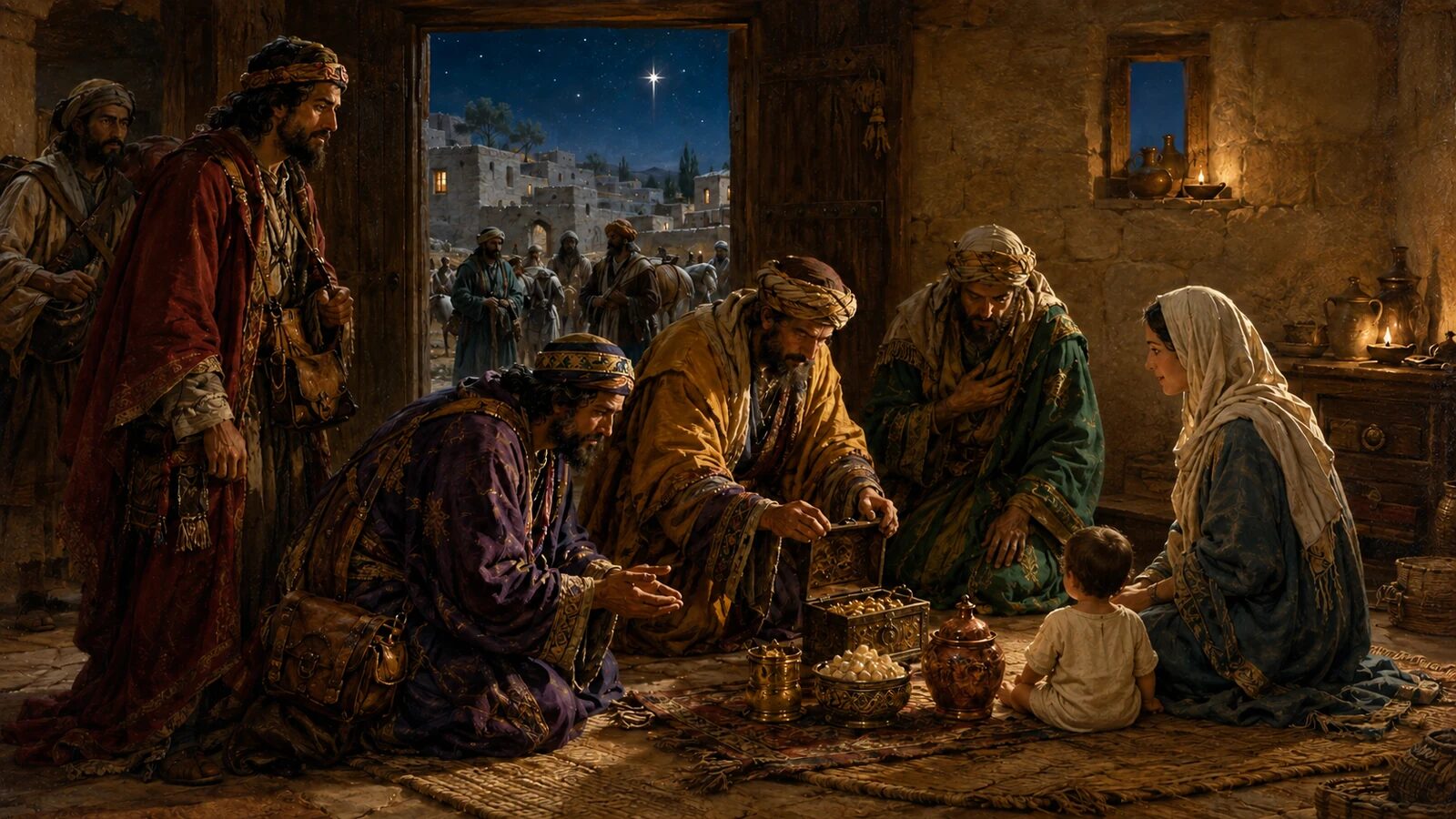
The Magi came looking for Jesus because they wanted to worship Him. Herod used the same language while planning to kill Him. I can’t assume that someone honors Christ simply because he knows how to speak reverently about Him. Matthew gives us these people’s words and actions, without many of the details later Christmas traditions have supplied.
Matthew’s Account of the Magi
Matthew does not give the visitors’ names, count their number, or call them kings. Three kinds of gifts do not tell us how many men brought them. Nor does he place them beside the manger on the night the shepherds came. He begins after Jesus was born:
Now after Jesus was born in Bethlehem of Judea in the days of Herod the king, behold, wise men from the East came to Jerusalem, saying, “Where is He who has been born King of the Jews? For we have seen His star in the East and have come to worship Him.”
Herod the Great ruled Judea as a client king backed by Rome. He had used political skill and violence to secure his position, but he was not the promised Son of David. The visitors were asking about a Child born King, not someone they hoped might eventually acquire a throne. Their question challenged the security Herod was determined to preserve.
Matthew says that Jerusalem was troubled with him. He does not describe each resident’s concern, so we should not assign Herod’s murderous purpose to everyone in the city. News that alarmed a suspicious ruler could have serious repercussions for others too. Herod’s own conduct becomes clear as Matthew follows his inquiries and the violence he later ordered.
Who the Magi Were and What They Knew
The Greek plural magoi could describe learned men associated with wisdom, interpretation, and observation of the heavens. The term had varied uses, including astrologers and people connected with eastern courts. It does not settle these men’s exact occupation or rank, and Matthew gives us no account of their earlier religious life.
The East could include Babylon or Persia. Jewish communities had lived in those regions since the exile, so there were ways for knowledge of Israel’s Scriptures to reach people beyond the Jewish community. Daniel had served in Babylon centuries earlier, and his position gave him an unusual opportunity to bear witness to Israel’s God:
Then the king promoted Daniel and gave him many great gifts; and he made him ruler over the whole province of Babylon, and chief administrator over all the wise men of Babylon.
Daniel’s prophetic teaching also included the coming of the Messiah:
Know therefore and understand, That from the going forth of the command To restore and build Jerusalem Until Messiah the Prince, There shall be seven weeks and sixty-two weeks.
These passages give us a reasonable explanation for how expectation of a Jewish Messiah could have reached eastern circles of learning. They do not identify a succession of teachers from Daniel to the Magi, and Matthew does not say these men calculated Daniel’s weeks or consulted his scroll. We know that they connected the sign they saw with the birth of Israel’s King; how they first acquired that knowledge is not explained.
Numbers 24:17 also speaks of a Star from Jacob and a Scepter from Israel. That royal imagery belongs within Scripture’s expectation of a coming ruler. It helps us understand the biblical setting without proving that the Magi themselves interpreted that prophecy. Their stated purpose is much clearer than their profession or homeland: they came to worship the King.
The Star, Scripture, and Bethlehem
After hearing their question, Herod gathered the chief priests and scribes and asked where the Messiah would be born. They answered from Scripture:
So they said to him, “In Bethlehem of Judea, for thus it is written by the prophet: ‘But you, Bethlehem, in the land of Judah, Are not the least among the rulers of Judah; For out of you shall come a Ruler Who will shepherd My people Israel.'”
Micah 5 had named Bethlehem centuries earlier, when Jerusalem faced judgment and needed hope beyond its failing rulers. The little town associated with David would produce God’s promised ruler. Matthew presents a promise specific enough for these men to name the place, rather than a resemblance someone noticed after the event.
The answer also describes a ruler who would shepherd God’s people, recalling the LORD’s words about David in 2 Samuel 5:2. Micah 5:4 likewise portrays the coming ruler shepherding His flock. Herod was prepared to kill to protect his position, but the promised King would care for the people entrusted to Him. Jesus guides His people rightly, correcting them without abandoning them, and would ultimately give His life for His sheep.
Micah also describes the ruler’s goings forth in language reaching beyond an ordinary human beginning. I read that alongside Matthew’s identification of Jesus as Immanuel, God with us, and John’s declaration that the Word was God and became flesh. The Child was a true descendant of David and also the eternal Son. His birth did not mark the beginning of His existence.
Herod privately asked the visitors when the star had appeared. He then sent them toward Bethlehem with a request:
And he sent them to Bethlehem and said, “Go and search carefully for the young Child, and when you have found Him, bring back word to me, that I may come and worship Him also.”
They left the king and saw the star again:
When they heard the king, they departed; and behold, the star which they had seen in the East went before them, till it came and stood over where the young Child was.
Matthew does not describe the star guiding them every mile from their homeland or directing them to stop in Jerusalem. Inquiring at the capital was a natural step for people seeking the King of the Jews. The chief priests and scribes had identified Bethlehem from Scripture; after the visitors left Herod, the star went before them and stood over the Child’s location. They rejoiced exceedingly when they saw it.
I find that final guidance difficult to explain as ordinary astronomy. God could have used something in His creation or provided a special sign under His direct control. Matthew tells us what the star did without explaining its physical nature. The account directs our attention to the Child it helped these men find.
God’s use of this sign does not give us permission to practice astrology or seek our personal future through omens. Scripture forbids divination and occult guidance. God brought the visitors toward Christ without endorsing everything that may have belonged to their background. His written Word supplied the answer they needed in Jerusalem.
Worship That Listens to God
When they reached the house, the visitors carried out the purpose they had announced:
And when they had come into the house, they saw the young Child with Mary His mother, and fell down and worshiped Him. And when they had opened their treasures, they presented gifts to Him: gold, frankincense, and myrrh.
Notice that Matthew places the visit in a house and calls Jesus a young Child. Luke describes the shepherds visiting near the time of the birth and finding Him in a manger. Matthew does not put the Magi into that same scene. We should respect the details of both accounts without forcing the visits into a single Christmas picture.
Herod’s later command to kill children two years old and under does not give us Jesus’ exact age when the visitors arrived. That range was based on what Herod had learned about the star’s appearance, and it could allow a broad margin. The term young Child does not supply a precise age either. Matthew places their visit after the birth and before the flight to Egypt, without giving us its date.
Mary was there with her Son, but Matthew says they worshiped Him. The Greek proskuneo describes bowing down or paying reverent honor. They gave Jesus the honor they had come to offer. Their knowledge may have been incomplete, but their actions were consistent with their stated intention.
The gifts were costly and fitting for the King they honored. Gold has royal associations, while frankincense is a fragrant resin used in incense and worship. Myrrh appears again in the accounts of Jesus’ suffering and burial: Mark records wine mixed with myrrh being offered at the crucifixion, and John records it among His burial spices. Matthew does not say the Magi intended all those associations or understood the coming cross.
The gifts also recall the honor from the nations described in Psalm 72 and Isaiah 60. Psalm 72 names distant rulers who will bring presents:
The kings of Tarshish and of the isles Will bring presents; The kings of Sheba and Seba Will offer gifts.
Those passages may help explain why later tradition pictured the Magi as kings, although Matthew does not identify the visitors that way or quote these prophecies at their arrival.
After their visit, God warned them not to go back to Herod:
Then, being divinely warned in a dream that they should not return to Herod, they departed for their own country another way.
Herod had asked them to return with information about the Child. Once God warned them otherwise, they changed their route and left without supplying it. Their obedience prevented Herod from using them to locate Jesus.
An angel also warned Joseph in a dream to take the Child and His mother to Egypt because Herod intended to kill Him. Joseph obeyed, and the family left by night. God used these warnings to protect the Messiah at His coming. They do not establish a routine method by which Christians should seek private guidance or replace Scripture with dreams.
When Herod realized the Magi had not returned, he became furious and ordered the slaughter of Bethlehem’s boys, two years old and under. God’s protection of His Son does not make those murders something to overlook. Herod was responsible for that violence, even though he could not overthrow God’s promise.
The King the Magi honored would later give Himself for sinners. He is the eternal Son, fully God, who became truly human and lived without sin. Wicked men physically tortured and punished His innocent body. He willingly endured that real punishment for our sins, shedding His blood and dying. His saving work was completed through His blood and death before His bodily resurrection. The Father did not punish, curse, abandon, strike, bruise, or pour wrath on Jesus. He was buried and rose bodily from the dead.
At the end of Matthew, after His resurrection, Jesus declares His authority to His disciples:
And Jesus came and spoke to them, saying, “All authority has been given to Me in heaven and on earth.”
He then commands His disciples to make disciples of all nations. Near the beginning of the Gospel, Gentiles came to honor Israel’s King; at its close, His people were sent to proclaim Him among the nations. He is the Savior of the world, with authority far beyond the borders of the land in which He was born.
Three Responses to the King
Herod’s claim to worship was a pretext for finding Jesus so he could kill Him. Religious language helped conceal his determination to keep control. I need to be honest about that temptation in myself. Saying I want to honor Christ cannot excuse resisting His Word when obedience would interfere with what I want.
The chief priests and scribes could identify Bethlehem from prophecy, but Matthew does not describe them accompanying the Magi. He records their accurate answer and then follows the visitors to the Child. He does not tell us what each teacher privately decided.
Bible knowledge is a gift, and it supplied the answer these travelers needed. The warning is against becoming satisfied with correct information while refusing the Lord it reveals. If I can explain a command but keep finding reasons not to obey it, the accuracy of my explanation does not make my refusal faithful.
The Magi traveled to find the King God had made known to them. Their journey and gifts did not buy salvation, but their willingness to go and worship shows a response to His grace. I cannot replace faith in Christ with religious connections or assume that knowing more than someone else makes me faithful.
My Final Thoughts
I want the truth I learn to lead me to Christ in faith and obedience. The Magi did more than ask where He was; they went to Him, worshiped, and listened when God warned them. I need that willingness to respond when His Word interrupts what I had planned. The King they honored deserves more than the respectful words Herod knew how to use.