
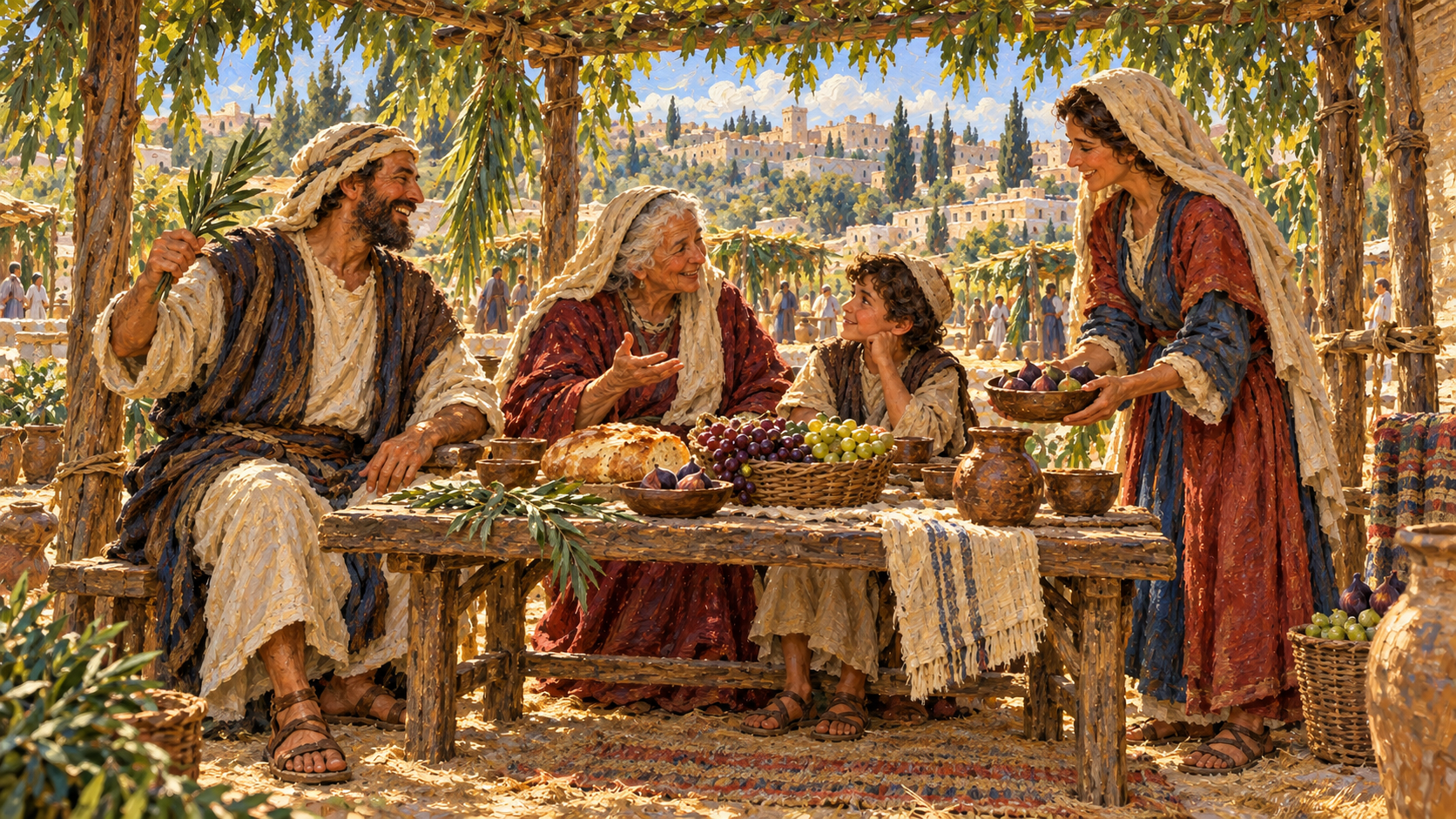
God gave Israel appointed times to remember what He had done and gather for worship at His sanctuary. Those days helped the nation order its life around Him. I want to understand that purpose before treating the feasts as a calendar of ceremonies or a chart of predictions. From there, we can follow what Scripture teaches about Christ and the church, while keeping Israel’s future promises in view.
The Lord’s Appointed Calendar
In Leviticus, God ordered Israel’s weeks and year around worship. Passover kept the deliverance from Egypt before the nation, and Unleavened Bread recalled the hurried departure that followed. The people brought God the first portion of their harvest before celebrating its completion later in the year. A national trumpet blast called Israel together. Then came the solemn Day of Atonement, when they humbled themselves, followed by days of rejoicing before the Lord while living in booths.
These observances belonged to God’s covenant with Israel through Moses. They set times for rest and worship at the sanctuary, with required offerings drawn from the agricultural life of the land. Remembering God’s acts shaped the nation’s life together. I need to understand what He was asking Israel to do before tracing how those observances were later fulfilled.
The New Testament itself connects the feasts with Christ. He is our Passover, and His resurrection is the firstfruits of the resurrection still to come. The Spirit was poured out when Pentecost had fully come. Hebrews explains how Christ’s blood obtains eternal redemption, while Colossians calls festival observance a shadow whose substance is Christ. Those passages give us solid reasons to study the connections. Where I draw an inference beyond an explicit statement, it must still answer to Scripture.
And the LORD spoke to Moses, saying, "Speak to the children of Israel, and say to them: 'The feasts of the LORD, which you shall proclaim to be holy convocations, these are My feasts. 'Six days shall work be done, but the seventh day is a Sabbath of solemn rest, a holy convocation. You shall do no work on it; it is the Sabbath of the LORD in all your dwellings. 'These are the feasts of the LORD, holy convocations which you shall proclaim at their appointed times. On the fourteenth day of the first month at twilight is the LORD's Passover. And on the fifteenth day of the same month is the Feast of Unleavened Bread to the LORD; seven days you must eat unleavened bread. On the first day you shall have a holy convocation; you shall do no customary work on it. But you shall offer an offering made by fire to the LORD for seven days. The seventh day shall be a holy convocation; you shall do no customary work on it.'"
The Hebrew word moed can refer to an appointed time, place, or meeting. Here it helps us understand why Leviticus calls these the Lord’s feasts: He determined when and how Israel would observe them. The people were to proclaim them as holy convocations, meaning sacred assemblies to which the people were summoned. A private day of reflection would not fulfill that command. These gatherings began with God’s instruction, rather than with human festivals to which religious meaning was later added.
This passage in Leviticus begins with the weekly Sabbath before turning to the annual observances of the first month. Passover was held at twilight on the fourteenth day, followed by Unleavened Bread on the fifteenth. That feast lasted seven days, with holy convocations and rest from customary work on its first and seventh days.
If I call every appointed time a prophecy, I can overlook what Israel was actually commanded to do. The people assembled to remember God’s acts, resting from ordinary work and bringing the required sacrifices. They also ate and rejoiced before Him as they taught later generations. Those purposes within Israel’s history and covenant help us understand how the observances point ahead to Christ.
For the festival cycle, Israel numbered its months beginning with the month of the Exodus, called Abib in the Torah and later known as Nisan. Torah here means the five books of Moses. This first month falls in the spring, while the seventh month, later called Tishri, falls in the autumn. The annual feasts cluster in those two seasons rather than being spread evenly across the year.
Leviticus 23 counts the Feast of Weeks from the wave offering instead of assigning it a fixed numerical date. The seasons also help us follow the calendar. Barley marked the beginning of harvest, with wheat following before the final ingathering later in the year. Israel’s worship was tied to the planting and harvesting of the land, so we should picture more than a series of religious anniversaries.
Jewish groups disagreed about how to reckon “the day after the Sabbath” for the festival count. Modern Jewish dates follow an established calculated calendar, while some interpreters propose alternatives based on observation. Those differences affect how we reconstruct the dates, but they give us no authority to announce when Christ will return. I would not turn a disputed calculation into a prediction Scripture has not made.
Some familiar names and associations came later. Leviticus calls the seventh-month observance a memorial of blowing rather than Rosh Hashanah. Later Jewish tradition associates Weeks with Sinai, whereas the Torah explicitly describes its harvest count and offering. We can respect a tradition while being clear about what the inspired text actually says.
Before listing the annual festivals, Leviticus repeats the weekly pattern: six days for work, followed by a seventh day of solemn rest and holy convocation. That Sabbath belonged to the Lord in all Israel’s dwellings.
The Sabbath reaches back to God’s rest after creation and became a covenant sign for Israel after the Exodus. It taught the nation to depend on Him instead of endless labor. Stopping economic activity also limited human power and gave servants and animals rest. Later festival Sabbaths likewise required people to cease work, though we should not automatically identify them with the ordinary weekly Sabbath.
Christ is Lord of the Sabbath, and He exposed legal traditions that used the day against mercy. The New Testament does not make Mosaic Sabbath observance a condition of salvation or holiness for Gentile believers. Yet I can still learn from what the Sabbath teaches about God’s ownership of time and the limits of human labor. Our ultimate rest is found in Christ.
The Spring Feasts Point Toward Christ
Now the LORD spoke to Moses and Aaron in the land of Egypt, saying, "This month shall be your beginning of months; it shall be the first month of the year to you. Speak to all the congregation of Israel, saying: 'On the tenth of this month every man shall take for himself a lamb, according to the house of his father, a lamb for a household. And if the household is too small for the lamb, let him and his neighbor next to his house take it according to the number of the persons; according to each man's need you shall make your count for the lamb. Your lamb shall be without blemish, a male of the first year. You may take it from the sheep or from the goats. Now you shall keep it until the fourteenth day of the same month. Then the whole assembly of the congregation of Israel shall kill it at twilight. And they shall take some of the blood and put it on the two doorposts and on the lintel of the houses where they eat it. Then they shall eat the flesh on that night; roasted in fire, with unleavened bread and with bitter herbs they shall eat it. Do not eat it raw, nor boiled at all with water, but roasted in fire–its head with its legs and its entrails. You shall let none of it remain until morning, and what remains of it until morning you shall burn with fire. And thus you shall eat it: with a belt on your waist, your sandals on your feet, and your staff in your hand. So you shall eat it in haste. It is the LORD's Passover. 'For I will pass through the land of Egypt on that night, and will strike all the firstborn in the land of Egypt, both man and beast; and against all the gods of Egypt I will execute judgment: I am the LORD. Now the blood shall be a sign for you on the houses where you are. And when I see the blood, I will pass over you; and the plague shall not be on you to destroy you when I strike the land of Egypt. 'So this day shall be to you a memorial; and you shall keep it as a feast to the LORD throughout your generations. You shall keep it as a feast by an everlasting ordinance.
Before the final plague, each Israelite household took an unblemished year-old male lamb. They killed it at twilight and applied its blood to the doorposts and lintel. The family ate the roasted animal with unleavened bread and bitter herbs, dressed and ready to leave. The Lord then passed through Egypt in judgment but passed over the houses marked by blood.
God had appointed the blood as a sign, so Israel needed to trust and obey His word rather than treat it as magic. Through the Passover, He judged the gods of Egypt and finally broke Pharaoh’s resistance. This marked the beginning of Israel’s national deliverance, which later generations were to commemorate by keeping the feast and teaching their children what He had done.
John identifies Jesus as the Lamb of God, and Paul explicitly says that Christ our Passover was sacrificed for us. That gives me a reason to look closely at how God delivered Israel at the first Passover. An innocent lamb died in another’s place, and its shed blood marked the household God rescued. Those people then left their bondage behind. The pattern points us to salvation through Christ’s blood, rather than sentimental admiration of His example.
Your glorying is not good. Do you not know that a little leaven leavens the whole lump? Therefore purge out the old leaven, that you may be a new lump, since you truly are unleavened. For indeed Christ, our Passover, was sacrificed for us. Therefore let us keep the feast, not with old leaven, nor with the leaven of malice and wickedness, but with the unleavened bread of sincerity and truth.
Israel left Egypt before its dough could rise, and the seven-day feast remembers that haste. The people cleared leaven from their houses and ate unleavened bread throughout the feast. Holy convocations marked both its opening and closing days. Passover and Unleavened Bread are therefore closely joined, but they remain distinguishable observances.
Paul draws on leaven’s ability to spread when he addresses the sexual immorality tolerated in Corinth. Because Christ our Passover has been sacrificed, the church must remove the evil that corrupts it. Keeping the feast with sincerity and truth is figurative language for the holiness that should follow God’s grace in the life of the church.
We cannot assume leaven always represents sin, since Jesus compares God’s kingdom to leaven working through dough and the Weeks offering includes leavened loaves. I need to understand the image from its context. Christ is sinless, but the direct connection in 1 Corinthians is between His Passover sacrifice and the church’s corresponding sincerity. The passage does not call Jesus “unleavened bread.”
And the LORD spoke to Moses, saying, "Speak to the children of Israel, and say to them: 'When you come into the land which I give to you, and reap its harvest, then you shall bring a sheaf of the firstfruits of your harvest to the priest. He shall wave the sheaf before the LORD, to be accepted on your behalf; on the day after the Sabbath the priest shall wave it. And you shall offer on that day, when you wave the sheaf, a male lamb of the first year, without blemish, as a burnt offering to the LORD. Its grain offering shall be two-tenths of an ephah of fine flour mixed with oil, an offering made by fire to the LORD, for a sweet aroma; and its drink offering shall be of wine, one-fourth of a hin. You shall eat neither bread nor parched grain nor fresh grain until the same day that you have brought an offering to your God; it shall be a statute forever throughout your generations in all your dwellings. 'And you shall count for yourselves from the day after the Sabbath, from the day that you brought the sheaf of the wave offering: seven Sabbaths shall be completed. Count fifty days to the day after the seventh Sabbath; then you shall offer a new grain offering to the LORD. You shall bring from your dwellings two wave loaves of two-tenths of an ephah. They shall be of fine flour; they shall be baked with leaven. They are the firstfruits to the LORD. And you shall offer with the bread seven lambs of the first year, without blemish, one young bull, and two rams. They shall be as a burnt offering to the LORD, with their grain offering and their drink offerings, an offering made by fire for a sweet aroma to the LORD. Then you shall sacrifice one kid of the goats as a sin offering, and two male lambs of the first year as a sacrifice of a peace offering. The priest shall wave them with the bread of the firstfruits as a wave offering before the LORD, with the two lambs. They shall be holy to the LORD for the priest. And you shall proclaim on the same day that it is a holy convocation to you. You shall do no customary work on it. It shall be a statute forever in all your dwellings throughout your generations. 'When you reap the harvest of your land, you shall not wholly reap the corners of your field when you reap, nor shall you gather any gleaning from your harvest. You shall leave them for the poor and for the stranger: I am the LORD your God.'"
Once Israel entered the land and began harvesting, the people were to bring a sheaf of firstfruits to the priest. He would wave it before the Lord on the day after the Sabbath. They could not eat bread from the crop until that offering had been presented, nor could they eat its grain parched or fresh.
By presenting the first portion, Israel gave thanks and devoted its expectation of the full harvest to God. A year-old lamb accompanied the sheaf, together with the prescribed grain and drink offerings. The people were worshiping with produce from land He had given them.
But now Christ is risen from the dead, and has become the firstfruits of those who have fallen asleep. For since by man came death, by Man also came the resurrection of the dead. For as in Adam all die, even so in Christ all shall be made alive. But each one in his own order: Christ the firstfruits, afterward those who are Christ's at His coming. Then comes the end, when He delivers the kingdom to God the Father, when He puts an end to all rule and all authority and power. For He must reign till He has put all enemies under His feet. The last enemy that will be destroyed is death. For "He has put all things under His feet." But when He says "all things are put under Him," it is evident that He who put all things under Him is excepted. Now when all things are made subject to Him, then the Son Himself will also be subject to Him who put all things under Him, that God may be all in all.
Paul explicitly calls the risen Christ the firstfruits of those who have fallen asleep. His bodily resurrection begins the harvest and guarantees that the rest will follow. Christ rose first, and those who belong to Him will rise at His coming. Our expectation of resurrection therefore rests on what has already happened to Him, as God’s redemptive work moves toward its appointed end.
“Fallen asleep” gently describes believers who have physically died, with the assurance that their bodies will rise. It does not mean their souls become unconscious. Paul says elsewhere that being absent from the body is being present with the Lord, so the harvest picture concerns bodily resurrection and reunion.
Many teachers place Resurrection Sunday precisely on the wave-sheaf day. I find Paul’s description of Christ as the “firstfruits” compelling. Pinning down the exact calendar date involves further questions about the Sabbath in Leviticus and how the Gospel chronology fits together. We can be certain of Paul’s teaching without pretending those disputed calculations are settled.
Israel counted seven complete Sabbaths from the wave offering and then reached the fiftieth day, reflected in the Greek name Pentecost. The people brought two wave loaves of fine flour baked with leaven. Alongside them came burnt offerings with the prescribed grain and drink offerings, as well as sin and peace offerings. The nation gathered for a holy convocation and ceased from customary work.
Leviticus calls those leavened loaves firstfruits to the Lord, which is another reason not to make leaven a symbol of sin in every passage. It does not identify one loaf as Jews and the other as Gentiles, or describe them as two testaments or two houses. Someone may use those comparisons as devotional analogies, but I would not present them as what the text means.
Leviticus presents Weeks as harvest worship. Its later association with the giving of Torah at Sinai helps explain subsequent Jewish observance, but neither Exodus nor Leviticus commands it as an anniversary of Sinai. The strongest New Testament connection comes in Acts 2, when the Spirit was poured out on the day of the feast itself.
The Autumn Feasts and Israel’s Hope
Then the LORD spoke to Moses, saying, "Speak to the children of Israel, saying: 'In the seventh month, on the first day of the month, you shall have a sabbath-rest, a memorial of blowing of trumpets, a holy convocation. You shall do no customary work on it; and you shall offer an offering made by fire to the LORD.'" And the LORD spoke to Moses, saying: "Also the tenth day of this seventh month shall be the Day of Atonement. It shall be a holy convocation for you; you shall afflict your souls, and offer an offering made by fire to the LORD. And you shall do no work on that same day, for it is the Day of Atonement, to make atonement for you before the LORD your God. For any person who is not afflicted in soul on that same day shall be cut off from his people. And any person who does any work on that same day, that person I will destroy from among his people. You shall do no manner of work; it shall be a statute forever throughout your generations in all your dwellings. It shall be to you a sabbath of solemn rest, and you shall afflict your souls; on the ninth day of the month at evening, from evening to evening, you shall celebrate your sabbath." Then the LORD spoke to Moses, saying, "Speak to the children of Israel, saying: 'The fifteenth day of this seventh month shall be the Feast of Tabernacles for seven days to the LORD. On the first day there shall be a holy convocation. You shall do no customary work on it. For seven days you shall offer an offering made by fire to the LORD. On the eighth day you shall have a holy convocation, and you shall offer an offering made by fire to the LORD. It is a sacred assembly, and you shall do no customary work on it. 'These are the feasts of the LORD which you shall proclaim to be holy convocations, to offer an offering made by fire to the LORD, a burnt offering and a grain offering, a sacrifice and drink offerings, everything on its day– besides the Sabbaths of the LORD, besides your gifts, besides all your vows, and besides all your freewill offerings which you give to the LORD. 'Also on the fifteenth day of the seventh month, when you have gathered in the fruit of the land, you shall keep the feast of the LORD for seven days; on the first day there shall be a sabbath-rest, and on the eighth day a sabbath-rest. And you shall take for yourselves on the first day the fruit of beautiful trees, branches of palm trees, the boughs of leafy trees, and willows of the brook; and you shall rejoice before the LORD your God for seven days. You shall keep it as a feast to the LORD for seven days in the year. It shall be a statute forever in your generations. You shall celebrate it in the seventh month. You shall dwell in booths for seven days. All who are native Israelites shall dwell in booths, that your generations may know that I made the children of Israel dwell in booths when I brought them out of the land of Egypt: I am the LORD your God.'" So Moses declared to the children of Israel the feasts of the LORD.
On the first day of the seventh month, Israel was to keep a Sabbath rest and gather for a holy convocation marked by trumpet blasts. The people also presented an offering by fire. The Hebrew expression zikhron teruah joins remembrance with a loud blast or shout, helping explain the character of this memorial. Numbers 29 supplies the details of its sacrifices.
A trumpet blast could summon people to an assembly or signal that it was time to move. Elsewhere in Scripture, trumpets announced war or accompanied worship. They could acclaim a king or proclaim a divine appearance as well. Since the instrument served several purposes, I cannot assume which one explains this memorial. Leviticus names no specific event being recalled, nor does it explicitly call the day a festival of repentance or judgment. It never identifies it as the date of the rapture.
The New Testament connects a trumpet of God with the church’s pre-Tribulation gathering, while later trumpets accompany Tribulation judgments. That imagery suggests a connection with the feast, but no verse says the gathering must happen on its calendar date. Christ’s promise gives us reason to be ready without guessing a year from a feast.
Now the LORD spoke to Moses after the death of the two sons of Aaron, when they offered profane fire before the LORD, and died; and the LORD said to Moses: "Tell Aaron your brother not to come at just any time into the Holy Place inside the veil, before the mercy seat which is on the ark, lest he die; for I will appear in the cloud above the mercy seat. "Thus Aaron shall come into the Holy Place: with the blood of a young bull as a sin offering, and of a ram as a burnt offering. He shall put the holy linen tunic and the linen trousers on his body; he shall be girded with a linen sash, and with the linen turban he shall be attired. These are holy garments. Therefore he shall wash his body in water, and put them on. And he shall take from the congregation of the children of Israel two kids of the goats as a sin offering, and one ram as a burnt offering. "Aaron shall offer the bull as a sin offering, which is for himself, and make atonement for himself and for his house. He shall take the two goats and present them before the LORD at the door of the tabernacle of meeting. Then Aaron shall cast lots for the two goats: one lot for the LORD and the other lot for the scapegoat. And Aaron shall bring the goat on which the LORD's lot fell, and offer it as a sin offering. But the goat on which the lot fell to be the scapegoat shall be presented alive before the LORD, to make atonement upon it, and to let it go as the scapegoat into the wilderness. "And Aaron shall bring the bull of the sin offering, which is for himself, and make atonement for himself and for his house, and shall kill the bull as the sin offering which is for himself. Then he shall take a censer full of burning coals of fire from the altar before the LORD, with his hands full of sweet incense beaten fine, and bring it inside the veil. And he shall put the incense on the fire before the LORD, that the cloud of incense may cover the mercy seat that is on the Testimony, lest he die. He shall take some of the blood of the bull and sprinkle it with his finger on the mercy seat on the east side; and before the mercy seat he shall sprinkle some of the blood with his finger seven times. "Then he shall kill the goat of the sin offering, which is for the people, bring its blood inside the veil, do with that blood as he did with the blood of the bull, and sprinkle it on the mercy seat and before the mercy seat. So he shall make atonement for the Holy Place, because of the uncleanness of the children of Israel, and because of their transgressions, for all their sins; and so he shall do for the tabernacle of meeting which remains among them in the midst of their uncleanness. There shall be no man in the tabernacle of meeting when he goes in to make atonement in the Holy Place, until he comes out, that he may make atonement for himself, for his household, and for all the assembly of Israel. And he shall go out to the altar that is before the LORD, and make atonement for it, and shall take some of the blood of the bull and some of the blood of the goat, and put it on the horns of the altar all around. Then he shall sprinkle some of the blood on it with his finger seven times, cleanse it, and consecrate it from the uncleanness of the children of Israel. "And when he has made an end of atoning for the Holy Place, the tabernacle of meeting, and the altar, he shall bring the live goat. Aaron shall lay both his hands on the head of the live goat, confess over it all the iniquities of the children of Israel, and all their transgressions, concerning all their sins, putting them on the head of the goat, and shall send it away into the wilderness by the hand of a suitable man. The goat shall bear on itself all their iniquities to an uninhabited land; and he shall release the goat in the wilderness. "Then Aaron shall come into the tabernacle of meeting, shall take off the linen garments which he put on when he went into the Holy Place, and shall leave them there. And he shall wash his body with water in a holy place, put on his garments, come out and offer his burnt offering and the burnt offering of the people, and make atonement for himself and for the people. The fat of the sin offering he shall burn on the altar. And he who released the goat as the scapegoat shall wash his clothes and bathe his body in water, and afterward he may come into the camp. The bull for the sin offering and the goat for the sin offering, whose blood was brought in to make atonement in the Holy Place, shall be carried outside the camp. And they shall burn in the fire their skins, their flesh, and their offal. Then he who burns them shall wash his clothes and bathe his body in water, and afterward he may come into the camp. "This shall be a statute forever for you: In the seventh month, on the tenth day of the month, you shall afflict your souls, and do no work at all, whether a native of your own country or a stranger who dwells among you. For on that day the priest shall make atonement for you, to cleanse you, that you may be clean from all your sins before the LORD. It is a sabbath of solemn rest for you, and you shall afflict your souls. It is a statute forever. And the priest, who is anointed and consecrated to minister as priest in his father's place, shall make atonement, and put on the linen clothes, the holy garments; then he shall make atonement for the Holy Sanctuary, and he shall make atonement for the tabernacle of meeting and for the altar, and he shall make atonement for the priests and for all the people of the assembly. This shall be an everlasting statute for you, to make atonement for the children of Israel, for all their sins, once a year." And he did as the LORD commanded Moses.
On the tenth day of the seventh month, Israel was to humble itself and do no work during a solemn Sabbath. Leviticus 16 describes the ritual the high priest was to perform. After washing and putting on holy linen garments, he brought a bull for himself and his household, along with two goats for the people.
One goat was killed as a sin offering, and its blood was taken behind the veil. Because the holy God dwelt among an unclean nation, the sanctuary and altar needed cleansing, as did the priesthood and the people. The living goat carried the confessed iniquities away into an uninhabited land.
I understand the two goats as complementary parts of one atonement ritual, not pictures of competing saviors. One supplied the blood brought into the sanctuary, while the other visibly carried confessed sins away from the camp. Taken together, they showed Israel both the seriousness of its guilt and God’s provision for removing it.
Leviticus commands the people to “afflict” their souls. They were to humble themselves deliberately and practice self-denial rather than celebrate. Jewish practice has long expressed this through fasting, but the point was not to make hunger a work that earned God’s favor. Israel ceased ordinary labor and humbled itself while the high priest carried out the commanded atonement.
The ritual provided annual covenant cleansing and priestly access under the Mosaic system, so we should not reduce it to a picture of final judgment. Yet the priest had to address his own sin before presenting animal blood, and the whole observance returned the following year. That repetition showed the work was incomplete. Hebrews draws our attention to this recurring ministry in order to contrast it with Christ’s finished work.
The Feast of Tabernacles began on the fifteenth day of the seventh month and lasted seven days, followed by an eighth-day sacred assembly. Having gathered the land’s fruit, the people took branches and rejoiced before the Lord. Native Israelites were to live in booths so later generations would remember that God had made Israel dwell in booths after bringing them out of Egypt.
Living in booths brought Israel’s vulnerable years of dependence in the wilderness to mind while the people enjoyed the abundance of a completed harvest. I can see how that joined gratitude with humility. Plenty in the land was no reason to forget the Deliverer who had sheltered and fed them.
On the last day, that great day of the feast, Jesus stood and cried out, saying, "If anyone thirsts, let him come to Me and drink. He who believes in Me, as the Scripture has said, out of his heart will flow rivers of living water." But this He spoke concerning the Spirit, whom those believing in Him would receive; for the Holy Spirit was not yet given, because Jesus was not yet glorified.
By the New Testament period, the feast included ceremonies involving water and illumination. We know those details from later historical descriptions, rather than from Leviticus. John deliberately tells us that Jesus publicly promised living water on the feast’s last great day. His Gospel connects Israel’s celebration with the Spirit supplied through Messiah.
Worship Required Pilgrimage and Sacrifice
Exodus 23 and Deuteronomy 16 name three annual feasts for which Israelite males were to travel to the place the Lord chose. Unleavened Bread came first, followed by Weeks and then Tabernacles. Those appearing before Him were not to come empty-handed. Their gifts were to reflect the blessing He had given them.
Gathering at the place God chose helped preserve national unity and opposed worship at shrines people chose for themselves. Households and tribes traveled to share in remembering His acts. Later, the psalms of ascent gave voice to pilgrims going up to Jerusalem.
Those pilgrimages help explain why devout Jews from many nations were in Jerusalem in Acts 2. When the Spirit was poured out, they heard God’s wonderful works in their own languages. Pentecost was already part of Israel’s appointed calendar. The church did not invent the feast, but the gospel event that took place on it carried Messiah’s message outward to the nations.
Leviticus 23 lays out the calendar, and Numbers 28 and 29 explain the offerings that accompanied it. Daily offerings continued all year, with additional sacrifices each week and still more at the new month and festivals. During the seven days of Tabernacles, the number of bulls offered decreased each day.
Israel’s offerings came from its flocks and fields. Along with animal sacrifices, the calendar required grain, oil, and wine, so the people’s worship involved the labor that produced those things. It also depended on the authorized priesthood and sanctuary. When I think about a feast today, I need to remember that it belonged to a covenant system centered on the altar and shed blood. It was more than a family meal or an illustration for a sermon.
A private modern reenactment cannot reproduce that observance without the authorized Aaronic priesthood and sanctuary. The commanded sacrifices and the national order tied to Israel’s land are also absent. We may study the feasts to remember what happened and may voluntarily observe selected customs. But omitting parts of the law while claiming to have restored its observance is not an honest description of what we are doing.
The Substance Belongs to Christ
And you, being dead in your trespasses and the uncircumcision of your flesh, He has made alive together with Him, having forgiven you all trespasses, having wiped out the handwriting of requirements that was against us, which was contrary to us. And He has taken it out of the way, having nailed it to the cross. Having disarmed principalities and powers, He made a public spectacle of them, triumphing over them in it. So let no one judge you in food or in drink, or regarding a festival or a new moon or sabbaths, which are a shadow of things to come, but the substance is of Christ.
God makes believers alive with Christ and forgives their trespasses. Through the cross, He cancels the written record of debt that stood against us and triumphs over spiritual rulers. Therefore no one may judge believers by rules concerning food, drink, festivals, new moons, or Sabbaths. These observances are a shadow, while the body or substance is Christ.
Calling the calendar a shadow does not make it evil. Its shape comes from God because a real body casts it. Israel’s observances outlined His deliverance and the holiness He required. Harvest celebrations taught dependence on Him, and the Day of Atonement taught the need for cleansing and priestly access. In Tabernacles, His dwelling with Israel was joined to their rest and future hope. Christ supplies the reality these patterns point toward.
Our access to God is found in the Messiah, along with forgiveness and our standing before Him. We do not receive those things through calendar observance. That is why requiring festival law for justification or Christian completeness denies the sufficiency Paul describes. But fulfillment in Christ does not make the church ethnic Israel or cancel God’s promises to that nation.
When the Day of Pentecost had fully come, they were all with one accord in one place. And suddenly there came a sound from heaven, as of a rushing mighty wind, and it filled the whole house where they were sitting. Then there appeared to them divided tongues, as of fire, and one sat upon each of them. And they were all filled with the Holy Spirit and began to speak with other tongues, as the Spirit gave them utterance. And there were dwelling in Jerusalem Jews, devout men, from every nation under heaven. And when this sound occurred, the multitude came together, and were confused, because everyone heard them speak in his own language. Then they were all amazed and marveled, saying to one another, "Look, are not all these who speak Galileans? And how is it that we hear, each in our own language in which we were born? Parthians and Medes and Elamites, those dwelling in Mesopotamia, Judea and Cappadocia, Pontus and Asia, Phrygia and Pamphylia, Egypt and the parts of Libya adjoining Cyrene, visitors from Rome, both Jews and proselytes, Cretans and Arabs–we hear them speaking in our own tongues the wonderful works of God." So they were all amazed and perplexed, saying to one another, "Whatever could this mean?" Others mocking said, "They are full of new wine." But Peter, standing up with the eleven, raised his voice and said to them, "Men of Judea and all who dwell in Jerusalem, let this be known to you, and heed my words. For these are not drunk, as you suppose, since it is only the third hour of the day. But this is what was spoken by the prophet Joel: 'And it shall come to pass in the last days, says God, That I will pour out of My Spirit on all flesh; Your sons and your daughters shall prophesy, Your young men shall see visions, Your old men shall dream dreams. And on My menservants and on My maidservants I will pour out My Spirit in those days; And they shall prophesy. I will show wonders in heaven above And signs in the earth beneath: Blood and fire and vapor of smoke. The sun shall be turned into darkness, And the moon into blood, Before the coming of the great and awesome day of the LORD. And it shall come to pass That whoever calls on the name of the LORD Shall be saved.'
The disciples were together when Pentecost fully came. A sound like a rushing mighty wind filled the house, and divided tongues like fire rested upon them. The Holy Spirit enabled them to speak in other languages, so Jews from many nations heard God’s wonderful works in their own native tongues.
Peter explained what was happening through Joel’s prophecy. God was pouring out His Spirit, and the promised age had begun through the risen and exalted Messiah. The languages were intelligible signs, meaning people could understand them. This was not uncontrolled noise. God equipped believers to bear witness and publicly formed a community that belonged to Messiah and was indwelt by His Spirit.
Acts 2 does not say the two leavened loaves predicted Jews and Gentiles, nor does it call Pentecost a replacement Sinai. I don’t need to add those claims to appreciate the fulfillment it describes. The Holy Spirit is a divine Person who indwells believers and gives gifts, and Scripture must govern every claim we make about His work. We should accept what He does without explaining it away, while refusing to imitate dramatic experiences Scripture does not support.
Now when these things had been thus prepared, the priests always went into the first part of the tabernacle, performing the services. But into the second part the high priest went alone once a year, not without blood, which he offered for himself and for the people's sins committed in ignorance; the Holy Spirit indicating this, that the way into the Holiest of All was not yet made manifest while the first tabernacle was still standing. It was symbolic for the present time in which both gifts and sacrifices are offered which cannot make him who performed the service perfect in regard to the conscience– concerned only with foods and drinks, various washings, and fleshly ordinances imposed until the time of reformation. But Christ came as High Priest of the good things to come, with the greater and more perfect tabernacle not made with hands, that is, not of this creation. Not with the blood of goats and calves, but with His own blood He entered the Most Holy Place once for all, having obtained eternal redemption. For if the blood of bulls and goats and the ashes of a heifer, sprinkling the unclean, sanctifies for the purifying of the flesh, how much more shall the blood of Christ, who through the eternal Spirit offered Himself without spot to God, cleanse your conscience from dead works to serve the living God? And for this reason He is the Mediator of the new covenant, by means of death, for the redemption of the transgressions under the first covenant, that those who are called may receive the promise of the eternal inheritance.
Under the tabernacle order, priests repeatedly entered the first room, but only the high priest could enter the second. He went in once a year and never without blood. Through that arrangement, the Holy Spirit showed that full access had not yet been made manifest while the first tabernacle stood.
Christ came as High Priest of the good things accomplished through a greater and perfect tabernacle. He entered the holy place once with His own blood and obtained eternal redemption. His blood cleanses our conscience so that we can serve the living God.
Jesus physically bore the punishment for our sins in His innocent body on the cross. He endured real torture and shed His blood as He died. The Father did not turn against Him or pour wrath on Him, nor did He abandon His Son. He was not the one who struck and bruised Jesus. Christ willingly died for the whole world and rose bodily from the dead. His sacrifice is complete and will never be repeated. His priesthood and blood fulfill the saving meaning of the Day of Atonement, which cannot be fulfilled by an annual Christian reenactment.
Everyone who repents and believes in Christ receives forgiveness and everlasting life, though God’s offer can be resisted. He makes the believer a new creation, indwelt and sealed by the Holy Spirit for the day of redemption. That salvation is eternally secure. It gives no permission for lawlessness, and a shallow profession does not prove someone has been born again. Keeping a festival can neither produce salvation nor preserve it.
Because Jesus’ sacrifice is once for all, nothing future can add saving merit to His blood. That does not remove the future turning of Israel to Messiah described by the prophets and Paul. Zechariah portrays Jerusalem mourning for the pierced One, while Romans 11 says Israel has experienced a partial hardening until the fullness of the Gentiles comes in.
Some interpreters see Israel’s future national awakening in the order of the seventh-month feasts. On that reading, Trumpets is a summons, followed by repentance pictured in Atonement and the joy of the kingdom in Tabernacles. The sequence can illustrate biblical themes. I would not treat it as a complete chart of the end times, though, because Scripture does not identify it that way.
Direct prophecy gives us the basis for this hope: God has not discarded Israel. The church’s pre-Tribulation gathering will be followed by the seven-year Tribulation. Christ will then return bodily and deliver the believing remnant before establishing His literal thousand-year reign. Feast imagery can help illustrate those promises, but our certainty must rest on the prophecies themselves.
And it shall come to pass that everyone who is left of all the nations which came against Jerusalem shall go up from year to year to worship the King, the LORD of hosts, and to keep the Feast of Tabernacles. And it shall be that whichever of the families of the earth do not come up to Jerusalem to worship the King, the LORD of hosts, on them there will be no rain. If the family of Egypt will not come up and enter in, they shall have no rain; they shall receive the plague with which the LORD strikes the nations who do not come up to keep the Feast of Tabernacles. This shall be the punishment of Egypt and the punishment of all the nations that do not come up to keep the Feast of Tabernacles.
After the Lord comes and reigns as King over all the earth, survivors from the nations that attacked Jerusalem go up year by year to worship the King and keep the Feast of Tabernacles. Nations that refuse face withheld rain and plague.
Here we have a future observance named directly in prophecy. Zechariah places the Feast of Tabernacles in the coming kingdom, with nations worshiping publicly in Jerusalem and facing agricultural judgment if they refuse to attend. I cannot turn all of that into a description of present inward experience. The passage speaks about Jerusalem and nations under the King’s rule.
We might ask why a feast would continue after Christ’s sacrifice is complete. Remembering accomplished redemption does not repeat the atonement, and keeping this feast will express obedience within Messiah’s kingdom. Zechariah is describing the King’s public rule over real nations, not a return to salvation by law.
The Church Must Follow Christ, Not the Calendar
The Jerusalem council refused to require Gentile believers to become Jews or keep the law of Moses in order to be saved. Paul warned the Galatians against accepting circumcision as a covenant obligation and told the Colossians not to accept judgment over festival days.
We are justified by grace through faith in Jesus Christ. Eating a Passover meal or keeping the Sabbath cannot do that, however carefully we follow a calendar or pronounce Hebrew. Dietary rules and pilgrimages cannot justify us either. I can learn about the water and bread used in modern rituals without treating them as additions to Christ’s blood. The same is true of candles and branches or the sound of a shofar.
Freedom from those legal obligations gives us no reason to despise Jewish people or Israel’s Scriptures. Gentile believers have received blessing through Israel’s Messiah and through the apostolic witness that came from Israel. We should read Torah with gratitude and oppose antisemitism, honoring God’s continuing purposes for the nation. Sharing salvation in Christ does not give the church Israel’s ethnic identity or cancel its national promises.
Teaching often called Hebrew Roots becomes legalistic when it requires Christians to adopt Israel’s calendar and dietary laws in order to be truly obedient. Requiring Sabbath keeping or Hebrew customs for spiritual completeness imposes the same burden. Learning biblical backgrounds can help us understand Scripture, and Jewish believers may voluntarily retain cultural practices. But the apostles refused to make such observances a boundary of salvation or a measure of holiness. We must not use them to claim spiritual superiority.
Romans 14 permits believers to esteem one day above another or esteem every day alike, provided each is persuaded before the Lord and does not despise or judge the other. That principle gives room for a Jewish believer to retain cultural observance and for a Gentile family to use a feast as a teaching occasion.
That freedom does not let anyone preach an observance as necessary for justification or make it a condition of belonging to God’s true people. Neither may it become a mark of spiritual superiority. Teachers must distinguish Scripture’s commands from later traditions and describe modern rituals honestly. Without the commanded sacrifices and sanctuary service, they cannot claim exact Torah observance.
If I use a feast to teach, I should ask whether it helps people understand Scripture and remember God’s acts. It should encourage love for Jewish neighbors and direct our worship toward Messiah, without making Hebrew customs a way to rank believers. Christ is the substance, and our conscience remains accountable to His Word.
A common chart places the fulfillment of the spring feasts at Christ’s first coming and the autumn feasts at His second coming. There are reasons people find that pattern useful. The New Testament explicitly connects Passover with Christ, along with the resurrection firstfruits and Pentecost. Trumpet imagery also relates to future prophecy, and Israel’s repentance and kingdom observance of Tabernacles remain ahead.
The problem comes when we treat that chart as an inspired key to every question of timing. Atonement was completed at the cross, even though Israel’s recognition of Messiah is still future. Tabernacles already bears witness to God’s dwelling and the Spirit, yet it also appears in the Millennium. Fulfillment can begin before its final expression, and a future observance may remember work that is already complete.
Jesus calls us to be ready and forbids arrogant prediction. The church’s gathering is imminent and pre-Tribulational, but Scripture does not require it to occur on the first day of the seventh month. Guessing dates turns attention away from daily faithfulness, and every failed prediction damages our witness.
Before relying on a modern chart, read the feast passages in Exodus and Leviticus and the additional commands in Numbers and Deuteronomy. Pay attention to what Israel was to remember and bring before the Lord. The days of rest and the food they ate also help us understand what each observance taught the next generation. Once we understand those instructions, we can trace the connections with Christ that Scripture establishes or responsibly supports.
We should rest in the blood of the true Passover Lamb and put corrupting compromise away in sincerity and truth. His resurrection as the firstfruits gives us hope of bodily resurrection ourselves. The Spirit now dwells in the believer, and our High Priest has opened the way for us to draw near through a sacrifice that will never need to be repeated.
We can reject Hebrew Roots legalism while praying for Jewish people to recognize their Messiah and honoring God’s future promises to Israel. Disdain for the nation has no place in that response. As we wait for the King, faithful obedience today is our best preparation. We have no need to guess dates.
I want to keep both Christ’s finished work and Israel’s future hope in view as we study these feasts. They commemorate actual events and point us to Him. They still teach us even though they are not Christian law. Any future application of the calendar must be governed by direct prophecy, including Israel’s promised turning to Messiah and worship in His kingdom.
Related studies: The Passover, Unleavened Bread, The Feast of Trumpets.
My Final Thoughts
The more I understand what God asked Israel to remember in these feasts, the more reason I have to study them with gratitude. They ordered the covenant nation’s rest and sacrifice, teaching worship through the harvest and hope in His promises. They cannot be reduced to Jewish history or an end-times chart. The New Testament brings us to Christ’s blood and resurrection, His priesthood, and the Spirit He gives. No later feast can add merit to His finished sacrifice, and fulfillment in Him neither erases Israel nor places the church under Mosaic law. As we honor God’s continuing promises to Israel and await the church’s pre-Tribulation gathering, we should rest in Messiah and live faithfully. He has promised to return without giving us a feast date to announce.