
God’s names are often gathered into charts, but a chart can make very different biblical expressions look identical. Some passages give His covenant name, while others name a place, altar, or city after He acts. I want to read each expression in its own setting so that we understand what God revealed, rather than make a familiar label promise something its passage never says.
The Covenant Name at the Burning Bush
God has made Himself known through His words and actions. His promises, judgments, provision, and rescue of sinners tell us whom we are being asked to trust. His names belong to that revelation. They are not religious labels we can arrange to suit whichever need concerns us at the moment.
The distinction between the expressions is worth keeping clear from the beginning. Genesis 22 names a place, Exodus 17 and Judges 6 name altars, and Ezekiel 48 names a city. In Exodus 15 and 31, the LORD describes His work within a sentence. Psalm 23 gives David’s confession, while LORD of hosts is a recurring title. Later devotional labels sometimes combine Hebrew words in a convenient form the verse itself does not use. These expressions all reveal God, but they do not all function as formal personal names.
Jehovah is an established English representation of the covenant name YHWH. In forms such as Jehovah-Jireh, that representation is joined to another Hebrew word or phrase to help us remember what a passage teaches. There is nothing wrong with using such a label, provided we know what it represents. Saying it cannot compel God to produce money, restore health, or make a project succeed. He reveals Himself so that we will trust and obey Him.
These passages also reveal the one triune God. The Father, Son, and Holy Spirit are distinct persons, each fully God, yet there is one God. We cannot divide His character into separate powers either. The One who provides is also holy, and the Healer is also Judge. His peace and His command over every host belong to the same Lord.
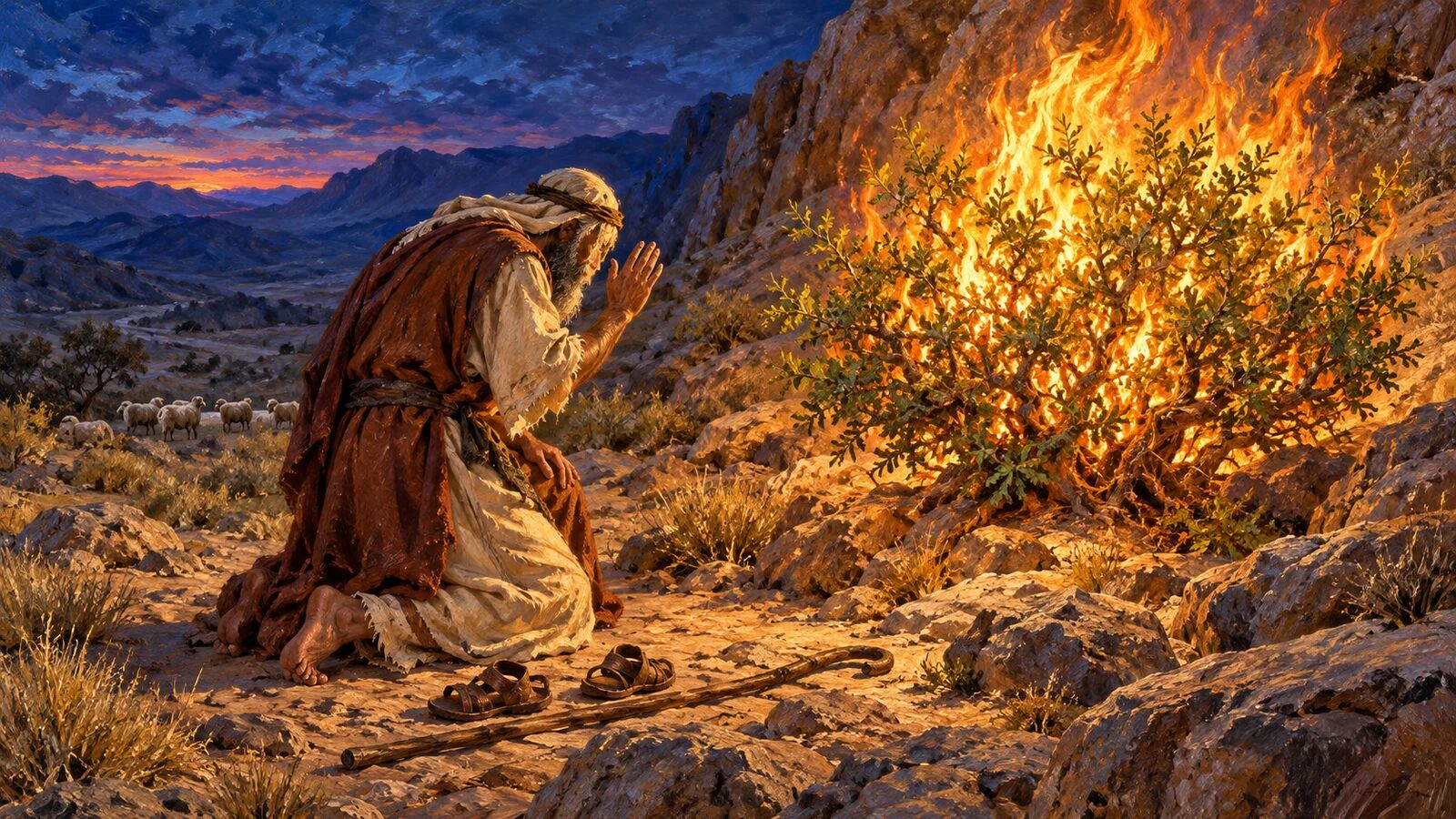
At the burning bush in Exodus 3, Moses was living in Midian while Israel remained enslaved in Egypt. The Angel of the LORD appeared in the flame, and the account then identifies the speaker as God and the LORD. I understand this distinctive Messenger to be the preincarnate Christ, the eternal Son appearing before He took human nature. He speaks as God, rather than as an ordinary created angel delivering someone else’s message.
God commissioned Moses to return to Egypt. Moses asked what he should say when the Israelites wanted to know the name of the God who sent him. The answer identified the God of their fathers as the One now acting to keep His covenant:
And God said to Moses, “I AM WHO I AM.” And He said, “Thus you shall say to the children of Israel, ‘I AM has sent me to you.'” Moreover God said to Moses, “Thus you shall say to the children of Israel: ‘The LORD God of your fathers, the God of Abraham, the God of Isaac, and the God of Jacob, has sent me to you. This is My name forever, and this is My memorial to all generations.’
Ehyeh, the first-person expression translated “I am” or “I will be,” belongs with the covenant name YHWH in the next verse, although the grammatical forms differ. God connects His name with His self-existence and faithful presence. Moses needed help beyond himself, as did Israel. The LORD depends on no one for His existence, and He would be with the man He was sending. The promised rescue rested on His ability to keep His word.
The NKJV follows the long English practice of printing YHWH as “LORD” in capitals, distinguishing it from the ordinary title Lord. I use the received English form “Jehovah.” The Hebrew consonants YHWH are preserved, but those consonants alone do not establish the precise ancient vowels. “Yahweh” is a scholarly reconstruction. We can retain Jehovah in English without pretending that the surviving consonants settle every question about ancient pronunciation.
Exodus 6 can initially sound as though Abraham, Isaac, and Jacob had never heard the name. Yet Genesis uses it repeatedly and says the patriarchs called upon it. They knew the LORD who promised, but they did not live to see this national deliverance. Their descendants would know His covenant faithfulness through public fulfillment: He would judge Egypt, bring Israel out, claim the people as His own, and lead them toward the promised land. The study The Name of God Jehovah: I Am Who I Am examines that revelation more fully.
Provider and Healer
Earlier, in Genesis 22, God commanded Abraham to offer Isaac, the son through whom He had promised the covenant line would continue. Obedience appeared to make fulfillment impossible. God was testing Abraham’s trust in His faithfulness, not tempting him to evil. The account stops Isaac’s death, and Scripture elsewhere condemns human sacrifice as an abomination.
Abraham told Isaac that God would provide the lamb for Himself. When Abraham was about to act, the Angel of the LORD called from heaven and stopped him. His obedience had demonstrated that he feared God. Abraham then saw the ram, and the text expressly says it was offered “instead of his son.”
Then Abraham lifted his eyes and looked, and there behind him was a ram caught in a thicket by its horns. So Abraham went and took the ram, and offered it up for a burnt offering instead of his son. And Abraham called the name of the place, The-LORD-Will-Provide; as it is said to this day, “In the Mount of the LORD it shall be provided.”
YHWH yireh is the name Abraham gave the place. The verb comes from raah, meaning to see; here God saw to the need and supplied the substitute. Jehovah-Jireh recalls that provision. It does not announce a separate divine power called provision or promise that believers will become wealthy.
Abraham had not received luxury or fulfillment of a private ambition. God had preserved the promised son. Elsewhere Scripture assures us that the Father knows His children’s needs while preparing us for hardship and contentment. Daily bread, wisdom, grace during weakness, and help through another believer can all be His provision. Following Christ may still involve costly sacrifice and persecution.
God’s greatest provision is Jesus Christ, His sinless Son. Wicked men tortured Him, and He willingly bore the punishment for our sins in His innocent body, shedding His blood and dying before rising bodily from the grave. Unlike Isaac, He was not released while another creature completed the offering. He died for the whole world, and everyone who believes in Him receives eternal life.
The expression Jehovah-Rapha comes from Israel’s wilderness journey after the exodus. Israel had sung after the LORD destroyed Pharaoh’s pursuing army at the sea. Three days later, the people reached Marah and complained because they could not drink its water. Moses cried to the LORD, who showed him a tree. When it was cast into the water, the bitterness was removed. God then instructed the people He had redeemed:
and said, “If you diligently heed the voice of the LORD your God and do what is right in His sight, give ear to His commandments and keep all His statutes, I will put none of the diseases on you which I have brought on the Egyptians. For I am the LORD who heals you.”
Jehovah-Rapha summarizes the clause describing the LORD as Israel’s healer. The promise contrasts obedience within that covenant with the diseases God had brought on Egypt in judgment. We cannot remove the audience and conditions and turn it into an unqualified medical guarantee for everyone. Nor was obedience the price of Israel’s rescue from Egypt. He had already redeemed them; now they were responsible to heed their Redeemer.
I think it is reckless to use this verse to accuse every sick believer of sin or defective faith. Job suffered despite being described as blameless and upright. Paul’s affliction remained after repeated prayer, Timothy had recurring stomach trouble, and Epaphroditus nearly died while serving Christ. We should pray for healing because God heals, while refusing to blame a sufferer without biblical grounds.
God may heal immediately, use medicine and ordinary care, or sustain someone through a long recovery. Complete bodily healing may await the resurrection. Being born again makes us secure in Christ; it does not exempt us from bodily suffering now. We can bring our needs honestly to the LORD without treating a name as a way to dictate His answer.
Banner, Sanctifier, and Peace
At Rephidim in Exodus 17, Israel questioned whether the LORD was among them. He provided water from the rock, and then Amalek attacked. Deuteronomy explains that the attackers struck the rear ranks, preying on the tired and weary without fearing God.
Joshua chose men and fought while Moses stood on the hill with the rod of God. Israel prevailed when Moses’ hand was raised and lost ground when it dropped. The rod and posture had no magical power; God made Israel’s dependence visible in the course of the battle. Aaron and Hur supported Moses’ heavy hands until sunset. The LORD gave victory while requiring people to fulfill their responsibilities.
And Moses built an altar and called its name, The-LORD-Is-My-Banner;
YHWH nissi names the altar. Nes means a banner, standard, or raised signal, and the ending in nissi gives the sense “my banner.” Moses identified the LORD Himself as the gathering point and source of confidence. Neither Moses, Joshua, the rod, nor the courage of the soldiers could take His place.
God’s banner does not guarantee success for a modern party, nation, business, or ministry. The church has no commission to call unwanted people Amalek and wage Israel’s war against them. Our struggle is not against flesh and blood. We stand in the Lord’s strength through truth, righteousness, the gospel, faith, salvation, His Word, and persevering prayer. The study Jehovah-Nissi: The LORD Is My Banner follows the battle and those later connections. I need to give God my allegiance, rather than assume He endorses my cause.
Exodus 31 places the next expression within Israel’s Sabbath command. The Sabbath was a covenant sign between the LORD and the children of Israel. Their rescue from Egypt had brought them under His authority, including His direction for their work and weekly rest:
“Speak also to the children of Israel, saying: ‘Surely My Sabbaths you shall keep, for it is a sign between Me and you throughout your generations, that you may know that I am the LORD who sanctifies you.
Jehovah-Mekoddishkem represents the clause describing the LORD who sanctifies His people. Sanctify means to set apart as holy. God claimed Israel for Himself, and their conduct was to reflect that relationship. Leviticus 20:8 likewise joins His sanctifying work with the people’s responsibility to keep His statutes.
We must not make the Sabbath a requirement for the church’s salvation. Water baptism, attendance, and moral reform cannot produce new birth either. Salvation comes by grace through faith in Jesus Christ. When someone believes, the Holy Spirit indwells and seals that person, who is set apart in Christ. Growth in practical holiness follows that new standing.
God uses Scripture, prayer, fellowship, and loving discipline in that growth. Suffering can deepen it as we respond in obedience, but eternal security never gives permission to settle into rebellion. When a believer sins, he should confess it and return to the light, trusting Christ as his Advocate. The study on Sanctification develops the difference between being set apart in Christ and growing in daily holiness.
Judges 6 describes people who had again done evil and were suffering under Midianite oppression. Raids destroyed their produce and drove Israelites into hiding. Gideon was threshing wheat in a winepress to conceal the grain when the Angel of the LORD appeared and addressed him as a mighty man of valor. Gideon asked why Israel was suffering if the LORD was with them.
The account moves between the Angel of the LORD speaking and the LORD speaking. When Gideon brought an offering, the Angel caused fire to consume it and then disappeared. These features belong with His divine identity, and I understand this encounter as another Christophany, an appearance of the eternal Son before His incarnation. Gideon realized he had seen the Angel of the LORD face to face and feared he would die.
Then the LORD said to him, “Peace be with you; do not fear, you shall not die.” So Gideon built an altar there to the LORD, and called it The-LORD-Is-Peace. To this day it is still in Ophrah of the Abiezrites.
Gideon named the altar YHWH shalom. Shalom can describe peace, welfare, wholeness, or things being set right. Here the LORD assured Gideon that he would live. Midian still threatened Israel, and a dangerous assignment lay ahead. Jehovah-Shalom did not mean that his circumstances had become calm or that obedience would cost him nothing.
Our deepest need for peace is also more than relief from anxiety. As sinners, we need reconciliation to God. Jesus made peace through the blood of His cross, and those justified by faith have a settled standing before Him. From that relationship we can bring our anxieties to the Father and receive His guarding peace. We pursue peace with others without compromising the truth or treating sin as harmless.
Righteousness, Shepherd, and LORD of Hosts
Jeremiah announced the promise commonly called Jehovah-Tsidkenu while Judah was failing under unfaithful rulers. Its shepherds had scattered the flock. The LORD promised to gather His people and raise up a righteous King from David’s line:
“Behold, the days are coming,” says the LORD, “That I will raise to David a Branch of righteousness; A King shall reign and prosper, And execute judgment and righteousness in the earth. In His days Judah will be saved, And Israel will dwell safely; Now this is His name by which He will be called: THE LORD OUR RIGHTEOUSNESS.
YHWH tsidqenu means the LORD our righteousness. Jeremiah applies the name to the promised Branch, the Davidic King. He is saying more than that God acts righteously: the coming King bears a divine name and supplies the just rule Judah’s kings failed to provide. Jesus fulfills that promise as David’s Son in His humanity and David’s Lord in His deity.
We cannot produce the righteousness God requires by collecting religious works. Even good deeds cannot erase guilt already incurred or cleanse an unclean heart. Jesus lived without sin, then willingly endured bodily punishment inflicted by wicked men, shedding His blood and dying for our sins. He rose bodily from the grave. Whoever believes in Him is justified, meaning God declares that believer righteous on the basis of Christ rather than personal merit.
We sometimes describe this as Christ’s righteousness being counted to us. Faith receives the Savior; it does not become a meritorious work, something that earns salvation. Justification also does not pretend sin never happened. Christ’s death accomplished redemption, and His bodily resurrection confirms that His completed sacrifice was accepted. Our standing rests on Him, so we can have assurance without boasting.
Jeremiah’s promise also retains its national and earthly fulfillment. It names Judah and Israel and describes safety under the Davidic King. Jesus will return bodily, restore Israel, judge righteously, and reign. His grace to the church does not cancel those promises. The same Messiah who justifies believers will keep His word to the nation.
The LORD who promised to gather Judah’s scattered flock is also the Shepherd David trusted. In Psalm 23, David speaks personally of that care. This is a confession, rather than a formal compound name assigned to a place. David had cared for sheep and knew his own need for God’s provision, direction, correction, and protection:
The LORD is my shepherd; I shall not want. He makes me to lie down in green pastures; He leads me beside the still waters. He restores my soul; He leads me in the paths of righteousness For His name’s sake.
David’s confidence that he would not want does not mean he expected everything he might desire. The Shepherd supplies what His sheep need and leads where they cannot safely guide themselves. David describes rest, water, restoration, and right paths. Yet the psalm later passes through a valley. God’s care is evident in His presence there, rather than a promise that the sheep will never enter it.
Jesus identifies Himself in John 10 as the Good Shepherd who lays down His life for the sheep and takes it up again. He personally knows them and gives them eternal life. The Son is not merely imitating the LORD’s care from a distance; He shares the divine identity of the Shepherd David trusted.
My sheep hear My voice, and I know them, and they follow Me. And I give them eternal life, and they shall never perish; neither shall anyone snatch them out of My hand.
The life He gives is eternal. His sheep follow because they belong to Him, but their final safety does not rest on their ability to keep themselves. The next verse adds the Father’s hand, and Jesus concludes, “I and My Father are one.” No enemy can remove a true believer from His keeping. That assurance does not make obedience unimportant; it identifies the Shepherd on whom our security depends.
The Shepherd who keeps His people is also the LORD of hosts. This title, represented by YHWH Sabaoth, describes His authority over organized multitudes or armies. The setting may bring heavenly beings, stars, or earthly forces into view. All remain under His command. No creature has power that can finally defeat His purpose.
Hannah appealed to the LORD of hosts in her grief over being childless. This title therefore reaches beyond a battlefield: the God who commands every host heard an afflicted woman’s prayer. David later confronted Goliath in the name of the LORD of hosts, the God of Israel’s armies. His confidence rested in the living God the giant had defied, rather than his own size or equipment.
Isaiah’s vision shows the seraphim declaring the LORD of hosts holy, with the whole earth full of His glory. His power is never detached from that holiness. No ruler can recruit His title to bless aggression, and I cannot use it to make personal anger sound sacred. He defines His cause and judges rightly. The One who cares tenderly for His people is also the Lord to whom every power must answer.
The LORD Is There, Jealous, Redeemer, and Savior
Ezekiel closes with Israel’s land restored and divided among the tribes, and a measured city within that future order. Earlier visions had shown God’s glory departing because of Israel’s sin. The ending promises that His presence will return, and the expression commonly called Jehovah-Shammah gives the city its name:
All the way around shall be eighteen thousand cubits; and the name of the city from that day shall be: THE LORD IS THERE.”
YHWH shammah means the LORD is there. It names the city rather than replacing God’s personal name with a new one. Its glory lies in what the name announces: the LORD will dwell with the restored nation. Ezekiel describes land, tribes, priesthood, sanctuary, and city, so I cannot reduce that promise to a general feeling that God is nearby.
Jesus will return bodily and establish His kingdom on earth. Revelation 20 describes His literal thousand-year reign, during which Israel will experience restoration under her Messiah and the nations will see His righteous government. Ezekiel also describes sacrifices in that restored order. They cannot repeat or add to Christ’s sacrifice, since Hebrews teaches that He offered one sacrifice for sins forever. I understand them as memorial offerings looking back to His shed blood, comparable in that respect to the Lord’s Supper. That memorial explanation is an interpretation of their place beside Christ’s finished work, rather than a label Ezekiel expressly gives them.
The millennial kingdom is distinct from the final state. After the last rebellion and judgment, God creates a new heaven and new earth. The New Jerusalem descends, and God dwells with redeemed humanity forever. Ezekiel’s city has its own future setting, while its promised blessing also directs our hope toward unbroken fellowship with God.
God’s promise to dwell with His people belongs with His demand for their exclusive worship. In Exodus 34, He was renewing the covenant terms after Israel had worshiped the golden calf. He forbade agreements that would draw the nation back into idolatry:
(for you shall worship no other god, for the LORD, whose name is Jealous, is a jealous God),
Qanna describes His holy jealousy. Human jealousy often comes from insecurity, envy, or wanting what belongs to someone else. None of those defects belongs to God. He alone deserves worship, and His jealousy rightly protects the covenant relationship. He will not share His glory with an idol.
I need to consider that warning even when no carved image is involved. If I trade obedience for approval, acceptance has claimed devotion that belongs to God. Money can govern my trust and decisions, while pleasure or a desire for control can become what I will not surrender. Even family and ministry, both good gifts, can be placed above the Giver. God’s jealousy calls us away from those enslaving loyalties.
Scripture also calls the LORD Redeemer. Goel describes a kinsman-redeemer, a family member with the right and responsibility to recover what was lost, defend a relative, or restore an inheritance. God uses that family language for His rescue of Israel. Isaiah repeatedly joins Redeemer with Holy One of Israel and LORD of hosts.
Jesus became our near kinsman by taking true humanity without ceasing to be God. No sinner could pay for another sinner’s release, but the sinless Son gave His own blood. His redemption includes forgiveness now, freedom from sin’s dominion, and the future redemption of the body in resurrection.
The title El Elyon means God Most High. In Genesis 14, Melchizedek blessed Abram in the name of God Most High, Possessor of heaven and earth. Abram identified that Most High God as the LORD. No ruler, spirit, or supposed deity stands above Him; these titles do not introduce competing gods.
Savior likewise describes His work throughout Scripture. The Hebrew verb yasha means to save or deliver, and some biblical names grow from that root. We need not invent a formal compound such as “Jehovah-Savior” to value what the Bible actually says. God’s deliverance of Israel from Egypt and from later enemies reveals His faithfulness, while our greatest need remains rescue from sin and judgment. The Father sent the Son as Savior of the world, and the Spirit gives life to believers. The distinct persons carry out one divine work of salvation.
The Divine Name and Jesus Christ
The connections with Jesus require us to keep both His deity and the distinctions within the Trinity clear. The Father, Son, and Holy Spirit are not three gods or three forms worn by one person. The Father is not the Son, the Son is not the Spirit, and the Spirit is not the Father. Each eternally shares the one undivided divine being.
The Old Testament prepares for that truth without using all the later doctrinal vocabulary. At the bush and in Gideon’s encounter, the Angel of the LORD bears God’s identity while also being distinguished as His Messenger. I understand those appearances as Christophanies. The incarnation goes further than a temporary appearance: the eternal Son was conceived by the Holy Spirit and born of the virgin Mary. He truly became man while remaining fully God, with two natures united in one person without mixture or change.
In John 8, Jesus claimed more than having been planned before Abraham lived. His words recall the declaration in Exodus:
Jesus said to them, “Most assuredly, I say to you, before Abraham was, I AM.”
His hearers took up stones, recognizing the seriousness of His claim. John also tells us that the Word was God, that everything was made through Him, and that the Word became flesh. Jesus is not the Father, yet He is fully divine. He is the Good Shepherd, Jeremiah’s righteous Davidic King, Emmanuel or God with us, and the Redeemer who became our kinsman. His personal name announces that the LORD saves.
These connections do not authorize us to assign every Old Testament expression to the Son while disregarding the Father and Spirit. Each passage determines how its words apply. But we must not make Jesus a lesser created helper outside the LORD’s identity. He shares the divine nature and reveals the Father perfectly.
That is why the gospel rests on more than an example of human courage. Wicked men tortured Jesus and nailed Him to a cross, while He willingly bore in His body the punishment for our sins. He shed real blood and physically died, completing His saving work before rising bodily on the third day. The Father did not punish, curse, abandon, strike, bruise, or pour wrath on Jesus. The living Christ offers salvation to every person.
The invitation is genuine and can be resisted. God does not bar a willing sinner from the Savior He offers. Whoever believes in the Son has eternal life; whoever refuses remains under condemnation. Repentance does not purchase salvation. It is the change of mind that turns from unbelief and receives Jesus for who He is.
When a sinner believes, he is born again, receiving new life, and is justified, indwelt by the Holy Spirit, and sealed for the day of redemption. These gifts are not earned in stages. Eternal life begins at once through Christ’s finished work, and Christian growth follows. That growth never becomes the price that keeps a believer adopted.
Knowing God’s name gives us confidence to approach Him, rather than verbal tools to make Him act. Correct Hebrew pronunciation cannot compel Him, and uncertainty over ancient vowels cannot prevent prayer. We come to the Father through the Son, depending on the Spirit, because He has opened the way.
Careful reading should deepen our trust and worship. When provision is uncertain, I can bring my need to the Father who already gave His Son. When illness continues, I can pray for healing while resting in the promised resurrection. When guilt accuses, I look to the LORD our righteousness rather than my record. The God who provides and heals also calls me to holiness, and His peace does not remove His right to correct me. I need the whole witness of Scripture, rather than a favorite name detached from everything else He has revealed.
My Final Thoughts
These names bring me to one faithful God meeting people in sin, fear, weakness, and need. Their settings keep me from treating them as formulas and help me understand why I can trust Him. Most clearly, they direct me to Jesus Christ, who saves sinners and keeps those who belong to Him. I want to honor the LORD’s name by believing what He has said and obeying the One whose character I have come to know through His Word.